
Solid Geometry - Math
Card 1 of 640
Find the surface area of the following half-cylinder.
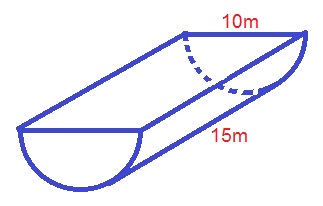
Find the surface area of the following half-cylinder.
Tap to reveal answer
The formula for the surface area of a half-cylinder must include one-half of the surface area of a cylinder, which would be:

We also need to add the area of the new rectangular face that is created by cutting the cylinder in half. The area of this rectangle would be:

where the length of the rectangle is the same as the height of the half-cylinder, and the width of the rectangle is the same as the diameter of the base of the half-cylinder. So we can rewrite the area of the rectangle as:

Now we can combine the two area formulas to find the total surface area of the half-cylinder:


where  is the radius of the base and
  is the length of the height, and
  is the diameter of the base.
Plugging in our values, we get:


The formula for the surface area of a half-cylinder must include one-half of the surface area of a cylinder, which would be:
We also need to add the area of the new rectangular face that is created by cutting the cylinder in half. The area of this rectangle would be:
where the length of the rectangle is the same as the height of the half-cylinder, and the width of the rectangle is the same as the diameter of the base of the half-cylinder. So we can rewrite the area of the rectangle as:
Now we can combine the two area formulas to find the total surface area of the half-cylinder:
where
Plugging in our values, we get:
← Didn't Know|Knew It →
Find the surface area of the following polyhedron.
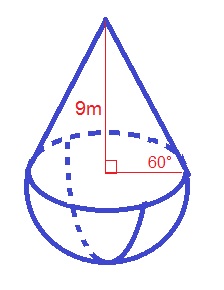
Find the surface area of the following polyhedron.
Tap to reveal answer
The formula for the surface area of the polyhedron is:

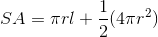

Where  is the radius of the cone,
  is the slant height of the cone, and
  is the radius of the sphere
Use the formula for a  triangle to find the radius and slant height:


Plugging in our values, we get:


The formula for the surface area of the polyhedron is:
Where
Use the formula for a
Plugging in our values, we get:
← Didn't Know|Knew It →
Find the surface area of the following polyhedron.
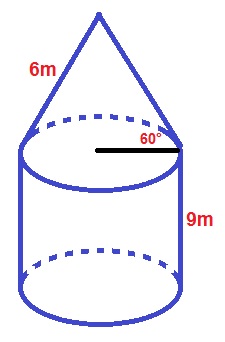
Find the surface area of the following polyhedron.
Tap to reveal answer
The formula for the surface area of the polyhedron is:



where  is the radius of the cone,
  is the slant height of the cone,
  is the radius of the cylinder, and
  is the height of the cylinder.
Use the formula for a  triangle to find the length of the radius:


Plugging in our values, we get:


The formula for the surface area of the polyhedron is:
where
Use the formula for a
Plugging in our values, we get:
← Didn't Know|Knew It →
Find the surface area of the following polyhedron.
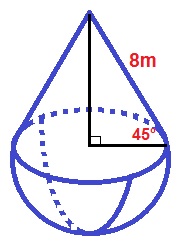
Find the surface area of the following polyhedron.
Tap to reveal answer
The formula for the surface area of a polyhedron is:



where  is the radius of the polyhedron and
  is the slant height of the cone.
Use the formula for a  triangle to find the length of the radius:


Plugging in our values, we get:


The formula for the surface area of a polyhedron is:
where
Use the formula for a
Plugging in our values, we get:
← Didn't Know|Knew It →
The length of a box is 3 times the width. Which of the following gives the length (L inches) in terms of the width (W inches) of the box?
The length of a box is 3 times the width. Which of the following gives the length (L inches) in terms of the width (W inches) of the box?
Tap to reveal answer
When reading word problems, there are certain clues that help interpret what is going on. The word “is” generally means “=” and the word “times” means it will be multiplied by something. Therefore, “the length of a box is 3 times the width” gives you the answer: L = 3 x W, or L = 3W.
When reading word problems, there are certain clues that help interpret what is going on. The word “is” generally means “=” and the word “times” means it will be multiplied by something. Therefore, “the length of a box is 3 times the width” gives you the answer: L = 3 x W, or L = 3W.
← Didn't Know|Knew It →
The width of a box, in inches, is 5 inches less than three times its length. Which of the following equations gives the width, W inches, in terms of the length, L inches, of the box?
The width of a box, in inches, is 5 inches less than three times its length. Which of the following equations gives the width, W inches, in terms of the length, L inches, of the box?
Tap to reveal answer
We notice the width is “5 inches less than three times its width,” so we express W as being three times its width (3L) and 5 inches less than that is 3L minus 5. In this case, W is the dependent and L is the independent variable.
W = 3L - 5
We notice the width is “5 inches less than three times its width,” so we express W as being three times its width (3L) and 5 inches less than that is 3L minus 5. In this case, W is the dependent and L is the independent variable.
W = 3L - 5
← Didn't Know|Knew It →
What is the surface area of a cube if its height is 3 cm?
What is the surface area of a cube if its height is 3 cm?
Tap to reveal answer
The area of one face is given by the length of a side squared.

The area of 6 faces is then given by six times the area of one face: 54 cm2.

The area of one face is given by the length of a side squared.
The area of 6 faces is then given by six times the area of one face: 54 cm2.
← Didn't Know|Knew It →
A cube has a height of 4 feet. What is the surface area of the cube in feet?
A cube has a height of 4 feet. What is the surface area of the cube in feet?
Tap to reveal answer
To find the surface area of a cube, square the length of one edge and multiply the result by six: 

To find the surface area of a cube, square the length of one edge and multiply the result by six:
← Didn't Know|Knew It →
If the surface area of a cube equals 96, what is the length of one side of the cube?
If the surface area of a cube equals 96, what is the length of one side of the cube?
Tap to reveal answer
The surface area of a cube = 6a2 where a is the length of the side of each edge of the cube. Put another way, since all sides of a cube are equal, a is just the lenght of one side of a cube.
We have 96 = 6a2 → a2 = 16, so that's the area of one face of the cube.
Solving we get √16, so a = 4
The surface area of a cube = 6a2 where a is the length of the side of each edge of the cube. Put another way, since all sides of a cube are equal, a is just the lenght of one side of a cube.
We have 96 = 6a2 → a2 = 16, so that's the area of one face of the cube.
Solving we get √16, so a = 4
← Didn't Know|Knew It →
A sphere with a volume of 
 is inscribed in a cube, as shown in the diagram below.
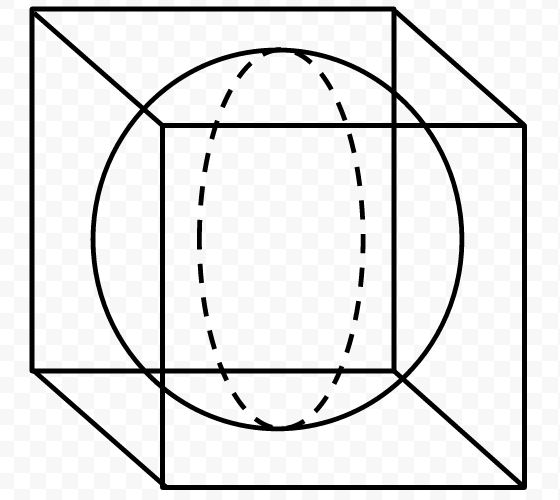
What is the surface area of the cube, in  ?
?
A sphere with a volume of
What is the surface area of the cube, in
Tap to reveal answer
We must first find the radius of the sphere in order to solve this problem. Since we already know the volume, we will use the volume formula to do this.
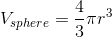


With the radius of the sphere in hand, we can now apply it to the cube. The radius of the sphere is half the distance from the top to the bottom of the cube (or half the distance from one side to another). Therefore, the radius represents half of a side length of a square. So in this case

The formula for the surface area of a cube is:


The surface area of the cube is 
We must first find the radius of the sphere in order to solve this problem. Since we already know the volume, we will use the volume formula to do this.
With the radius of the sphere in hand, we can now apply it to the cube. The radius of the sphere is half the distance from the top to the bottom of the cube (or half the distance from one side to another). Therefore, the radius represents half of a side length of a square. So in this case
The formula for the surface area of a cube is:
The surface area of the cube is
← Didn't Know|Knew It →
The side of a cube has a length of  . What is the total surface area of the cube?
The side of a cube has a length of
Tap to reveal answer
A cube has 6 faces. The area of each face is found by squaring the length of the side.

Multiply the area of one face by the number of faces to get the total surface area of the cube.

A cube has 6 faces. The area of each face is found by squaring the length of the side.
Multiply the area of one face by the number of faces to get the total surface area of the cube.
← Didn't Know|Knew It →
What is the surface area of a cube with a side length of  ?
?
What is the surface area of a cube with a side length of
Tap to reveal answer
To find the surface area of a cube, we must count the number of surface faces and add the areas of each together. In a cube there are  faces, each a square with the same side lengths. In this example the side length is
  .
.
The area of a square is given by the equation  . Using our side length, we can solve the area of once face of the cube.

We then multiply this number by  , the number of faces of the cube to find the total surface area.

Our answer for the surface area is  .
.
To find the surface area of a cube, we must count the number of surface faces and add the areas of each together. In a cube there are
The area of a square is given by the equation
We then multiply this number by
Our answer for the surface area is
← Didn't Know|Knew It →
What is the surface area of a cube with a side length of 15?
What is the surface area of a cube with a side length of 15?
Tap to reveal answer
To find the surface area of a cube we must count the number of surface faces and add the areas of each of them together.
In a cube there are 6 faces, each a square with the same side lengths.
In this example the side lengths is 15 so the area of each square would be 
We then multiply this number by 6, the number of faces of the cube, to get 
Our answer for the surface area is  .
.
To find the surface area of a cube we must count the number of surface faces and add the areas of each of them together.
In a cube there are 6 faces, each a square with the same side lengths.
In this example the side lengths is 15 so the area of each square would be
We then multiply this number by 6, the number of faces of the cube, to get
Our answer for the surface area is
← Didn't Know|Knew It →
If a right triangle has a hypotenuse of length 5, and the length of the other sides are  and
and  , what would be the surface area of a cube having side length
  ?
?
If a right triangle has a hypotenuse of length 5, and the length of the other sides are
Tap to reveal answer
By the Pythagorean Theorem,


The surface area of a cube having 6 sides, is 6 times the area of one of its sides.
The area of any side of a cube is the square of the side length.
So if the side length is  , the area of any side is
  , or
, or  .
.
Thus the surface area of the cube is


By the Pythagorean Theorem,
The surface area of a cube having 6 sides, is 6 times the area of one of its sides.
The area of any side of a cube is the square of the side length.
So if the side length is
Thus the surface area of the cube is
← Didn't Know|Knew It →
What is the surface area of a cube with a side length of  ?
?
What is the surface area of a cube with a side length of
Tap to reveal answer
In order to find the surface area of a cube, use the formula  .
.


In order to find the surface area of a cube, use the formula
← Didn't Know|Knew It →
What is the surface area, in inches, of a rectangular prism with a length of  , a width of
  , and a height of
  ?
?
What is the surface area, in inches, of a rectangular prism with a length of
Tap to reveal answer
In order to find the surface area of a rectangular prism, use the formula  .
.
However, all units must be the same. All of the units of this problem are in inches with the exception of  .
.
Convert to inches.


Now, we can insert the known values into the surface area formula in order to calulate the surface area of the rectangular prism.


If you calculated the surface area to equal  , then you utilized the volume formula of a rectangular prism, which is
  ; this is incorrect.
In order to find the surface area of a rectangular prism, use the formula
However, all units must be the same. All of the units of this problem are in inches with the exception of
Convert to inches.
Now, we can insert the known values into the surface area formula in order to calulate the surface area of the rectangular prism.
If you calculated the surface area to equal
← Didn't Know|Knew It →

Tap to reveal answer


← Didn't Know|Knew It →
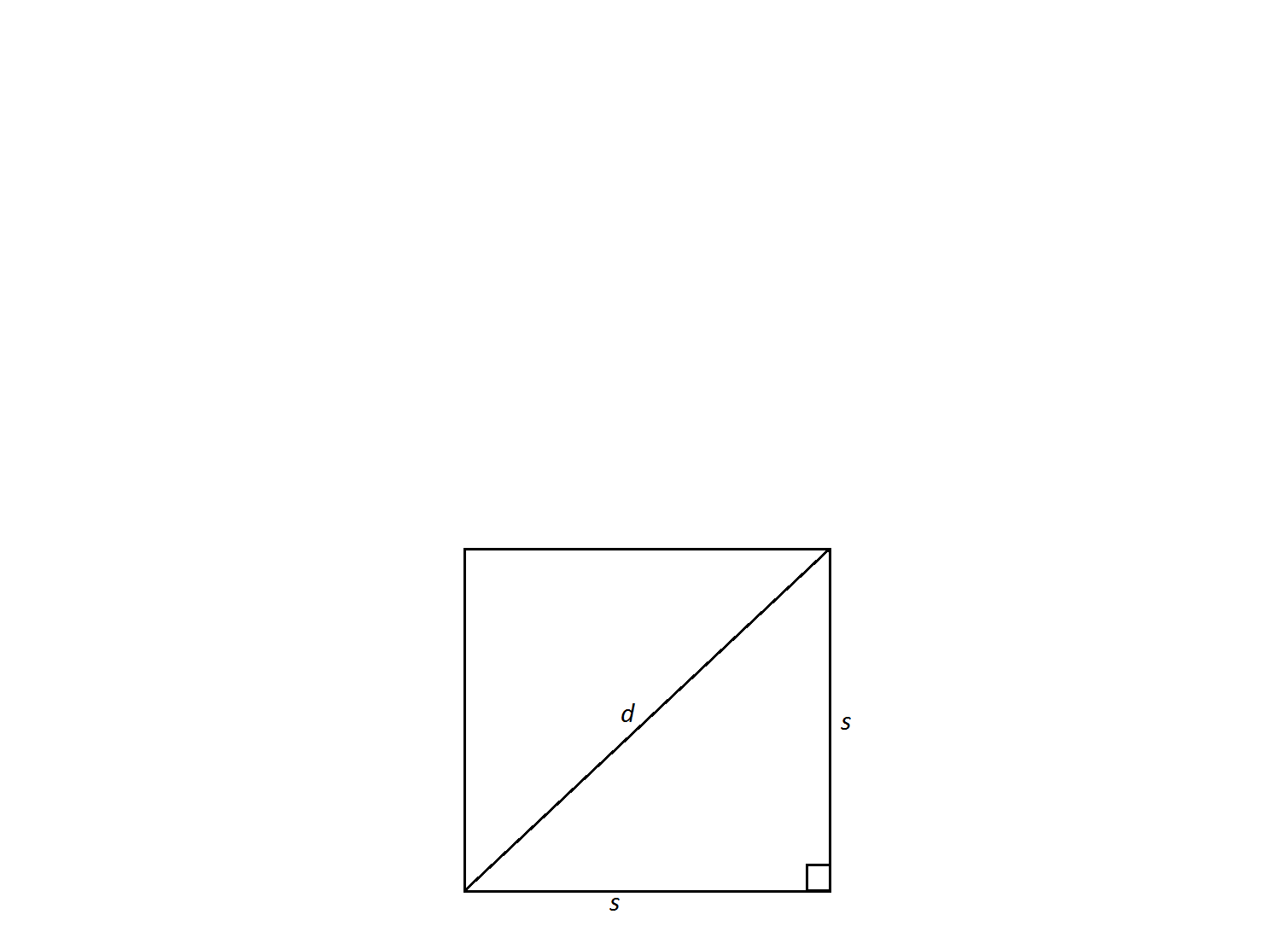 What is the surface area of a cube with a diagonal of
  ?
?
What is the surface area of a cube with a diagonal of
Tap to reveal answer
A few facts need to be known to solve this problem. Observe that the diagonal of the square face of the cube cuts it into two right isosceles triangles; therefore, the length of a side of the square to its diagonal is the same as an isosceles right triangle's leg to its hypotenuse:  .
.


Rearrange an solve for  .
.

Now, solve for the area of the cube using the formula  .
.


A few facts need to be known to solve this problem. Observe that the diagonal of the square face of the cube cuts it into two right isosceles triangles; therefore, the length of a side of the square to its diagonal is the same as an isosceles right triangle's leg to its hypotenuse:
Rearrange an solve for
Now, solve for the area of the cube using the formula
← Didn't Know|Knew It →
This figure is a cube with one face having an area of 16 in2.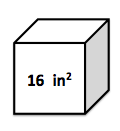
What is the surface area of the cube (in2)?
This figure is a cube with one face having an area of 16 in2.
What is the surface area of the cube (in2)?
Tap to reveal answer
The surface area of a cube is the sum of the area of each face. Since there are 6 faces on a cube, the surface area of the entire cube is  .
.
The surface area of a cube is the sum of the area of each face. Since there are 6 faces on a cube, the surface area of the entire cube is
← Didn't Know|Knew It →
The side length of a particular cube is  . What is the surface area of this cube?
The side length of a particular cube is
Tap to reveal answer
To find the surface of a cube, use the standard equation:

where  denotes the side length.
Plug in the given value for  to find the answer:

To find the surface of a cube, use the standard equation:
where
Plug in the given value for
← Didn't Know|Knew It →