
Intermediate Single-Variable Algebra - Math
Card 1 of 448
Given  , what is the value of the discriminant?
Given
Tap to reveal answer
In general, the discriminant is  .
.
In this particual case  .
.
Plug in these three values and simplify: 
In general, the discriminant is
In this particual case
Plug in these three values and simplify:
← Didn't Know|Knew It →
Use the discriminant to determine the nature of the roots:

Use the discriminant to determine the nature of the roots:
Tap to reveal answer
The formula for the discriminant is:



Since the discriminant is negative, there are  imaginary roots.
The formula for the discriminant is:
Since the discriminant is negative, there are
← Didn't Know|Knew It →
Use the discriminant to determine the nature of the roots:

Use the discriminant to determine the nature of the roots:
Tap to reveal answer
The formula for the discriminant is:


Since the discriminant is positive and not a perfect square, there are irrational roots.
The formula for the discriminant is:
Since the discriminant is positive and not a perfect square, there are
← Didn't Know|Knew It →
Use the discriminant to determine the nature of the roots:

Use the discriminant to determine the nature of the roots:
Tap to reveal answer
The formula for the discriminant is:


Since the discriminant is negative, there are imaginary roots.
The formula for the discriminant is:
Since the discriminant is negative, there are
← Didn't Know|Knew It →
Given , what is the value of the discriminant?
Given
Tap to reveal answer
In general, the discriminant is .
In this particual case .
Plug in these three values and simplify:
In general, the discriminant is
In this particual case
Plug in these three values and simplify:
← Didn't Know|Knew It →
Use the discriminant to determine the nature of the roots:
Use the discriminant to determine the nature of the roots:
Tap to reveal answer
The formula for the discriminant is:
Since the discriminant is negative, there are imaginary roots.
The formula for the discriminant is:
Since the discriminant is negative, there are
← Didn't Know|Knew It →
Use the discriminant to determine the nature of the roots:
Use the discriminant to determine the nature of the roots:
Tap to reveal answer
The formula for the discriminant is:
Since the discriminant is positive and not a perfect square, there are irrational roots.
The formula for the discriminant is:
Since the discriminant is positive and not a perfect square, there are
← Didn't Know|Knew It →
Use the discriminant to determine the nature of the roots:
Use the discriminant to determine the nature of the roots:
Tap to reveal answer
The formula for the discriminant is:
Since the discriminant is negative, there are imaginary roots.
The formula for the discriminant is:
Since the discriminant is negative, there are
← Didn't Know|Knew It →
Consider the equation  .
.
According to the Rational Zeroes Theorem, if  are all integers, then, regardless of their values, which of the following cannot be a solution to the equation?
Consider the equation
According to the Rational Zeroes Theorem, if
Tap to reveal answer
By the Rational Zeroes Theorem, any rational solution must be a factor of the constant, 6, divided by the factor of the leading coefficient, 14.
Four of the answer choices have this characteristic:


 is in lowest terms, and 3 is not a factor of 14. It is therefore the correct answer.
By the Rational Zeroes Theorem, any rational solution must be a factor of the constant, 6, divided by the factor of the leading coefficient, 14.
Four of the answer choices have this characteristic:
← Didn't Know|Knew It →
Find the zeros.

Find the zeros.
Tap to reveal answer
Factor the equation to  . Set both equal to zero and you get
  and
and  . Remember, the zeros of an equation are wherever the function crosses the
  -axis.
Factor the equation to
← Didn't Know|Knew It →
Solve the quadratic equation using any method:

Solve the quadratic equation using any method:
Tap to reveal answer
Use the quadratic formula to solve:
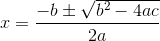


Use the quadratic formula to solve:
← Didn't Know|Knew It →
Find the zeros.

Find the zeros.
Tap to reveal answer
Factor out an  from the equation so that you have
  "x(x-10)") . Set
. Set  and
and  equal to
  . Your roots are
  and
and  .
.
Factor out an
← Didn't Know|Knew It →
Find the zeros.

Find the zeros.
Tap to reveal answer
Set  equal to zero and you get
  . Set
. Set  equal to zero as well and you get
  and
and  because when you take a square root, your answer will be positive and negative.
Set
← Didn't Know|Knew It →
Find the zeros.

Find the zeros.
Tap to reveal answer
Factor out a  from the entire equation. After that, you get
  . Factor the expression to
  . Set both of those equal to zero and your answers are
  and
and  .
.
Factor out a
← Didn't Know|Knew It →
Find the zeros.

Find the zeros.
Tap to reveal answer
This expression is the difference of perfect squares. Therefore, it factors to . Set both of those equal to zero and your answers are
  and
and  .
.
This expression is the difference of perfect squares. Therefore, it factors to
← Didn't Know|Knew It →
Find the zeros.

Find the zeros.
Tap to reveal answer
Factor the equation to  . Set both equal to
  and you get
  and
and  .
.
Factor the equation to
← Didn't Know|Knew It →
Find the zeros.

Find the zeros.
Tap to reveal answer
Factor a  out of the quation to get

which can be further factored to
 .
.
Set the last two expressions equal to zero and you get  and
and  .
.
Factor a
which can be further factored to
Set the last two expressions equal to zero and you get
← Didn't Know|Knew It →
Find the zeros.

Find the zeros.
Tap to reveal answer
Set each expression equal to zero and you get 0 and 6.
Set each expression equal to zero and you get 0 and 6.
← Didn't Know|Knew It →
Find the zeros.

Find the zeros.
Tap to reveal answer
Set both expressions equal to  . The first factor yields
  . The second factor gives you
  .
.
Set both expressions equal to
← Didn't Know|Knew It →
Find the zeros.

Find the zeros.
Tap to reveal answer
Set both expressions to  and you get
  and
and  .
.
Set both expressions to
← Didn't Know|Knew It →