
Pentagons - ISEE Upper Level Quantitative Reasoning
Card 0 of 500
The perimeters of six squares form an arithmetic sequence. The smallest square has area 9; the second smallest square has area 25. Give the perimeter of the largest of the six squares.
The perimeters of six squares form an arithmetic sequence. The smallest square has area 9; the second smallest square has area 25. Give the perimeter of the largest of the six squares.
The two smallest squares have areas 9 and 25, so their sidelengths are the square roots of these, or, respectively, 3 and 5. Their perimeters are the sidelengths multiplied by four, or, respectively, 12 and 20. Therefore, in the arithmetic sequence,


and the common difference is  .
.
The perimeter of the  th smallest square is

Setting  , the perimeter of the largest (or sixth-smallest) square is
 .
.
The two smallest squares have areas 9 and 25, so their sidelengths are the square roots of these, or, respectively, 3 and 5. Their perimeters are the sidelengths multiplied by four, or, respectively, 12 and 20. Therefore, in the arithmetic sequence,
and the common difference is
The perimeter of the
Setting
Compare your answer with the correct one above
The area of a square is  .
.
Give the perimeter of the square.
The area of a square is
Give the perimeter of the square.
The length of one side of a square is the square root of its area. The polynomial representing the area of the square can be recognized as a perfect square trinomial:



Therefore, the square root of the area is
 ,
,
which is the length of one side.
The perimeter of the square is four times this length, or
 .
.
The length of one side of a square is the square root of its area. The polynomial representing the area of the square can be recognized as a perfect square trinomial:
Therefore, the square root of the area is
which is the length of one side.
The perimeter of the square is four times this length, or
Compare your answer with the correct one above
The perimeters of six squares form an arithmetic sequence. The second-smallest square has sides that are two inches longer than those of the smallest square.
Which, if either, is the greater quantity?
(a) The perimeter of the third-smallest square
(b) The length of one side of the largest square
The perimeters of six squares form an arithmetic sequence. The second-smallest square has sides that are two inches longer than those of the smallest square.
Which, if either, is the greater quantity?
(a) The perimeter of the third-smallest square
(b) The length of one side of the largest square
Let the length of one side of the first square be  . Then the length of one side of the second-smallest square is
  , and the perimeters of the squares are

and

This makes the common difference of the perimeters 8 units.
The perimeters of the squares being in arithmetic progression, the perimeter of the  th-smallest square is

Since  , this becomes

The perimeter of the third-smallest square is

The perimeter of the largest, or sixth-smallest, square is

The length of one side of this square is one fourth of this, or

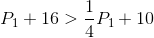
Therefore, we are comparing  and
and  .
.
Since a perimeter must be positive,
 ;
;
also,  .
.
Therefore, regardless of the value of  ,
,
 ,
,
and
 ,
,
making (a) the greater quantity.
Let the length of one side of the first square be
and
This makes the common difference of the perimeters 8 units.
The perimeters of the squares being in arithmetic progression, the perimeter of the
Since
The perimeter of the third-smallest square is
The perimeter of the largest, or sixth-smallest, square is
The length of one side of this square is one fourth of this, or
Therefore, we are comparing
Since a perimeter must be positive,
also,
Therefore, regardless of the value of
and
making (a) the greater quantity.
Compare your answer with the correct one above
The sidelength of a square is  . Give its perimeter in terms of
  .
.
The sidelength of a square is
The perimeter of a square is four times the length of a side, which here is  :
:

The perimeter of a square is four times the length of a side, which here is
Compare your answer with the correct one above
A diagonal of a square has length  . Give its perimeter.
A diagonal of a square has length
The length of a side of a square can be determined by dividing the length of a diagonal by  - that is,
  . A diagonal has length
  , so the sidelength is

Multiply this by four to get the perimeter:

The length of a side of a square can be determined by dividing the length of a diagonal by
Multiply this by four to get the perimeter:
Compare your answer with the correct one above

The above diagram depicts trapezoid  . Which is the greater quantity?
(a) 
(b) 
The above diagram depicts trapezoid
(a)
(b)
 ;
;  and
and  are same-side interior angles, as are
  and
and  .
.
The Same-Side Interior Angles Theorem states that if two parallel lines are crossed by a transversal, then the sum of the measures of a pair of same-side interior angles is always  .
.
Therefore,  , making the two quantities equal.
The Same-Side Interior Angles Theorem states that if two parallel lines are crossed by a transversal, then the sum of the measures of a pair of same-side interior angles is always
Therefore,
Compare your answer with the correct one above
Given Trapezoid  , where . Also,
Which is the greater quantity?
(a) 
(b) 
Given Trapezoid
Which is the greater quantity?
(a)
(b)
and are same-side interior angles, as are and .
The Same-Side Interior Angles Theorem states that if two parallel lines are crossed by a transversal, then the sum of the measures of a pair of same-side interior angles is always . Therefore,
 , or
, or 
 , or
, or 
Substitute:


(a) is the greater quantity
The Same-Side Interior Angles Theorem states that if two parallel lines are crossed by a transversal, then the sum of the measures of a pair of same-side interior angles is always
Substitute:
(a) is the greater quantity
Compare your answer with the correct one above
Consider trapezoid , where . Also,  is acute and
  is obtuse.
Which is the greater quantity?
(a) 
(b) 
Consider trapezoid
Which is the greater quantity?
(a)
(b)
and are same-side interior angles, as are and .
The Same-Side Interior Angles Theorem states that if two parallel lines are crossed by a transversal, then same-side interior angles are supplementary. A pair of supplementary angles comprises either two right angles, or one acute angle and one obtuse angle. Since  is acute and
  is obtuse, is obtuse and is acute. Therefore the greater measure of the two, making (b) greater.
The Same-Side Interior Angles Theorem states that if two parallel lines are crossed by a transversal, then same-side interior angles are supplementary. A pair of supplementary angles comprises either two right angles, or one acute angle and one obtuse angle. Since
Compare your answer with the correct one above

Which quantity is greater?
(a) The perimeter of the above trapezoid
(b) The perimeter of a rectangle with length and width  and
and  , respectively.
Which quantity is greater?
(a) The perimeter of the above trapezoid
(b) The perimeter of a rectangle with length and width
The perimeter of a rectangle is twice the sum of its length and its width:

Since the height of the trapezoid in the figure is  , both of its legs must have length greater than or equal to
  . But for a leg to be of length
 , it must be perpendicular to the bases. Since perpendicularity of both legs would make the trapezoid a rectangle - which it cannot be - it follows that both legs cannot be of length
  . Therefore, the perimeter of the trapezoid is:

The perimeter of the trapezoid must be greater than that of the rectangle.
The perimeter of a rectangle is twice the sum of its length and its width:
Since the height of the trapezoid in the figure is
The perimeter of the trapezoid must be greater than that of the rectangle.
Compare your answer with the correct one above

Figure NOT drawn to scale.
In the above figure,  is the midsegment of isosceles Trapezoid
  . Also,
  .
.
What is the perimeter of Trapezoid  ?
?
Figure NOT drawn to scale.
In the above figure,
What is the perimeter of Trapezoid
The length of the midsegment of a trapezoid is half sum of the lengths of the bases, so
 .
.
Also, by definition, since Trapezoid  is isosceles,
  . The midsegment divides both legs of Trapezoid
  into congruent segments; combining these facts:

 .
.
 , so the perimeter of Trapezoid
  is
is
 .
.
The length of the midsegment of a trapezoid is half sum of the lengths of the bases, so
Also, by definition, since Trapezoid
Compare your answer with the correct one above
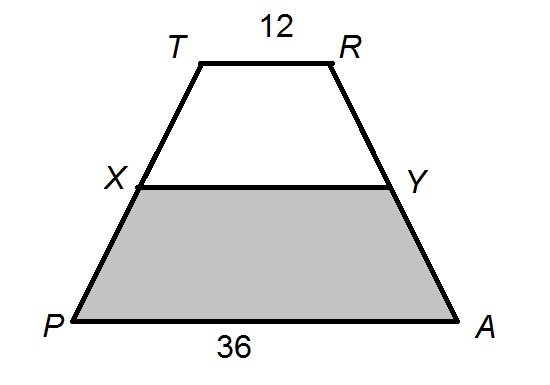
In the above figure,  is the midsegment of Trapezoid
  .
.
Which is the greater quantity?
(a) Twice the perimeter of Trapezoid 
(b) The perimeter of Trapezoid 
In the above figure,
Which is the greater quantity?
(a) Twice the perimeter of Trapezoid
(b) The perimeter of Trapezoid
The midsegment of a trapezoid bisects both of its legs, so
 and
and  .
.
For reasons that will be apparent later, we will set

Also, the length of the midsegment is half sum of the lengths of the bases:
 .
.
The perimeter of Trapezoid  is
is

Twice this is

The perimeter of Trapezoid  is
is

 and
and  , so
, so  , making (a) the greater quantity.
The midsegment of a trapezoid bisects both of its legs, so
For reasons that will be apparent later, we will set
Also, the length of the midsegment is half sum of the lengths of the bases:
The perimeter of Trapezoid
Twice this is
The perimeter of Trapezoid
Compare your answer with the correct one above

Refer to the above figure, which shows a parallelogram. What is  equal to?
Refer to the above figure, which shows a parallelogram. What is
The sum of two consecutive angles of a parallelogram is  .
.


157 is the correct choice.
The sum of two consecutive angles of a parallelogram is
157 is the correct choice.
Compare your answer with the correct one above
Which of the following can be the measures of the four angles of a parallelogram?
Which of the following can be the measures of the four angles of a parallelogram?
Opposite angles of a parallelogram must have the same measure, so the correct choice must have two pairs, each of the same angle measure. We can therefore eliminate  and
and  as choices.
Also, the sum of the measures of the angles of any quadrilateral must be  , so we add the angle measures of the remaining choices:
 :
:
 , so we can eliminate this choice.
 :
:
 , so we can eliminate this choice.

 ; this is the correct choice.
Opposite angles of a parallelogram must have the same measure, so the correct choice must have two pairs, each of the same angle measure. We can therefore eliminate
Also, the sum of the measures of the angles of any quadrilateral must be
Compare your answer with the correct one above
In Parallelogram  ,
,  and
and  .
.
Which is the greater quantity?
(a) 
(b) 
In Parallelogram
Which is the greater quantity?
(a)
(b)
In Parallelogram  ,
,  and
and  are opposite angles and are therefore congruent. This means that


Both are positive, so  .
.
In Parallelogram
Both are positive, so
Compare your answer with the correct one above
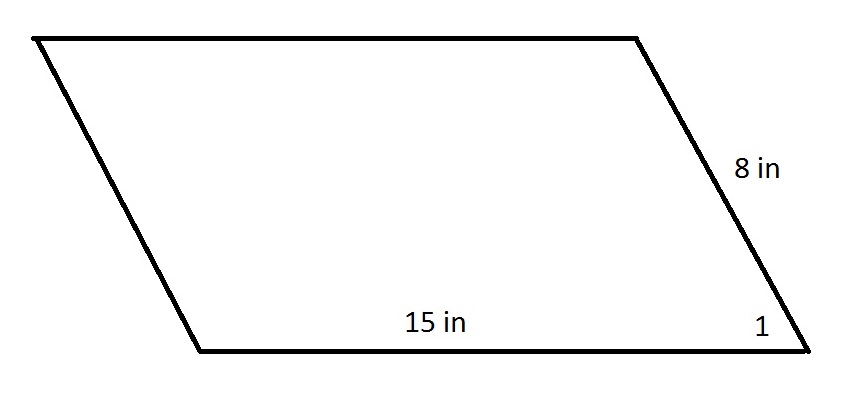
In the above parallelogram,  is acute. Which is the greater quantity?
(A) The perimeter of the parallelogram
(B) 46 inches
In the above parallelogram,
(A) The perimeter of the parallelogram
(B) 46 inches
The measure of  is actually irrelevant. The perimeter of the parallelogram is the sum of its four sides; since opposite sides of a parallelogram have the same length, the perimeter is
 inches,
making the quantities equal.
The measure of
making the quantities equal.
Compare your answer with the correct one above
Parallelogram A is below:
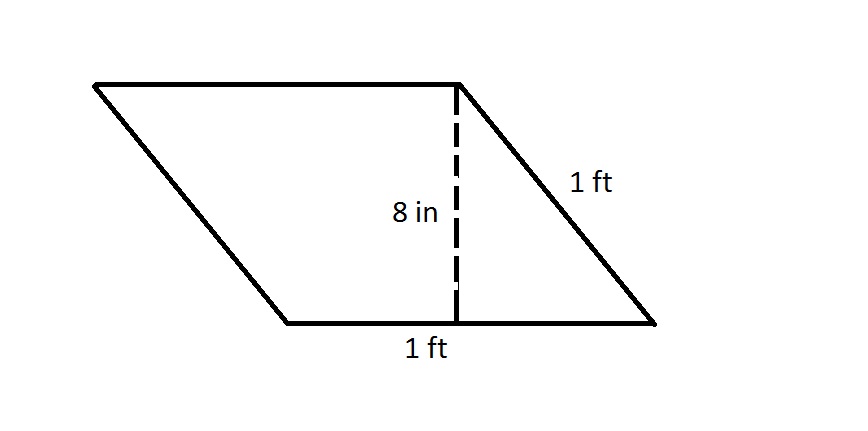
Parallelogram B is below:
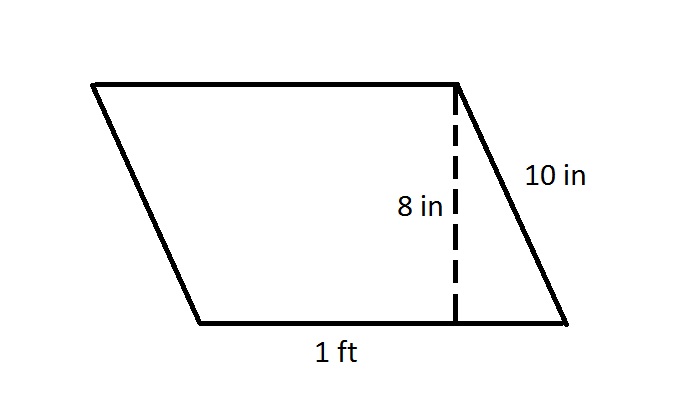
Note: These figures are NOT drawn to scale.
Refer to the parallelograms above. Which is the greater quantity?
(A) The perimeter of parallelogram A
(B) The perimeter of parallelogram B
Parallelogram A is below:
Parallelogram B is below:
Note: These figures are NOT drawn to scale.
Refer to the parallelograms above. Which is the greater quantity?
(A) The perimeter of parallelogram A
(B) The perimeter of parallelogram B
The perimeter of a parallelogram is the sum of its sidelengths; its height is irrelevant. Also, opposite sides of a parallelogram are congruent.
The perimeter of parallelogram A is
 inches;
The perimeter of parallelogram B is
 inches.
(A) is greater.
The perimeter of a parallelogram is the sum of its sidelengths; its height is irrelevant. Also, opposite sides of a parallelogram are congruent.
The perimeter of parallelogram A is
The perimeter of parallelogram B is
(A) is greater.
Compare your answer with the correct one above
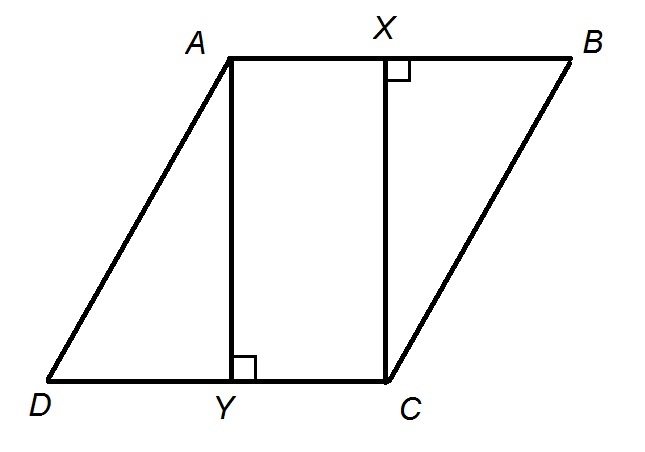
Figure NOT drawn to scale.
The above figure depicts Rhombus  with
with  and
and  .
.
Give the perimeter of Rhombus  .
.
Figure NOT drawn to scale.
The above figure depicts Rhombus
Give the perimeter of Rhombus
All four sides of a rhombus have the same length, so we can find the perimeter of Rhombus  by taking the length of one side and multiplying it by four. Since
  , the perimeter is four times this, or
  .
.
Note that the length of  is actually irrelevant to the problem.
All four sides of a rhombus have the same length, so we can find the perimeter of Rhombus
Note that the length of
Compare your answer with the correct one above
Rhombus  has two diagonals that intersect at point
  ;
;  . Which is the greater quantity?
(a) 
(b) 
Rhombus
(a)
(b)
The diagonals of a rhombus always intersect at right angles, so  . The measures of the interior angles of the rhombus are irrelevant.
The diagonals of a rhombus always intersect at right angles, so
Compare your answer with the correct one above
A rhombus has diagonals of length two and one-half feet and six feet. Which is the greater quantity?
(A) The perimeter of the rhombus
(B) Four yards
A rhombus has diagonals of length two and one-half feet and six feet. Which is the greater quantity?
(A) The perimeter of the rhombus
(B) Four yards
It will be easier to look at these measurements as inches for the time being:
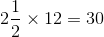 and
and  , so these are the lengths of the diagonals in inches.
The diagonals of a rhombus are each other's perpendicular bisector, so, as can be seen in the diagram below, one side of a rhombus and one half of each diagonal form a right triangle. If we let  be the length of one side of the rhombus, then this is the hypotenuse of that right triangle; its legs are one-half the lengths of the diagonals, or 15 and 36 inches.
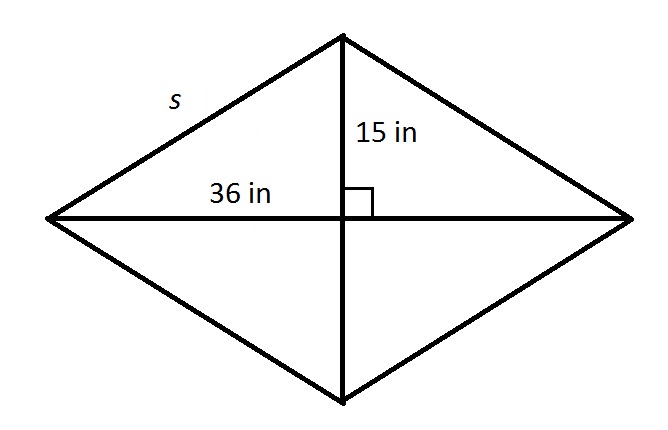
By the Pythagorean Theorem,

Each side of the rhombus measures 39 inches, and its perimeter is
 inches.
Four yards is equal to  inches, so (A) is greater.
It will be easier to look at these measurements as inches for the time being:
The diagonals of a rhombus are each other's perpendicular bisector, so, as can be seen in the diagram below, one side of a rhombus and one half of each diagonal form a right triangle. If we let
By the Pythagorean Theorem,
Each side of the rhombus measures 39 inches, and its perimeter is
Four yards is equal to
Compare your answer with the correct one above
A rectangle has a width of 2_x_. If the length is five more than 150% of the width, what is the perimeter of the rectangle?
A rectangle has a width of 2_x_. If the length is five more than 150% of the width, what is the perimeter of the rectangle?
Given that w = 2_x_ and l = 1.5_w_ + 5, a substitution will show that l = 1.5(2_x_) + 5 = 3_x_ + 5.
P = 2_w_ + 2_l_ = 2(2_x_) + 2(3_x_ + 5) = 4_x_ + 6_x_ + 10 = 10_x_ + 10 = 10(x + 1)
Given that w = 2_x_ and l = 1.5_w_ + 5, a substitution will show that l = 1.5(2_x_) + 5 = 3_x_ + 5.
P = 2_w_ + 2_l_ = 2(2_x_) + 2(3_x_ + 5) = 4_x_ + 6_x_ + 10 = 10_x_ + 10 = 10(x + 1)
Compare your answer with the correct one above