
How to find the answer from a table
ISEE Upper Level Quantitative Reasoning · Learn by Concept
Help Questions
ISEE Upper Level Quantitative Reasoning › How to find the answer from a table
Below is a table that gives the population of Washington City for five census years.
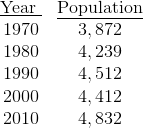
Which is the greater quantity?
(a) The population increase in Washington City from 1970 to 1975
(b) The population increase in Washington City from 1975 to 1980
It is impossible to tell from the information given
(a) and (b) are equal
(a) is greater
(b) is greater
Explanation
No information is given in the table about the population of Washington City in 1975. Therefore, it cannot be determined with any certainty which population change was the greater.
A pair of fair dice are tossed. Which is the greater quantity?
(a) The probability that the sum will be at least eight
(b) The probability that the sum will be at most six
(a) and (b) are equal
(a) is greater
(b) is greater
It is impossible to tell from the information given
Explanation
The following table illustrates the ways that the dice can come up. The orange cells indicate a roll of 6 or less; the pink cells indicate a roll of eight or more.
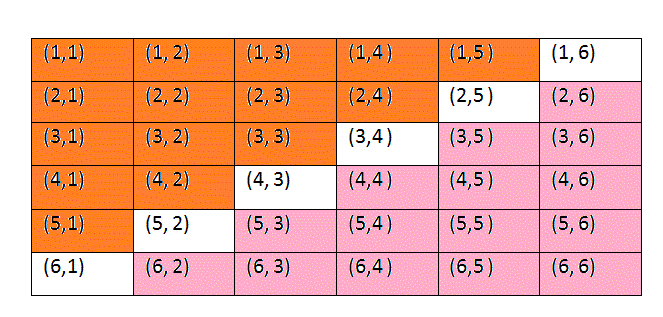
Since each of these outcomes are equally likely, and there are fifteen outcomes that are favorable to each of the two events, the probabilities are the same.
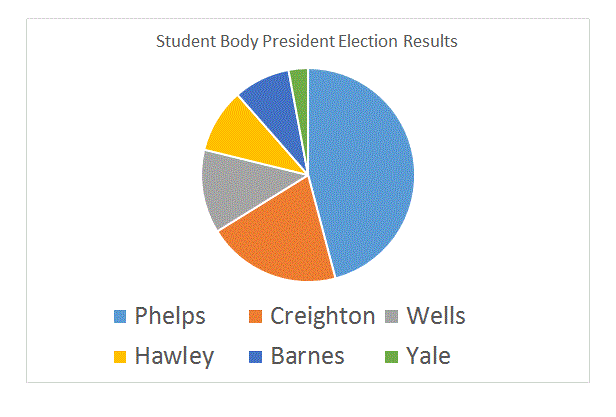
Refer to the above circle graph. Which of these quantities is greater?
(a) The number of students who voted
(b) The number of students who did not vote
It is impossible to tell from the information given
(a) is greater
(b) is greater
(a) and (b) are equal
Explanation
The above graph only reflects the relative numbers of students who voted for each of the six candidates; it does not give any information about the numbers of students who voted for each candidate, or the number of students who did not vote.
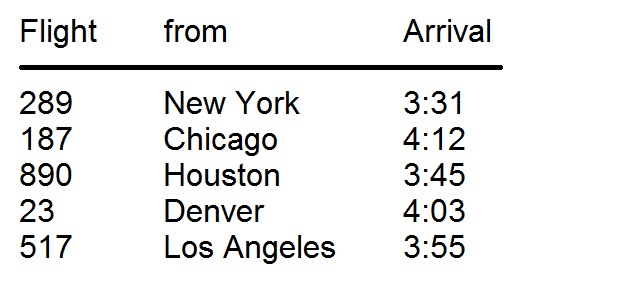
Above is a part of a schedule of flight arrivals; the common destination is Atlanta, Georgia, which is located in the Eastern Time Zone. New York is also in the Eastern Time Zone (ET); Chicago and Houston are in the Central Time Zone, which is one hour behind ET; Denver is in the Mountain Time Zone, two hours behind ET; Los Angeles is in the Pacific Time Zone, three hours behind ET. All arrival times are PM and are given in Eastern Time.
Flight 289 lasted 1 hour 57 minutes. When it took off, what time was it at the location of its departure?
1:34 PM
12:34 PM
11:34 AM
10:34 AM
2:34 PM
Explanation
Flight 289 took off from New York, which is in the same time zone as Atlanta, so no adjustments for Time Zone need to be made. Subtract 1 hour 57 minutes from the arrival time of 3:31:

We can "borrow" one hour and subtract as follows:

It was 1:34 PM in New York when the airplane departed.
A standard deck of cards is altered by removing two jacks. A card is drawn at random from this altered deck. Which is the greater quantity?
(a) The probability of drawing a red card
(b) The probability of drawing a black card
It is impossible to tell from the information given
(a) is greater
(b) is greater
(a) and (b) are greater
Explanation
The colors of the jacks removed are not given, so it is not known whether there are more black cards or red cards now.
Two standard decks of cards are altered as follows: the jacks from Deck 1 are switched with the aces from Deck 2.
Which is the greater quantity?
(a) The probability that a card randomly drawn from Deck 1 is black
(b) The probability that a card randomly drawn from Deck 2 is black
(a) and (b) are equal
(a) is greater
(b) is greater
It is impossible to tell from the information given
Explanation
Two black cards and two red cards from Deck 1 are being switched with two black cards and two red cards from Deck 2, so even after the switch, in each deck, half the cards are black and half are red. Therefore, the probability of drawing a black card from Deck 1 remains 
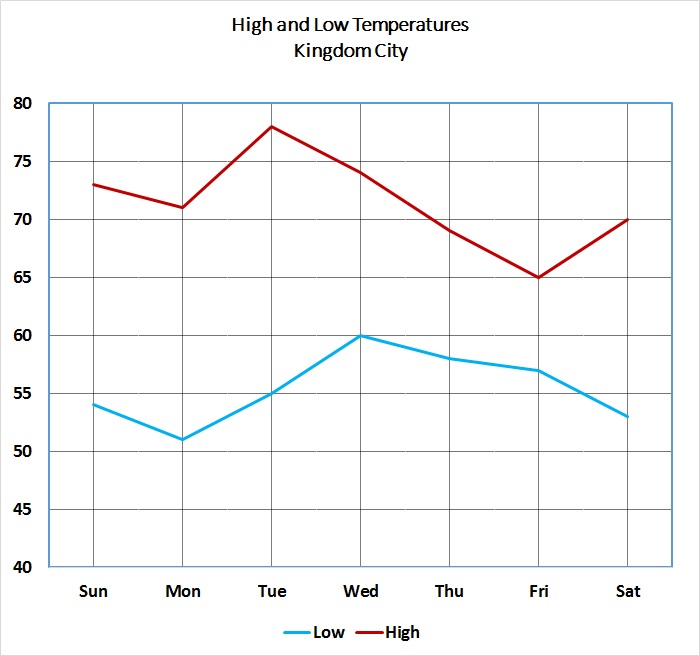
Refer to the above graph, which shows the high and low temperatures for Kingdom City over a one-week period.
Which is the greater quantity?
(a) The lowest high temperature for any of the seven days
(b) The highest low temperature for any of the seven days
(a) is the greater quantity
(b) is the greater quantity
(a) and (b) are equal
It is impossible to determine which is greater from the information given
Explanation
Examine the low point of the line representing the high temperatures and the high point of the line representing the low temperatures.
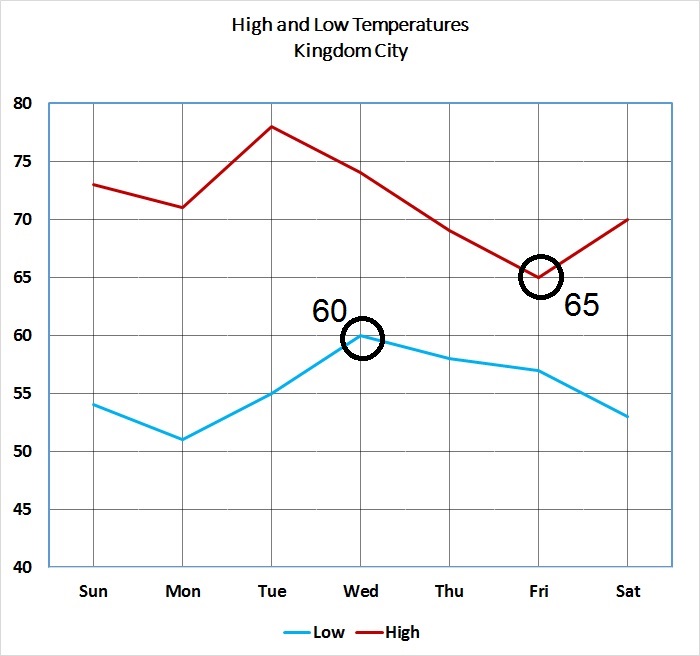
It can be seen that the lowest of the high temperatures is 65 degrees (Friday), and that the highest of the low temperatures is 60 degrees (Wednesday). This makes the former quantity the greater.
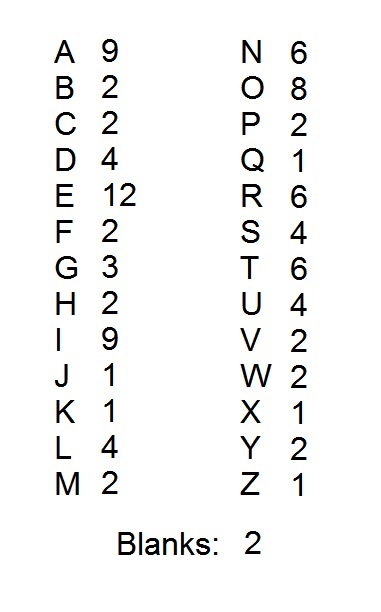
A popular word game uses one hundred tiles, each of which is marked with a letter or a blank. The distribution of the tiles is shown above, with each letter paired with the number of tiles marked with that letter. Notice that there are two blank tiles.
All of the tiles are put in a box except for the unique tiles; they are replaced by five tiles from another set - one of each of the five vowels ("Y" is considered a consonant here). A tile is drawn at random. Which is the greater quantity?
(a) The probability that the tile is a consonant
(b)

(a) is the greater quantity
(b) is the greater quantity
(a) and (b) are equal
It is impossible to determine which is greater from the information given
Explanation
It is easier to count the tiles that are vowels or blanks than it is to count the tiles marked with consonants. Keeping in mind that one of each vowel has been added, the number of each vowel is as follows:
A: 10 tiles
E: 13 tiles
I: 10 tiles
O: 9 tiles
U: 5 tiles
Blanks: 2 tiles
Add these: 
Since the five unique tiles - "J", "K", "Q", "X", and "Z" - were replaced by five vowel tiles, the number of tiles remained constant at 100. Therefore, there are

consonant tiles; consonants therefore make up more than one half of the tiles, and the probability that a randomly drawn tile will be a consonant is greater than 
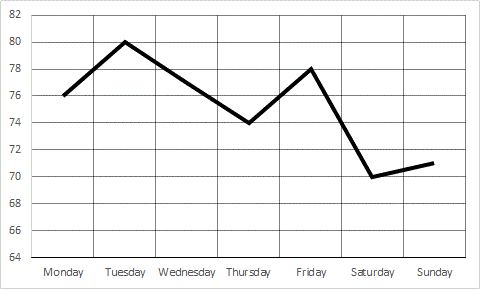
Refer to the above graph, which shows the high temperatures in the town of Smithville over seven days.
Which is the greater quantity?
(a) The high temperature for Sunday
(b) The low temperature for Saturday
(a) is greater.
(b) is greater.
(a) and (b) are equal.
It is impossible to tell from the information given.
Explanation
From the graph, it can be seen that the high temperature for Sunday is higher that the high temperature for Saturday, which, by definition, must be greater than the low temperature for Saturday. That makes (a) greater.
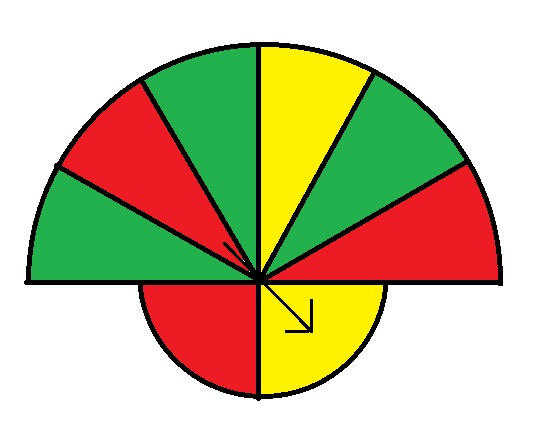
The above figure shows a spinner used in a game. The upper semicircle has twice the radius of the lower semicircle.
Which of the following is the greater quantity?
(a) The probability that a random spin will cause the spinner to land in a green region.
(b) The probability that a random spin will cause the spinner to land in a red region.
(b) is the greater quantity
(a) is the greater quantity
It cannot be determined which of (a) and (b) is greater
(a) and (b) are equal
Explanation
The size of the regions do not matter in this problem; it is the central angles of the sectors that are relevant. The best way to understand this is to look at the spinner again, but after cutting out the central circle:
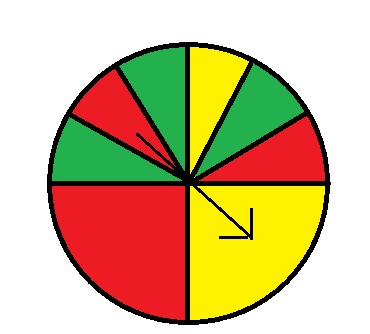
If we rearrange the sectors, we see the following:
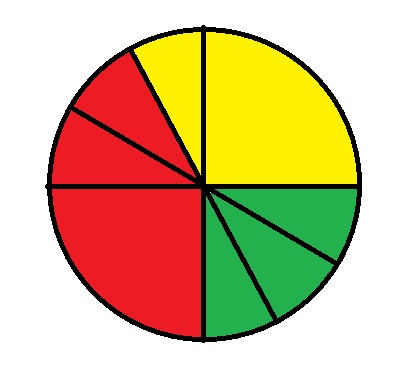
The probability of the spinner landing in red exceeds that of it landing in green.