
Pentagons - ISEE Upper Level Quantitative Reasoning
Card 1 of 52
In a pentagon in which all the angles are equal and the perimeter is 35 inches, how many inches would be the sum of 2 of the sides?
In a pentagon in which all the angles are equal and the perimeter is 35 inches, how many inches would be the sum of 2 of the sides?
Tap to reveal answer
In a pentagon in which all angles are equal, all sides will also be equal; therefore, the length of one side can be found by dividing the perimeter by 5 (the number of sides in a pentagon). Given that  , the sum of 2 of the sides will be
In a pentagon in which all angles are equal, all sides will also be equal; therefore, the length of one side can be found by dividing the perimeter by 5 (the number of sides in a pentagon). Given that
← Didn't Know|Knew It →
If a pentagon has a perimeter of 85in, what is the length of one side of the pentagon?
If a pentagon has a perimeter of 85in, what is the length of one side of the pentagon?
Tap to reveal answer
A pentagon has 5 equal sides. We know the formula to find perimeter of a pentagon is

where a is the length of one side of the pentagon. Now, we know the total perimeter is 85in. Knowing this, we will substitute into the formula. We get


Therefore, the length of one side of the pentagon is 17in.
A pentagon has 5 equal sides. We know the formula to find perimeter of a pentagon is
where a is the length of one side of the pentagon. Now, we know the total perimeter is 85in. Knowing this, we will substitute into the formula. We get
Therefore, the length of one side of the pentagon is 17in.
← Didn't Know|Knew It →
The measures of the angles of a pentagon are  . If
. If  , what is
  ?
?
The measures of the angles of a pentagon are
Tap to reveal answer
The angles of a pentagon measure a total of  . From the information, we know that:


If  , then





The angles of a pentagon measure a total of
If
← Didn't Know|Knew It →
A convex pentagon has four angles that measure  each. What is the measure of the fifth angle?
A convex pentagon has four angles that measure
Tap to reveal answer
The angles of a pentagon measure a total of . If we let the unknown angle measure be  , then from this information:




Since an angle measure cannot be negative, this pentagon cannot exist.
The angles of a pentagon measure a total of
Since an angle measure cannot be negative, this pentagon cannot exist.
← Didn't Know|Knew It →
The measures of the angles of a pentagon are  . If
. If  , what is
  ?
?
The measures of the angles of a pentagon are
Tap to reveal answer
The angles of a pentagon measure a total of . From the information, we know:
If  , then the above becomes:





The angles of a pentagon measure a total of
If
← Didn't Know|Knew It →
Solve for  :
:
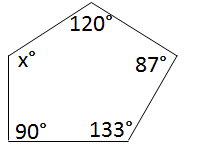
Solve for
Tap to reveal answer
The sum of the interior angles of a pentagon can be determined by the following equation, where  is the number of sides:

Therefore:




The sum of the interior angles of a pentagon can be determined by the following equation, where
Therefore:
← Didn't Know|Knew It →
The measures of the angles of a pentagon are . If , what is ?
The measures of the angles of a pentagon are
Tap to reveal answer
The angles of a pentagon measure a total of . From the information, we know that:
If , then
The angles of a pentagon measure a total of
If
← Didn't Know|Knew It →
A convex pentagon has four angles that measure each. What is the measure of the fifth angle?
A convex pentagon has four angles that measure
Tap to reveal answer
The angles of a pentagon measure a total of . If we let the unknown angle measure be , then from this information:
Since an angle measure cannot be negative, this pentagon cannot exist.
The angles of a pentagon measure a total of
Since an angle measure cannot be negative, this pentagon cannot exist.
← Didn't Know|Knew It →
The measures of the angles of a pentagon are . If , what is ?
The measures of the angles of a pentagon are
Tap to reveal answer
The angles of a pentagon measure a total of . From the information, we know:
If , then the above becomes:
The angles of a pentagon measure a total of
If
← Didn't Know|Knew It →
Solve for :
Solve for
Tap to reveal answer
The sum of the interior angles of a pentagon can be determined by the following equation, where is the number of sides:
Therefore:
The sum of the interior angles of a pentagon can be determined by the following equation, where
Therefore:
← Didn't Know|Knew It →
A pentagon with a perimeter of one mile has three congruent sides. The second-longest side is 250 feet longer than any one of those three congruent sides, and the longest side is 500 feet longer than the second-longest side.
Which is the greater quantity?
(a) The length of the longest side of the pentagon
(b) Twice the length of one of the three shortest sides of the pentagon
A pentagon with a perimeter of one mile has three congruent sides. The second-longest side is 250 feet longer than any one of those three congruent sides, and the longest side is 500 feet longer than the second-longest side.
Which is the greater quantity?
(a) The length of the longest side of the pentagon
(b) Twice the length of one of the three shortest sides of the pentagon
Tap to reveal answer
If each of the five congruent sides has measure  , then the other two sides have measures
  and
and  . Add the sides to get the perimeter, which is equal to
  feet, the solve for
  :
:





 feet
feet
Now we can compare (a) and (b).
(a) The longest side has measure  feet.
feet.
(b) The three shortest sides each have length 856 feet; twice this is  feet.
feet.
(b) is greater.
If each of the five congruent sides has measure
Now we can compare (a) and (b).
(a) The longest side has measure
(b) The three shortest sides each have length 856 feet; twice this is
(b) is greater.
← Didn't Know|Knew It →
A regular pentagon has perimeter one yard. Which is the greater quantity?
(A) The length of one side
(B) 7 inches
A regular pentagon has perimeter one yard. Which is the greater quantity?
(A) The length of one side
(B) 7 inches
Tap to reveal answer
One yard is equal to 36 inches. A regular pentagon has five sides of equal length, so one side of the pentagon has length
 inches.
Since  , (A) is greater.
One yard is equal to 36 inches. A regular pentagon has five sides of equal length, so one side of the pentagon has length
Since
← Didn't Know|Knew It →
In a pentagon in which all the angles are equal and the perimeter is 35 inches, how many inches would be the sum of 2 of the sides?
In a pentagon in which all the angles are equal and the perimeter is 35 inches, how many inches would be the sum of 2 of the sides?
Tap to reveal answer
In a pentagon in which all angles are equal, all sides will also be equal; therefore, the length of one side can be found by dividing the perimeter by 5 (the number of sides in a pentagon). Given that , the sum of 2 of the sides will be
In a pentagon in which all angles are equal, all sides will also be equal; therefore, the length of one side can be found by dividing the perimeter by 5 (the number of sides in a pentagon). Given that
← Didn't Know|Knew It →
If a pentagon has a perimeter of 85in, what is the length of one side of the pentagon?
If a pentagon has a perimeter of 85in, what is the length of one side of the pentagon?
Tap to reveal answer
A pentagon has 5 equal sides. We know the formula to find perimeter of a pentagon is
where a is the length of one side of the pentagon. Now, we know the total perimeter is 85in. Knowing this, we will substitute into the formula. We get
Therefore, the length of one side of the pentagon is 17in.
A pentagon has 5 equal sides. We know the formula to find perimeter of a pentagon is
where a is the length of one side of the pentagon. Now, we know the total perimeter is 85in. Knowing this, we will substitute into the formula. We get
Therefore, the length of one side of the pentagon is 17in.
← Didn't Know|Knew It →
In a pentagon in which all the angles are equal and the perimeter is 35 inches, how many inches would be the sum of 2 of the sides?
In a pentagon in which all the angles are equal and the perimeter is 35 inches, how many inches would be the sum of 2 of the sides?
Tap to reveal answer
In a pentagon in which all angles are equal, all sides will also be equal; therefore, the length of one side can be found by dividing the perimeter by 5 (the number of sides in a pentagon). Given that , the sum of 2 of the sides will be
In a pentagon in which all angles are equal, all sides will also be equal; therefore, the length of one side can be found by dividing the perimeter by 5 (the number of sides in a pentagon). Given that
← Didn't Know|Knew It →
If a pentagon has a perimeter of 85in, what is the length of one side of the pentagon?
If a pentagon has a perimeter of 85in, what is the length of one side of the pentagon?
Tap to reveal answer
A pentagon has 5 equal sides. We know the formula to find perimeter of a pentagon is
where a is the length of one side of the pentagon. Now, we know the total perimeter is 85in. Knowing this, we will substitute into the formula. We get
Therefore, the length of one side of the pentagon is 17in.
A pentagon has 5 equal sides. We know the formula to find perimeter of a pentagon is
where a is the length of one side of the pentagon. Now, we know the total perimeter is 85in. Knowing this, we will substitute into the formula. We get
Therefore, the length of one side of the pentagon is 17in.
← Didn't Know|Knew It →
A pentagon with a perimeter of one mile has three congruent sides. The second-longest side is 250 feet longer than any one of those three congruent sides, and the longest side is 500 feet longer than the second-longest side.
Which is the greater quantity?
(a) The length of the longest side of the pentagon
(b) Twice the length of one of the three shortest sides of the pentagon
A pentagon with a perimeter of one mile has three congruent sides. The second-longest side is 250 feet longer than any one of those three congruent sides, and the longest side is 500 feet longer than the second-longest side.
Which is the greater quantity?
(a) The length of the longest side of the pentagon
(b) Twice the length of one of the three shortest sides of the pentagon
Tap to reveal answer
If each of the five congruent sides has measure , then the other two sides have measures and . Add the sides to get the perimeter, which is equal to feet, the solve for :
feet
Now we can compare (a) and (b).
(a) The longest side has measure feet.
(b) The three shortest sides each have length 856 feet; twice this is feet.
(b) is greater.
If each of the five congruent sides has measure
Now we can compare (a) and (b).
(a) The longest side has measure
(b) The three shortest sides each have length 856 feet; twice this is
(b) is greater.
← Didn't Know|Knew It →
A regular pentagon has perimeter one yard. Which is the greater quantity?
(A) The length of one side
(B) 7 inches
A regular pentagon has perimeter one yard. Which is the greater quantity?
(A) The length of one side
(B) 7 inches
Tap to reveal answer
One yard is equal to 36 inches. A regular pentagon has five sides of equal length, so one side of the pentagon has length
inches.
Since , (A) is greater.
One yard is equal to 36 inches. A regular pentagon has five sides of equal length, so one side of the pentagon has length
Since
← Didn't Know|Knew It →
Find the perimeter of a pentagon with a side of length 12in.
Find the perimeter of a pentagon with a side of length 12in.
Tap to reveal answer
To find the perimeter of a pentagon, we will use the following formula:

where a is the length of one side of the pentagon.
Now, we know the length of one side of the pentagon is 12in.
Knowing this, we can substitute into the formula. We get


To find the perimeter of a pentagon, we will use the following formula:
where a is the length of one side of the pentagon.
Now, we know the length of one side of the pentagon is 12in.
Knowing this, we can substitute into the formula. We get
← Didn't Know|Knew It →
Find the perimeter of a pentagon with a side having a length of 21in.
Find the perimeter of a pentagon with a side having a length of 21in.
Tap to reveal answer
A pentagon has 5 sides. To find the perimeter, we will use the following formula:

where a is the length of a side of the pentagon.
Now, we know the length of a side of the pentagon is 21in.
Knowing this, we will substitute into the formula. We get


A pentagon has 5 sides. To find the perimeter, we will use the following formula:
where a is the length of a side of the pentagon.
Now, we know the length of a side of the pentagon is 21in.
Knowing this, we will substitute into the formula. We get
← Didn't Know|Knew It →