
Lines - ISEE Upper Level Quantitative Reasoning
Card 1 of 296

Examine the above diagram. If  , give
  in terms of
  .
.
Examine the above diagram. If
Tap to reveal answer
The two marked angles are same-side exterior angles of parallel lines, which are supplementary - that is, their measures have sum 180. We can solve for  in this equation:


The two marked angles are same-side exterior angles of parallel lines, which are supplementary - that is, their measures have sum 180. We can solve for
← Didn't Know|Knew It →

Examine the above diagram. If  , give
  in terms of
  .
.
Examine the above diagram. If
Tap to reveal answer
The two marked angles are same-side interior angles of parallel lines, which are supplementary - that is, their measures have sum 180. We can solve for  in this equation:


The two marked angles are same-side interior angles of parallel lines, which are supplementary - that is, their measures have sum 180. We can solve for
← Didn't Know|Knew It →

Examine the above diagram. Which of the following statements must be true whether or not  and
and  are parallel?
Examine the above diagram. Which of the following statements must be true whether or not
Tap to reveal answer
Four statements can be eliminated by the various parallel theorems and postulates. Congruence of alternate interior angles or corresponding angles forces the lines to be parallel, so
 and
and
 .
.
Also, if same-side interior angles or same-side exterior angles are supplementary, the lines are parallel, so
 and
and
 .
.
However,  whether or not
  since they are vertical angles, which are always congruent.
Four statements can be eliminated by the various parallel theorems and postulates. Congruence of alternate interior angles or corresponding angles forces the lines to be parallel, so
Also, if same-side interior angles or same-side exterior angles are supplementary, the lines are parallel, so
However,
← Didn't Know|Knew It →

Examine the above diagram. What is  ?
?
Examine the above diagram. What is
Tap to reveal answer
By angle addition,


By angle addition,
← Didn't Know|Knew It →
 and
and  are supplementary;
  and
and  are complementary.
 .
.
What is  ?
?
What is
Tap to reveal answer
Supplementary angles and complementary angles have measures totaling  and
and  , respectively.
 , so its supplement
  has measure

 , the complement of
  , has measure

Supplementary angles and complementary angles have measures totaling
← Didn't Know|Knew It →

Note: Figure NOT drawn to scale.
In the above figure,  and
and  . Which of the following is equal to
  ?
?
Note: Figure NOT drawn to scale.
In the above figure,
Tap to reveal answer
 and
and  form a linear pair, so their angle measures total
  . Set up and solve the following equation:


← Didn't Know|Knew It →
Two angles which form a linear pair have measures  and
and  . Which is the lesser of the measures (or the common measure) of the two angles?
Two angles which form a linear pair have measures
Tap to reveal answer
Two angles that form a linear pair are supplementary - that is, they have measures that total . Therefore, we set and solve for  in this equation:


The two angles have measure

and

 is the lesser of the two measures and is the correct choice.
Two angles that form a linear pair are supplementary - that is, they have measures that total
The two angles have measure
and
← Didn't Know|Knew It →
Two vertical angles have measures  and
and  . Which is the lesser of the measures (or the common measure) of the two angles?
Two vertical angles have measures
Tap to reveal answer
Two vertical angles - angles which share a vertex and whose union is a pair of lines - have the same measure. Therefore, we set up and solve the equation


Two vertical angles - angles which share a vertex and whose union is a pair of lines - have the same measure. Therefore, we set up and solve the equation
← Didn't Know|Knew It →
A line  intersects parallel lines
  and
and  .
.  and
and  are corresponding angles;
  and
and  are same side interior angles.


Evaluate  .
.
A line
Evaluate
Tap to reveal answer
When a transversal such as  crosses two parallel lines, two corresponding angles - angles in the same relative position to their respective lines - are congruent. Therefore,


Two same-side interior angles are supplementary - that is, their angle measures total 180 - so


We can solve this system by the substitution method as follows:


Backsolve:


 , which is the correct response.
When a transversal such as
Two same-side interior angles are supplementary - that is, their angle measures total 180 - so
We can solve this system by the substitution method as follows:
Backsolve:
← Didn't Know|Knew It →

Note: Figure NOT drawn to scale.
Refer to the above diagram. Give the measure of  .
.
Note: Figure NOT drawn to scale.
Refer to the above diagram. Give the measure of
Tap to reveal answer
The top and bottom angles, being vertical angles - angles which share a vertex and whose union is a pair of lines - have the same measure, so
 ,
,
or, simplified,


The right and bottom angles form a linear pair, so their degree measures total 180. That is,

Substitute  for
for  :
:


The left and right angles, being vertical angles, have the same measure, so, since the right angle measures  , this is also the measure of the left angle,
  .
.
The top and bottom angles, being vertical angles - angles which share a vertex and whose union is a pair of lines - have the same measure, so
or, simplified,
The right and bottom angles form a linear pair, so their degree measures total 180. That is,
Substitute
The left and right angles, being vertical angles, have the same measure, so, since the right angle measures
← Didn't Know|Knew It →
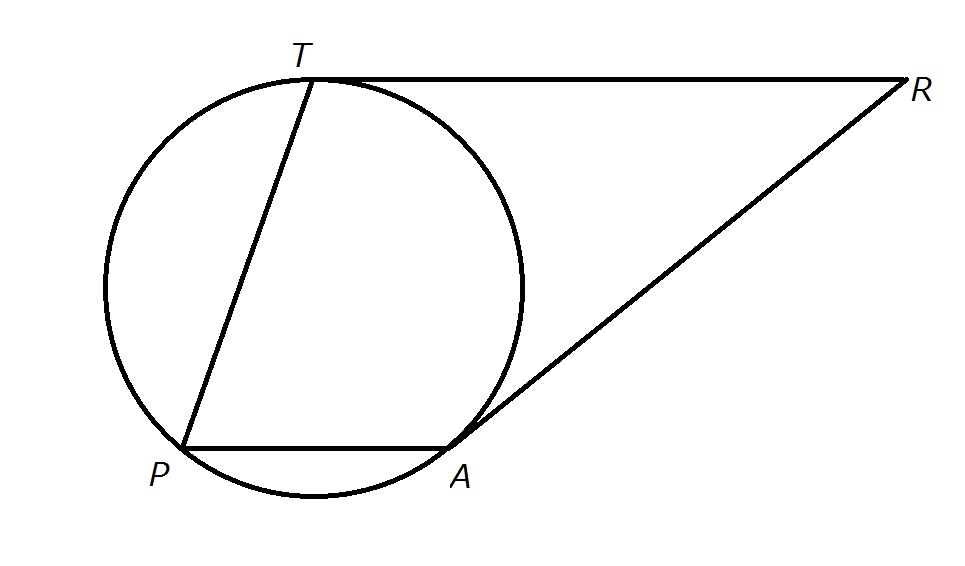
Figure NOT drawn to scale
The above figure shows Trapezoid  , with
  and
and  tangent to the circle.
  ; evaluate
  .
.
Figure NOT drawn to scale
The above figure shows Trapezoid
Tap to reveal answer
By the Same-Side Interior Angle Theorem, since  ,
,  and
and  are supplementary - that is, their degree measures total
  . Therefore,



 is an inscribed angle, so the arc it intercepts,
  , has twice its degree measure;
 .
.
The corresponding major arc,  , has as its measure

The measure of an angle formed by two tangents to a circle is equal to half the difference of those of its intercepted arcs:


Again, by the Same-Side Interior Angles Theorem,  and
and  are supplementary, so



By the Same-Side Interior Angle Theorem, since
The corresponding major arc,
The measure of an angle formed by two tangents to a circle is equal to half the difference of those of its intercepted arcs:
Again, by the Same-Side Interior Angles Theorem,
← Didn't Know|Knew It →
A pentagon has five angles whose measures are  .
.
Which quantity is greater?
(a) 
(b) 
A pentagon has five angles whose measures are
Which quantity is greater?
(a)
(b)
Tap to reveal answer
The angles of a pentagon measure a total of  . From the information given, we know that:


However, we cannot tell whether  or
or  is greater. For example, if
  , then
  ; if
; if  , then
  .
.
The angles of a pentagon measure a total of
However, we cannot tell whether
← Didn't Know|Knew It →
A pentagon has five angles whose measures are  .
.
Which quantity is greater?
(a) 
(b) 180
A pentagon has five angles whose measures are
Which quantity is greater?
(a)
(b) 180
Tap to reveal answer
The angles of a pentagon measure a total of . From the information, we know that:


making the two quantities equal.
The angles of a pentagon measure a total of
making the two quantities equal.
← Didn't Know|Knew It →
Pentagon  and hexagon
  are both regular, with their sidelengths equal. Diagonals
  and
and  are constructed.
Which is the greater quantity?
(a) 
(b) 
Pentagon
Which is the greater quantity?
(a)
(b)
Tap to reveal answer
Each diagonal, along with two consecutive sides of its polygon, forms a triangle. All of the sides of the pentagon and the hexagon are congruent to one another, so between the two triangles, there are two pairs of two congruent corresponding sides:


Their included angles,  and
and  , are interior angles of the pentagon and hexagon, respectively. The angle with greater measure will be opposite the longer side. We can use the Interior Angles Theorem to calculate the measures:


Each diagonal, along with two consecutive sides of its polygon, forms a triangle. All of the sides of the pentagon and the hexagon are congruent to one another, so between the two triangles, there are two pairs of two congruent corresponding sides:
Their included angles,
← Didn't Know|Knew It →
Pentagon and hexagon are both regular and have equal sidelengths. Diagonals and are constructed.
Which is the greater quantity?
(a) 
(b) 
Pentagon
Which is the greater quantity?
(a)
(b)
Tap to reveal answer
In both situations, the two adjacent sides and the diagonal form an isosceles triangle.
By the Isosceles Triangle Theorem,  and
and  . Also, since the measures of the angles of a triangle total
  , we know that

and
 .
.
We can use these equations to compare  and
and  .
.
(a) 


(b) 


In both situations, the two adjacent sides and the diagonal form an isosceles triangle.
By the Isosceles Triangle Theorem,
and
We can use these equations to compare
(a)
(b)
← Didn't Know|Knew It →
You are given pentagon  .
.


Which is the greater quantity?
(A) 
(B) 
You are given pentagon
Which is the greater quantity?
(A)
(B)
Tap to reveal answer
It is impossible to tell, as scenarios can be constructed that would allow  to be less than, equal to, or greater than 108, keeping in mind that the sum of the degree measures of a pentagon is
  .
.
Case 1: The pentagon is regular, so all five angles are of the same measure:

This fits the conditions of the problem and makes the two quantities equal.
Case 2: 
The sum of the angle measures is therefore

This also fits the conditions of the problem, and makes (B) greater.
It is impossible to tell, as scenarios can be constructed that would allow
Case 1: The pentagon is regular, so all five angles are of the same measure:
This fits the conditions of the problem and makes the two quantities equal.
Case 2:
The sum of the angle measures is therefore
This also fits the conditions of the problem, and makes (B) greater.
← Didn't Know|Knew It →
In Pentagon  ,
,

The other four angles are congruent to one another.
What is  ?
?
In Pentagon
The other four angles are congruent to one another.
What is
Tap to reveal answer
The degree measures of a pentagon, which has five angles, total  .
.
 .
.
Let  . Then since the other three angles all have the same measure as
  ,
,

Therefore, we can set up, and solve for  in, the equation


The degree measures of a pentagon, which has five angles, total
Let
Therefore, we can set up, and solve for
← Didn't Know|Knew It →

Note: Figure NOT drawn to scale
In the above figure,  and
and  are adjacent sides of a regular pentagon;
  and
and  are adjacent sides of a regular hexagon. Which of the following is the greater quantity?
(a) 
(b) 
Note: Figure NOT drawn to scale
In the above figure,
(a)
(b)
Tap to reveal answer
Extend  as seen below:

 , as an interior angle of a regular pentagon (five-sided polygon), has measure
 .
.
Its exterior angle  has measure
  .
.
 , as an interior angle of a regular hexagon (six-sided polygon), has measure
 .
.
Its exterior angle  has measure
  .
.
Add the measures of  and
and  to get that of
  :
:
 .
.
 .
.
Extend
Its exterior angle
Its exterior angle
Add the measures of
← Didn't Know|Knew It →
A hexagon has six angles with measures 
Which quantity is greater?
(a) 
(b) 240
A hexagon has six angles with measures
Which quantity is greater?
(a)
(b) 240
Tap to reveal answer
The angles of a hexagon measure a total of  . From the information, we know that:






The quantities are equal.
The angles of a hexagon measure a total of
The quantities are equal.
← Didn't Know|Knew It →
A hexagon has six angles with measures 
Which quantity is greater?
(a)
(b) 
A hexagon has six angles with measures
Which quantity is greater?
(a)
(b)
Tap to reveal answer
The angles of a hexagon measure a total of . From the information, we know that:







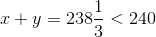
This makes (b) greater.
The angles of a hexagon measure a total of
This makes (b) greater.
← Didn't Know|Knew It →