
How to subtract exponential variables - ISEE Upper Level Quantitative Reasoning
Card 1 of 48
Simplify the expression:

Simplify the expression:
Tap to reveal answer
Group, then collect like terms.




Group, then collect like terms.
← Didn't Know|Knew It →
Assume neither  nor
nor  is zero.
Which is the greater quantity?
(a) 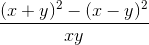
(b) 
Assume neither
Which is the greater quantity?
(a)
(b)
Tap to reveal answer
Simplify the expression in (a):
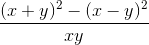



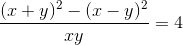 regardless of the values of the variables, and (a) and (b) are equal.
Simplify the expression in (a):
← Didn't Know|Knew It →
 is a positive number.
  is a negative number.
Which is the greater quantity?
(a) 
(b) 
Which is the greater quantity?
(a)
(b)
Tap to reveal answer

 is a positive number and
  is a negative number, so
  and
and  . Therefore,
 .
.
(b) is always greater.
(b) is always greater.
← Didn't Know|Knew It →
Simplify the expression:

Simplify the expression:
Tap to reveal answer
Group, then collect like terms:


Group, then collect like terms:
← Didn't Know|Knew It →
Simplify:

Simplify:
Tap to reveal answer


← Didn't Know|Knew It →
Assume that  . Which of the following expressions is equivalent to:
 ?
?
Assume that
Tap to reveal answer


← Didn't Know|Knew It →
If  , simplify:

If
Tap to reveal answer


← Didn't Know|Knew It →
If  , simplify:

If
Tap to reveal answer


← Didn't Know|Knew It →
If  , simplify:

If
Tap to reveal answer


← Didn't Know|Knew It →
If  , simplify:

If
Tap to reveal answer


← Didn't Know|Knew It →
If  , simplify:

If
Tap to reveal answer


← Didn't Know|Knew It →
Simplify the following expression:

Simplify the following expression:
Tap to reveal answer
Simplify the following expression:

We can treat this basically as a regular subtraction problem.
We want to subtract our coefficients, while leaving the exponents the same.

Simplify the following expression:
We can treat this basically as a regular subtraction problem.
We want to subtract our coefficients, while leaving the exponents the same.
← Didn't Know|Knew It →
Simplify the expression:
Simplify the expression:
Tap to reveal answer
Group, then collect like terms:
Group, then collect like terms:
← Didn't Know|Knew It →
Simplify:
Simplify:
Tap to reveal answer
← Didn't Know|Knew It →
Assume that . Which of the following expressions is equivalent to:
?
Assume that
Tap to reveal answer
← Didn't Know|Knew It →
If , simplify:
If
Tap to reveal answer
← Didn't Know|Knew It →
If , simplify:
If
Tap to reveal answer
← Didn't Know|Knew It →
If , simplify:
If
Tap to reveal answer
← Didn't Know|Knew It →
If , simplify:
If
Tap to reveal answer
← Didn't Know|Knew It →
If , simplify:
If
Tap to reveal answer
← Didn't Know|Knew It →