
How to multiply exponents - ISEE Upper Level Quantitative Reasoning
Card 1 of 128
Which quantity is greater?
(a) 
(b) 
Which quantity is greater?
(a)
(b)
Tap to reveal answer
(a) 
(b) 
(b) is the greater quantity.
(a)
(b)
(b) is the greater quantity.
← Didn't Know|Knew It →
Which is the greater quantity?
(a) 
(b) 
Which is the greater quantity?
(a)
(b)
Tap to reveal answer

The two quantities are equal.
The two quantities are equal.
← Didn't Know|Knew It →
Simplify: 
Simplify:
Tap to reveal answer
Apply the power of a power property:
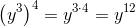
Apply the power of a power property:
← Didn't Know|Knew It →
Simplify the expression: 
Simplify the expression:
Tap to reveal answer
Apply the power of a product rule, then apply the power of a power rule:




Apply the power of a product rule, then apply the power of a power rule:
← Didn't Know|Knew It →
Which of the following expressions is equal to  ?
?
Which of the following expressions is equal to
Tap to reveal answer
Any nonzero number raised to the power of 0 is equal to 1.
Any nonzero number raised to the power of 0 is equal to 1.
← Didn't Know|Knew It →
 is positive.
Which is the greater quantity?
(a) 
(b) 
Which is the greater quantity?
(a)
(b)
Tap to reveal answer
Use the power of a power property:
(a) 
(b) 
Since  ,
,  . Subsequently,
 ,
,
making (a) greater
Use the power of a power property:
(a)
(b)
Since
making (a) greater
← Didn't Know|Knew It →
Two quantities are given - one in Column A and the other in Column B. Compare the quantities in the two columns.
Assume, in both columns, that  .
.
Column A Column B


Two quantities are given - one in Column A and the other in Column B. Compare the quantities in the two columns.
Assume, in both columns, that
Column A Column B
Tap to reveal answer
Column A gives simplifies to give us  , and Column B simplifies to give us
  . At first glance, Column B is greater, as it would be for all answers greater than 1. However, if
  , the two columns are equal. Furthermore, if
  is negative, or a fraction, Column A is greater. Thus, since we could arrive at all three answers by using different numbers, we cannot determine the answer conclusively.
Column A gives simplifies to give us
← Didn't Know|Knew It →
Column A Column B


Column A Column B
Tap to reveal answer
Anything raised to zero is equal to 1. Therefore, Column A has to be greater because 1 is greater than 0.
Anything raised to zero is equal to 1. Therefore, Column A has to be greater because 1 is greater than 0.
← Didn't Know|Knew It →
Which of the following expressions is equivalent to
 ?
?
Which of the following expressions is equivalent to
Tap to reveal answer
Use the difference of squares pattern as follows:



Use the difference of squares pattern as follows:
← Didn't Know|Knew It →
Raise  to the fourth power and give the result in scientific notation.
Raise
Tap to reveal answer
Use the properties of exponents to raise the number to the fourth power:


This is not in scientific notation, so adjust:


Use the properties of exponents to raise the number to the fourth power:
This is not in scientific notation, so adjust:
← Didn't Know|Knew It →
Which expression is equal to 65,000?
Which expression is equal to 65,000?
Tap to reveal answer
 is equal to
Move the decimal one place to the right for each number of the exponent with a base ten.
For example,  ,
,  , etc.
Move the decimal one place to the right for each number of the exponent with a base ten.
For example,
← Didn't Know|Knew It →
44,000,000 can be written in scientific notation as  for some
  .
.
Which is the greater quantity?
(A) 
(B) 8
44,000,000 can be written in scientific notation as
Which is the greater quantity?
(A)
(B) 8
Tap to reveal answer
To write 44,000,000 in scientifc notation, write the implied decimal point after the final "0", then move it left until it is after the first nonzero digit (the first "4").

This requires a displacement of seven places, so

 , and (B) is greater.
To write 44,000,000 in scientifc notation, write the implied decimal point after the final "0", then move it left until it is after the first nonzero digit (the first "4").
This requires a displacement of seven places, so
← Didn't Know|Knew It →
Give the result:

Give the result:
Tap to reveal answer
For any two numbers  ,
,

We can solve this problem most easily by taking advantage of this pattern, setting
 :
:


For any two numbers
We can solve this problem most easily by taking advantage of this pattern, setting
← Didn't Know|Knew It →
Give the result:

Give the result:
Tap to reveal answer
For any two numbers  ,
,

We can solve this problem most easily by taking advantage of this pattern, setting
 :
:


For any two numbers
We can solve this problem most easily by taking advantage of this pattern, setting
← Didn't Know|Knew It →
Give the cube of  in scientific notation.
Give the cube of
Tap to reveal answer


This is not in scientific notation, so adjust:


This is not in scientific notation, so adjust:
← Didn't Know|Knew It →


Evaluate  .
.
Evaluate
Tap to reveal answer
By the Power of a Product Principle,

Also, by the Power of a Power Principle,

Combining these ideas,

By the Power of a Product Principle,
Also, by the Power of a Power Principle,
Combining these ideas,
← Didn't Know|Knew It →

Tap to reveal answer
Subtract the numbers inside the parentheses first. This leaves you with 3, which you then raise to the 3rd power:

Subtract the numbers inside the parentheses first. This leaves you with 3, which you then raise to the 3rd power:
← Didn't Know|Knew It →
Evaluate:

Evaluate:
Tap to reveal answer
Any nonzero number taken to the power of 0 is equal to 1, so

Any nonzero number taken to the power of 0 is equal to 1, so
← Didn't Know|Knew It →
Multiply:

Multiply:
Tap to reveal answer
Use the FOIL method:


Use the FOIL method:
← Didn't Know|Knew It →
Simplify:

Simplify:
Tap to reveal answer
Based on the power rule, we know that in order to raise a power to a power we need to multiply the exponents, i.e.
 .
.

Based on the power rule, we know that in order to raise a power to a power we need to multiply the exponents, i.e.
← Didn't Know|Knew It →