
How to find the missing part of a list - ISEE Upper Level Quantitative Reasoning
Card 1 of 208
Examine the sequence:

What number goes into the circle?
Examine the sequence:
What number goes into the circle?
Tap to reveal answer
Each element is obtained by adding a number to the previous one; the number added increases by 1 each time:


 - this number replaces the square
 - this number replaces the circle
Each element is obtained by adding a number to the previous one; the number added increases by 1 each time:
← Didn't Know|Knew It →
Ten students are running for student council; each member of the student body will choose four.
Two of the candidates are Kevin's brothers, Mickey and Steve. Kevin wants to vote for one, but not both, of his brothers. How many ways can Kevin fill out his ballot so that he can vote for exactly one of his brothers?
Ten students are running for student council; each member of the student body will choose four.
Two of the candidates are Kevin's brothers, Mickey and Steve. Kevin wants to vote for one, but not both, of his brothers. How many ways can Kevin fill out his ballot so that he can vote for exactly one of his brothers?
Tap to reveal answer
Kevin will choose three students from the eight who are not his brothers, and will do so without respect to order. This is the number of combinations of three from eight:

Kevin will also choose one of his two brothers. By the multiplication principle, Kevin has  ways to fill out the ballot.
Kevin will choose three students from the eight who are not his brothers, and will do so without respect to order. This is the number of combinations of three from eight:
Kevin will also choose one of his two brothers. By the multiplication principle, Kevin has
← Didn't Know|Knew It →
Nine students are running for student council; each member of the student body will choose four.
The candidates include two of Eileen's sisters, Maureen and Colleen. Eileen wants to vote for one or both of them. How many ways can Eileen fill out her ballot so that one or both of her sisters is among her choices?
Nine students are running for student council; each member of the student body will choose four.
The candidates include two of Eileen's sisters, Maureen and Colleen. Eileen wants to vote for one or both of them. How many ways can Eileen fill out her ballot so that one or both of her sisters is among her choices?
Tap to reveal answer
If Eileen wants to choose both sisters, then she will choose two out of the other seven candidates. This is the number of combinations of two out of seven:

If Eileen wants to choose one sister, then she will choose three out of the other eight candidates. This is the number of combinations of three out of eight:

Since there are also two ways Eileen can choose one sister, by the multiplication principle, she can fill out the ballot  ways that include one sister.
Add these two:

If Eileen wants to choose both sisters, then she will choose two out of the other seven candidates. This is the number of combinations of two out of seven:
If Eileen wants to choose one sister, then she will choose three out of the other eight candidates. This is the number of combinations of three out of eight:
Since there are also two ways Eileen can choose one sister, by the multiplication principle, she can fill out the ballot
Add these two:
← Didn't Know|Knew It →
Define 
What is the natural domain of  ?
?
Define
What is the natural domain of
Tap to reveal answer
The only possible restriction of the domain here is the denominator  , which cannot be equal to 0. We can find any such values of
  as follows:


This has no real solution, so the domain is the set of all real numbers,  .
.
The only possible restriction of the domain here is the denominator
This has no real solution, so the domain is the set of all real numbers,
← Didn't Know|Knew It →
Define
What is the range of ?
Define
What is the range of
Tap to reveal answer
 , so
, so
 , or
, or

Since  , then

The range is therefore

Since
The range is therefore
← Didn't Know|Knew It →
The Department of Motor Vehicles wants to make all of the state's license numbers conform to two rules:
Rule 1: The number must comprise two letters (A-Z) followed by four numerals (0-9).
Rule 2: Repeats are allowed, but neither of the letters can be an "O" or an "I".
Which of the following expressions is equal to the number of possible license numbers that would conform to this rule?
The Department of Motor Vehicles wants to make all of the state's license numbers conform to two rules:
Rule 1: The number must comprise two letters (A-Z) followed by four numerals (0-9).
Rule 2: Repeats are allowed, but neither of the letters can be an "O" or an "I".
Which of the following expressions is equal to the number of possible license numbers that would conform to this rule?
Tap to reveal answer
Repeats are allowed, so the first character can be one of the 24 allowed letters (26 minus the "I" and the "O"), as can the second; each of the next four characters can each be one of the 10 numerals. By the multiplication principle, the number of possible license plate numbers is:

Repeats are allowed, so the first character can be one of the 24 allowed letters (26 minus the "I" and the "O"), as can the second; each of the next four characters can each be one of the 10 numerals. By the multiplication principle, the number of possible license plate numbers is:
← Didn't Know|Knew It →
The Department of Motor Vehicles wants to make all of the state's license numbers conform to two rules:
Rule 1: The number must comprise two letters (A-Z) followed by four numerals (0-9).
Rule 2: Numerals can be repeated but not letters.
Which of the following expressions is equal to the number of possible license numbers that would conform to this rule?
The Department of Motor Vehicles wants to make all of the state's license numbers conform to two rules:
Rule 1: The number must comprise two letters (A-Z) followed by four numerals (0-9).
Rule 2: Numerals can be repeated but not letters.
Which of the following expressions is equal to the number of possible license numbers that would conform to this rule?
Tap to reveal answer
The first letter can be any one of the 26 letters, but after this choice is made, since the letter cannot be repeated, there are 25 choices for the second letter. Each of the next four characters can each be one of the 10 numerals, with repetition allowed. By the multiplication principle, the number of possible license numbers is

The first letter can be any one of the 26 letters, but after this choice is made, since the letter cannot be repeated, there are 25 choices for the second letter. Each of the next four characters can each be one of the 10 numerals, with repetition allowed. By the multiplication principle, the number of possible license numbers is
← Didn't Know|Knew It →
Find the missing part of the list:

Find the missing part of the list:
Tap to reveal answer
The sequence pattern follows the rule:

Therefore,
 .
.
The sequence pattern follows the rule:
Therefore,
← Didn't Know|Knew It →
Jack noticed that a group of prime numbers followed a pattern in which they increased by 2, then 4, in an alternating pattern:

(11 plus 2 is 13, 13 plus 4 is 17, 17 plus 2 is 19, 19 plus 4 is 23.)
Jack believes that this pattern applies for all prime numbers, not just this group.
Which of the following is the best counter argument to his belief?
Jack noticed that a group of prime numbers followed a pattern in which they increased by 2, then 4, in an alternating pattern:
(11 plus 2 is 13, 13 plus 4 is 17, 17 plus 2 is 19, 19 plus 4 is 23.)
Jack believes that this pattern applies for all prime numbers, not just this group.
Which of the following is the best counter argument to his belief?
Tap to reveal answer
While Jack's pattern applies to the group of number that he selected, it will not apply for the next prime number, 29, because it is 6 greater than the previous prime number of 23. Therefore, the correct answer is:
The next prime number, 29, breaks the pattern because it is 6 greater than 23.
While Jack's pattern applies to the group of number that he selected, it will not apply for the next prime number, 29, because it is 6 greater than the previous prime number of 23. Therefore, the correct answer is:
The next prime number, 29, breaks the pattern because it is 6 greater than 23.
← Didn't Know|Knew It →
Find the value of x.

Find the value of x.
Tap to reveal answer
Find the value of x.

We have a geometric series here. In other words, each term is a consistent multiple of the number before it. To find our common multiple, we need to take one term and divide it by the term before it. Let's try using the 3rd and 4th terms.
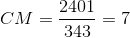
So, to move from one term to the next, we need to multiply by seven.
To find x, we need to multiply our first term (7), by 7.

So, our answer is 49.
We can check this by multiplying 49 by 7

Doing so yields 343, which is in fact the next term in our sequence.
Find the value of x.
We have a geometric series here. In other words, each term is a consistent multiple of the number before it. To find our common multiple, we need to take one term and divide it by the term before it. Let's try using the 3rd and 4th terms.
So, to move from one term to the next, we need to multiply by seven.
To find x, we need to multiply our first term (7), by 7.
So, our answer is 49.
We can check this by multiplying 49 by 7
Doing so yields 343, which is in fact the next term in our sequence.
← Didn't Know|Knew It →
Which of the following can be the next number after 47 in the sequence below?

Which of the following can be the next number after 47 in the sequence below?
Tap to reveal answer
Each number in the set is the value of the preceding number multiplied by 2, plus 1:

Therefore, the next number in the set will be 47 times 2, plus 1. This gives us:

Each number in the set is the value of the preceding number multiplied by 2, plus 1:
Therefore, the next number in the set will be 47 times 2, plus 1. This gives us:
← Didn't Know|Knew It →
A pair of fair dice are tossed. What is the probability that the product of the numbers of the faces is greater than or equal to  ?
?
A pair of fair dice are tossed. What is the probability that the product of the numbers of the faces is greater than or equal to ?
Tap to reveal answer
Out of a possible thirty-six rolls, the following result in a product of twenty or greater:

This is eight out of thirty-six, making the probability
 .
.
Out of a possible thirty-six rolls, the following result in a product of twenty or greater:
This is eight out of thirty-six, making the probability
← Didn't Know|Knew It →
Given a set  , which of the following sets could we assign to
  such that
  ?
?
Given a set
Tap to reveal answer
 is the union of the sets, i.e. the set of all elements in
  ,
,  , or both.
For  ,
,  must include all elements in
  that are not in
  , or
, or  . This allows us to eliminate
  , which excludes 5, and
  , which excludes 2.
Also,  cannot include any element not in
  . This allows us to eliminate
  , which includes 12.
This leaves  .
.
If  , then

 .
.
This is the correct choice.
For
Also,
This leaves
If
This is the correct choice.
← Didn't Know|Knew It →
Define set  . Which of the following sets could we define to be set
  so that
  ?
?
Define set
Tap to reveal answer
For  to be a true statement, sets
  and
and  cannot have any elements in common. We can eliminate four of these choices of
  by noting that in each, there is one element (underlined) also in
  :
:


However,  shares no elements with
  , so their intersection is
  by definition. This is the correct choice.
For
However,
← Didn't Know|Knew It →
Examine the sequence:
What number goes into the circle?
Examine the sequence:
What number goes into the circle?
Tap to reveal answer
Each element is obtained by adding a number to the previous one; the number added increases by 1 each time:
- this number replaces the square
- this number replaces the circle
Each element is obtained by adding a number to the previous one; the number added increases by 1 each time:
← Didn't Know|Knew It →
Ten students are running for student council; each member of the student body will choose four.
Two of the candidates are Kevin's brothers, Mickey and Steve. Kevin wants to vote for one, but not both, of his brothers. How many ways can Kevin fill out his ballot so that he can vote for exactly one of his brothers?
Ten students are running for student council; each member of the student body will choose four.
Two of the candidates are Kevin's brothers, Mickey and Steve. Kevin wants to vote for one, but not both, of his brothers. How many ways can Kevin fill out his ballot so that he can vote for exactly one of his brothers?
Tap to reveal answer
Kevin will choose three students from the eight who are not his brothers, and will do so without respect to order. This is the number of combinations of three from eight:
Kevin will also choose one of his two brothers. By the multiplication principle, Kevin has ways to fill out the ballot.
Kevin will choose three students from the eight who are not his brothers, and will do so without respect to order. This is the number of combinations of three from eight:
Kevin will also choose one of his two brothers. By the multiplication principle, Kevin has
← Didn't Know|Knew It →
Nine students are running for student council; each member of the student body will choose four.
The candidates include two of Eileen's sisters, Maureen and Colleen. Eileen wants to vote for one or both of them. How many ways can Eileen fill out her ballot so that one or both of her sisters is among her choices?
Nine students are running for student council; each member of the student body will choose four.
The candidates include two of Eileen's sisters, Maureen and Colleen. Eileen wants to vote for one or both of them. How many ways can Eileen fill out her ballot so that one or both of her sisters is among her choices?
Tap to reveal answer
If Eileen wants to choose both sisters, then she will choose two out of the other seven candidates. This is the number of combinations of two out of seven:
If Eileen wants to choose one sister, then she will choose three out of the other eight candidates. This is the number of combinations of three out of eight:
Since there are also two ways Eileen can choose one sister, by the multiplication principle, she can fill out the ballot ways that include one sister.
Add these two:
If Eileen wants to choose both sisters, then she will choose two out of the other seven candidates. This is the number of combinations of two out of seven:
If Eileen wants to choose one sister, then she will choose three out of the other eight candidates. This is the number of combinations of three out of eight:
Since there are also two ways Eileen can choose one sister, by the multiplication principle, she can fill out the ballot
Add these two:
← Didn't Know|Knew It →
Define
What is the natural domain of ?
Define
What is the natural domain of
Tap to reveal answer
The only possible restriction of the domain here is the denominator , which cannot be equal to 0. We can find any such values of as follows:
This has no real solution, so the domain is the set of all real numbers, .
The only possible restriction of the domain here is the denominator
This has no real solution, so the domain is the set of all real numbers,
← Didn't Know|Knew It →
Define
What is the range of ?
Define
What is the range of
Tap to reveal answer
, so
, or
Since , then
The range is therefore
Since
The range is therefore
← Didn't Know|Knew It →
The Department of Motor Vehicles wants to make all of the state's license numbers conform to two rules:
Rule 1: The number must comprise two letters (A-Z) followed by four numerals (0-9).
Rule 2: Repeats are allowed, but neither of the letters can be an "O" or an "I".
Which of the following expressions is equal to the number of possible license numbers that would conform to this rule?
The Department of Motor Vehicles wants to make all of the state's license numbers conform to two rules:
Rule 1: The number must comprise two letters (A-Z) followed by four numerals (0-9).
Rule 2: Repeats are allowed, but neither of the letters can be an "O" or an "I".
Which of the following expressions is equal to the number of possible license numbers that would conform to this rule?
Tap to reveal answer
Repeats are allowed, so the first character can be one of the 24 allowed letters (26 minus the "I" and the "O"), as can the second; each of the next four characters can each be one of the 10 numerals. By the multiplication principle, the number of possible license plate numbers is:
Repeats are allowed, so the first character can be one of the 24 allowed letters (26 minus the "I" and the "O"), as can the second; each of the next four characters can each be one of the 10 numerals. By the multiplication principle, the number of possible license plate numbers is:
← Didn't Know|Knew It →