
How to find the exponent of variables - ISEE Upper Level Quantitative Reasoning
Card 1 of 136
Simplify:

Simplify:
Tap to reveal answer
Apply the power of a product property:


Apply the power of a product property:
← Didn't Know|Knew It →
What is the coefficient of  in the expansion of
  .
.
What is the coefficient of
Tap to reveal answer
By the Binomial Theorem, if  is expanded, the coefficient of
  is
is
 .
.
Substitute  : The coefficient of
  is:
is:


By the Binomial Theorem, if
Substitute
← Didn't Know|Knew It →
What is the coefficient of  in the expansion of
  ?
?
What is the coefficient of
Tap to reveal answer
By the Binomial Theorem, the  term of
  is
is
 .
.
Substitute  and this becomes
 .
.
The coefficient is
 .
.
By the Binomial Theorem, the
Substitute
The coefficient is
← Didn't Know|Knew It →
What is the coefficient of  in the expansion of
  ?
?
What is the coefficient of
Tap to reveal answer
By the Binomial Theorem, the term of  is
is
 ,
,
making the coefficient of
 .
.
We can set  in this expression:


By the Binomial Theorem, the
making the coefficient of
We can set
← Didn't Know|Knew It →
Simplify the expression: 
Simplify the expression:
Tap to reveal answer
Apply the power of a power property twice:

Apply the power of a power property twice:
← Didn't Know|Knew It →
Evaluate:

Evaluate:
Tap to reveal answer
We need to apply the power of power rule twice:

We need to apply the power of power rule twice:
← Didn't Know|Knew It →

Solve for  .
.
Solve for
Tap to reveal answer
Based on the power of a product rule we have:

The bases are the same, so we can write:

Based on the power of a product rule we have:
The bases are the same, so we can write:
← Didn't Know|Knew It →
Simplify:

Simplify:
Tap to reveal answer
First, recognize that raising the fraction to a negative power is the same as raising the inverted fraction to a positive power.

Apply the exponent within the parentheses and simplify.


This fraction cannot be simplified further.
First, recognize that raising the fraction to a negative power is the same as raising the inverted fraction to a positive power.
Apply the exponent within the parentheses and simplify.
This fraction cannot be simplified further.
← Didn't Know|Knew It →
Simplify:

Simplify:
Tap to reveal answer
First, recognize that raising the fraction to a negative power is the same as raising the inverted fraction to a positive power.

Apply the exponent within the parentheses and simplify.


First, recognize that raising the fraction to a negative power is the same as raising the inverted fraction to a positive power.
Apply the exponent within the parentheses and simplify.
← Didn't Know|Knew It →
Simplify if  and
and  .
.

Simplify if
Tap to reveal answer
Begin by factoring the numerator and denominator.  can be factored out of each term.

 can be canceled, since it appears in both the numerator and denomintor.

Next, factor the numerator.

Simplify.

Begin by factoring the numerator and denominator.
Next, factor the numerator.
Simplify.
← Didn't Know|Knew It →

Evaluate  .
.
Evaluate
Tap to reveal answer


← Didn't Know|Knew It →

Evaluate  .
.
Evaluate
Tap to reveal answer
To solve for the variable isolate it on one side of the equation with all of constants on the other side.

First add one third to both sides.


Calculate a common denominator to add the two fractions.


Square both sides to solve for y.

To solve for the variable isolate it on one side of the equation with all of constants on the other side.
First add one third to both sides.
Calculate a common denominator to add the two fractions.
Square both sides to solve for y.
← Didn't Know|Knew It →


Evaluate  .
.
Evaluate
Tap to reveal answer
By the Power of a Product Principle,

Also, by the Power of a Power Principle,

Combining these ideas, then substituting:


By the Power of a Product Principle,
Also, by the Power of a Power Principle,
Combining these ideas, then substituting:
← Didn't Know|Knew It →

Evaluate  .
.
Evaluate
Tap to reveal answer
By the Power of a Power Principle,

So

Also, by the Power of a Product Principle,

 , so, substituting,
 .
.
By the Power of a Power Principle,
So
Also, by the Power of a Product Principle,
← Didn't Know|Knew It →
Simplify the following:

Simplify the following:
Tap to reveal answer
Simplify the following:

Let's recall the rules for distributing exponents.
We treat coefficients (like the 7) like regular numbers and raise them to the new exponent.
We deal with variables (like the t, h, and b) by multiplying their current exponent by the new exponent.
Doing so yields:

Simplify to get:

Simplify the following:
Let's recall the rules for distributing exponents.
We treat coefficients (like the 7) like regular numbers and raise them to the new exponent.
We deal with variables (like the t, h, and b) by multiplying their current exponent by the new exponent.
Doing so yields:
Simplify to get:
← Didn't Know|Knew It →
Simplify:

Simplify:
Tap to reveal answer

← Didn't Know|Knew It →

Which is greater?
(a) 
(b) 
Which is greater?
(a)
(b)
Tap to reveal answer
If  , then
  and
and 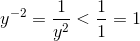
 , so by transitivity,
  , and (b) is greater
If
← Didn't Know|Knew It →
Which is greater?
(a) 
(b) 
Which is greater?
(a)
(b)
Tap to reveal answer
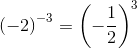
A negative number to an odd power is negative, so the expression in (a) is negative. The expression in (b) is positive since the base is positive. (b) is greater.
A negative number to an odd power is negative, so the expression in (a) is negative. The expression in (b) is positive since the base is positive. (b) is greater.
← Didn't Know|Knew It →
Expand: 
Which is the greater quantity?
(a) The coefficient of 
(b) The coefficient of 
Expand:
Which is the greater quantity?
(a) The coefficient of
(b) The coefficient of
Tap to reveal answer
By the Binomial Theorem, if  is expanded, the coefficient of
  is
is
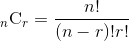 .
.
(a) Substitute  : The coerfficient of
  is
is
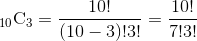 .
.
(b) Substitute  : The coerfficient of
  is
is
 .
.
The two are equal.
By the Binomial Theorem, if
(a) Substitute
(b) Substitute
The two are equal.
← Didn't Know|Knew It →
Expand: 
Which is the greater quantity?
(a) The coefficient of 
(b) The coefficient of 
Expand:
Which is the greater quantity?
(a) The coefficient of
(b) The coefficient of
Tap to reveal answer
Using the Binomial Theorem, if  is expanded, the
  term is

 .
.
This makes  the coefficient of
  .
.
We compare the values of this expression at  for both
  and
and  .
.
(a) If  and
and  , the coefficient is
 .
.
This is the coefficient of  .
.
(b) If  and
and  , the coefficient is
 .
.
This is the coefficient of  .
.
(b) is the greater quantity.
Using the Binomial Theorem, if
This makes
We compare the values of this expression at
(a) If
This is the coefficient of
(b) If
This is the coefficient of
(b) is the greater quantity.
← Didn't Know|Knew It →