
How to find the area of a square - ISEE Upper Level Quantitative Reasoning
Card 1 of 128
The perimeter of a square is one yard. Which is the greater quantity?
(a) The area of the square
(b)  square foot
The perimeter of a square is one yard. Which is the greater quantity?
(a) The area of the square
(b)
Tap to reveal answer
One yard is equal to three feet, so the length of one side of a square with this perimeter is  feet. The area of the square is
  square feet.
  , making (a) greater.
One yard is equal to three feet, so the length of one side of a square with this perimeter is
← Didn't Know|Knew It →
Square 1 is inscribed inside a circle. The circle is inscribed inside Square 2.
Which is the greater quantity?
(a) Twice the area of Square 1
(b) The area of Square 2
Square 1 is inscribed inside a circle. The circle is inscribed inside Square 2.
Which is the greater quantity?
(a) Twice the area of Square 1
(b) The area of Square 2
Tap to reveal answer
Let  be the sidelength of Square 1. Then the length of a diagonal of this square - which is
  times this sidelength, or
  , by the
  Theorem - is the same as the diameter of this circle, which, in turn, is equal to the sidelength of Square 2.
Therefore, Square 1 has area  , and Square 2 has area
 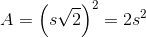 , twice that of Square 1.
Let
Therefore, Square 1 has area
← Didn't Know|Knew It →
Which is the greater quantity?
(A) The area of a square with sidelength one foot
(B) The area of a rectangle with length nine inches and height fourteen inches
Which is the greater quantity?
(A) The area of a square with sidelength one foot
(B) The area of a rectangle with length nine inches and height fourteen inches
Tap to reveal answer
The area of a square is the square of its sidelength, which here is 12 inches:
 square inches.
The area of a rectangle is its length multiplied by its height, which, respectively, are 9 inches and 14 inches:
 square inches.
The square has the greater area.
The area of a square is the square of its sidelength, which here is 12 inches:
The area of a rectangle is its length multiplied by its height, which, respectively, are 9 inches and 14 inches:
The square has the greater area.
← Didn't Know|Knew It →
A square lawn has sidelength twenty yards. Give its area in square feet.
A square lawn has sidelength twenty yards. Give its area in square feet.
Tap to reveal answer
20 yards converts to  feet. The area of a square is the square of its sidelength, so the area in square feet is
  square feet.
20 yards converts to
← Didn't Know|Knew It →
Four squares have sidelengths one meter, 120 centimeters, 140 centimeters, and 140 centimeters. Which is the greater quantity?
(A) The mean of their areas
(B) The median of their areas
Four squares have sidelengths one meter, 120 centimeters, 140 centimeters, and 140 centimeters. Which is the greater quantity?
(A) The mean of their areas
(B) The median of their areas
Tap to reveal answer
The areas of the squares are:
 square centimeters (one meter being 100 centimeters)
 square centimeters
 square centimeters
 square centimeters
The mean of these four areas is their sum divided by four:

 square centimeters.
The median is the mean of the two middle values, or
 square centimeters.
The median, (B), is greater.
The areas of the squares are:
The mean of these four areas is their sum divided by four:
The median is the mean of the two middle values, or
The median, (B), is greater.
← Didn't Know|Knew It →
Rectangle A and Square B both have perimeter 2 meters. Rectangle A has width 25 centimeters. The area of Rectangle A is what percent of the area of Square B?
Rectangle A and Square B both have perimeter 2 meters. Rectangle A has width 25 centimeters. The area of Rectangle A is what percent of the area of Square B?
Tap to reveal answer
The perimeter of a rectangle can be given by the formula

Rectangle A has perimeter 2 meters, which is equal to 200 centimeters, and width 25 centimeters, so the length is:





The dimensions of Rectangle A are 75 centimeters and 25 centimeters, so its area is
 square centimeters.
The sidelength of a square is one-fourth its perimeter, which here is
 centimeters; its area is therefore
 square centimeters.
The area of Rectangle A is therefore
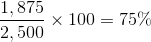
that of Square B.
The perimeter of a rectangle can be given by the formula
Rectangle A has perimeter 2 meters, which is equal to 200 centimeters, and width 25 centimeters, so the length is:
The dimensions of Rectangle A are 75 centimeters and 25 centimeters, so its area is
The sidelength of a square is one-fourth its perimeter, which here is
The area of Rectangle A is therefore
that of Square B.
← Didn't Know|Knew It →
The sidelength of Square A is three-sevenths that of Square B. What is the ratio of the area of Square B to that of Square A?
The sidelength of Square A is three-sevenths that of Square B. What is the ratio of the area of Square B to that of Square A?
Tap to reveal answer
Since the ratio is the same regardless of the sidelengths, then for simplicity's sake, assume the sidelength of Square B is 7. The area of Square B is therefore the square of this, or 49.
Then the sidelength of Square A is three-sevenths of 7, or 3. Its area is the square of 3, or 9.
The ratio of the area of Square B to that of Square A is therefore 49 to 9.
Since the ratio is the same regardless of the sidelengths, then for simplicity's sake, assume the sidelength of Square B is 7. The area of Square B is therefore the square of this, or 49.
Then the sidelength of Square A is three-sevenths of 7, or 3. Its area is the square of 3, or 9.
The ratio of the area of Square B to that of Square A is therefore 49 to 9.
← Didn't Know|Knew It →
The lengths of the sides of ten squares form an arithmetic sequence. One side of the smallest square measures sixty centimeters; one side of the second-smallest square measures one meter.
Give the area of the largest square, rounded to the nearest square meter.
The lengths of the sides of ten squares form an arithmetic sequence. One side of the smallest square measures sixty centimeters; one side of the second-smallest square measures one meter.
Give the area of the largest square, rounded to the nearest square meter.
Tap to reveal answer
Let  be the lengths of the sides of the squares in meters.
  and
and  , so their common difference is

The arithmetic sequence formula is

The length of a side of the largest square - square 10 - can be found by substituting  :
:

The largest square has sides of length 4.2 meters, so its area is the square of this, or  square meters.
Of the choices, 18 square meters is closest.
Let
The arithmetic sequence formula is
The length of a side of the largest square - square 10 - can be found by substituting
The largest square has sides of length 4.2 meters, so its area is the square of this, or
Of the choices, 18 square meters is closest.
← Didn't Know|Knew It →
The areas of six squares form an arithmetic sequence. The smallest square has perimeter 16; the second smallest square has perimeter 20. Give the area of the largest of the six squares.
The areas of six squares form an arithmetic sequence. The smallest square has perimeter 16; the second smallest square has perimeter 20. Give the area of the largest of the six squares.
Tap to reveal answer
The two smallest squares have perimeters 16 and 20, so their sidelengths are one fourth of these, or, respectively, 4 and 5. Their areas are the squares of these, or, respectively, 16 and 25. Therefore, in the arithmetic sequence,


and the common difference is  .
.
The area of the  th smallest square is

Setting  , the area of the largest (or sixth-smallest) square is

The two smallest squares have perimeters 16 and 20, so their sidelengths are one fourth of these, or, respectively, 4 and 5. Their areas are the squares of these, or, respectively, 16 and 25. Therefore, in the arithmetic sequence,
and the common difference is
The area of the
Setting
← Didn't Know|Knew It →
The perimeter of a square is  . Give the area of the square in terms of
  .
.
The perimeter of a square is
Tap to reveal answer
The length of one side of a square is one fourth its perimeter. Since the perimeter of the square is  , the length of one side is

The area of the square is the square of this sidelength, or

The length of one side of a square is one fourth its perimeter. Since the perimeter of the square is
The area of the square is the square of this sidelength, or
← Didn't Know|Knew It →
The sidelength of a square is  . Give its area in terms of
  .
.
The sidelength of a square is
Tap to reveal answer
The area of a square is the square of its sidelength. Therefore, square  :
:

The area of a square is the square of its sidelength. Therefore, square
← Didn't Know|Knew It →
A diagonal of a square has length  . Give its area.
A diagonal of a square has length
Tap to reveal answer
A square being a rhombus, its area can be determined by taking half the product of the lengths of its (congruent) diagonals:

A square being a rhombus, its area can be determined by taking half the product of the lengths of its (congruent) diagonals:
← Didn't Know|Knew It →
Which is the greater quantity?
(a) The area of a square with sides of length  meters
(b) The area of a square with perimeter  centimeters
Which is the greater quantity?
(a) The area of a square with sides of length
(b) The area of a square with perimeter
Tap to reveal answer
A square with perimeter  centimeters has sides of length one-fourth of this, or
  centimeters. Since one meter is equal to 100 centimeters, divide by 100 to get the equivalent in meters - this is

meters.
The square in (b) has sidelength less than that of the square in (a), so its area is also less than that in (a).
A square with perimeter
meters.
The square in (b) has sidelength less than that of the square in (a), so its area is also less than that in (a).
← Didn't Know|Knew It →
On the coordinate plane, Square A has as one side a segment with its endpoints at the origin and at the point with coordinates  . Square B has as one side a segment with its endpoints at the origin and at the point with coordinates
  .
.  and
and  are both positive numbers and
  . Which is the greater quantity?
(a) The area of Square A
(b) The area of Square B
On the coordinate plane, Square A has as one side a segment with its endpoints at the origin and at the point with coordinates
(a) The area of Square A
(b) The area of Square B
Tap to reveal answer
The length of a segment with endpoints  and
and  can be found using the distance formula with
  ,
,  ,
,  :
:



The length of a segment with endpoints and  can be found using the distance formula with ,
  ,
,  :
:


The sides are of equal length, so the squares have equal area. Note that the fact that  is irrelevant to the question.
The length of a segment with endpoints
The length of a segment with endpoints
The sides are of equal length, so the squares have equal area. Note that the fact that
← Didn't Know|Knew It →
On the coordinate plane, Square A has as one side a segment with its endpoints at the origin and at the point with coordinates  . Square B has as one side a segment with its endpoints at the origin and at the point with coordinates
  .
.  and
and  are both positive numbers. Which is the greater quantity?
(a) The area of Square A
(b) The area of Square B
On the coordinate plane, Square A has as one side a segment with its endpoints at the origin and at the point with coordinates
(a) The area of Square A
(b) The area of Square B
Tap to reveal answer
It can be proved that the given information is insufficient to answer the question by looking at two cases.
Case 1: 
Square A has as a side a segment with endpoints at and  , the length of which can be found using the distance formula with ,
  ,
,  :
:


This is the length of one side of Square A; the area of the square is the square of this, or 52.
Square B has as a side a segment with endpoints at and  , the length of which can be found the same way:


This is the length of one side of Square B; the area of the square is the square of this, or 50. This makes Square A the greater in area.
Case 2: 
Square A has as a side a segment with endpoints at and  ; this was found earlier to be a square of area 50.
Square B has as a side a segment with endpoints at and  , the length of which can be found using the distance formula with ,
  ,
,  :
:


This is the length of one side of Square B; the area of the square is the square of this, or 52. This makes Square B the greater in area.
It can be proved that the given information is insufficient to answer the question by looking at two cases.
Case 1:
Square A has as a side a segment with endpoints at
This is the length of one side of Square A; the area of the square is the square of this, or 52.
Square B has as a side a segment with endpoints at
This is the length of one side of Square B; the area of the square is the square of this, or 50. This makes Square A the greater in area.
Case 2:
Square A has as a side a segment with endpoints at
Square B has as a side a segment with endpoints at
This is the length of one side of Square B; the area of the square is the square of this, or 52. This makes Square B the greater in area.
← Didn't Know|Knew It →
On the coordinate plane, Square A has as one side a segment with its endpoints at the origin and at the point with coordinates  . Square B has as one side a segment with its endpoints at the origin and at the point with coordinates
  . and are both positive numbers and
  . Which is the greater quantity?
(a) The area of Square A
(b) The area of Square B
On the coordinate plane, Square A has as one side a segment with its endpoints at the origin and at the point with coordinates
(a) The area of Square A
(b) The area of Square B
Tap to reveal answer
The length of a segment with endpoints and  can be found using the distance formula with , ,
  :
:


This is the length of one side of Square A; the area of the square is the square of this, or  .
.
By similar reasoning, the length of a segment with endpoints and  is
is

and the area of Square B is
 .
.
Since  , and both are positive, it follows that


Square B has the greater area.
The length of a segment with endpoints
This is the length of one side of Square A; the area of the square is the square of this, or
By similar reasoning, the length of a segment with endpoints
and the area of Square B is
Since
Square B has the greater area.
← Didn't Know|Knew It →
Five squares have sidelengths one foot, two feet, three feet, four feet, and five feet.
Which is the greater quantity?
(A) The mean of their areas
(B) The median of their areas
Five squares have sidelengths one foot, two feet, three feet, four feet, and five feet.
Which is the greater quantity?
(A) The mean of their areas
(B) The median of their areas
Tap to reveal answer
The areas of the squares are:
 square foot
 square feet
 square feet
 square feet
 square feet
Therefore, we are comparing the mean and the median of the set  .
.
The mean of this set is the sum divided by 5:

The median is the middle element after arrangement in ascending order, which is 9.
This makes (A), the mean, greater.
The areas of the squares are:
Therefore, we are comparing the mean and the median of the set
The mean of this set is the sum divided by 5:
The median is the middle element after arrangement in ascending order, which is 9.
This makes (A), the mean, greater.
← Didn't Know|Knew It →
A square is made into a rectangle by increasing the width by 20% and decreasing the length by 20%. By what percentage has the area of the square changed?
A square is made into a rectangle by increasing the width by 20% and decreasing the length by 20%. By what percentage has the area of the square changed?
Tap to reveal answer
The area decreases by 20% of 20%, which is 4%.
The easiest way to see this is to plug in numbers for the sides of the square. If we are using percentages, it is easiest to use factors of 10 or 100. In this case we will say that the square has a side length of 10.
10% of 10 is 1, so 20% is 2. Now we can just increase one of the sides by 2, and decrease another side by 2. So our rectangle has dimensions of 12 x 8 instead of 10 x 10.
The original square had an area of 100, and the new rectangle has an area of 96. So the rectangle is 4 square units smaller, which is 4% smaller than the original square.
The area decreases by 20% of 20%, which is 4%.
The easiest way to see this is to plug in numbers for the sides of the square. If we are using percentages, it is easiest to use factors of 10 or 100. In this case we will say that the square has a side length of 10.
10% of 10 is 1, so 20% is 2. Now we can just increase one of the sides by 2, and decrease another side by 2. So our rectangle has dimensions of 12 x 8 instead of 10 x 10.
The original square had an area of 100, and the new rectangle has an area of 96. So the rectangle is 4 square units smaller, which is 4% smaller than the original square.
← Didn't Know|Knew It →
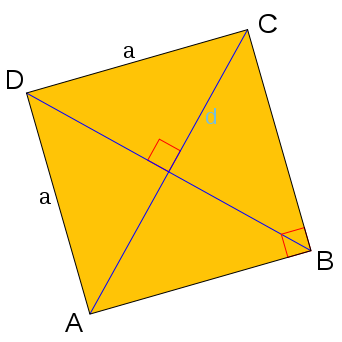
Side  shown in the diagram of square
  below is equal to 21cm. What is the area of
  ?
?
Side
Tap to reveal answer
To find the area of a quadrilateral, multiply length times width. In a square, since all sides are equal,  is both the length and width.

To find the area of a quadrilateral, multiply length times width. In a square, since all sides are equal,
← Didn't Know|Knew It →
If Amy is carpeting her living room, which meaures  feet by
  feet, how many square feet of carpet will she need?
If Amy is carpeting her living room, which meaures
Tap to reveal answer
To find the area of the floor, multiply the length of the room by the width (which is the same forumla used to find the area of a square). The equation can be written: 
Substitute  feet for
  and
and  feet for
  :
:

Amy will need  of carpet.
To find the area of the floor, multiply the length of the room by the width (which is the same forumla used to find the area of a square). The equation can be written:
Substitute
Amy will need
← Didn't Know|Knew It →