
How to factor a number - ISEE Upper Level Quantitative Reasoning
Card 1 of 240
Adam fills up  of his glass in
  of a minute. What is the total time, in seconds, that it takes him to fill up his entire glass?
Adam fills up
Tap to reveal answer
There are more than one ways to go about solving this problem.
The easiest was probably involves converting the  minute to 30 seconds as soon as possible.
Now we can see that Adam has filled  of his cup in 30 seconds. We can also see that he needs to fill
  of his cup to fill his cup entirely. Since 3 of those quarters fill up in 30 seconds, then 1 of those quarters can be filled in 10 seconds Thus Adam needs an additional 10 seconds to finish filling his glass, or a total of 40 seconds.
There are more than one ways to go about solving this problem.
The easiest was probably involves converting the
Now we can see that Adam has filled
← Didn't Know|Knew It →
Give the prime factorization of 135.
Give the prime factorization of 135.
Tap to reveal answer

3 and 5 are both primes, so this is as far as we can go. Rearranging, the prime factorization is
 .
.
3 and 5 are both primes, so this is as far as we can go. Rearranging, the prime factorization is
← Didn't Know|Knew It →
What is the sum of all of the factors of 60?
What is the sum of all of the factors of 60?
Tap to reveal answer
60 has twelve factors: 1, 2, 3, 4, 5, 6, 10, 12, 15, 20, 30, and 60.
Their sum is  .
.
60 has twelve factors: 1, 2, 3, 4, 5, 6, 10, 12, 15, 20, 30, and 60.
Their sum is
← Didn't Know|Knew It →
What is the product of all of the factors of 25?
What is the product of all of the factors of 25?
Tap to reveal answer
25 has three factors: 1, 5, and 25. Their product is

25 has three factors: 1, 5, and 25. Their product is
← Didn't Know|Knew It →
Which of these numbers has exactly three factors?
Which of these numbers has exactly three factors?
Tap to reveal answer
None of the choices are prime, so each has at least three factors. The question, then, is which one has only three factors?
We can eliminate four choices by showing that each has at least four factors - that is, at least two different factors other than 1 and itself:


Each, therefore, has at least four factors.
However, the only way to factor 121 other than  is
is  . Therefore, 121 has only 1, 11, and 121 as factors, and it is the correct choice.
None of the choices are prime, so each has at least three factors. The question, then, is which one has only three factors?
We can eliminate four choices by showing that each has at least four factors - that is, at least two different factors other than 1 and itself:
Each, therefore, has at least four factors.
However, the only way to factor 121 other than
← Didn't Know|Knew It →
Which of the following digits can go into the box to form a three-digit number divisible by 3?

Which of the following digits can go into the box to form a three-digit number divisible by 3?
Tap to reveal answer
Place each of these digits into the box in turn. Divide each of the numbers formed and see which quotient yields a zero remainder:





Only 627 is divisible by 3 so the correct choice is 2.
Place each of these digits into the box in turn. Divide each of the numbers formed and see which quotient yields a zero remainder:
Only 627 is divisible by 3 so the correct choice is 2.
← Didn't Know|Knew It →
Which of the following digits can go into the box to form a three-digit number divisible by 4?

Which of the following digits can go into the box to form a three-digit number divisible by 4?
Tap to reveal answer
For a number to be divisible by 4, the last two digits must form an integer divisible by 4. 2 (02), 22, 62, and 82 all yield remainders of 2 when divided by 4, so none of these alternatives make the number a multiple of 4.
For a number to be divisible by 4, the last two digits must form an integer divisible by 4. 2 (02), 22, 62, and 82 all yield remainders of 2 when divided by 4, so none of these alternatives make the number a multiple of 4.
← Didn't Know|Knew It →
Which of the following is divisible by  ?
?
Which of the following is divisible by
Tap to reveal answer
Numbers that are divisble by 6 are also divisble by 2 and 3. Only even numbers are divisible by 2, therefore, 72165 is excluded. The sum of the digits of numbers divisible by 3 are also divisible by 3. For example,

Because 18 is divisible by 3, 63,072 is divisible by 3.
Numbers that are divisble by 6 are also divisble by 2 and 3. Only even numbers are divisible by 2, therefore, 72165 is excluded. The sum of the digits of numbers divisible by 3 are also divisible by 3. For example,
Because 18 is divisible by 3, 63,072 is divisible by 3.
← Didn't Know|Knew It →
Add the factors of  .
.
Add the factors of
Tap to reveal answer
The factors of  are:
are: 
Their sum is  .
.
The factors of
Their sum is
← Didn't Know|Knew It →
Add the factors of 19.
Add the factors of 19.
Tap to reveal answer
19 is a prime number and has 1 and 19 as its only factors. Their sum is 20.
19 is a prime number and has 1 and 19 as its only factors. Their sum is 20.
← Didn't Know|Knew It →
Factor the number  to all of its prime factors.
Factor the number
Tap to reveal answer
Use a tree to find all of the factors of  .
.
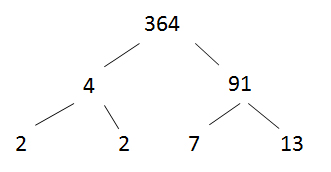
The prime factors of  are
are  .
.
Use a tree to find all of the factors of
The prime factors of
← Didn't Know|Knew It →
Find the prime factorization for 72.
Find the prime factorization for 72.
Tap to reveal answer
To find the prime factorization, start by breaking 72 down. I picked  , which can be broken down further to
  . The 4 can be broken down further, so go one more step to
  . The answers are given in exponents so give your answer in that format:
To find the prime factorization, start by breaking 72 down. I picked
← Didn't Know|Knew It →
What are all of the prime factors of 34?
What are all of the prime factors of 34?
Tap to reveal answer
What are all of the prime factors of 34?
We need to find which prime numbers can be multiplied to get to 34.
We can find these numbers by dividing prime numbers out one at a time.
Recall that a prime factor is a number which is only divisible by one and itself.
When performing prime factorization on an even number, always begin by pulling out 2.

Now, we are essentially done, because 17 is also a prime number. So, the prime factors of 34 are 2 and 17.
What are all of the prime factors of 34?
We need to find which prime numbers can be multiplied to get to 34.
We can find these numbers by dividing prime numbers out one at a time.
Recall that a prime factor is a number which is only divisible by one and itself.
When performing prime factorization on an even number, always begin by pulling out 2.
Now, we are essentially done, because 17 is also a prime number. So, the prime factors of 34 are 2 and 17.
← Didn't Know|Knew It →
What is the prime factorization of 78?
What is the prime factorization of 78?
Tap to reveal answer
What is the prime factorization of 78?
To find the prime factorization of a number, we need to find all the prime numbers which, when multiplied, give us our original number.
When starting with an even number, find the PF by first pulling out a two.

Next, what can we pull out of the 39? Let's try 3

Can we pull anything out of the 13? Nope!
Therefore, our answer is:

What is the prime factorization of 78?
To find the prime factorization of a number, we need to find all the prime numbers which, when multiplied, give us our original number.
When starting with an even number, find the PF by first pulling out a two.
Next, what can we pull out of the 39? Let's try 3
Can we pull anything out of the 13? Nope!
Therefore, our answer is:
← Didn't Know|Knew It →
Let  be the set of all integers
  such that
  is divisible by three and
  . How many elements are in
  ?
?
Let
Tap to reveal answer
The elements are as follows:

This can be rewritten as
 .
.
Therefore, there are  elements in
  .
.
The elements are as follows:
This can be rewritten as
Therefore, there are
← Didn't Know|Knew It →
Let  be the set of all integers
  such that
  is divisible by
  and
and  . How many elements are in
  ?
?
Let
Tap to reveal answer
The elements are as follows:

This can be rewritten as
 .
.
Therefore, there are  elements in
  .
.
The elements are as follows:
This can be rewritten as
Therefore, there are
← Didn't Know|Knew It →
How many integers from 51 to 70 inclusive do not have 2, 3, or 5 as a factor?
How many integers from 51 to 70 inclusive do not have 2, 3, or 5 as a factor?
Tap to reveal answer
We can eliminate the ten even integers right off the bat, since, by definition, all have  as a factor. Of the remaining (odd) integers, we eliminate
  and
and  , as they have
  as a factor. What remains is:

We can now eliminate the multiples of  . This leaves
 .
.
The correct choice is  .
.
We can eliminate the ten even integers right off the bat, since, by definition, all have
We can now eliminate the multiples of
The correct choice is
← Didn't Know|Knew It →
Which is the greater quantity?
(a) The number of factors of 169
(b) The number of factors of 121
Which is the greater quantity?
(a) The number of factors of 169
(b) The number of factors of 121
Tap to reveal answer
Each number has only three factors. 121 has 1, 11, and 121 as factors; 169 has 1, 13, and 169 as factors. The answer is that the quantities are equal.
Each number has only three factors. 121 has 1, 11, and 121 as factors; 169 has 1, 13, and 169 as factors. The answer is that the quantities are equal.
← Didn't Know|Knew It →
Which of the following is NOT a factor of  ?
?
Which of the following is NOT a factor of
Tap to reveal answer
First, we must solve for 
While 64 is divisible by 4, 8, and 16, it is not divisible by 7; therefore, 7 is not a factor of 64 and is thus the correct answer.
First, we must solve for
While 64 is divisible by 4, 8, and 16, it is not divisible by 7; therefore, 7 is not a factor of 64 and is thus the correct answer.
← Didn't Know|Knew It →
Give the prime factorization of 91.
Give the prime factorization of 91.
Tap to reveal answer

Both are prime factors so this is the prime factorization.
Both are prime factors so this is the prime factorization.
← Didn't Know|Knew It →