
How to divide variables - ISEE Upper Level Quantitative Reasoning
Card 1 of 84
The ratio of 10 to 14 is closest to what value?
The ratio of 10 to 14 is closest to what value?
Tap to reveal answer
Another way to express ratios is through division. 10 divided by 14 is approximate 0.71.
Another way to express ratios is through division. 10 divided by 14 is approximate 0.71.
← Didn't Know|Knew It →
If  is the quotient of
  and
and  , which statement could be true?
If
Tap to reveal answer
A quotient is the result of division. If  is the quotient of
  and
and  , that means that
  could be true.
A quotient is the result of division. If
← Didn't Know|Knew It →
 is a negative integer. Which is the greater quantity?
(A) 
(B) 
(A)
(B)
Tap to reveal answer
Since the quotient of negative numbers is positive, both results will be positive.
We can rewrite both of these as quotients of positive numbers, as follows:


Since the expressions have the same dividend and the second has the greater divisor, the first has the greater quotient.
Therefore, (A) is greater.
Since the quotient of negative numbers is positive, both results will be positive.
We can rewrite both of these as quotients of positive numbers, as follows:
Since the expressions have the same dividend and the second has the greater divisor, the first has the greater quotient.
Therefore, (A) is greater.
← Didn't Know|Knew It →
Let  be negative. Which of the following is the greater quantity?
(A) 
(B) 
Let
(A)
(B)
Tap to reveal answer
The quotient of two negative numbers is positive. The expressions can be rewritten as follows:


Both expressions have the same dividend; the second has the lesser divisor so it has the greater quotient. This makes (B) greater.
The quotient of two negative numbers is positive. The expressions can be rewritten as follows:
Both expressions have the same dividend; the second has the lesser divisor so it has the greater quotient. This makes (B) greater.
← Didn't Know|Knew It →
is a negative integer. Which is the greater quantity?
(A) 
(B) 
(A)
(B)
Tap to reveal answer
Since the quotient of negative numbers is positive, both results will be positive.
We can rewrite both of these as products of positive numbers, as follows:


 , so
, so
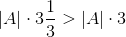 , and
, and
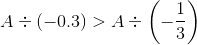
making (B) greater.
Since the quotient of negative numbers is positive, both results will be positive.
We can rewrite both of these as products of positive numbers, as follows:
making (B) greater.
← Didn't Know|Knew It →
When evaluating the expression
 ,
,
assuming you know the values of all five variables, what is the second operation that must be performed?
When evaluating the expression
assuming you know the values of all five variables, what is the second operation that must be performed?
Tap to reveal answer
In the order of operations, any expression within parentheses must be performed first. Between the parentheses, there are two operations, an exponentiation (squaring), and a subtraction. By the order of operations, the exponentiation is performed first; the subtraction is performed second, making this the correct response.
In the order of operations, any expression within parentheses must be performed first. Between the parentheses, there are two operations, an exponentiation (squaring), and a subtraction. By the order of operations, the exponentiation is performed first; the subtraction is performed second, making this the correct response.
← Didn't Know|Knew It →
 ;
;  .
.
Which is the greater quantity?
(a) The reciprocal of 
(b) The reciprocal of 
Which is the greater quantity?
(a) The reciprocal of
(b) The reciprocal of
Tap to reveal answer
We show that the given information is insufficient by examining two cases.
Case 1:

The reciprocal of  is
is  , or
, or  .
.
Also,  , the reciprocal of which is
  .
.
 , so (b) is the greater quantity.
Case 2:  .
.
The reciprocal of  is
is  , or 2.
Also, 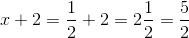 , the reciprocal of which is
  .
.
 , so (a) is the greater quantity.
 in both cases, but in one case, (a) is greater and in the other, (b) is greater.
We show that the given information is insufficient by examining two cases.
Case 1:
The reciprocal of
Also,
Case 2:
The reciprocal of
Also,
← Didn't Know|Knew It →
 is a negative number.
Which is the greater quantity?
(a) The reciprocal of 
(b) The reciprocal of 
Which is the greater quantity?
(a) The reciprocal of
(b) The reciprocal of
Tap to reveal answer
Since  is negative, its reciprocal
  is also negative. Since
 ,
,
by the Multiplication Property of Inequality,


That is, the reciprocal of  is greater than that of
  .
.
Since
by the Multiplication Property of Inequality,
That is, the reciprocal of
← Didn't Know|Knew It →

Tap to reveal answer
Never divide fractions! Simply flip the fraction that follows the division symbol, and then multiply it by the first fraction. So this expression becomes:
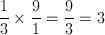
Never divide fractions! Simply flip the fraction that follows the division symbol, and then multiply it by the first fraction. So this expression becomes:
← Didn't Know|Knew It →
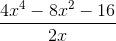
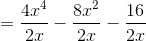
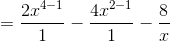
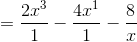
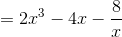
Simplify:
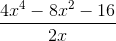
Simplify:
Tap to reveal answer
← Didn't Know|Knew It →
Divide:
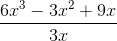
Divide:
Tap to reveal answer

← Didn't Know|Knew It →
If  , divide:
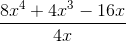
If
Tap to reveal answer

← Didn't Know|Knew It →
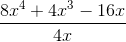
Divide:
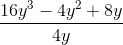
Divide:
Tap to reveal answer
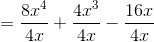
In this division problem, you can simplify first the coefficients, then the variables.
Each of the coefficients in the numerator is divisible by the coefficient in the denominator, allowing you to divide out and cancel the 4 in the denominator:

Finally, you can simplify the varaibles. Remember that when simplifying variables in a fraction (division problem), you subtract the numerator variable's exponent by the denominator variable's exponent. You can do this with each term in this problem, because each term in the numerator has at least a  :
:
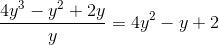
In this division problem, you can simplify first the coefficients, then the variables.
Each of the coefficients in the numerator is divisible by the coefficient in the denominator, allowing you to divide out and cancel the 4 in the denominator:
Finally, you can simplify the varaibles. Remember that when simplifying variables in a fraction (division problem), you subtract the numerator variable's exponent by the denominator variable's exponent. You can do this with each term in this problem, because each term in the numerator has at least a
← Didn't Know|Knew It →
Divide:
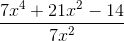
Divide:
Tap to reveal answer
In this division problem, you can simplify first the coefficients, then the variables.
Each of the coefficients in the numerator is divisible by the coefficient in the denominator, allowing you to divide out and cancel the 7 in the denominator:

Finally, you can simplify the varaibles. Remember that when simplifying variables in a fraction (division problem), you subtract the numerator variable's exponent by the denominator variable's exponent.
You can only do this with the first two terms in the numerator, since the final term does not have a variable. Instead, the final term will keep  in the denominator:

In this division problem, you can simplify first the coefficients, then the variables.
Each of the coefficients in the numerator is divisible by the coefficient in the denominator, allowing you to divide out and cancel the 7 in the denominator:
Finally, you can simplify the varaibles. Remember that when simplifying variables in a fraction (division problem), you subtract the numerator variable's exponent by the denominator variable's exponent.
You can only do this with the first two terms in the numerator, since the final term does not have a variable. Instead, the final term will keep
← Didn't Know|Knew It →
Divide:
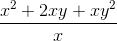
Divide:
Tap to reveal answer

← Didn't Know|Knew It →
Which of the following is a factor of  ?
?
Which of the following is a factor of
Tap to reveal answer
The first step to solving this question is to reduce  .
.


The only number listed that is a factor of 36 is 18, given that 2 times 18 is 36. Therefore, 18 is the correct answer.
The first step to solving this question is to reduce
The only number listed that is a factor of 36 is 18, given that 2 times 18 is 36. Therefore, 18 is the correct answer.
← Didn't Know|Knew It →
Divide:

Divide:
Tap to reveal answer
To divide this problem we simplify it first. In this problem we can separate the big fraction into three smaller fractions.

Then from here, we can pull out a  from both the numerator and denominator of each smaller fraction.

Now we cancel terms and get the following result:

To divide this problem we simplify it first. In this problem we can separate the big fraction into three smaller fractions.
Then from here, we can pull out a
Now we cancel terms and get the following result:
← Didn't Know|Knew It →
Divide:

Divide:
Tap to reveal answer
To divide this problem we start by simplify it. In this problem we can break the large fraction into three smaller fractions.

From here we can factor out a  from the numerator and denominator of each fraction.

Now we can cancel the  terms and are left with the following result:

To divide this problem we start by simplify it. In this problem we can break the large fraction into three smaller fractions.
From here we can factor out a
Now we can cancel the
← Didn't Know|Knew It →
Simplify:

Simplify:
Tap to reveal answer
To simplify this problem we first separate the large fraction into three smaller fractions.


From here we can factor out  from the numerator and denominator of the first two fractions.

The  can be canceled out in the first two fractions. From here we can factor out a
  from the numerator and denominator of the third fraction.

Thus becoming:

To simplify this problem we first separate the large fraction into three smaller fractions.
From here we can factor out
The
Thus becoming:
← Didn't Know|Knew It →
Simplify the following expression:

Simplify the following expression:
Tap to reveal answer
Simplify the following expression:

Let's begin by simplifying the coefficients

Next, complete the question by subtracting the exponents:

So, our answer is:

Simplify the following expression:
Let's begin by simplifying the coefficients
Next, complete the question by subtracting the exponents:
So, our answer is:
← Didn't Know|Knew It →