
How to divide exponents - ISEE Upper Level Quantitative Reasoning
Card 1 of 112
Simplify: 
Simplify:
Tap to reveal answer
Apply the quotient of powers rule.
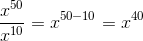
Apply the quotient of powers rule.
← Didn't Know|Knew It →
Simplify: 
Simplify:
Tap to reveal answer
Separate the fraction and apply the quotient of powers rule:

Separate the fraction and apply the quotient of powers rule:
← Didn't Know|Knew It →
Evaluate:

Evaluate:
Tap to reveal answer
Any nonzero number raised to the power of 0 is equal to 1, so  , and
, and
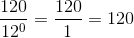
Any nonzero number raised to the power of 0 is equal to 1, so
← Didn't Know|Knew It →
Evaluate:

Evaluate:
Tap to reveal answer
Any nonzero number raised to the power of 0 is equal to 1, so  . Therefore,
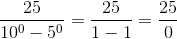
However, an expression with a denominator of 0 is undefined, so that is the correct choice.
Any nonzero number raised to the power of 0 is equal to 1, so
However, an expression with a denominator of 0 is undefined, so that is the correct choice.
← Didn't Know|Knew It →
Simplify:

Simplify:
Tap to reveal answer
Based on the quotient rule for exponents, we know that for any non-zero number  and any integers
  and
and  ,
,
 .
.
We should separate the fraction and apply the quotient rule for exponents:
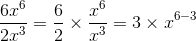
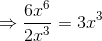
Based on the quotient rule for exponents, we know that for any non-zero number
We should separate the fraction and apply the quotient rule for exponents:
← Didn't Know|Knew It →
Simplify:

Simplify:
Tap to reveal answer
Based on the quotient rule for exponents, we know that for any non-zero number  and any integers
  and
and  ,
,
 .
.
We also know that any non-zero number raised to the power of  is
is  .
.

Based on the quotient rule for exponents, we know that for any non-zero number
We also know that any non-zero number raised to the power of
← Didn't Know|Knew It →
Simplify:

Simplify:
Tap to reveal answer
We know that any non-zero number raised to the power of  is equal to
  .
.

Now factor:

We know that any non-zero number raised to the power of
Now factor:
← Didn't Know|Knew It →
Evaluate:

Evaluate:
Tap to reveal answer
We know that any non-zero number raised to the power of  is equal to
  .
.

We know that any non-zero number raised to the power of
← Didn't Know|Knew It →
Evaluate:

Evaluate:
Tap to reveal answer
Based on the quotient rule for exponents, we know that, for any non-zero number  and any integers
  and
and  ,
,
 .
.

Based on the quotient rule for exponents, we know that, for any non-zero number
← Didn't Know|Knew It →
Simplify:

Simplify:
Tap to reveal answer
When a fraction is raised to a power, the numerator and the denominator are both raised to that power:

The power rule says that in order to raise a power to a power, we need to multiply the exponents, i.e.
 ,
,
where  and
and  are real numbers.

When a fraction is raised to a power, the numerator and the denominator are both raised to that power:
The power rule says that in order to raise a power to a power, we need to multiply the exponents, i.e.
where
← Didn't Know|Knew It →
Simplify the following:

Simplify the following:
Tap to reveal answer
Simplify the following:

Let's begin by recalling that when dividing variables with similar base, we need to subtract the exponents.
To deal with the coefficients, simply treat them as a fraction and simplify.

So our answer is

Simplify the following:
Let's begin by recalling that when dividing variables with similar base, we need to subtract the exponents.
To deal with the coefficients, simply treat them as a fraction and simplify.
So our answer is
← Didn't Know|Knew It →
Evaluate:

Evaluate:
Tap to reveal answer
When a fraction is raised to a power, the numerator and the denominator are both raised to that power:

The power rule says that in order to raise a power to a power, we need to multiply the exponents, i.e.
 .
.

When a fraction is raised to a power, the numerator and the denominator are both raised to that power:
The power rule says that in order to raise a power to a power, we need to multiply the exponents, i.e.
← Didn't Know|Knew It →
Simplify:

Simplify:
Tap to reveal answer
The Negative Exponent Rule says  .
.

The Negative Exponent Rule says
← Didn't Know|Knew It →
Evaluate:

Assume variables are non-zero.
Evaluate:
Assume variables are non-zero.
Tap to reveal answer
We know that any non-zero number raised to the power of is equal to .

We know that any non-zero number raised to the power of
← Didn't Know|Knew It →
Evaluate:

Evaluate:
Tap to reveal answer
When a fraction is raised to a power, the numerator and the denominator are both raised to that power. In addition, the power rule says that in order to raise a power to a power, multiply the exponents, i.e.
 .
.

When a fraction is raised to a power, the numerator and the denominator are both raised to that power. In addition, the power rule says that in order to raise a power to a power, multiply the exponents, i.e.
← Didn't Know|Knew It →
Simplify:

Simplify:
Tap to reveal answer
Based on the negative exponent rule we have:

Which says negative exponents in the numerator get moved to the denominator and become positive exponents. And negative exponents in the denominator get moved to the numerator and become positive exponents. So we can write:
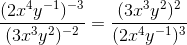
Based on the power rule for exponents we can write:

That means; to raise a power to a power we need to multiply the exponents.So we have:

Separate the equation:
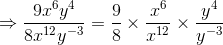

Based on the negative exponent rule we have:
Which says negative exponents in the numerator get moved to the denominator and become positive exponents. And negative exponents in the denominator get moved to the numerator and become positive exponents. So we can write:
Based on the power rule for exponents we can write:
That means; to raise a power to a power we need to multiply the exponents.So we have:
Separate the equation:
← Didn't Know|Knew It →
Evaluate:

Evaluate:
Tap to reveal answer
First we need to subtract the numbers in parentheses. So we can write:

We can alternatively write:

First we need to subtract the numbers in parentheses. So we can write:
We can alternatively write:
← Didn't Know|Knew It →
Simplify:

Simplify:
Tap to reveal answer
Based on the zero-exponent rule we have:

That means any non-zero number raised to the zero power is equal to  . So we can write:

Based on the power rule for exponents we can write:
That means; to raise a power to a power we need to multiply the exponents. In addition based on the negative exponent rule we have:
Which says negative exponents in the numerator get moved to the denominator and become positive exponents. And negative exponents in the denominator get moved to the numerator and become positive exponents. So we can write:

Based on the zero-exponent rule we have:
That means any non-zero number raised to the zero power is equal to
Based on the power rule for exponents we can write:
That means; to raise a power to a power we need to multiply the exponents. In addition based on the negative exponent rule we have:
Which says negative exponents in the numerator get moved to the denominator and become positive exponents. And negative exponents in the denominator get moved to the numerator and become positive exponents. So we can write:
← Didn't Know|Knew It →
What is the value of the expression below?

What is the value of the expression below?
Tap to reveal answer
When values having the same base are divided, their exponents are subtracted.


Therefore, the correct answer is

When values having the same base are divided, their exponents are subtracted.
Therefore, the correct answer is
← Didn't Know|Knew It →
What is the value of the expression  ?
?
What is the value of the expression
Tap to reveal answer
When dealing with dividing scientific notation, you can divide the like terms separately. First, divide 4.2 by 7.0. This yields 0.6. Then divide the 10s.  because when you divide a term with the same base, you subtract exponents. This gives you a combined answer of
  . Since this is not in scientific notation, move the decimal over one place to the right so that it will be in the appropriate notation. This gives you
  .
.
When dealing with dividing scientific notation, you can divide the like terms separately. First, divide 4.2 by 7.0. This yields 0.6. Then divide the 10s.
← Didn't Know|Knew It →