
Solid Geometry - ISEE Upper Level Quantitative Reasoning
Card 1 of 676
The volume of a cube is  . What is the length of an edge of the cube?
The volume of a cube is
Tap to reveal answer
Let  be the length of an edge of the cube. The volume of a cube can be determined by the equation:


Let
← Didn't Know|Knew It →
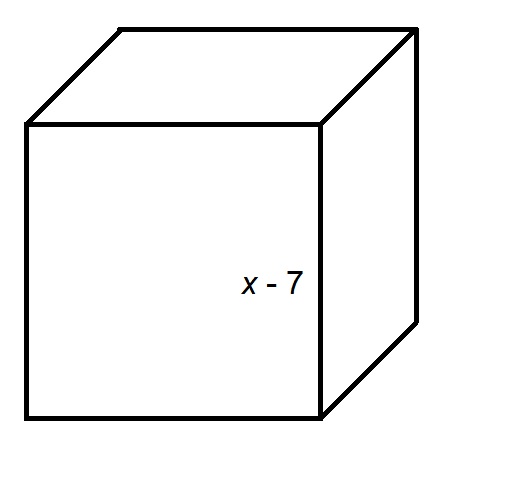
The above cube has surface area 486. Evaluate  .
.
The above cube has surface area 486. Evaluate
Tap to reveal answer
The surface area of a cube is six times the square of the length of each edge, which here is  . Therefore,

Substituting, then solving for  :
:




Since the sidelength is positive,


The surface area of a cube is six times the square of the length of each edge, which here is
Substituting, then solving for
Since the sidelength is positive,
← Didn't Know|Knew It →
There is a sculpture in front of town hall which is shaped like a cube. If it has a volume of  , what is the length of one side of the cube?
There is a sculpture in front of town hall which is shaped like a cube. If it has a volume of
Tap to reveal answer
There is a sculpture in front of town hall which is shaped like a cube. If it has a volume of  , what is the length of one side of the cube?
To find the side length of a cube from its volume, simply use the following formula:

Plug in what is known and use some algebra to get our answer:

There is a sculpture in front of town hall which is shaped like a cube. If it has a volume of
To find the side length of a cube from its volume, simply use the following formula:
Plug in what is known and use some algebra to get our answer:
← Didn't Know|Knew It →
You have a cube with a volume of  . What is the cube's side length?
You have a cube with a volume of
Tap to reveal answer
You have a cube with a volume of  . What is the cube's side length?
If we begin with the formula for volume of a cube, we can work backwards to find the side length.



Making our answer:

You have a cube with a volume of
If we begin with the formula for volume of a cube, we can work backwards to find the side length.
Making our answer:
← Didn't Know|Knew It →
You have a crate with equal dimensions (height, length and width). If the volume of the cube is  , what is the length of one of the crate's dimension?
You have a crate with equal dimensions (height, length and width). If the volume of the cube is
Tap to reveal answer
You have a crate with equal dimensions (height, length and width). If the volume of the cube is  , what is the length of one of the crate's dimension?
Let's begin with realizing that we are dealing with a cube. A crate with equal dimensions will have equal height, length, and width, so it must be a cube.
With that in mind, we can find our side length by starting with the volume and working backward.

So, to find our side length, we just need to take the cubed root of the volume.

So, our answer is 6 meters, a fairly large crate!
You have a crate with equal dimensions (height, length and width). If the volume of the cube is
Let's begin with realizing that we are dealing with a cube. A crate with equal dimensions will have equal height, length, and width, so it must be a cube.
With that in mind, we can find our side length by starting with the volume and working backward.
So, to find our side length, we just need to take the cubed root of the volume.
So, our answer is 6 meters, a fairly large crate!
← Didn't Know|Knew It →
If the volume of a cube is 30, what must be the length of the edge of the cube?
If the volume of a cube is 30, what must be the length of the edge of the cube?
Tap to reveal answer
Write the formula to find the volume of a cube.

Substitute the volume into the equation.

Cube root both sides.

The answer is: 
Write the formula to find the volume of a cube.
Substitute the volume into the equation.
Cube root both sides.
The answer is:
← Didn't Know|Knew It →
You have a cube with a volume of . What is the cube's side length?
You have a cube with a volume of
Tap to reveal answer
You have a cube with a volume of . What is the cube's side length?
If we begin with the formula for volume of a cube, we can work backwards to find the side length.
Making our answer:
You have a cube with a volume of
If we begin with the formula for volume of a cube, we can work backwards to find the side length.
Making our answer:
← Didn't Know|Knew It →
The length of the side of a cube is  . Give its surface area in terms of
  .
.
The length of the side of a cube is
Tap to reveal answer
Substitute  in the formula for the surface area of a cube:


Substitute
← Didn't Know|Knew It →
If a cube has one side measuring  cm, what is the surface area of the cube?
If a cube has one side measuring
Tap to reveal answer
To find the surface area of a cube, use the formula  , where
  represents the length of the side. Since the side of the cube measures
  , we can substitute
  in for
  .
.

To find the surface area of a cube, use the formula
← Didn't Know|Knew It →
Your friend gives you a puzzle cube for your birthday. If the length of one edge is 5 cm, what is the surface area of the cube?
Your friend gives you a puzzle cube for your birthday. If the length of one edge is 5 cm, what is the surface area of the cube?
Tap to reveal answer
Your friend gives you a puzzle cube for your birthday. If the length of one edge is 5 cm, what is the surface area of the cube?
To find the surface area of a cube, use the following formula:

This works, because we have 6 sides, each of which has an area of 
Plug in our known to get our answer:

Your friend gives you a puzzle cube for your birthday. If the length of one edge is 5 cm, what is the surface area of the cube?
To find the surface area of a cube, use the following formula:
This works, because we have 6 sides, each of which has an area of
Plug in our known to get our answer:
← Didn't Know|Knew It →
A cube has a side length of  , what is the surface area of the cube?
A cube has a side length of
Tap to reveal answer
A cube has a side length of  , what is the surface area of the cube?
Surface area of a cube can be found as follows:

Plug in our side length to find our answer:

Making our answer:

A cube has a side length of
Surface area of a cube can be found as follows:
Plug in our side length to find our answer:
Making our answer:
← Didn't Know|Knew It →
One of your holiday gifts is wrapped in a cube-shaped box.
If one of the edges has a length of 6 inches, what is the surface area of the box?
One of your holiday gifts is wrapped in a cube-shaped box.
If one of the edges has a length of 6 inches, what is the surface area of the box?
Tap to reveal answer
One of your holiday gifts is wrapped in a cube-shaped box.
If one of the edges has a length of 6 inches, what is the surface area of the box?
We can find the surface area of a square by squaring the length of the side and then multiplying it by 6.

One of your holiday gifts is wrapped in a cube-shaped box.
If one of the edges has a length of 6 inches, what is the surface area of the box?
We can find the surface area of a square by squaring the length of the side and then multiplying it by 6.
← Didn't Know|Knew It →
While exploring an ancient ruin, you discover a small puzzle cube. You measure the side length to be  . Find the cube's surface area.
While exploring an ancient ruin, you discover a small puzzle cube. You measure the side length to be
Tap to reveal answer
While exploring an ancient ruin, you discover a small puzzle cube. You measure the side length to be  . Find the cube's surface area.
To find the surface area, use the following formula:

While exploring an ancient ruin, you discover a small puzzle cube. You measure the side length to be
To find the surface area, use the following formula:
← Didn't Know|Knew It →
Find the surface area of a cube that has a width of 6cm.
Find the surface area of a cube that has a width of 6cm.
Tap to reveal answer
To find the surface area of a cube, we will use the following formula:

where a is the length of any side of the cube.
Now, we know the width of the cube is 6cm. Because it is a cube, all sides are 6cm. That is why we can choose any side to substitute into the formula.
Now, knowing this, we can substitute into the formula. We get


To find the surface area of a cube, we will use the following formula:
where a is the length of any side of the cube.
Now, we know the width of the cube is 6cm. Because it is a cube, all sides are 6cm. That is why we can choose any side to substitute into the formula.
Now, knowing this, we can substitute into the formula. We get
← Didn't Know|Knew It →
Find the surface area of a cube with a length of 7in.
Find the surface area of a cube with a length of 7in.
Tap to reveal answer
To find the surface area of a cube, we will use the following formula:

where a is the length of any side of the cube. Note that all sides are equal on a cube. That is why we can use any length in the formula.
Now, we know the length of the cube is 7in.
Knowing this, we can substitute into the formula. We get


To find the surface area of a cube, we will use the following formula:
where a is the length of any side of the cube. Note that all sides are equal on a cube. That is why we can use any length in the formula.
Now, we know the length of the cube is 7in.
Knowing this, we can substitute into the formula. We get
← Didn't Know|Knew It →
Find the surface area of a cube with a width of 4cm.
Find the surface area of a cube with a width of 4cm.
Tap to reveal answer
To find the surface area of a cube, we will use the following formula.

where a is the length of any side of the cube.
Now, we know the width of the cube is 4in. Because it is a cube, all sides are equal (this is why we can use any length in the formula). So, we will use 4in in the formula. We get


To find the surface area of a cube, we will use the following formula.
where a is the length of any side of the cube.
Now, we know the width of the cube is 4in. Because it is a cube, all sides are equal (this is why we can use any length in the formula). So, we will use 4in in the formula. We get
← Didn't Know|Knew It →
Find the surface area of a cube with a length of 12in.
Find the surface area of a cube with a length of 12in.
Tap to reveal answer
To find the surface area of a cube, we will use the following formula:

where l is the length, and w is the width of the cube.
Now, we know the length of the cube is 12in. Because it is a cube, all lengths, widths, and heights are the same. Therefore, the width is also 12in.
Knowing this, we can substitute into the formula. We get


To find the surface area of a cube, we will use the following formula:
where l is the length, and w is the width of the cube.
Now, we know the length of the cube is 12in. Because it is a cube, all lengths, widths, and heights are the same. Therefore, the width is also 12in.
Knowing this, we can substitute into the formula. We get
← Didn't Know|Knew It →
Find the surface area of a cube with a base of 8in.
Find the surface area of a cube with a base of 8in.
Tap to reveal answer
A cube has all equal sides (length, width, height). To find the surface area of a cube, we will use the following formula:

Now, we know the base of the cube is 8in. Because all sides are equal (i.e. all sides are 8in), we will use that to substitute into the formula. We get


A cube has all equal sides (length, width, height). To find the surface area of a cube, we will use the following formula:
Now, we know the base of the cube is 8in. Because all sides are equal (i.e. all sides are 8in), we will use that to substitute into the formula. We get
← Didn't Know|Knew It →
You are building a box to hold your collection of rare rocks. You want to build a cube-shaped box with a side length of 3 feet. If you do so, what will the surface area of your box be?
You are building a box to hold your collection of rare rocks. You want to build a cube-shaped box with a side length of 3 feet. If you do so, what will the surface area of your box be?
Tap to reveal answer
You are building a box to hold your collection of rare rocks. You want to build a cube-shaped box with a side length of 3 feet. If you do so, what will the surface area of your box be?
To find the surface area, use the formula:

Where s is our side length and SA is our surface area.
Plug in our known and simplify

So, our answer is

You are building a box to hold your collection of rare rocks. You want to build a cube-shaped box with a side length of 3 feet. If you do so, what will the surface area of your box be?
To find the surface area, use the formula:
Where s is our side length and SA is our surface area.
Plug in our known and simplify
So, our answer is
← Didn't Know|Knew It →
Find the surface area of a cube with a length of 11in.
Find the surface area of a cube with a length of 11in.
Tap to reveal answer
To find the surface area of a cube, we will use the following formula:

where a is the length of any side of the cube. Because it is a cube, all sides are equal. Therefore, we can use any side in the formula.
Now, we know the length of the cube is 11in. We can substitute that into the formula. We get


To find the surface area of a cube, we will use the following formula:
where a is the length of any side of the cube. Because it is a cube, all sides are equal. Therefore, we can use any side in the formula.
Now, we know the length of the cube is 11in. We can substitute that into the formula. We get
← Didn't Know|Knew It →