
Variables - ISEE Upper Level Quantitative Reasoning
Card 1 of 976
Half of one hundred divided by five and multiplied by one-tenth is .
Half of one hundred divided by five and multiplied by one-tenth is .
Tap to reveal answer
Let's take this step by step. "Half of one hundred" is 100/2 = 50. Then "half of one hundred divided by five" is 50/5 = 10. "Multiplied by one-tenth" really is the same as dividing by ten, so the last step gives us 10/10 = 1.
Let's take this step by step. "Half of one hundred" is 100/2 = 50. Then "half of one hundred divided by five" is 50/5 = 10. "Multiplied by one-tenth" really is the same as dividing by ten, so the last step gives us 10/10 = 1.
← Didn't Know|Knew It →
Simplify: 
Simplify:
Tap to reveal answer

← Didn't Know|Knew It →
Simplify:

Simplify:
Tap to reveal answer
Break the fraction up and apply the quotient of powers rule:

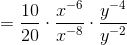
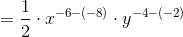
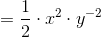


Break the fraction up and apply the quotient of powers rule:
← Didn't Know|Knew It →
Simplify: 
Simplify:
Tap to reveal answer
To simplify this expression, look at the like terms separately. First, simplify  . This becomes
  . Then, deal with the
  . Since the bases are the same and you're dividing, you can subtract exponents. This gives you
  Since the exponent is positive, you put in the numerator. This gives you a final answer of
  .
.
To simplify this expression, look at the like terms separately. First, simplify
← Didn't Know|Knew It →
 is a negative number.
Which is the greater quantity?
(a) The reciprocal of 
(b) The reciprocal of 
Which is the greater quantity?
(a) The reciprocal of
(b) The reciprocal of
Tap to reveal answer
A negative number raised to an odd power is negative; a negative number raised to an even power is positive. It follows that  is negative and
  is positive. Also, the reciprocal of a nonzero number assumes the same sign as the number itself, so the reciprocal of
  is positive and that of
  is negative. It follows that the reciprocal of
  is the greater of the two.
A negative number raised to an odd power is negative; a negative number raised to an even power is positive. It follows that
← Didn't Know|Knew It →
Simplify:
Simplify:
Tap to reveal answer
Break the fraction up and apply the quotient of powers rule:
Break the fraction up and apply the quotient of powers rule:
← Didn't Know|Knew It →
Multiply:

Multiply:
Tap to reveal answer
This can be solved using the pattern for the sum times difference of two terms:




This can be solved using the pattern for the sum times difference of two terms:
← Didn't Know|Knew It →
Multiply:
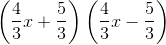
Multiply:
Tap to reveal answer
This can be solved using the pattern for the sum times difference of two terms:
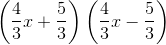
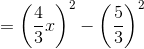
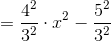
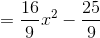
This can be solved using the pattern for the sum times difference of two terms:
← Didn't Know|Knew It →
Simplify:

Simplify:
Tap to reveal answer
This can be solved using the pattern for the square of a binomial:

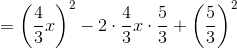

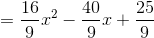
This can be solved using the pattern for the square of a binomial:
← Didn't Know|Knew It →
N is a positive integer;  . Which is greater?
(a) 
(b) 0
N is a positive integer;
(a)
(b) 0
Tap to reveal answer
 . Since
  ,
,  , and
, and  . This makes (a) greater.
← Didn't Know|Knew It →
N is a positive integer; . Which is greater?
(a) 
(b) 
N is a positive integer;
(a)
(b)
Tap to reveal answer
If  , then
  .
.
If  , then
  .
.
Therefore, at least two possibilities can be demonstrated.
If
If
Therefore, at least two possibilities can be demonstrated.
← Didn't Know|Knew It →
Which is the greater quantity?
(a) 
(b) 
Which is the greater quantity?
(a)
(b)
Tap to reveal answer




Since  ,
,
 .
.
Since
← Didn't Know|Knew It →
Assume  is nonzero. Which of the following is equivalent to
  ?
?
Assume
Tap to reveal answer
Using the associative property of multiplication,
 .
.
Using the distributive property,
 .
.
Using the commutative and associative properties of multiplication,

and
 .
.
The expression  is the sum of unlike terms and cannot be simplified further.
The only expression that can be restated as  is
is  .
.
Using the associative property of multiplication,
Using the distributive property,
Using the commutative and associative properties of multiplication,
and
The expression
The only expression that can be restated as
← Didn't Know|Knew It →
Assume  is nonzero. Which expression is not equivalent to
  ?
?
Assume
Tap to reveal answer
Each expression can be simplified using the properties of exponents, among others:




The correct choice is  , as it is the only choice not equivalent to
  .
.
Each expression can be simplified using the properties of exponents, among others:
The correct choice is
← Didn't Know|Knew It →
Let  be negative. Which of the following is the greater quantity?
(A) 
(B) 
Let
(A)
(B)
Tap to reveal answer
 ,
,
So by the multiplication property of inequality, when each is multiplied by the negative number  ,
,

and (B) is greater.
So by the multiplication property of inequality, when each is multiplied by the negative number
and (B) is greater.
← Didn't Know|Knew It →
 is a positive number. Which is greater?
(A) One ninth of 117% of 
(B) One eleventh of 143% of 
(A) One ninth of 117% of
(B) One eleventh of 143% of
Tap to reveal answer
117% of  is equal to
  .
.
One-ninth of this is 
143% of  is equal to
One-eleventh of this is 
Regardless of the value of  , the quanitites are equal.
117% of
One-ninth of this is
143% of
One-eleventh of this is
Regardless of the value of
← Didn't Know|Knew It →
A hat sells for the same pre-tax price in Store A and Store B. Store A then discounts the hat 30%, and Store B discounts it 25%. After the discount, the hat is taxed at a 10% rate in Store A. The hat is taxed at a 5% rate in store B.
Which is greater?
(A) The amount that will be paid for the hat in Store A after discount and tax
(B) The amount that will be paid for the hat in Store B after discount and tax
A hat sells for the same pre-tax price in Store A and Store B. Store A then discounts the hat 30%, and Store B discounts it 25%. After the discount, the hat is taxed at a 10% rate in Store A. The hat is taxed at a 5% rate in store B.
Which is greater?
(A) The amount that will be paid for the hat in Store A after discount and tax
(B) The amount that will be paid for the hat in Store B after discount and tax
Tap to reveal answer
Let  be the original price of the hat before discount or tax.
Store A discounts the hat by 30%, meaning that its discounted price before sales tax is

The amount paid after sales tax is this price plus 10% of it, or

Store B discounts the hat by 25%, meaning that its discounted price before sales tax is

The amount paid after sales tax is this price plus 5% of it, or

 and
and  must be positive, so
  .
.
(B) must be greater regardess of  .
.
Let
Store A discounts the hat by 30%, meaning that its discounted price before sales tax is
The amount paid after sales tax is this price plus 10% of it, or
Store B discounts the hat by 25%, meaning that its discounted price before sales tax is
The amount paid after sales tax is this price plus 5% of it, or
(B) must be greater regardess of
← Didn't Know|Knew It →
A hat sells for the same price in Store A, where the sales tax is 8%, and Store B, where there is no sales tax. Store A then discounts the hat by 8%; Store B does not discount it.
Which is greater?
(A) The amount that will be paid for the hat in Store A after discount and tax
(B) The amount that will be paid for the hat in Store B
A hat sells for the same price in Store A, where the sales tax is 8%, and Store B, where there is no sales tax. Store A then discounts the hat by 8%; Store B does not discount it.
Which is greater?
(A) The amount that will be paid for the hat in Store A after discount and tax
(B) The amount that will be paid for the hat in Store B
Tap to reveal answer
Let be the original price of the hat before discount or tax.
Store A discounts the hat by 8%, meaning that its discounted price before sales tax is
 .
.
The amount paid after sales tax is this price plus 8% of it, or
 .
.
Since Store B neither discounts the price nor charges sales tax, the amount paid will be the original  .
.
 , so
, so  .
.
The hat will cost more in Store B, so (B) is greater.
Let
Store A discounts the hat by 8%, meaning that its discounted price before sales tax is
The amount paid after sales tax is this price plus 8% of it, or
Since Store B neither discounts the price nor charges sales tax, the amount paid will be the original
The hat will cost more in Store B, so (B) is greater.
← Didn't Know|Knew It →
 and
and  are positive integers. Which is the greater quantity?
(A) 
(B) 
(A)
(B)
Tap to reveal answer
We can compare these positive numbers by comparing their squares; the greater number will have the greater square.
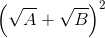


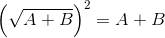
Since  and
and  are positive,
  and
and
 .
.
Therefore,

and
 .
.
We can compare these positive numbers by comparing their squares; the greater number will have the greater square.
Since
Therefore,
and
← Didn't Know|Knew It →
Which of the following expressions is equivalent to
 ?
?
Which of the following expressions is equivalent to
Tap to reveal answer
Use the difference of squares pattern as follows:

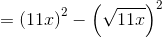


Use the difference of squares pattern as follows:
← Didn't Know|Knew It →