
Plane Geometry - ISEE Middle Level Quantitative Reasoning
Card 0 of 990
A regular pentagon has perimeter 1 yard. Give the length of one side.
A regular pentagon has perimeter 1 yard. Give the length of one side.
A regular pentagon has five sides of equal length. The perimeter, which is the sum of the lengths of these sides, is one yard, which is equal to 36 inches. Therefore, the length of one side is
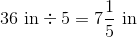 .
.
A regular pentagon has five sides of equal length. The perimeter, which is the sum of the lengths of these sides, is one yard, which is equal to 36 inches. Therefore, the length of one side is
Compare your answer with the correct one above
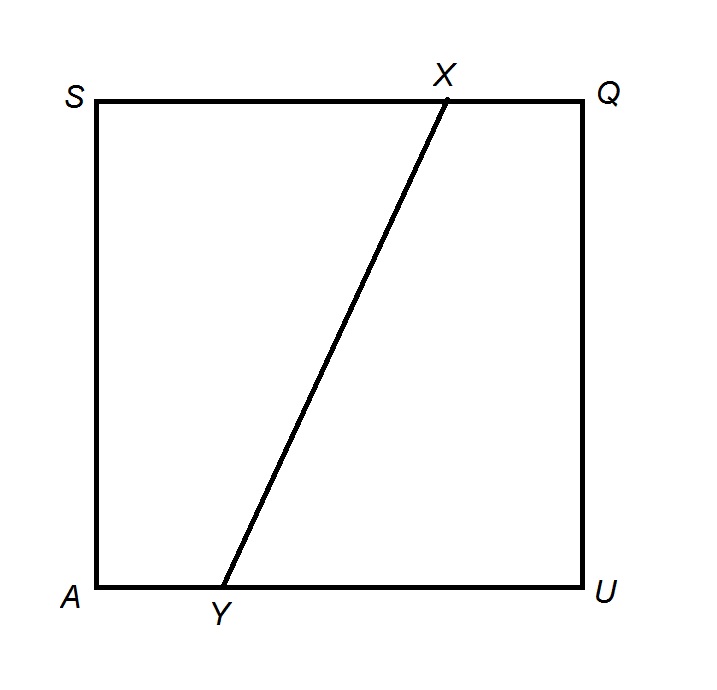
Note: Figure NOT drawn to scale
The above figure shows Square  .
.

Which is the greater quantity?
(a) The area of Trapezoid 
(b) The area of Trapezoid 
Note: Figure NOT drawn to scale
The above figure shows Square
Which is the greater quantity?
(a) The area of Trapezoid
(b) The area of Trapezoid
The easiest way to answer the question is to locate  on
on  such that
  :
:
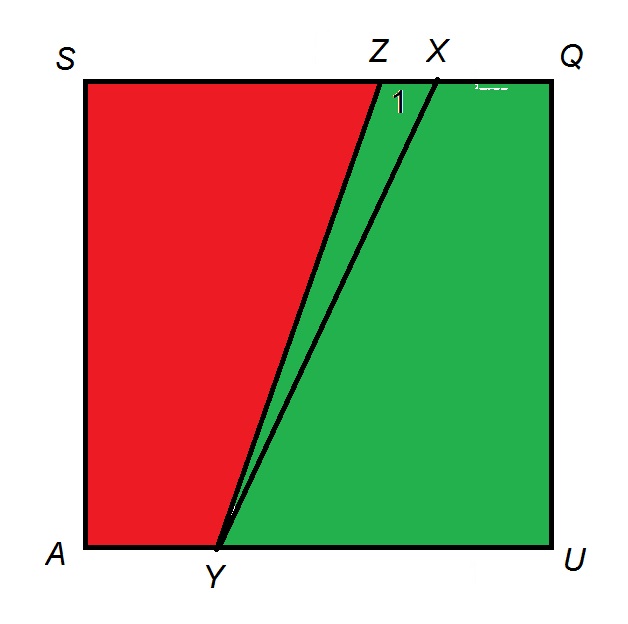
Trapezoids  and
and  have the same height, which is
  . Their bases, by construction, have the same lengths -
  and
and  . Therefore, Trapezoids
  and
and  have the same area.
Since , it follows that  , and
, and  . It follows that Trapezoid
  is greater in area than Trapezoids
  and
and  , and Trapezoid is less in area.
The easiest way to answer the question is to locate
Trapezoids
Since
Compare your answer with the correct one above
A regular hexagon has perimeter 8 feet. Give the length of one side.
A regular hexagon has perimeter 8 feet. Give the length of one side.
The perimeter can be converted from feet to inches by multiplying by conversion factor 12 {inches per foot):

A regular hexagon has six sides of equal length. Divide this perimeter by 6 to obtain the length of each side:

The perimeter can be converted from feet to inches by multiplying by conversion factor 12 {inches per foot):
A regular hexagon has six sides of equal length. Divide this perimeter by 6 to obtain the length of each side:
Compare your answer with the correct one above
A triangle has base 80 inches and area 4,200 square inches. What is its height?
A triangle has base 80 inches and area 4,200 square inches. What is its height?
Use the area formula for a triangle, setting  :
:


 inches
Use the area formula for a triangle, setting
Compare your answer with the correct one above
The sum of the lengths of the legs of an isosceles right triangle is one meter. What is its area in square centimeters?
The sum of the lengths of the legs of an isosceles right triangle is one meter. What is its area in square centimeters?
The legs of an isosceles right triangle have equal length, so, if the sum of their lengths is one meter, which is equal to 100 centimeters, each leg measures half of this, or
 centimeters.
The area of a triangle is half the product of its height and base; for a right triangle, the legs serve as height and base, so the area of the triangle is
 square centimeters.
The legs of an isosceles right triangle have equal length, so, if the sum of their lengths is one meter, which is equal to 100 centimeters, each leg measures half of this, or
The area of a triangle is half the product of its height and base; for a right triangle, the legs serve as height and base, so the area of the triangle is
Compare your answer with the correct one above

Figure NOT drawn to scale
Square  has area 1,600.
  ;
;  . Which of the following is the greater quantity?
(a) The area of 
(b) The area of 
Figure NOT drawn to scale
Square
(a) The area of
(b) The area of
Square  has area 1,600, so the length of each side is
  .
.
Since  ,
,

Therefore,  .
.
 has as its area
  ;
;  has as its area
  .
.
Since  and
and  , it follows that

and

 has greater area than
  .
.
Square
Since
Therefore,
Since
and
Compare your answer with the correct one above
The above figure depicts Square  .
.  ,
,  , and
, and  are the midpoints of
  ,
,  , and
, and  , respectively.
 has area
  . What is the area of Square
  ?
?
The above figure depicts Square
Since , , and are the midpoints of , , and , if we call  the length of each side of the square, then

The area of  is half the product of the lengths of its legs:


The area of the square is the square of the length of a side, which is  . This is eight times the area of
  , so the correct choice is
Since
The area of
The area of the square is the square of the length of a side, which is
Compare your answer with the correct one above

Which of the following is the greater quantity?
(a) The area of the above triangle
(b) 800
Which of the following is the greater quantity?
(a) The area of the above triangle
(b) 800
The area of a right triangle is half the product of the lengths of its legs, which here are 25 and 60. So

which is less than 800.
The area of a right triangle is half the product of the lengths of its legs, which here are 25 and 60. So
which is less than 800.
Compare your answer with the correct one above

The above figure gives the lengths of the three sides of the triangle in feet. Give its area in square inches.
The above figure gives the lengths of the three sides of the triangle in feet. Give its area in square inches.
The area of a right triangle is half the product of the lengths of its legs, which here are  feet and
  feet.
feet.
Multiply each length by 12 to convert to inches - the lengths become  and
and  . The area in square inches is therefore
 square inches.
The area of a right triangle is half the product of the lengths of its legs, which here are
Multiply each length by 12 to convert to inches - the lengths become
Compare your answer with the correct one above
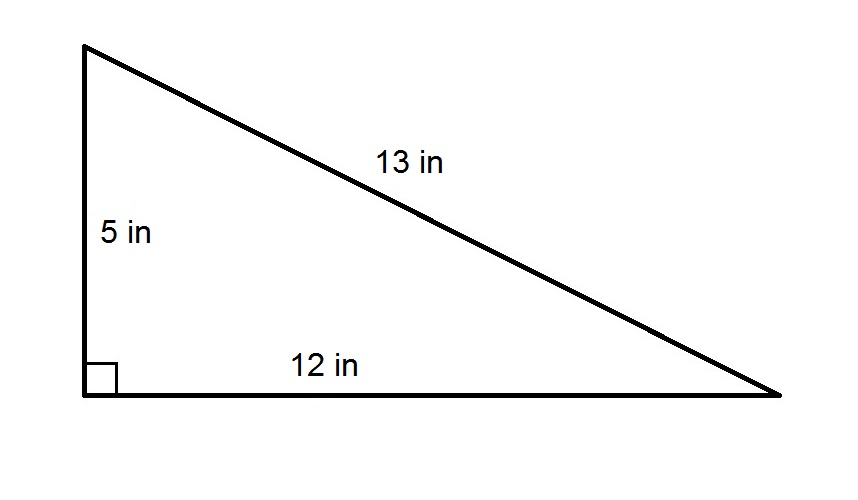
Refer to the above figure. Which is the greater quantity?
(a) The perimeter of the triangle
(b) 3 feet
Refer to the above figure. Which is the greater quantity?
(a) The perimeter of the triangle
(b) 3 feet
The perimeter of the triangle - the sum of the lengths of its sides - is
 inches.
3 feet are equivalent to  inches, so this is the greater quantity.
The perimeter of the triangle - the sum of the lengths of its sides - is
3 feet are equivalent to
Compare your answer with the correct one above
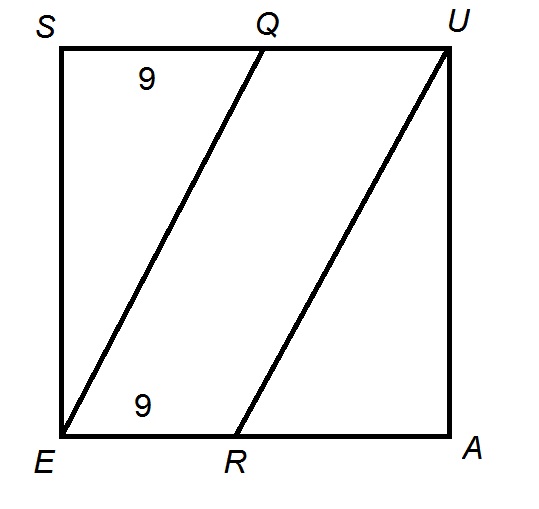
Figure NOT drawn to scale.
In the above diagram, Square  has area 400. Which is the greater quantity?
(a) The area of 
(b) The area of 
Figure NOT drawn to scale.
In the above diagram, Square
(a) The area of
(b) The area of
Square  has area 400, so its common sidelength is the square root of 400, or 20. Therefore,
 .
.
The area of a right triangle is half the product of the lengths of its legs.
 has legs
  and
and  , so its area is
 .
.
 has legs
  and
and  , so its area is
 .
.
 has the greater area.
Square
The area of a right triangle is half the product of the lengths of its legs.
Compare your answer with the correct one above
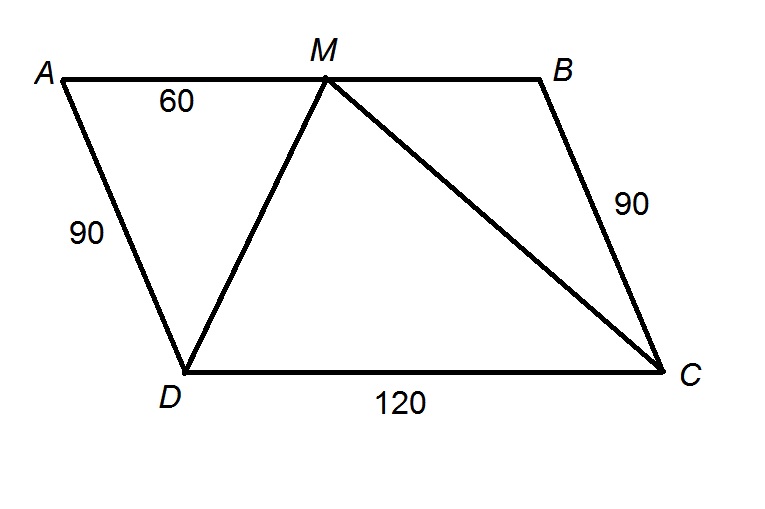
Figure NOT drawn to scale
The above diagram depicts Parallelogram  . Which is the greater quantity?
(a) The area of 
(b) The area of 
Figure NOT drawn to scale
The above diagram depicts Parallelogram
(a) The area of
(b) The area of
Opposite sides of a parallelogram have the same measure, so





Base  of
of  and base
  of
of  have the same length; also, as can be seen below, both have the same height, which is the height of the parallelogram.
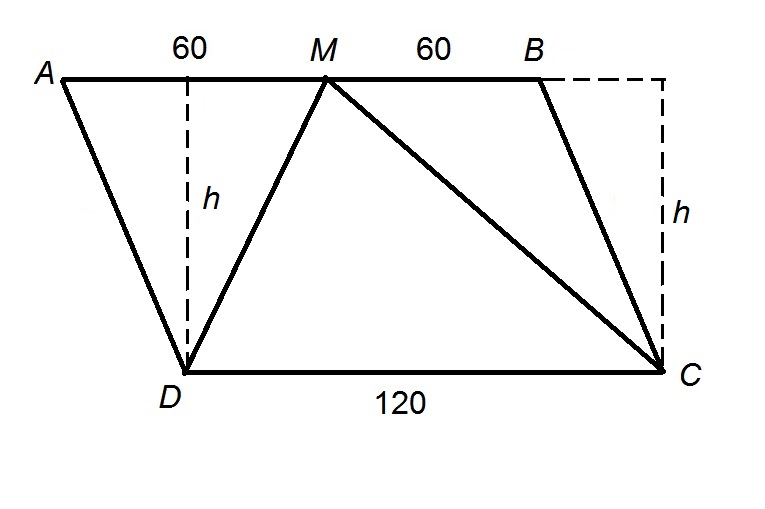
Therefore, the areas of  and
and  have the same area -
 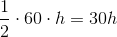 .
.
Opposite sides of a parallelogram have the same measure, so
Base
Therefore, the areas of
Compare your answer with the correct one above
Which is the greater quantity?
(a) 370 meters
(b) 3,700 centimeters
Which is the greater quantity?
(a) 370 meters
(b) 3,700 centimeters
One meter is equivalent to 100 centimeters, so 370 meters can be converted to centimeters by multiplying by 100:
 .
.
370 meters are equal to 37.000 centimeters and is the greater quantity.
One meter is equivalent to 100 centimeters, so 370 meters can be converted to centimeters by multiplying by 100:
370 meters are equal to 37.000 centimeters and is the greater quantity.
Compare your answer with the correct one above
Which is the greater quantity?
(a) 4.8 kilometers
(b) 4,800 meters
Which is the greater quantity?
(a) 4.8 kilometers
(b) 4,800 meters
One kilometer is equal to 1,000 meters, so convert 4.8 kilometers to meters by multiplying by 1,000:
 meters
The two quantities are equal.
One kilometer is equal to 1,000 meters, so convert 4.8 kilometers to meters by multiplying by 1,000:
The two quantities are equal.
Compare your answer with the correct one above
Which is the greater quantity?
(a) The sidelength of a cube with surface area 
(b) The sidelength of a cube with volume 
Which is the greater quantity?
(a) The sidelength of a cube with surface area
(b) The sidelength of a cube with volume
(a) A cube has six faces, each a square. Since the surface area of this cube is  , each face has one-sixth this area, or
  ; the sidelength is the square root of this, or
  .
.
(b) The volume of a cube is the cube of its sidelength, so we take the cube root of the volume of this cube to get the sidelength:

The cubes have the same sidelength.
(a) A cube has six faces, each a square. Since the surface area of this cube is
(b) The volume of a cube is the cube of its sidelength, so we take the cube root of the volume of this cube to get the sidelength:
The cubes have the same sidelength.
Compare your answer with the correct one above
Which is the greater quantity?
(a) The volume of a rectangular prism with length 60 centimeters, width 30 centimeters, and height 15 centimeters
(b) The volume of a cube with sidelength 300 millimeters
Which is the greater quantity?
(a) The volume of a rectangular prism with length 60 centimeters, width 30 centimeters, and height 15 centimeters
(b) The volume of a cube with sidelength 300 millimeters
(a) The volume of the prism is the product of its length, its width, and its height:

(b) The volume of the cube is the cube of its sidelength. We restate 300 millimeters as 30 centimeters, and cube this:

The volumes are equal.
(a) The volume of the prism is the product of its length, its width, and its height:
(b) The volume of the cube is the cube of its sidelength. We restate 300 millimeters as 30 centimeters, and cube this:
The volumes are equal.
Compare your answer with the correct one above
Give the area of the above triangle.
Give the area of the above triangle.
The area of a right triangle is half the product of the lengths of its legs, which here are 25 and 60. So
The area of a right triangle is half the product of the lengths of its legs, which here are 25 and 60. So
Compare your answer with the correct one above
If a parallelogram has side lengths of  and
and  , what is the area?
If a parallelogram has side lengths of
To find the area of a parallelogram, you use the formula,
 .
.
Since the height in this problem is not known, you cannot solve for area.
To find the area of a parallelogram, you use the formula,
Since the height in this problem is not known, you cannot solve for area.
Compare your answer with the correct one above
What is the area of the triangle?
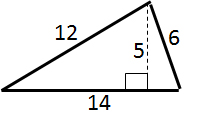
What is the area of the triangle?
Area of a triangle can be determined using the equation:

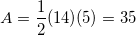
Area of a triangle can be determined using the equation:
Compare your answer with the correct one above
What is the area of a triangle with a base of  and a height of
  ?
?
What is the area of a triangle with a base of
The formula for the area of a triangle is  .
.
Plug the given values into the formula to solve:


The formula for the area of a triangle is
Plug the given values into the formula to solve:
Compare your answer with the correct one above