
Geometry - ISEE Middle Level Quantitative Reasoning
Card 0 of 1110
Give the equation of the line through point  that has slope
  .
.
Give the equation of the line through point
Use the point-slope formula with 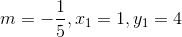

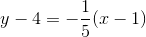
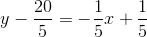
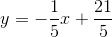
Use the point-slope formula with
Compare your answer with the correct one above
Which is the greater quantity?
(A) The slope of the line 
(B) The slope of the line 
Which is the greater quantity?
(A) The slope of the line
(B) The slope of the line
Rewrite each in the slope-intercept form,  ;
;  will be the slope.





The slope of the line of  is
is 



The slope of the line of  is also
The slopes are equal.
Rewrite each in the slope-intercept form,
The slope of the line of
The slope of the line of
The slopes are equal.
Compare your answer with the correct one above
Which is the greater quantity?
(A) The slope of the line 
(B) The slope of the line 
Which is the greater quantity?
(A) The slope of the line
(B) The slope of the line
Rewrite each in the slope-intercept form, ; will be the slope.




The slope of this line is  .
.




The slope of this line is  .
.
Since  , (A) is greater.
Rewrite each in the slope-intercept form,
The slope of this line is
The slope of this line is
Since
Compare your answer with the correct one above
 and
and  are positive integers, and
  . Which is the greater quantity?
(a) The slope of the line on the coordinate plane through the points  and
and  .
.
(b) The slope of the line on the coordinate plane through the points  and
and  .
.
(a) The slope of the line on the coordinate plane through the points
(b) The slope of the line on the coordinate plane through the points
The slope of a line through the points  and
and  can be found by setting

in the slope formula:
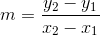
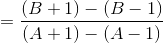
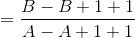


The slope of a line through the points  and
and  can be found similarly:
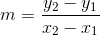
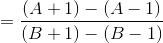
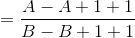


The lines have the same slope.
The slope of a line through the points
in the slope formula:
The slope of a line through the points
The lines have the same slope.
Compare your answer with the correct one above
A line passes through the points with coordinates  and
and  , where
  . Which expression is equal to the slope of the line?
A line passes through the points with coordinates
The slope of a line through the points  and
and  , can be found by setting
 :
:
in the slope formula:

The slope of a line through the points
in the slope formula:
Compare your answer with the correct one above
Choose the best answer from the four choices given.
The point (15, 6) is on which of the following lines?
Choose the best answer from the four choices given.
The point (15, 6) is on which of the following lines?
For this problem, simply plug in the values for the point (15,6) into the different equations (15 for the  -value and 6 for the
  -value) to see which one fits.
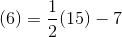 (NO)
(NO)
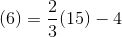 (YES!)
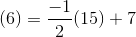 (NO)
(NO)
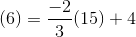 (NO)
(NO)
For this problem, simply plug in the values for the point (15,6) into the different equations (15 for the
Compare your answer with the correct one above
Choose the best answer from the four choices given.
What is the point of intersection for the following two lines?

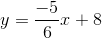
Choose the best answer from the four choices given.
What is the point of intersection for the following two lines?
At the intersection point of the two lines the  - and
- and  - values for each equation will be the same. Thus, we can set the two equations as equal to each other:
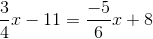
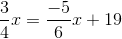
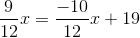

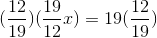

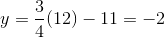
point of intersection 
At the intersection point of the two lines the
point of intersection
Compare your answer with the correct one above
Choose the best answer from the four choices given.
What is the  -intercept of the line represented by the equation

Choose the best answer from the four choices given.
What is the
In the formula  , the y-intercept is represented by
  (because if you set
  to zero, you are left with
  ).
).
Thus, to find the  -intercept, set the
  value to zero and solve for
  .
.


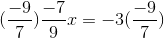
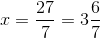
In the formula
Thus, to find the
Compare your answer with the correct one above
The ordered pair  is in which quadrant?
The ordered pair
There are four quadrants in the coordinate plane. Quadrant I is the top right, and they are numbered counter-clockwise. Since the x-coordinate is  , you go to the left one unit (starting from the origin). Since the y-coordinate is
  , you go upwards four units. Therefore, you are in Quadrant II.
There are four quadrants in the coordinate plane. Quadrant I is the top right, and they are numbered counter-clockwise. Since the x-coordinate is
Compare your answer with the correct one above
If angles s and r add up to 180 degrees, which of the following best describes them?
If angles s and r add up to 180 degrees, which of the following best describes them?
Two angles that are supplementary add up to 180 degrees. They cannot both be acute, nor can they both be obtuse. Therefore, "Supplementary" is the correct answer.
Two angles that are supplementary add up to 180 degrees. They cannot both be acute, nor can they both be obtuse. Therefore, "Supplementary" is the correct answer.
Compare your answer with the correct one above
The lines of the equations

and

intersect at a point  .
.
Which is the greater quantity?
(a) 
(b) 
The lines of the equations
and
intersect at a point
Which is the greater quantity?
(a)
(b)
If  and
and  , we can substitute in the second equation as follows:




Substitute:


If
Substitute:
Compare your answer with the correct one above
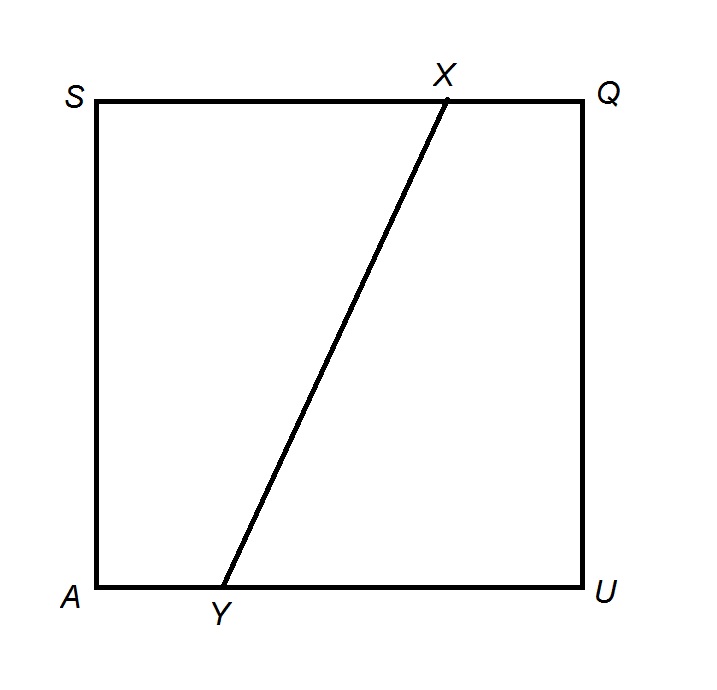
Note: Figure NOT drawn to scale
The above figure shows Square  .
.

Which is the greater quantity?
(a) The area of Trapezoid 
(b) The area of Trapezoid 
Note: Figure NOT drawn to scale
The above figure shows Square
Which is the greater quantity?
(a) The area of Trapezoid
(b) The area of Trapezoid
The easiest way to answer the question is to locate  on
on  such that
  :
:
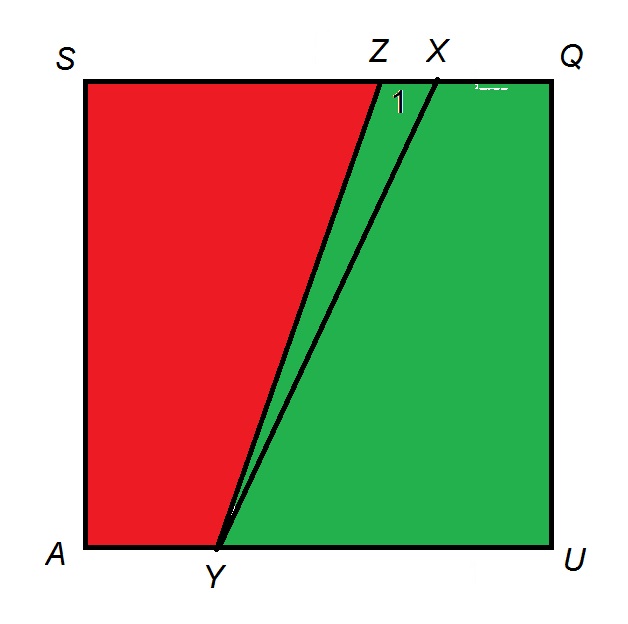
Trapezoids  and
and  have the same height, which is
  . Their bases, by construction, have the same lengths -
  and
and  . Therefore, Trapezoids
  and
and  have the same area.
Since , it follows that  , and
, and  . It follows that Trapezoid
  is greater in area than Trapezoids
  and
and  , and Trapezoid is less in area.
The easiest way to answer the question is to locate
Trapezoids
Since
Compare your answer with the correct one above
A triangle has base 80 inches and area 4,200 square inches. What is its height?
A triangle has base 80 inches and area 4,200 square inches. What is its height?
Use the area formula for a triangle, setting  :
:


 inches
Use the area formula for a triangle, setting
Compare your answer with the correct one above
The sum of the lengths of the legs of an isosceles right triangle is one meter. What is its area in square centimeters?
The sum of the lengths of the legs of an isosceles right triangle is one meter. What is its area in square centimeters?
The legs of an isosceles right triangle have equal length, so, if the sum of their lengths is one meter, which is equal to 100 centimeters, each leg measures half of this, or
 centimeters.
The area of a triangle is half the product of its height and base; for a right triangle, the legs serve as height and base, so the area of the triangle is
 square centimeters.
The legs of an isosceles right triangle have equal length, so, if the sum of their lengths is one meter, which is equal to 100 centimeters, each leg measures half of this, or
The area of a triangle is half the product of its height and base; for a right triangle, the legs serve as height and base, so the area of the triangle is
Compare your answer with the correct one above

Figure NOT drawn to scale
Square  has area 1,600.
  ;
;  . Which of the following is the greater quantity?
(a) The area of 
(b) The area of 
Figure NOT drawn to scale
Square
(a) The area of
(b) The area of
Square  has area 1,600, so the length of each side is
  .
.
Since  ,
,

Therefore,  .
.
 has as its area
  ;
;  has as its area
  .
.
Since  and
and  , it follows that

and

 has greater area than
  .
.
Square
Since
Therefore,
Since
and
Compare your answer with the correct one above
The above figure depicts Square  .
.  ,
,  , and
, and  are the midpoints of
  ,
,  , and
, and  , respectively.
 has area
  . What is the area of Square
  ?
?
The above figure depicts Square
Since , , and are the midpoints of , , and , if we call  the length of each side of the square, then

The area of  is half the product of the lengths of its legs:


The area of the square is the square of the length of a side, which is  . This is eight times the area of
  , so the correct choice is
Since
The area of
The area of the square is the square of the length of a side, which is
Compare your answer with the correct one above

Which of the following is the greater quantity?
(a) The area of the above triangle
(b) 800
Which of the following is the greater quantity?
(a) The area of the above triangle
(b) 800
The area of a right triangle is half the product of the lengths of its legs, which here are 25 and 60. So

which is less than 800.
The area of a right triangle is half the product of the lengths of its legs, which here are 25 and 60. So
which is less than 800.
Compare your answer with the correct one above

The above figure gives the lengths of the three sides of the triangle in feet. Give its area in square inches.
The above figure gives the lengths of the three sides of the triangle in feet. Give its area in square inches.
The area of a right triangle is half the product of the lengths of its legs, which here are  feet and
  feet.
feet.
Multiply each length by 12 to convert to inches - the lengths become  and
and  . The area in square inches is therefore
 square inches.
The area of a right triangle is half the product of the lengths of its legs, which here are
Multiply each length by 12 to convert to inches - the lengths become
Compare your answer with the correct one above
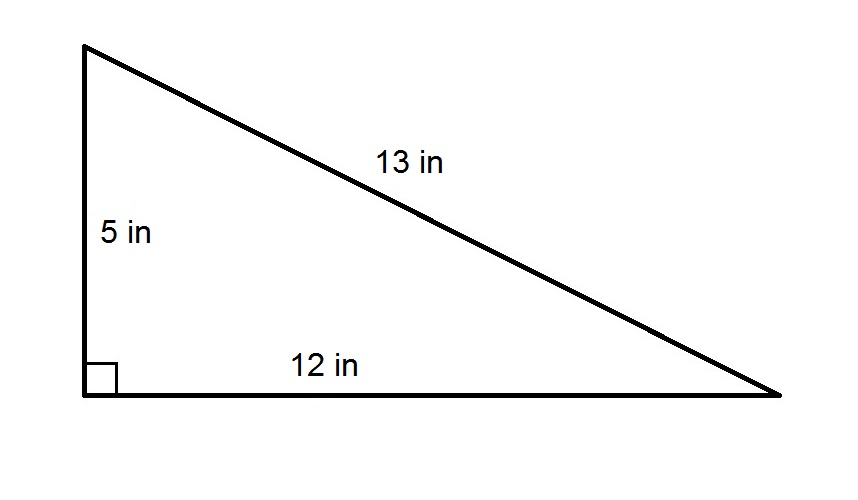
Refer to the above figure. Which is the greater quantity?
(a) The perimeter of the triangle
(b) 3 feet
Refer to the above figure. Which is the greater quantity?
(a) The perimeter of the triangle
(b) 3 feet
The perimeter of the triangle - the sum of the lengths of its sides - is
 inches.
3 feet are equivalent to  inches, so this is the greater quantity.
The perimeter of the triangle - the sum of the lengths of its sides - is
3 feet are equivalent to
Compare your answer with the correct one above
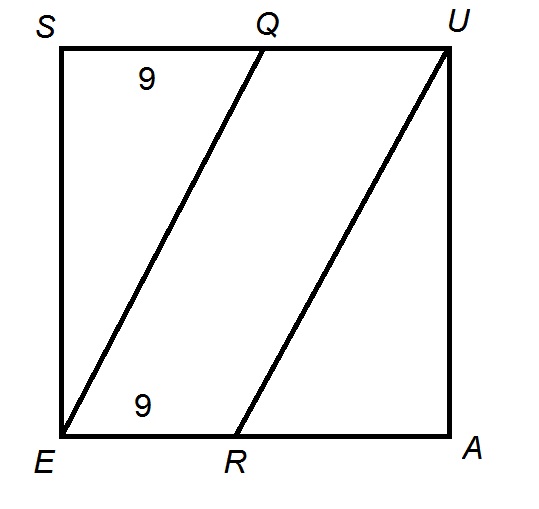
Figure NOT drawn to scale.
In the above diagram, Square  has area 400. Which is the greater quantity?
(a) The area of 
(b) The area of 
Figure NOT drawn to scale.
In the above diagram, Square
(a) The area of
(b) The area of
Square  has area 400, so its common sidelength is the square root of 400, or 20. Therefore,
 .
.
The area of a right triangle is half the product of the lengths of its legs.
 has legs
  and
and  , so its area is
 .
.
 has legs
  and
and  , so its area is
 .
.
 has the greater area.
Square
The area of a right triangle is half the product of the lengths of its legs.
Compare your answer with the correct one above