
How to find the perimeter of a parallelogram
ISEE Middle Level Quantitative Reasoning · Learn by Concept
Help Questions
ISEE Middle Level Quantitative Reasoning › How to find the perimeter of a parallelogram
If a parallelogram has side lengths of 


Explanation
The perimeter of a parallelogram is two times the two side lengths and add them together.
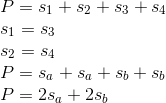
Therefore, this particular problem becomes as follows.

and

so

If the perimter of a parallelogram is 


The answer cannot be found


Explanation
The perimeter of a parallelogram is found by adding up all four sides.
Since there are two pairs of side with equal lengths, two sides must have a length of 
So the perimeter would be


To find the value of the other side length, you would divide the remaining perimeter not include in the other sides by 
So 
That means the other side length would be 
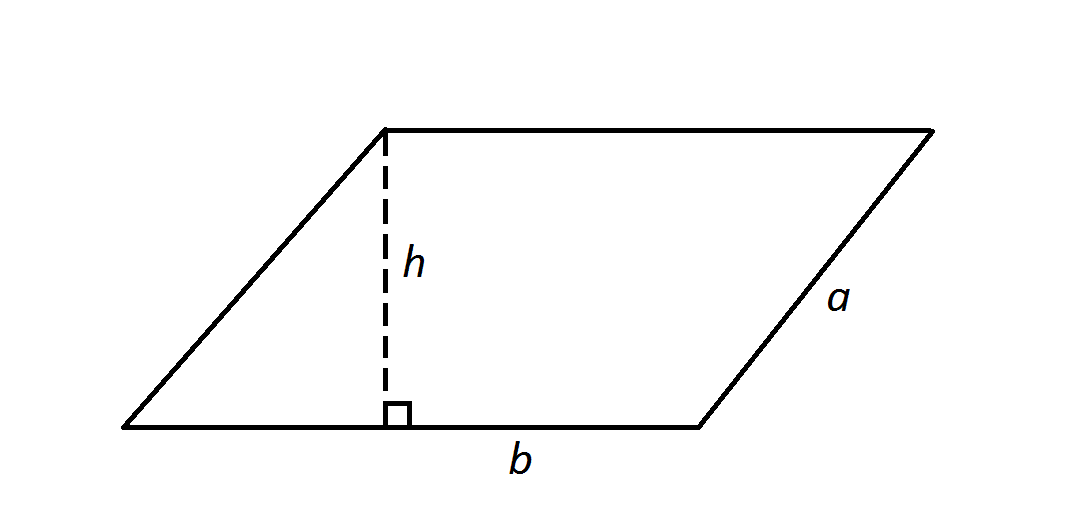
Note: Figure NOT drawn to scale.



Find the perimeter of the parallelogram in the diagram.


Explanation
The perimeter of the parallelogram is the sum of the four side lengths - here, that formula becomes

Note that the height 
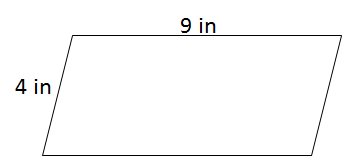
Find the perimeter of the parallelogram.
26 in
13 in
36 in
18 in
Explanation
To find the perimeter of a parallelogram, add the lengths of the sides. Opposite sides of a parallelogram are equivalent.
