
Whole and Part - ISEE Middle Level Quantitative Reasoning
Card 0 of 775
Red is a very popular car color. A production company manufactures cars and parks them in a lot behind the plant. There are  cars in the parking lot and
  of them are red. How many red cars are in the parking lot?
Red is a very popular car color. A production company manufactures cars and parks them in a lot behind the plant. There are
We can use ratios and proportions to solve this problem. Percentages can be written as ratios. The word “percent” means for every hundred. In the problem, we are told that  of the cars are red. In other words, for every hundred cars
  of them are red. We can write the following ratio:

Reduce.

We know that there are  cars in the parking lot. We can write the following ratio by substituting the variable
  for the number of red cars:

Now, we can create a proportion using our two ratios.

Cross multiply and solve for  .
.

Simplify.

Divide both sides of the equation by  .
.

Solve.

There are  red cars in the parking lot.
We can use ratios and proportions to solve this problem. Percentages can be written as ratios. The word “percent” means for every hundred. In the problem, we are told that
Reduce.
We know that there are
Now, we can create a proportion using our two ratios.
Cross multiply and solve for
Simplify.
Divide both sides of the equation by
Solve.
There are
Compare your answer with the correct one above
Red is a very popular car color. A production company manufactures cars and parks them in a lot behind the plant. There are  cars in the parking lot and
  of them are red. How many red cars are in the parking lot?
Red is a very popular car color. A production company manufactures cars and parks them in a lot behind the plant. There are
We can use ratios and proportions to solve this problem. Percentages can be written as ratios. The word “percent” means for every hundred. In the problem, we are told that  of the cars are red. In other words, for every hundred cars
  of them are red. We can write the following ratio:

Reduce.

We know that there are  cars in the parking lot. We can write the following ratio by substituting the variable
  for the number of red cars:

Now, we can create a proportion using our two ratios.

Cross multiply and solve for  .
.

Simplify.

Divide both sides of the equation by  .
.

Solve.

There are  red cars in the parking lot.
We can use ratios and proportions to solve this problem. Percentages can be written as ratios. The word “percent” means for every hundred. In the problem, we are told that
Reduce.
We know that there are
Now, we can create a proportion using our two ratios.
Cross multiply and solve for
Simplify.
Divide both sides of the equation by
Solve.
There are
Compare your answer with the correct one above
Red is a very popular car color. A production company manufactures cars and parks them in a lot behind the plant. There are  cars in the parking lot and
  of them are red. How many red cars are in the parking lot?
Red is a very popular car color. A production company manufactures cars and parks them in a lot behind the plant. There are
We can use ratios and proportions to solve this problem. Percentages can be written as ratios. The word “percent” means for every hundred. In the problem, we are told that  of the cars are red. In other words, for every hundred cars
  of them are red. We can write the following ratio:

Reduce.

We know that there are  cars in the parking lot. We can write the following ratio by substituting the variable
  for the number of red cars:

Now, we can create a proportion using our two ratios.

Cross multiply and solve for  .
.

Simplify.

Divide both sides of the equation by  .
.

Solve.

There are  red cars in the parking lot.
We can use ratios and proportions to solve this problem. Percentages can be written as ratios. The word “percent” means for every hundred. In the problem, we are told that
Reduce.
We know that there are
Now, we can create a proportion using our two ratios.
Cross multiply and solve for
Simplify.
Divide both sides of the equation by
Solve.
There are
Compare your answer with the correct one above
Red is a very popular car color. A production company manufactures cars and parks them in a lot behind the plant. There are  cars in the parking lot and
  of them are red. How many red cars are in the parking lot?
Red is a very popular car color. A production company manufactures cars and parks them in a lot behind the plant. There are
We can use ratios and proportions to solve this problem. Percentages can be written as ratios. The word “percent” means for every hundred. In the problem, we are told that  of the cars are red. In other words, for every hundred cars
  of them are red. We can write the following ratio:

Reduce.

We know that there are  cars in the parking lot. We can write the following ratio by substituting the variable
  for the number of red cars:

Now, we can create a proportion using our two ratios.

Cross multiply and solve for  .
.

Simplify.

Divide both sides of the equation by  .
.

Solve.

There are  red cars in the parking lot.
We can use ratios and proportions to solve this problem. Percentages can be written as ratios. The word “percent” means for every hundred. In the problem, we are told that
Reduce.
We know that there are
Now, we can create a proportion using our two ratios.
Cross multiply and solve for
Simplify.
Divide both sides of the equation by
Solve.
There are
Compare your answer with the correct one above
Red is a very popular car color. A production company manufactures cars and parks them in a lot behind the plant. There are  cars in the parking lot and
  of them are red. How many red cars are in the parking lot?
Red is a very popular car color. A production company manufactures cars and parks them in a lot behind the plant. There are
We can use ratios and proportions to solve this problem. Percentages can be written as ratios. The word “percent” means for every hundred. In the problem, we are told that  of the cars are red. In other words, for every hundred cars
  of them are red. We can write the following ratio:

Reduce.

We know that there are  cars in the parking lot. We can write the following ratio by substituting the variable
  for the number of red cars:

Now, we can create a proportion using our two ratios.

Cross multiply and solve for  .
.

Simplify.

Divide both sides of the equation by  .
.

Solve.

There are  red cars in the parking lot.
We can use ratios and proportions to solve this problem. Percentages can be written as ratios. The word “percent” means for every hundred. In the problem, we are told that
Reduce.
We know that there are
Now, we can create a proportion using our two ratios.
Cross multiply and solve for
Simplify.
Divide both sides of the equation by
Solve.
There are
Compare your answer with the correct one above
Red is a very popular car color. A production company manufactures cars and parks them in a lot behind the plant. There are  cars in the parking lot and
  of them are red. How many red cars are in the parking lot?
Red is a very popular car color. A production company manufactures cars and parks them in a lot behind the plant. There are
We can use ratios and proportions to solve this problem. Percentages can be written as ratios. The word “percent” means for every hundred. In the problem, we are told that  of the cars are red. In other words, for every hundred cars
  of them are red. We can write the following ratio:

Reduce.

We know that there are  cars in the parking lot. We can write the following ratio by substituting the variable
  for the number of red cars:

Now, we can create a proportion using our two ratios.

Cross multiply and solve for  .
.

Simplify.

Divide both sides of the equation by  .
.

Solve.

There are  red cars in the parking lot.
We can use ratios and proportions to solve this problem. Percentages can be written as ratios. The word “percent” means for every hundred. In the problem, we are told that
Reduce.
We know that there are
Now, we can create a proportion using our two ratios.
Cross multiply and solve for
Simplify.
Divide both sides of the equation by
Solve.
There are
Compare your answer with the correct one above
Red is a very popular car color. A production company manufactures cars and parks them in a lot behind the plant. There are  cars in the parking lot and
  of them are red. How many red cars are in the parking lot?
Red is a very popular car color. A production company manufactures cars and parks them in a lot behind the plant. There are
We can use ratios and proportions to solve this problem. Percentages can be written as ratios. The word “percent” means for every hundred. In the problem, we are told that  of the cars are red. In other words, for every hundred cars
  of them are red. We can write the following ratio:

Reduce.

We know that there are  cars in the parking lot. We can write the following ratio by substituting the variable
  for the number of red cars:

Now, we can create a proportion using our two ratios.

Cross multiply and solve for  .
.

Simplify.

Divide both sides of the equation by  .
.

Solve.

There are  red cars in the parking lot.
We can use ratios and proportions to solve this problem. Percentages can be written as ratios. The word “percent” means for every hundred. In the problem, we are told that
Reduce.
We know that there are
Now, we can create a proportion using our two ratios.
Cross multiply and solve for
Simplify.
Divide both sides of the equation by
Solve.
There are
Compare your answer with the correct one above
Red is a very popular car color. A production company manufactures cars and parks them in a lot behind the plant. There are  cars in the parking lot and
  of them are red. How many red cars are in the parking lot?
Red is a very popular car color. A production company manufactures cars and parks them in a lot behind the plant. There are
We can use ratios and proportions to solve this problem. Percentages can be written as ratios. The word “percent” means for every hundred. In the problem, we are told that  of the cars are red. In other words, for every hundred cars
  of them are red. We can write the following ratio:

Reduce.

We know that there are  cars in the parking lot. We can write the following ratio by substituting the variable
  for the number of red cars:

Now, we can create a proportion using our two ratios.

Cross multiply and solve for  .
.

Simplify.

Divide both sides of the equation by  .
.

Solve.

There are  red cars in the parking lot.
We can use ratios and proportions to solve this problem. Percentages can be written as ratios. The word “percent” means for every hundred. In the problem, we are told that
Reduce.
We know that there are
Now, we can create a proportion using our two ratios.
Cross multiply and solve for
Simplify.
Divide both sides of the equation by
Solve.
There are
Compare your answer with the correct one above
You are given a bag with 5 red marbles, 3 green marbles and 7 blue marbles. What percent of the bag are red marbles?
You are given a bag with 5 red marbles, 3 green marbles and 7 blue marbles. What percent of the bag are red marbles?
When finding the percent, we must take the part and divide it by the whole.

In this case, 5 is the part and we must find the sum of everything to make the whole as shown in the denominator below.

We can now reduce the fraction and convert to percent.

When finding the percent, we must take the part and divide it by the whole.
In this case, 5 is the part and we must find the sum of everything to make the whole as shown in the denominator below.
We can now reduce the fraction and convert to percent.
Compare your answer with the correct one above
 and
and  are positive integers;
  . Which is the greater quantity?
(a)  of
of 
(b)  of
of 
(a)
(b)
 of
of  is equal to

 of
of  is equal to

The two are equal regardless of the value or relation of  and
and  .
.
The two are equal regardless of the value or relation of
Compare your answer with the correct one above
and are positive integers; . Which is the greater quantity?
(a)  of
of 
(b) 0.5 % of 
(a)
(b) 0.5 % of
 , so 0.5% of a number is the same as
  of the number. Therefore, in each choice, we are taking the same percent of a number. Since , 0.5%, or
  , of
, of  is less than 0.5% of
  .
.
Compare your answer with the correct one above
40% of  is 200
70% of  is 350
Which is the greater quantity?
(a) 
(b) 
40% of
70% of
Which is the greater quantity?
(a)
(b)
Each statement can be written as a proportion, and solved for its variable by cross-multiplying. In each case, we replace as follows:

(a) The percent is 40, the part is 200, and the whole is  :
:


(b) The percent is 70, the part is 350, and the whole is  :
:


Each statement can be written as a proportion, and solved for its variable by cross-multiplying. In each case, we replace as follows:
(a) The percent is 40, the part is 200, and the whole is
(b) The percent is 70, the part is 350, and the whole is
Compare your answer with the correct one above
Chet bought an MP3 player and got $14.50 back in change. The tax on the MP3 player was 5%.
Which is the greater quantity?
(a) The price of the MP3 player before tax
(b) 
Chet bought an MP3 player and got $14.50 back in change. The tax on the MP3 player was 5%.
Which is the greater quantity?
(a) The price of the MP3 player before tax
(b)
No clue is given as to how much Chet paid for the device - neither the price paid for the player nor the amount of money Chet gave the clerk is given here.
No clue is given as to how much Chet paid for the device - neither the price paid for the player nor the amount of money Chet gave the clerk is given here.
Compare your answer with the correct one above
Albert sent a letter to his penpal everyday for the entire month of January and February. How many letters did Albert send his penpal?
Albert sent a letter to his penpal everyday for the entire month of January and February. How many letters did Albert send his penpal?
Add the total days in January and February:

Answer: Albert sent his penpal 59 letters.
Add the total days in January and February:
Answer: Albert sent his penpal 59 letters.
Compare your answer with the correct one above
Harvey bought a suit at a 25% employee discount at the store where he works. The suit originally cost $350.00. How much did he end up paying?
Harvey bought a suit at a 25% employee discount at the store where he works. The suit originally cost $350.00. How much did he end up paying?
Finding 25% of a number is the same as multiplying it by 0.25; to get the discount, multiply 0.25 by the original purchase price of $350.00

To get the price Harvey paid, subtract the discount from the original price:

Finding 25% of a number is the same as multiplying it by 0.25; to get the discount, multiply 0.25 by the original purchase price of $350.00
To get the price Harvey paid, subtract the discount from the original price:
Compare your answer with the correct one above
 is a positive integer. Which is the greater quantity?
(a) The remainder if  is divided by 5
(b) The remainder if  is divided by 4
(a) The remainder if
(b) The remainder if
The information is insufficient.
For example, if  :
:
 .
.

 .
.

This gives the division in (b) the greater remainder.
But if  :
:
 .
.

 .
.

This gives the division in (a) the greater remainder.
The information is insufficient.
For example, if
This gives the division in (b) the greater remainder.
But if
This gives the division in (a) the greater remainder.
Compare your answer with the correct one above

Which of the following is true if  ?
?
Which of the following is true if
Two expressions are equivalent in modulo 9 arithmetic if and only if, when each is divided by 9, the same remainder is yielded.
 ,
,
so




 , so
, so
 is the correct choice.
Two expressions are equivalent in modulo 9 arithmetic if and only if, when each is divided by 9, the same remainder is yielded.
so
Compare your answer with the correct one above
is a positive even integer. Which is the greater quantity?
(a) The remainder if  is divided by 6
(b) The remainder if  is divided by 3.
(a) The remainder if
(b) The remainder if
Since  is an even integer, by definition, there is an integer
  such that
 .
.
 ; therefore,
 ; the remainder is 0.
Also,
 ; the remainder is 0.
The two remainders are both equal to 0.
Since
Also,
The two remainders are both equal to 0.
Compare your answer with the correct one above
is a positive odd integer. Which is the greater quantity?
(a) The remainder if is divided by 8
(b) The remainder if  is divided by 4
(a) The remainder if
(b) The remainder if
 , with a remainder of 0.
If  were to yield a remainder of 0, then
 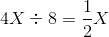 must be a whole number; this can only happen if
  is even. Since
  is odd, it follows that
  is not a whole number, and
  must yield a nonzero remainder. (a) must be the greater quantity.
If
Compare your answer with the correct one above
150% of what number is 9,000?
150% of what number is 9,000?
Taking 150% of a number is the same as multiplying that number by 1.5. We can find our number, therefore, by dividing 9,000 by 1.5:

Taking 150% of a number is the same as multiplying that number by 1.5. We can find our number, therefore, by dividing 9,000 by 1.5:
Compare your answer with the correct one above