
Percentage - ISEE Middle Level Quantitative Reasoning
Card 0 of 1480
What is the equivalent of  %.
%.
What is the equivalent of
To solve, divide: 
Answer: 
To solve, divide:
Answer:
Compare your answer with the correct one above
What is the equivalent of  %.
%.
What is the equivalent of
To solve, divide: 
Answer: 
To solve, divide:
Answer:
Compare your answer with the correct one above
Find the decimal equivalent of  .
.
Find the decimal equivalent of
To solve, divide:

Answer: 
To solve, divide:
Answer:
Compare your answer with the correct one above
What is the equivalent of  %?
%?
What is the equivalent of
To solve, divide: 
Answer: 
To solve, divide:
Answer:
Compare your answer with the correct one above
What is the equivalent of  %?
%?
What is the equivalent of
To solve, divide:

Answer: 
To solve, divide:
Answer:
Compare your answer with the correct one above
What is the equivalent of  %?
%?
What is the equivalent of
To solve, divide:

Answer: 
To solve, divide:
Answer:
Compare your answer with the correct one above
What is the equivalent of  %?
%?
What is the equivalent of
To solve, divide:

Answer: 
To solve, divide:
Answer:
Compare your answer with the correct one above
What is the equivalent of  %?
%?
What is the equivalent of
To solve, divide:

Answer: 
To solve, divide:
Answer:
Compare your answer with the correct one above
What is the percent change from 60 to 54?
What is the percent change from 60 to 54?
The change from 60 to 54 is a decrease in 6 from the base of 60.
Given that  , there is a 10 percent decrease. Thus, "10 percent decrease" is the correct answer.
The change from 60 to 54 is a decrease in 6 from the base of 60.
Given that
Compare your answer with the correct one above
What is the equivalent of  %?
%?
What is the equivalent of
To solve, divide: 
Answer: 
To solve, divide:
Answer:
Compare your answer with the correct one above
If 6 out of 8 dogs at a pound get adopted, what percentage of the dogs will get adopted?
If 6 out of 8 dogs at a pound get adopted, what percentage of the dogs will get adopted?
If 6 out of 8 dogs get adopted, that means that  are adopted.
 .
.
 of 100 is 75. Therefore, 75 percent of the dogs were adopted.
If 6 out of 8 dogs get adopted, that means that
Compare your answer with the correct one above
 is a positive number. Which is the greater quantity?
(a) 25% of one third of 
(b) 33% of one fourth of 
(a) 25% of one third of
(b) 33% of one fourth of
25% of a number is the same as that number multiplied by  , so 25% of one third of is equal to
  .
.
Similarly, 33% of a number is the same as that number multiplied by  , so 33% of one fourth of is equal to
We can compare these quantities by finding a common denominator.  , so
, so

and
 .
.
25% of one third of  is the greater quantity.
25% of a number is the same as that number multiplied by
Similarly, 33% of a number is the same as that number multiplied by
We can compare these quantities by finding a common denominator.
and
25% of one third of
Compare your answer with the correct one above
Using the information given in each question, compare the quantity in Column A to the quantity in Column B.
Jack scores a 40 on his first test and improves his score by 80% on his second test. Jill scores 50 on her first test, and her second test is 130% of her first test.
Column A Column B
Jack's 2nd Jill's 2nd
test score test score
Using the information given in each question, compare the quantity in Column A to the quantity in Column B.
Jack scores a 40 on his first test and improves his score by 80% on his second test. Jill scores 50 on her first test, and her second test is 130% of her first test.
Column A Column B
Jack's 2nd Jill's 2nd
test score test score
Jack improves by 80%, so we multiply his original score by 1.8 (the 1 to represent his earlier score and the .8 to add on his improvement). 40% times 1.8 equals 72%.
Jill's second test is 130% of her first test (that is, a 30% improvement). To find her new score we multiply her first score by 1.3. 50% times 1.3 equals 65%.
Thus, Jack's second test score is higher.
Jack improves by 80%, so we multiply his original score by 1.8 (the 1 to represent his earlier score and the .8 to add on his improvement). 40% times 1.8 equals 72%.
Jill's second test is 130% of her first test (that is, a 30% improvement). To find her new score we multiply her first score by 1.3. 50% times 1.3 equals 65%.
Thus, Jack's second test score is higher.
Compare your answer with the correct one above
1,111 is  of 999
999 is  of 1,111
Which is the greater quantity?
(a) 
(b) 
1,111 is
999 is
Which is the greater quantity?
(a)
(b)
No calculation is necessary. In (a), the part is greater than the whole, so the percent  must be greater than 100. In (b) The part is less than the whole, so
  must be less than 100. Therefore,
No calculation is necessary. In (a), the part is greater than the whole, so the percent
Compare your answer with the correct one above
 of 2,001 is 1
 of 1,999 is 1
Which is the greater quantity?
(a) 
(b) 
Which is the greater quantity?
(a)
(b)
No calculation is necessary. The whole in (b) is less, so 1 is a greater portion of that whole than the whole in (a). This makes (b) greater.
No calculation is necessary. The whole in (b) is less, so 1 is a greater portion of that whole than the whole in (a). This makes (b) greater.
Compare your answer with the correct one above
Which is the greater quantity?
(a) 
(b) 
Which is the greater quantity?
(a)
(b)
 can be rewritten as
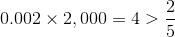
Compare your answer with the correct one above
There were 48 pieces of fruit brought to the brunch. Twelve of the pieces of fruit were bananas. What percentage of the fruit were bananas?
There were 48 pieces of fruit brought to the brunch. Twelve of the pieces of fruit were bananas. What percentage of the fruit were bananas?
Percentage involves part over whole. The total number of fruit was 48. The number of bananas was 12. Therefore, you can make a fraction from those numbers:  . Then, to find the percentage, divide 12 by 48. This gives you 0.25. To find the percentage, move the decimal point to the right two places. This gives you 25%.
Percentage involves part over whole. The total number of fruit was 48. The number of bananas was 12. Therefore, you can make a fraction from those numbers:
Compare your answer with the correct one above
70% of 4,000 is equal to what percent of 6,400?
70% of 4,000 is equal to what percent of 6,400?
70% of 4,000 is equal to  , which is
 percent of 6,400.
Evaluate:

The correct response is 
70% of 4,000 is equal to
Evaluate:
The correct response is
Compare your answer with the correct one above
What is 0.5% of 1,000,000?
What is 0.5% of 1,000,000?
Convert the percentage to a decimal:

Multiply by 1,000,000 to get our answer.

Convert the percentage to a decimal:
Multiply by 1,000,000 to get our answer.
Compare your answer with the correct one above
What is 200% of 1,000?
What is 200% of 1,000?
Convert the percentage to a decimal.

Multiply 1,000 by the decimal value to find the answer.

Convert the percentage to a decimal.
Multiply 1,000 by the decimal value to find the answer.
Compare your answer with the correct one above