
Fractions - ISEE Middle Level Quantitative Reasoning
Card 0 of 3045
Arrange these numbers from least to greatest:
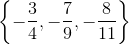
Arrange these numbers from least to greatest:
Rewrite all three numbers as their decimal equivalents by dividing numerator by denominator.
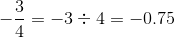


To arrange negative numbers from least to greatest, we must arrange them so that their absolute values (values without the negative symbol) go from greatest to least. In descending order, the absolute values are
 ,
,
so, in ascending order, the numbers themselves are
 ,
,
or, in their fractional equivalents,
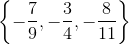 .
.
Rewrite all three numbers as their decimal equivalents by dividing numerator by denominator.
To arrange negative numbers from least to greatest, we must arrange them so that their absolute values (values without the negative symbol) go from greatest to least. In descending order, the absolute values are
so, in ascending order, the numbers themselves are
or, in their fractional equivalents,
Compare your answer with the correct one above
Arrange these numbers from least to greatest:

Arrange these numbers from least to greatest:
Rewrite all three numbers as their decimal equivalents by dividing numerator by denominator.
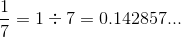
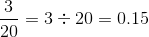
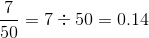
From the decimal equivalents, the fractions can be arranged as follows:

Rewrite all three numbers as their decimal equivalents by dividing numerator by denominator.
From the decimal equivalents, the fractions can be arranged as follows:
Compare your answer with the correct one above
Arrange these numbers from least to greatest:
Arrange these numbers from least to greatest:
Rewrite all three numbers as their decimal equivalents by dividing numerator by denominator.
To arrange negative numbers from least to greatest, we must arrange them so that their absolute values (values without the negative symbol) go from greatest to least. In descending order, the absolute values are
,
so, in ascending order, the numbers themselves are
,
or, in their fractional equivalents,
.
Rewrite all three numbers as their decimal equivalents by dividing numerator by denominator.
To arrange negative numbers from least to greatest, we must arrange them so that their absolute values (values without the negative symbol) go from greatest to least. In descending order, the absolute values are
so, in ascending order, the numbers themselves are
or, in their fractional equivalents,
Compare your answer with the correct one above
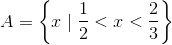
How many of the following four numbers are elements of the set
(A) 
(B) 
(C) 
(D) 
How many of the following four numbers are elements of the set
(A)
(B)
(C)
(D)
 and
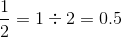
and 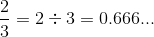 , so we choose the numbers that fall between these two. Of the four choices, only 0.67 is not between these two numbers. The correct response is "three".
Compare your answer with the correct one above
How many of the following four numbers are elements of the set
(A)
(B)
(C)
(D)
How many of the following four numbers are elements of the set
(A)
(B)
(C)
(D)
and , so we choose the numbers that fall between these two. Of the four choices, only 0.67 is not between these two numbers. The correct response is "three".
Compare your answer with the correct one above
Arrange these numbers from least to greatest:
Arrange these numbers from least to greatest:
Rewrite all three numbers as their decimal equivalents by dividing numerator by denominator.
To arrange negative numbers from least to greatest, we must arrange them so that their absolute values (values without the negative symbol) go from greatest to least. In descending order, the absolute values are
,
so, in ascending order, the numbers themselves are
,
or, in their fractional equivalents,
.
Rewrite all three numbers as their decimal equivalents by dividing numerator by denominator.
To arrange negative numbers from least to greatest, we must arrange them so that their absolute values (values without the negative symbol) go from greatest to least. In descending order, the absolute values are
so, in ascending order, the numbers themselves are
or, in their fractional equivalents,
Compare your answer with the correct one above
How many of the following four numbers are elements of the set
(A)
(B)
(C)
(D)
How many of the following four numbers are elements of the set
(A)
(B)
(C)
(D)
and , so we choose the numbers that fall between these two. Of the four choices, only 0.67 is not between these two numbers. The correct response is "three".
Compare your answer with the correct one above
How many of the following four numbers are elements of the set
(A)
(B)
(C)
(D)
How many of the following four numbers are elements of the set
(A)
(B)
(C)
(D)
and , so we choose the numbers that fall between these two. Of the four choices, only 0.67 is not between these two numbers. The correct response is "three".
Compare your answer with the correct one above
How many of the following four numbers are elements of the set
(A)
(B)
(C)
(D)
How many of the following four numbers are elements of the set
(A)
(B)
(C)
(D)
and , so we choose the numbers that fall between these two. Of the four choices, only 0.67 is not between these two numbers. The correct response is "three".
Compare your answer with the correct one above
Arrange these numbers from least to greatest:
Arrange these numbers from least to greatest:
Rewrite all three numbers as their decimal equivalents by dividing numerator by denominator.
From the decimal equivalents, the fractions can be arranged as follows:
Rewrite all three numbers as their decimal equivalents by dividing numerator by denominator.
From the decimal equivalents, the fractions can be arranged as follows:
Compare your answer with the correct one above
Arrange these numbers from least to greatest:
Arrange these numbers from least to greatest:
Rewrite all three numbers as their decimal equivalents by dividing numerator by denominator.
From the decimal equivalents, the fractions can be arranged as follows:
Rewrite all three numbers as their decimal equivalents by dividing numerator by denominator.
From the decimal equivalents, the fractions can be arranged as follows:
Compare your answer with the correct one above
Arrange these numbers from least to greatest:
Arrange these numbers from least to greatest:
Rewrite all three numbers as their decimal equivalents by dividing numerator by denominator.
To arrange negative numbers from least to greatest, we must arrange them so that their absolute values (values without the negative symbol) go from greatest to least. In descending order, the absolute values are
,
so, in ascending order, the numbers themselves are
,
or, in their fractional equivalents,
.
Rewrite all three numbers as their decimal equivalents by dividing numerator by denominator.
To arrange negative numbers from least to greatest, we must arrange them so that their absolute values (values without the negative symbol) go from greatest to least. In descending order, the absolute values are
so, in ascending order, the numbers themselves are
or, in their fractional equivalents,
Compare your answer with the correct one above
Arrange these numbers from least to greatest:
Arrange these numbers from least to greatest:
Rewrite all three numbers as their decimal equivalents by dividing numerator by denominator.
From the decimal equivalents, the fractions can be arranged as follows:
Rewrite all three numbers as their decimal equivalents by dividing numerator by denominator.
From the decimal equivalents, the fractions can be arranged as follows:
Compare your answer with the correct one above
Arrange these numbers from least to greatest:
Arrange these numbers from least to greatest:
Rewrite all three numbers as their decimal equivalents by dividing numerator by denominator.
From the decimal equivalents, the fractions can be arranged as follows:
Rewrite all three numbers as their decimal equivalents by dividing numerator by denominator.
From the decimal equivalents, the fractions can be arranged as follows:
Compare your answer with the correct one above
Arrange these numbers from least to greatest:
Arrange these numbers from least to greatest:
Rewrite all three numbers as their decimal equivalents by dividing numerator by denominator.
To arrange negative numbers from least to greatest, we must arrange them so that their absolute values (values without the negative symbol) go from greatest to least. In descending order, the absolute values are
,
so, in ascending order, the numbers themselves are
,
or, in their fractional equivalents,
.
Rewrite all three numbers as their decimal equivalents by dividing numerator by denominator.
To arrange negative numbers from least to greatest, we must arrange them so that their absolute values (values without the negative symbol) go from greatest to least. In descending order, the absolute values are
so, in ascending order, the numbers themselves are
or, in their fractional equivalents,
Compare your answer with the correct one above
Find the decimal equivalent of 95%.
Find the decimal equivalent of 95%.
Divide: 
Answer: 
Divide:
Answer:
Compare your answer with the correct one above
Find the decimal equivalent of 33%.
Find the decimal equivalent of 33%.
Divide: 
Answer: .33
Divide:
Answer: .33
Compare your answer with the correct one above
Find the decimal equivalent of 58%.
Find the decimal equivalent of 58%.
Divide:

Divide:
Compare your answer with the correct one above
Subtract:

Subtract:
To solve, subtract the numerators and leave the denominators the same:

Answer: 
To solve, subtract the numerators and leave the denominators the same:
Answer:
Compare your answer with the correct one above
One euro is worth approximately $1.27. For how many euros (nearest whole) can an American tourist expect to exchange $1,000?
One euro is worth approximately $1.27. For how many euros (nearest whole) can an American tourist expect to exchange $1,000?
One Euro is equivalent to $1.27, so divide the number of dollars by this conversion factor. $1,000 is equivalent to
 euros
euros
One Euro is equivalent to $1.27, so divide the number of dollars by this conversion factor. $1,000 is equivalent to
Compare your answer with the correct one above