
Trapezoids - ISEE Lower Level Quantitative Reasoning
Card 0 of 780
Daria found the perimeter of the below trapezoid to be 29 inches.
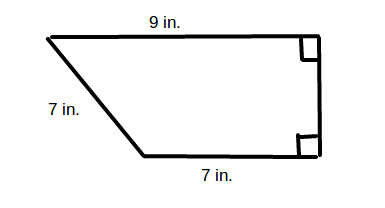
What is the length of the missing side?
Daria found the perimeter of the below trapezoid to be 29 inches.
What is the length of the missing side?
To find the perimeter of a trapezoid, add up the lengths of its four sides. In the given trapezoid,

To find the missing side, combine like terms and solve for  :
:



The missing side of the trapezoid is  long.
long.
To find the perimeter of a trapezoid, add up the lengths of its four sides. In the given trapezoid,
To find the missing side, combine like terms and solve for
The missing side of the trapezoid is
Compare your answer with the correct one above
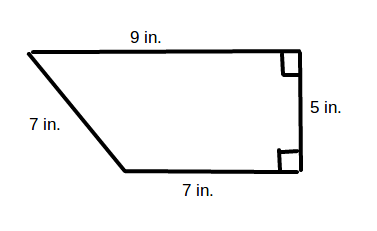
What is the perimeter of the above trapezoid?
What is the perimeter of the above trapezoid?
To find the perimeter of a trapezoid, add up the lengths of the four sides. In the given trapezoid,

To find the perimeter of a trapezoid, add up the lengths of the four sides. In the given trapezoid,
Compare your answer with the correct one above
Angela found the perimeter of the trapezoid below to be 35 cm.
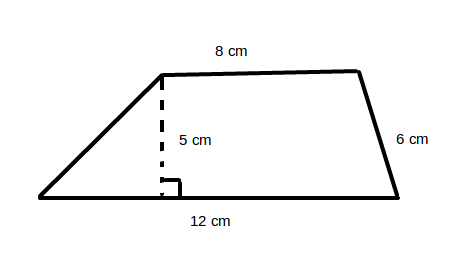
What is the length of the missing side?
Angela found the perimeter of the trapezoid below to be 35 cm.
What is the length of the missing side?
To find the perimeter of a trapezoid, add up the lengths of the four sides. In the given trapezoid,

To find the missing side, combine like terms and solve for  .
.



The length of the missing side is thus  .
.
To find the perimeter of a trapezoid, add up the lengths of the four sides. In the given trapezoid,
To find the missing side, combine like terms and solve for
The length of the missing side is thus
Compare your answer with the correct one above
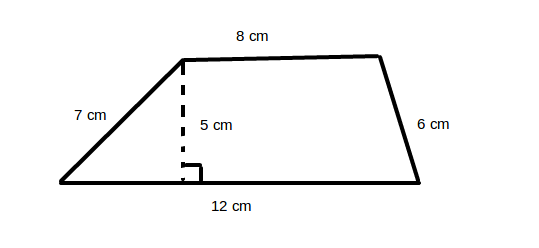
What is the perimeter of the above trapezoid?
What is the perimeter of the above trapezoid?
To find the perimeter of a trapezoid, add up the lengths of the four sides. In the given trapezoid,

To find the perimeter of a trapezoid, add up the lengths of the four sides. In the given trapezoid,
Compare your answer with the correct one above
Find the perimeter of the following trapezoid.
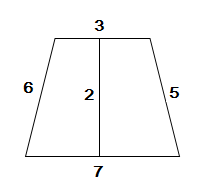
Find the perimeter of the following trapezoid.
In order to find the perimeter of the trapezoid, we have to add up all the outer sides:

In order to find the perimeter of the trapezoid, we have to add up all the outer sides:
Compare your answer with the correct one above
Find the perimeter of the following trapezoid.
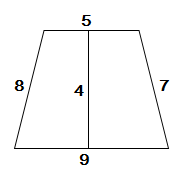
Find the perimeter of the following trapezoid.
In order to find the perimeter we must add up all the outer sides of the trapezoid.

In order to find the perimeter we must add up all the outer sides of the trapezoid.
Compare your answer with the correct one above
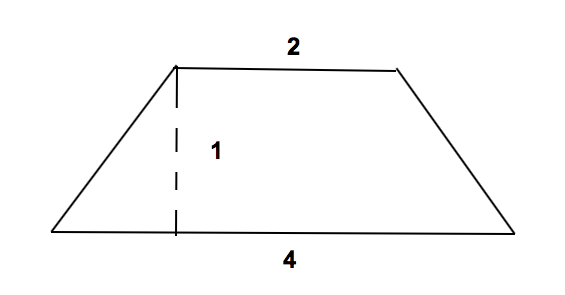
What is the area of a trapezoid if its height is 1, its long base is 4, and its short base is 2?
What is the area of a trapezoid if its height is 1, its long base is 4, and its short base is 2?
The area of a trapezoid is given by the formula  .
.
We know that the height is 1, the long base is 4, and the short base is 2.



The area of a trapezoid is given by the formula
We know that the height is 1, the long base is 4, and the short base is 2.
Compare your answer with the correct one above
Which formula would you use to find the area of a trapezoid?
Which formula would you use to find the area of a trapezoid?
The find the area of a trapezoid, use:
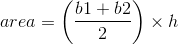
The find the area of a trapezoid, use:
Compare your answer with the correct one above
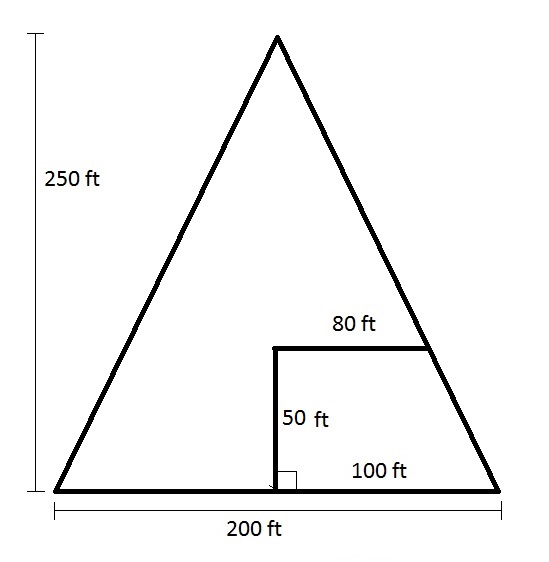
Note: Figure NOT drawn to scale.
Mr. Smith owns the triangular piece of land seen in the above diagram. He sells the trapezoidal parcel shown at bottom right to his brother. What is the area of the land he retains?
Note: Figure NOT drawn to scale.
Mr. Smith owns the triangular piece of land seen in the above diagram. He sells the trapezoidal parcel shown at bottom right to his brother. What is the area of the land he retains?
The area of a triangle is half the product of its base and its height, so Mr. Smith's parcel originally had area
 square feet.
The area of a trapezoid is the half product of its height and the sum of its two parallel sides (bases), so the portion Mr. Smith sold to his brother has area
 square feet.
Therefore, Mr. Smith retains a parcel of area
 square feet.
The area of a triangle is half the product of its base and its height, so Mr. Smith's parcel originally had area
The area of a trapezoid is the half product of its height and the sum of its two parallel sides (bases), so the portion Mr. Smith sold to his brother has area
Therefore, Mr. Smith retains a parcel of area
Compare your answer with the correct one above
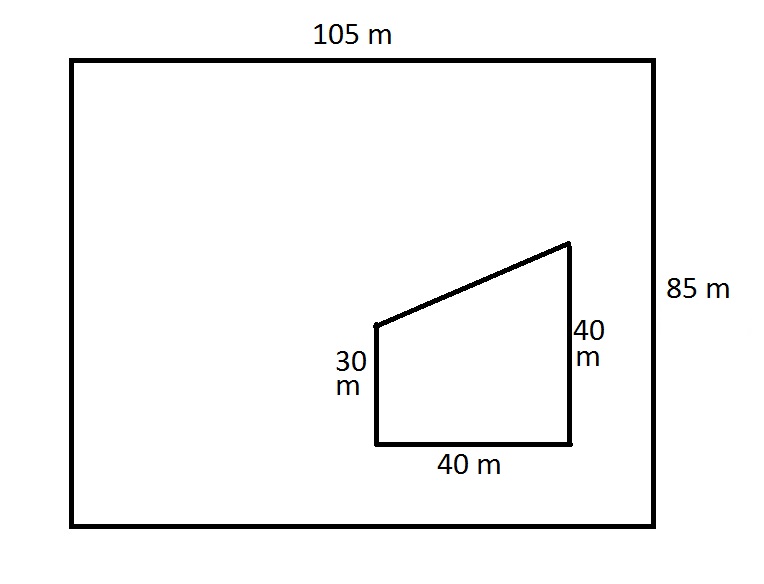
The above diagram shows a trapezoidal home within a rectangular yard. What is the area of the yard?
The above diagram shows a trapezoidal home within a rectangular yard. What is the area of the yard?
The area of the yard is the area of the small trapezoid subtracted from that of the large rectangle. The area of a rectangle is the product of its length and its height, so the large rectangle has area
 square meters.
The area of a trapezoid is half the product of its height and the sum of its two parallel sides (bases), so the small trapezoid has area
 square meters.
The area of the yard is the difference of the two:
 square meters.
The area of the yard is the area of the small trapezoid subtracted from that of the large rectangle. The area of a rectangle is the product of its length and its height, so the large rectangle has area
The area of a trapezoid is half the product of its height and the sum of its two parallel sides (bases), so the small trapezoid has area
The area of the yard is the difference of the two:
Compare your answer with the correct one above
What is the width of the rectangle if the perimeter is  and the length is
  ?
?
What is the width of the rectangle if the perimeter is
The formula for perimeter of a rectangle is 
To solve for the width we can plug our known values into the equation.


Subtract  from both sides

Divide  by both sides

The formula for perimeter of a rectangle is
To solve for the width we can plug our known values into the equation.
Subtract
Divide
Compare your answer with the correct one above
What is the area of the above trapezoid?
What is the area of the above trapezoid?
The formula for the area of a trapezoid is 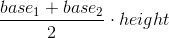
In other words, find the average of the bases and multiply by the height. Substituting in the values of the bases for the given trapezoid,  and
and  , you get:

The formula for the area of a trapezoid is
In other words, find the average of the bases and multiply by the height. Substituting in the values of the bases for the given trapezoid,
Compare your answer with the correct one above
What is the area of the above trapezoid?
What is the area of the above trapezoid?
The formula for the area of a trapezoid is 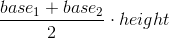
In other words, find the average of the bases and multiply by the height. Substituting the values of the bases of the given trapezoid,  and
and  , into the equation, you get:

The area of the trapezoid is thus  .
.
The formula for the area of a trapezoid is
In other words, find the average of the bases and multiply by the height. Substituting the values of the bases of the given trapezoid,
The area of the trapezoid is thus
Compare your answer with the correct one above
Ted drew the parallelogram shown below.
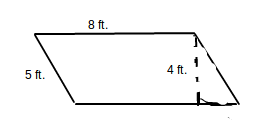
What is the perimeter of the parallelogram?
Ted drew the parallelogram shown below.
What is the perimeter of the parallelogram?
The perimeter of a parallelogram can be found by summing the lengths of each of the sides. In a parallelogram, opposite sides have the same length. Therefore, you should use the equation 8 + 8 + 5 + 5 = P. The perimeter of the parallelogram is 26 feet.
The perimeter of a parallelogram can be found by summing the lengths of each of the sides. In a parallelogram, opposite sides have the same length. Therefore, you should use the equation 8 + 8 + 5 + 5 = P. The perimeter of the parallelogram is 26 feet.
Compare your answer with the correct one above
Guillermo drew the parallelogram below.
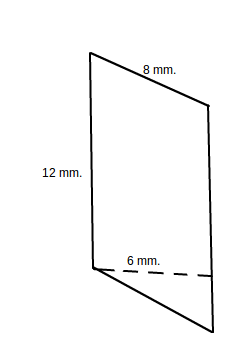
What is the perimeter of the parallelogram?
Guillermo drew the parallelogram below.
What is the perimeter of the parallelogram?
The perimeter of a parallelogram can be found by summing the lengths of each of the sides. In a parallelogram, opposite sides have the same length. Therefore, you should use the equation 8 + 8 + 12 + 12 = P. The perimeter of the parallelogram is 40 feet.
The perimeter of a parallelogram can be found by summing the lengths of each of the sides. In a parallelogram, opposite sides have the same length. Therefore, you should use the equation 8 + 8 + 12 + 12 = P. The perimeter of the parallelogram is 40 feet.
Compare your answer with the correct one above
Find the perimeter of the following parallelogram.
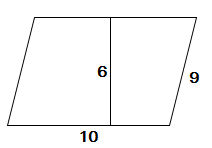
Find the perimeter of the following parallelogram.
We plug in our values into the equation for the perimeter:

We plug in our values into the equation for the perimeter:
Compare your answer with the correct one above
Find the perimeter of the following parallelogram.
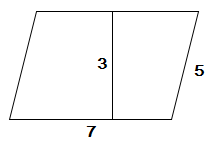
Find the perimeter of the following parallelogram.
We plug in our values into the equation for the perimeter:

We plug in our values into the equation for the perimeter:
Compare your answer with the correct one above
What is the perimeter of the polygon below?

What is the perimeter of the polygon below?
To find the area of a perimeter, we add all of the side lengths together.

To find the area of a perimeter, we add all of the side lengths together.
Compare your answer with the correct one above
What is the perimeter of the polygon below?

What is the perimeter of the polygon below?
To find the area of a perimeter, we add all of the side lengths together.

To find the area of a perimeter, we add all of the side lengths together.
Compare your answer with the correct one above
What is the perimeter of the polygon below?

What is the perimeter of the polygon below?
To find the area of a perimeter, we add all of the side lengths together.

To find the area of a perimeter, we add all of the side lengths together.
Compare your answer with the correct one above