
Plane Geometry - ISEE Lower Level Quantitative Reasoning
Card 0 of 2380
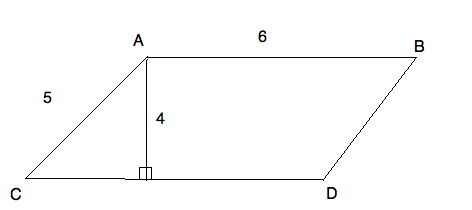
What is the area of the parallelogram ABCD?
What is the area of the parallelogram ABCD?
A parallelogram's area is found by multiplying its height by the base. The height of the parallelogram is not the side. It is the line that makes a right angle with the base. Therefore, the area of this parallelogram is:

A parallelogram's area is found by multiplying its height by the base. The height of the parallelogram is not the side. It is the line that makes a right angle with the base. Therefore, the area of this parallelogram is:
Compare your answer with the correct one above
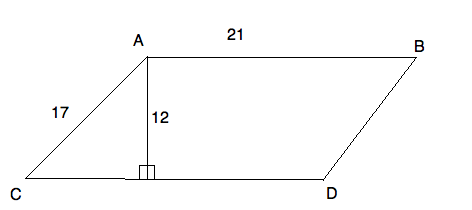
What is the area of parallelogram ABCD?
What is the area of parallelogram ABCD?
A parallelogram's area is found by multiplying its height by the base. The height of the parallelogram is not the side. It is the line that makes a right angle with the base. Therefore, the area of this parallelogram is:

A parallelogram's area is found by multiplying its height by the base. The height of the parallelogram is not the side. It is the line that makes a right angle with the base. Therefore, the area of this parallelogram is:
Compare your answer with the correct one above
A parallelogram measures  along its base and is
  high. Calculate the area.
A parallelogram measures
The formula to calucate a parallelogram's area is:

You calculate the parallelogram's area by multiplying its base by its height. Therefore, 
The formula to calucate a parallelogram's area is:
You calculate the parallelogram's area by multiplying its base by its height. Therefore,
Compare your answer with the correct one above
A parallelogram measures  along its base and is
  high. Calculate the area.
A parallelogram measures
The formula to calucate a parallelogram's area is:

You calculate the parallelogram's area by multiplying its base by its height. Therefore, 
The formula to calucate a parallelogram's area is:
You calculate the parallelogram's area by multiplying its base by its height. Therefore,
Compare your answer with the correct one above
Find the area of a parallelogram whose height is  and base is
  .
.
Find the area of a parallelogram whose height is
To solve, simply use the formula for the area of a parallelogram. Thus,

To solve, simply use the formula for the area of a parallelogram. Thus,
Compare your answer with the correct one above
What is the area of a parallelogram if the base is  , the other side is
  , and the height is
  ?
?
What is the area of a parallelogram if the base is
The area of a parallelogram is  so the answer would be
  .
.
The area of a parallelogram is
Compare your answer with the correct one above
Find the area of the given parallelogram:
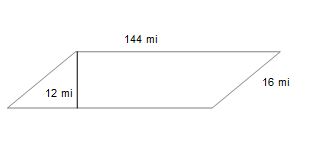
Find the area of the given parallelogram:
Find the area of the given parallelogram:
To find the area of a parallelogram, simply do the following:

Where b is the base, and h is the height. Note that the height is the length of the perpendicular line connecting both bases. In this case, our height is 12mi and our base is 144 miles.

Find the area of the given parallelogram:
To find the area of a parallelogram, simply do the following:
Where b is the base, and h is the height. Note that the height is the length of the perpendicular line connecting both bases. In this case, our height is 12mi and our base is 144 miles.
Compare your answer with the correct one above
Find the area of the given parallelogram:
Find the area of the given parallelogram:
Find the area of the given parallelogram:
To find the area of a parallelogram, simply use the following formula for area of a parallelogram:
Where b is the base, and h is the height. Note that the height is the length of the perpendicular line connecting both bases. In this case, our height is 12 mi and our base is 144 mi.
Find the area of the given parallelogram:
To find the area of a parallelogram, simply use the following formula for area of a parallelogram:
Where b is the base, and h is the height. Note that the height is the length of the perpendicular line connecting both bases. In this case, our height is 12 mi and our base is 144 mi.
Compare your answer with the correct one above
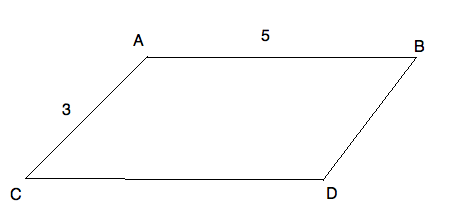
What is the perimeter of parallelogram ABCD?
What is the perimeter of parallelogram ABCD?
The perimeter of a parallelogram is very easy to find. You just need to add up all the sides. However, you need to notice that the sides "across" from each other are equal on parallelograms. So, your figure could be redrawn:
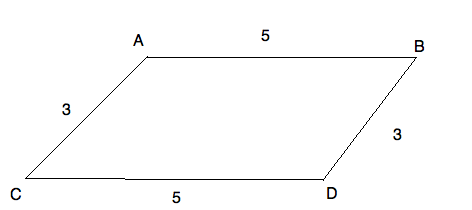
The perimeter of your figure is therefore:

The perimeter of a parallelogram is very easy to find. You just need to add up all the sides. However, you need to notice that the sides "across" from each other are equal on parallelograms. So, your figure could be redrawn:
The perimeter of your figure is therefore:
Compare your answer with the correct one above
A parallelogram has a side length of  . It also has a side length of
  . Calculate the perimeter.
A parallelogram has a side length of
A parallelogram has four sides and its opposite sides are equal in length. Therefore, if it has one side length of , it also has another side length of of
  . Since we know one of its side lenghts is
  , then the remaining side is
  . We can add all 4 side lengths
  to calculate the perimeter.
A parallelogram has four sides and its opposite sides are equal in length. Therefore, if it has one side length of
Compare your answer with the correct one above
What is the perimeter of a parallelogram if the base is  , the other side is
  , and the height is
  ?
?
What is the perimeter of a parallelogram if the base is
The perimeter of a parallelogram is the sum of all four sides or the sum of two times each side length. The side lengths are  and
and  so the perimeter is
  .
.
The perimeter of a parallelogram is the sum of all four sides or the sum of two times each side length. The side lengths are
Compare your answer with the correct one above
Find the perimeter of the given parallelogram:
Find the perimeter of the given parallelogram:
Find the perimeter of the given parallelogram:
The perimeter of any shape can be found by adding up the lentghs of its sides.
In this case, we have four sides. 2 that are 16 miles long, and 2 that are 144 miles long.
Find perimeter as follows:

Making our answer 320 miles
Find the perimeter of the given parallelogram:
The perimeter of any shape can be found by adding up the lentghs of its sides.
In this case, we have four sides. 2 that are 16 miles long, and 2 that are 144 miles long.
Find perimeter as follows:
Making our answer 320 miles
Compare your answer with the correct one above
Find the area of the trapezoid.
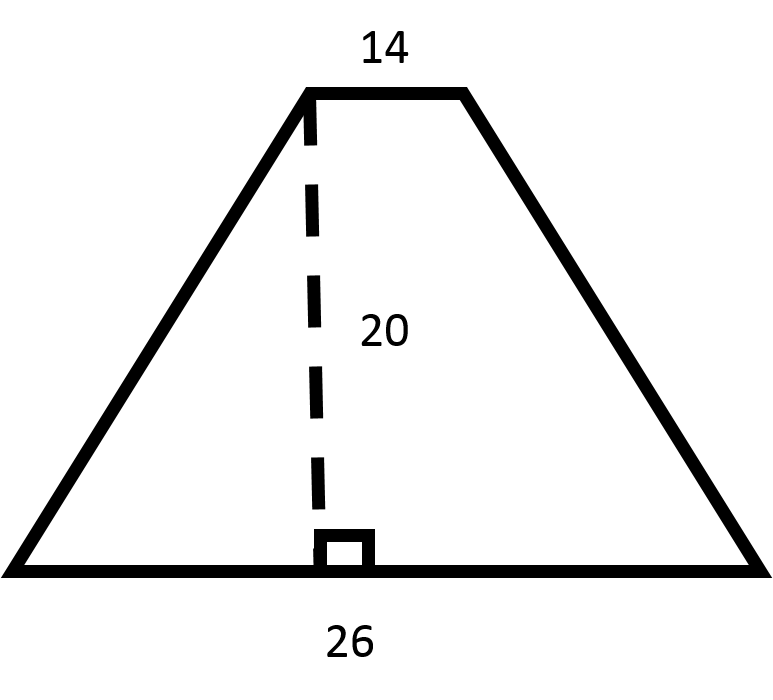
Find the area of the trapezoid.
Recall the formula for finding the area of a trapezoid:

Now, plug in the values for the bases and the height to find the area.

Recall the formula for finding the area of a trapezoid:
Now, plug in the values for the bases and the height to find the area.
Compare your answer with the correct one above
Find the area of the trapezoid.
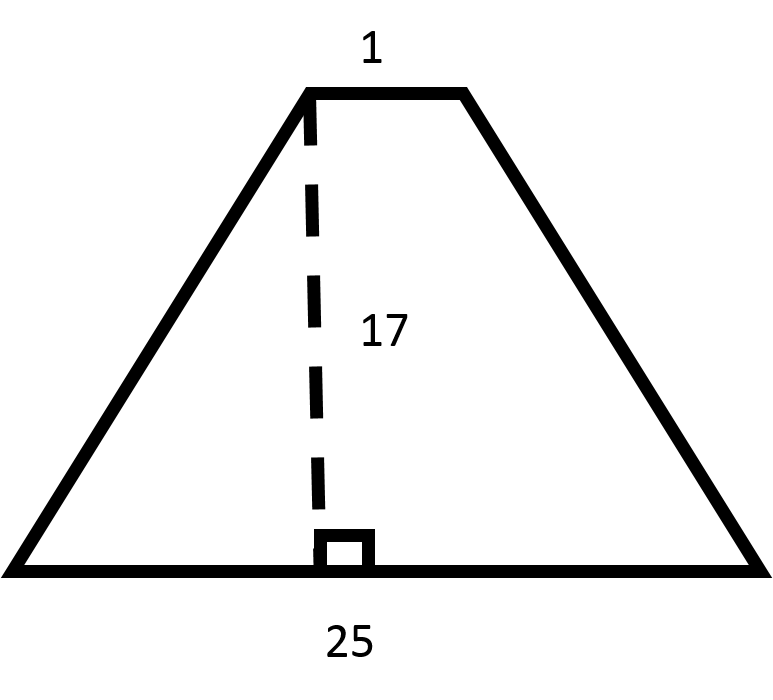
Find the area of the trapezoid.
Recall the formula for finding the area of a trapezoid:
Now, plug in the values for the bases and the height to find the area.

Recall the formula for finding the area of a trapezoid:
Now, plug in the values for the bases and the height to find the area.
Compare your answer with the correct one above
A trapezoid has two bases measuring  and
and  , and a height measuring
What is its area?
A trapezoid has two bases measuring
What is its area?
To find the area of a trapezoid, use this formula:  .
.
Use the information from the question to solve.


The area is  .
.
To find the area of a trapezoid, use this formula:
Use the information from the question to solve.
The area is
Compare your answer with the correct one above
Calculate the area of the trapezoid:

Calculate the area of the trapezoid:
Break the figure into a rectangle and a triangle. Use the dotted line as a guide. The rectangle has a length of 8 and a width of 6. The triangle has a base of 6 and width of 6.
Area of the rectangle:


Area of the triangle:


Add them together:

Break the figure into a rectangle and a triangle. Use the dotted line as a guide. The rectangle has a length of 8 and a width of 6. The triangle has a base of 6 and width of 6.
Area of the rectangle:
Area of the triangle:
Add them together:
Compare your answer with the correct one above

Figure not drawn to scale
Find the area of the trapezoid.
Figure not drawn to scale
Find the area of the trapezoid.
In order to find the area of the trapezoid, we must follow the formula below:

 One of the bases of the trapezoid
 The other base of the trapezoid
 The height of the trapezoid
In this question,  ,
,  , and
, and 


By following the formula and order of operations, we are able to solve the problem. The area of the trapezoid is 72 in.2
In order to find the area of the trapezoid, we must follow the formula below:
In this question,
By following the formula and order of operations, we are able to solve the problem. The area of the trapezoid is 72 in.2
Compare your answer with the correct one above
Find the area of the trapezoid:

Find the area of the trapezoid:


Compare your answer with the correct one above
In a trapezoid, the top base is equal to 5 and the bottom base is equal to 11. It has a height of 6. What is the area?
In a trapezoid, the top base is equal to 5 and the bottom base is equal to 11. It has a height of 6. What is the area?
The area of a trapezoid is equal to the sum of the bases, divided by 2, and then multiplied by the height:


The area of a trapezoid is equal to the sum of the bases, divided by 2, and then multiplied by the height:
Compare your answer with the correct one above
A trapezoid's bases are  and
and  long. It's height is
  . What is the area of this trapezoid?
A trapezoid's bases are
The formula to calculate the area of a trapezoid is:


The formula to calculate the area of a trapezoid is:
Compare your answer with the correct one above