
Geometry - HSPT Math
Card 1 of 2400
The length of a rectangle is two times as long as the width. The width is equal to  inches. What is the perimeter of the rectangle?
The length of a rectangle is two times as long as the width. The width is equal to
Tap to reveal answer


← Didn't Know|Knew It →
What is the perimeter of the triangle below?

What is the perimeter of the triangle below?
Tap to reveal answer
To find the perimeter of a triangle, we add all of the side lengths together.

To find the perimeter of a triangle, we add all of the side lengths together.
← Didn't Know|Knew It →
What is the perimeter of the triangle below?

What is the perimeter of the triangle below?
Tap to reveal answer
To find the perimeter of a triangle, we add all of the side lengths together.

To find the perimeter of a triangle, we add all of the side lengths together.
← Didn't Know|Knew It →
What is the perimeter of the triangle below?

What is the perimeter of the triangle below?
Tap to reveal answer
To find the perimeter of a triangle, we add all of the side lengths together.

To find the perimeter of a triangle, we add all of the side lengths together.
← Didn't Know|Knew It →
What is the perimeter of the triangle below?

What is the perimeter of the triangle below?
Tap to reveal answer
To find the perimeter of a triangle, we add all of the side lengths together.

To find the perimeter of a triangle, we add all of the side lengths together.
← Didn't Know|Knew It →
What is the perimeter of the triangle below?

What is the perimeter of the triangle below?
Tap to reveal answer
To find the perimeter of a triangle, we add all of the side lengths together.

To find the perimeter of a triangle, we add all of the side lengths together.
← Didn't Know|Knew It →
What is the perimeter of the triangle below?

What is the perimeter of the triangle below?
Tap to reveal answer
To find the perimeter of a triangle, we add all of the side lengths together.

To find the perimeter of a triangle, we add all of the side lengths together.
← Didn't Know|Knew It →
What is the perimeter of the triangle below?

What is the perimeter of the triangle below?
Tap to reveal answer
To find the perimeter of a triangle, we add all of the side lengths together.

To find the perimeter of a triangle, we add all of the side lengths together.
← Didn't Know|Knew It →
What is the perimeter of the triangle below?

What is the perimeter of the triangle below?
Tap to reveal answer
To find the perimeter of a triangle, we add all of the side lengths together.

To find the perimeter of a triangle, we add all of the side lengths together.
← Didn't Know|Knew It →
What is the perimeter of the triangle below?

What is the perimeter of the triangle below?
Tap to reveal answer
To find the perimeter of a triangle, we add all of the side lengths together.

To find the perimeter of a triangle, we add all of the side lengths together.
← Didn't Know|Knew It →
What is the perimeter of the triangle below?

What is the perimeter of the triangle below?
Tap to reveal answer
To find the perimeter of a triangle, we add all of the side lengths together.

To find the perimeter of a triangle, we add all of the side lengths together.
← Didn't Know|Knew It →
What is the perimeter of the triangle below?

What is the perimeter of the triangle below?
Tap to reveal answer
To find the perimeter of a triangle, we add all of the side lengths together.

To find the perimeter of a triangle, we add all of the side lengths together.
← Didn't Know|Knew It →
What is the perimeter of the regular pentagon below?

What is the perimeter of the regular pentagon below?
Tap to reveal answer
A regular pentagon has five equal sides. To find the perimeter of a pentagon, we can multiply the known side length by  (since there are five sides) or we can add the known side length to itself five times.


A regular pentagon has five equal sides. To find the perimeter of a pentagon, we can multiply the known side length by
← Didn't Know|Knew It →

The perimeter of the above square is 40% of what number?
The perimeter of the above square is 40% of what number?
Tap to reveal answer
The perimeter of a square with sides of length 12 is 4 times this, or
 .
.
The number of which 48 is 40% can be found by dividing 48 by 40%, or  :
:
 ..
..
The perimeter of a square with sides of length 12 is 4 times this, or
The number of which 48 is 40% can be found by dividing 48 by 40%, or
← Didn't Know|Knew It →
You are looking at a map of your town and your house is located at the coordinate (0,0). Your school is located at the point (3,4). If each coordinate distance is 1.3 miles, how far away is your school?
You are looking at a map of your town and your house is located at the coordinate (0,0). Your school is located at the point (3,4). If each coordinate distance is 1.3 miles, how far away is your school?
Tap to reveal answer
The coordinate length between you and your school is equivalent to the hypotenuse of a right triangle with sides of 3 and 4 units:


The distance is 5 coordinate lengths, and each coordinate length corresponds to 1.3 miles of distance, so

The coordinate length between you and your school is equivalent to the hypotenuse of a right triangle with sides of 3 and 4 units:
The distance is 5 coordinate lengths, and each coordinate length corresponds to 1.3 miles of distance, so
← Didn't Know|Knew It →
Which of the following points will you find on the  -axis?
Which of the following points will you find on the
Tap to reveal answer
A point is located on the  -axis if and only if it has
  -coordinate (first coordinate) 0. Of the five choices, only
  fits that description.
A point is located on the
← Didn't Know|Knew It →
Which of the following is a vertex of the square?

Which of the following is a vertex of the square?
Tap to reveal answer
The coordinates of a point are determined by the distance from the origin. The first point in the ordered pair is the number of units to the left or right of the origin. Negative numbers indicate the number of units to the left while positive numbers indicate the number of units to the right. The second number indicates the number of units above or below the origin. Positive numbers indicate the number of units above while negative numbrs indicate the number of units below the origin. The vertices of the square are:

The coordinates of a point are determined by the distance from the origin. The first point in the ordered pair is the number of units to the left or right of the origin. Negative numbers indicate the number of units to the left while positive numbers indicate the number of units to the right. The second number indicates the number of units above or below the origin. Positive numbers indicate the number of units above while negative numbrs indicate the number of units below the origin. The vertices of the square are:
← Didn't Know|Knew It →
Which of the following points is on the  -axis?
Which of the following points is on the
Tap to reveal answer
A point is located on the  -axis if and only if it has a
  -coordinate equal to zero. So the answer is
  .
.
A point is located on the
← Didn't Know|Knew It →
Billy set up a ramp for his toy cars. He did this by taking a wooden plank and putting one end on top of a brick that was 3 inches high. He then put the other end on top of a box that was 9 inches high. The bricks were 18 inches apart. What is the slope of the plank?
Billy set up a ramp for his toy cars. He did this by taking a wooden plank and putting one end on top of a brick that was 3 inches high. He then put the other end on top of a box that was 9 inches high. The bricks were 18 inches apart. What is the slope of the plank?
Tap to reveal answer
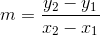
The value of the slope (m) is rise over run, and can be calculated with the formula below:
The coordinates of the first end of the plank would be (0,3), given that this is the starting point of the plank (so x would be 0), and y would be 3 since the brick is 3 inches tall.
The coordinates of the second end of the plank would be (18,9) since the plank is 18 inches long (so x would be 18) and y would be 9 since the box was 9 inches tall at the other end.
From this information we know that we can assign the following coordinates for the equation:
 and
and 
Below is the solution we would get from plugging this information into the equation for slope:

This reduces to 
The value of the slope (m) is rise over run, and can be calculated with the formula below:
The coordinates of the first end of the plank would be (0,3), given that this is the starting point of the plank (so x would be 0), and y would be 3 since the brick is 3 inches tall.
The coordinates of the second end of the plank would be (18,9) since the plank is 18 inches long (so x would be 18) and y would be 9 since the box was 9 inches tall at the other end.
From this information we know that we can assign the following coordinates for the equation:
Below is the solution we would get from plugging this information into the equation for slope:
This reduces to
← Didn't Know|Knew It →
A deer walks in a straight line for 8 hours. At the end of its journey, the deer is 30 miles north and 40 miles east of where it began. What was the average speed of the deer?
A deer walks in a straight line for 8 hours. At the end of its journey, the deer is 30 miles north and 40 miles east of where it began. What was the average speed of the deer?
Tap to reveal answer
To find the speed of the deer, you must have the distance traveled and the time.
The distance is found using the Pythagorean Theorem:


The answer must be in miles per hour so the total miles are divided by the hours to get the final answer:

To find the speed of the deer, you must have the distance traveled and the time.
The distance is found using the Pythagorean Theorem:
The answer must be in miles per hour so the total miles are divided by the hours to get the final answer:
← Didn't Know|Knew It →