
How to simplify expressions - HSPT Math
Card 1 of 888
Simplify the following expression: x3 - 4(x2 + 3) + 15
Simplify the following expression: x3 - 4(x2 + 3) + 15
Tap to reveal answer
To simplify this expression, you must combine like terms. You should first use the distributive property and multiply -4 by x2 and -4 by 3.
x3 - 4x2 -12 + 15
You can then add -12 and 15, which equals 3.
You now have x3 - 4x2 + 3 and are finished. Just a reminder that x3 and 4x2 are not like terms as the x’s have different exponents.
To simplify this expression, you must combine like terms. You should first use the distributive property and multiply -4 by x2 and -4 by 3.
x3 - 4x2 -12 + 15
You can then add -12 and 15, which equals 3.
You now have x3 - 4x2 + 3 and are finished. Just a reminder that x3 and 4x2 are not like terms as the x’s have different exponents.
← Didn't Know|Knew It →
Which of the following does not simplify to  ?
?
Which of the following does not simplify to
Tap to reveal answer
5x – (6x – 2x) = 5x – (4x) = x
(x – 1)(x + 2) - x2 + 2 = x2 + x – 2 – x2 + 2 = x
x(4x)/(4x) = x
(3 – 3)x = 0x = 0
5x – (6x – 2x) = 5x – (4x) = x
(x – 1)(x + 2) - x2 + 2 = x2 + x – 2 – x2 + 2 = x
x(4x)/(4x) = x
(3 – 3)x = 0x = 0
← Didn't Know|Knew It →
Simplify the following expression:
2x(x2 + 4ax – 3a2) – 4a2(4x + 3a)
Simplify the following expression:
2x(x2 + 4ax – 3a2) – 4a2(4x + 3a)
Tap to reveal answer
Begin by distributing each part:
2x(x2 + 4ax – 3a2) = 2x * x2 + 2x * 4ax – 2x * 3a2 = 2x3 + 8ax2 – 6a2x
The second:
–4a2(4x + 3a) = –16a2x – 12a3
Now, combine these:
2x3 + 8ax2 – 6a2x – 16a2x – 12a3
The only common terms are those with a2x; therefore, this reduces to
2x3 + 8ax2 – 22a2x – 12a3
This is the same as the given answer:
–12a3 – 22a2x + 8ax2 + 2x3
Begin by distributing each part:
2x(x2 + 4ax – 3a2) = 2x * x2 + 2x * 4ax – 2x * 3a2 = 2x3 + 8ax2 – 6a2x
The second:
–4a2(4x + 3a) = –16a2x – 12a3
Now, combine these:
2x3 + 8ax2 – 6a2x – 16a2x – 12a3
The only common terms are those with a2x; therefore, this reduces to
2x3 + 8ax2 – 22a2x – 12a3
This is the same as the given answer:
–12a3 – 22a2x + 8ax2 + 2x3
← Didn't Know|Knew It →
Simplify the expression:
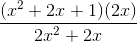
Simplify the expression:
Tap to reveal answer
Factor out a (2_x_) from the denominator, which cancels with (2_x_) from the numerator. Then factor the numerator, which becomes (x + 1)(x + 1), of which one of them cancels and you're left with (x + 1).
Factor out a (2_x_) from the denominator, which cancels with (2_x_) from the numerator. Then factor the numerator, which becomes (x + 1)(x + 1), of which one of them cancels and you're left with (x + 1).
← Didn't Know|Knew It →
Simplify the following expression:

Simplify the following expression:
Tap to reveal answer

First distribute the 2: 
Combine the like terms: 
First distribute the 2:
Combine the like terms:
← Didn't Know|Knew It →
You are given that  are whole numbers.
Which of the following is true of  if
if  and
and  are both odd?
You are given that
Which of the following is true of
Tap to reveal answer
If  is odd, then
  is odd, since the product of two odd whole numbers must be odd. When the odd number
  is added, the result,
  , is even, since the sum of two odd numbers must be even.
If  is even, then
  is even, since the product of an odd number and an even number must be even. When the odd number
  is added, the result,
  , is odd, since the sum of an odd number and an even number must be odd.
If
If
← Didn't Know|Knew It →
Simplify the expression:

Simplify the expression:
Tap to reveal answer
Combine all the like terms.
The  terms can be combined together, which gives you
  .
.
When you combine the  terms together, you get
  .
.
There is only one  term so it doesn't get combined with anything. Put them all together and you get
 .
.
Combine all the like terms.
The
When you combine the
There is only one
← Didn't Know|Knew It →
Simplify: 
Simplify:
Tap to reveal answer
In order to simplify this expression, distribute and multiply the outer term with the two inner terms.

In order to simplify this expression, distribute and multiply the outer term with the two inner terms.
← Didn't Know|Knew It →
Simplify: 
Simplify:
Tap to reveal answer
When the same bases are multiplied, their exponents can be added. Similarly, when the bases are divided, their exponents can be subtracted. Apply this rule for the given problem.

When the same bases are multiplied, their exponents can be added. Similarly, when the bases are divided, their exponents can be subtracted. Apply this rule for the given problem.
← Didn't Know|Knew It →
Simplify: 
Simplify:
Tap to reveal answer
To simplify this expression, reduce the term inside the parenthesis.
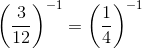
Rewrite the negative exponent as a fraction.
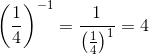
To simplify this expression, reduce the term inside the parenthesis.
Rewrite the negative exponent as a fraction.
← Didn't Know|Knew It →
Simplify the expression 
Simplify the expression
Tap to reveal answer
To simplify this expression, combine like terms. In this expression,  and
and are like terms. They are like terms because each term consists of a single variable,
 , and a numeric coefficient. Add the coefficients of these terms. Addition is the operation that you would use denoted by a plus sign next to the x.

 and
and  are also like terms. They are like terms because each term consists of a single variable,
  , and a numeric coefficient. These two like terms are separated by a subtraction sign, therefore subtraction is the operation you would use

Therefore, the correct answer is

To simplify this expression, combine like terms. In this expression,
Therefore, the correct answer is
← Didn't Know|Knew It →
Simplify the expression 
Simplify the expression
Tap to reveal answer
To simplify this expression, combine like terms. In this expression,  and
and  are like terms. They are like terms because each term consists of a
  , and a numeric coefficient. Add the coefficients of these terms. Addition is the operation that you would use denoted by a plus sign.

 and
and  are also like terms. They are like terms because each term consists of
  and a numeric coefficient. These two like terms are separated by a addition sign, therefore addition is the operation you would use.

Therefore, the correct answer is

To simplify this expression, combine like terms. In this expression,
Therefore, the correct answer is
← Didn't Know|Knew It →
Simplify the expression:
Simplify the expression:
Tap to reveal answer
Combine all the like terms.
The terms can be combined together, which gives you .
When you combine the terms together, you get .
There is only one term so it doesn't get combined with anything. Put them all together and you get
.
Combine all the like terms.
The
When you combine the
There is only one
← Didn't Know|Knew It →
Suppose you know the values of  ,
,  , and
, and  , and you want to evaluate the expression below.

Which of the following is the first step you must complete?
Suppose you know the values of
Which of the following is the first step you must complete?
Tap to reveal answer
Use the order of operations, PEMDAS: Parentheses, Exponents, Multiplication, Division, Addition, Subtraction
In our expression, there are no parentheses, so square  first.
Use the order of operations, PEMDAS: Parentheses, Exponents, Multiplication, Division, Addition, Subtraction
In our expression, there are no parentheses, so square
← Didn't Know|Knew It →
If you rewrite the phrase "the product of nine and a number added to the sum of six and twice the number" as an algebraic expression, then simplify the expression, the result is:
If you rewrite the phrase "the product of nine and a number added to the sum of six and twice the number" as an algebraic expression, then simplify the expression, the result is:
Tap to reveal answer
"The product of nine and a number" is  . "Twice the number" is
  , and "The sum of six and twice the number" is
  .
.
"The product...added to the sum..." is  ; simplify to get

"The product of nine and a number" is
"The product...added to the sum..." is
← Didn't Know|Knew It →
Simplify the expression: 
Simplify the expression:
Tap to reveal answer







← Didn't Know|Knew It →
Simplify: 
Simplify:
Tap to reveal answer

← Didn't Know|Knew It →

Tap to reveal answer
First find the exponent value: 
Then find the value of 
Finally, solve the entire expression with the known values: 
The answer is 36.
First find the exponent value:
Then find the value of
Finally, solve the entire expression with the known values:
The answer is 36.
← Didn't Know|Knew It →

Tap to reveal answer
First convert each mixed number into and improper fraction

Then convert the operation to multiplication and flip the second fraction

Reduce where possible and multiply to solve:

The answer is 
First convert each mixed number into and improper fraction
Then convert the operation to multiplication and flip the second fraction
Reduce where possible and multiply to solve:
The answer is
← Didn't Know|Knew It →
Multiply:

Multiply:
Tap to reveal answer
Use the distributive property:

Use the distributive property:
← Didn't Know|Knew It →