
Geometry - HSPT Math
Card 1 of 2400
What is the area of the figure below?
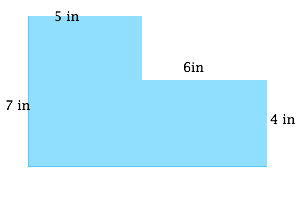
What is the area of the figure below?
Tap to reveal answer
To find the area of the figure above, we need to split the figure into two rectangles.

Using our area formula,  , we can solve for the area of both of our rectangles


To find our final answer, we need to add the areas together.

To find the area of the figure above, we need to split the figure into two rectangles.
Using our area formula,
To find our final answer, we need to add the areas together.
← Didn't Know|Knew It →
What is the area of the figure below?

What is the area of the figure below?
Tap to reveal answer
To find the area of the figure above, we need to slip the figure into two rectangles.

Using our area formula,  , we can solve for the area of both of our rectangles


To find our final answer, we need to add the areas together.

To find the area of the figure above, we need to slip the figure into two rectangles.
Using our area formula,
To find our final answer, we need to add the areas together.
← Didn't Know|Knew It →
What is the area of the figure below?

What is the area of the figure below?
Tap to reveal answer
To find the area of the figure above, we need to slip the figure into two rectangles.

Using our area formula,  , we can solve for the area of both of our rectangles


To find our final answer, we need to add the areas together.

To find the area of the figure above, we need to slip the figure into two rectangles.
Using our area formula,
To find our final answer, we need to add the areas together.
← Didn't Know|Knew It →
What is the area of the figure below?

What is the area of the figure below?
Tap to reveal answer
To find the area of the figure above, we need to slip the figure into two rectangles.

Using our area formula,  , we can solve for the area of both of our rectangles


To find our final answer, we need to add the areas together.

To find the area of the figure above, we need to slip the figure into two rectangles.
Using our area formula,
To find our final answer, we need to add the areas together.
← Didn't Know|Knew It →
What is the area of the figure below?

What is the area of the figure below?
Tap to reveal answer
To find the area of the figure above, we need to slip the figure into two rectangles.

Using our area formula,  , we can solve for the area of both of our rectangles


To find our final answer, we need to add the areas together.

To find the area of the figure above, we need to slip the figure into two rectangles.
Using our area formula,
To find our final answer, we need to add the areas together.
← Didn't Know|Knew It →
I have a hollow cube with 3” sides suspended inside a larger cube of 9” sides. If I fill the larger cube with water and the hollow cube remains empty yet suspended inside, what volume of water was used to fill the larger cube?
I have a hollow cube with 3” sides suspended inside a larger cube of 9” sides. If I fill the larger cube with water and the hollow cube remains empty yet suspended inside, what volume of water was used to fill the larger cube?
Tap to reveal answer
Determine the volume of both cubes and then subtract the smaller from the larger. The large cube volume is 9” * 9” * 9” = 729 in3 and the small cube is 3” * 3” * 3” = 27 in3. The difference is 702 in3.
Determine the volume of both cubes and then subtract the smaller from the larger. The large cube volume is 9” * 9” * 9” = 729 in3 and the small cube is 3” * 3” * 3” = 27 in3. The difference is 702 in3.
← Didn't Know|Knew It →
A cube weighs 5 pounds. How much will a different cube of the same material weigh if the sides are 3 times as long?
A cube weighs 5 pounds. How much will a different cube of the same material weigh if the sides are 3 times as long?
Tap to reveal answer
A cube that has three times as long sides is 3x3x3=27 times bigger than the original. Therefore, the answer is 5x27= 135.
A cube that has three times as long sides is 3x3x3=27 times bigger than the original. Therefore, the answer is 5x27= 135.
← Didn't Know|Knew It →
The volume of a cylinder is 36π. If the cylinder’s height is 4, what is the cylinder’s diameter?
The volume of a cylinder is 36π. If the cylinder’s height is 4, what is the cylinder’s diameter?
Tap to reveal answer
Volume of a cylinder? V = πr2h. Rewritten as a diameter equation, this is:
V = π(d/2)2h = πd2h/4
Sub in h and V: 36p = πd2(4)/4 so 36p = πd2
Thus d = 6
Volume of a cylinder? V = πr2h. Rewritten as a diameter equation, this is:
V = π(d/2)2h = πd2h/4
Sub in h and V: 36p = πd2(4)/4 so 36p = πd2
Thus d = 6
← Didn't Know|Knew It →
What is the area of a triangle with a side lengths of 5?
What is the area of a triangle with a side lengths of 5?
Tap to reveal answer
The area of a triangle is found with the equation
 .
.
Since we do not have the height, we cannot answer the question.
The area of a triangle is found with the equation
Since we do not have the height, we cannot answer the question.
← Didn't Know|Knew It →
A room has dimensions of 18ft by 15ft by 9ft. The last dimension is the height of the room. It has one door that is 3ft by 7ft and two windows, each 2ft by 5ft. There is no trim to the floor, wall, doors, or windows. What is the total exposed wall space?
A room has dimensions of 18ft by 15ft by 9ft. The last dimension is the height of the room. It has one door that is 3ft by 7ft and two windows, each 2ft by 5ft. There is no trim to the floor, wall, doors, or windows. What is the total exposed wall space?
Tap to reveal answer
If broken down into parts, this is an easy problem. It is first necessary to isolate the dimensions of the walls. If the room is 9 ft high, we know 18 x 15 designates the area of the floor and ceiling. Based on this, we know that the room has the following dimensions for the walls: 18 x 9 and 15 x 9. Since there are two of each, we can calculate the total area of walls - ignoring doors and windows - by doubling the sum of these two areas:
2 * (18 * 9 + 15 * 9) = 2 * (162 + 135) = 2 * 297 = 594 ft2
Now, we merely need to calculate the area "taken out" of the walls:
For the door: 3 * 7 = 21 ft2
For the windows: 2 * (2 * 5) = 20 ft2
The total wall space is therefore: 594 – 21 – 20 = 553 ft2
If broken down into parts, this is an easy problem. It is first necessary to isolate the dimensions of the walls. If the room is 9 ft high, we know 18 x 15 designates the area of the floor and ceiling. Based on this, we know that the room has the following dimensions for the walls: 18 x 9 and 15 x 9. Since there are two of each, we can calculate the total area of walls - ignoring doors and windows - by doubling the sum of these two areas:
2 * (18 * 9 + 15 * 9) = 2 * (162 + 135) = 2 * 297 = 594 ft2
Now, we merely need to calculate the area "taken out" of the walls:
For the door: 3 * 7 = 21 ft2
For the windows: 2 * (2 * 5) = 20 ft2
The total wall space is therefore: 594 – 21 – 20 = 553 ft2
← Didn't Know|Knew It →
You are looking at a map of your town and your house is located at the coordinate (0,0). Your school is located at the point (3,4). If each coordinate distance is 1.3 miles, how far away is your school?
You are looking at a map of your town and your house is located at the coordinate (0,0). Your school is located at the point (3,4). If each coordinate distance is 1.3 miles, how far away is your school?
Tap to reveal answer
The coordinate length between you and your school is equivalent to the hypotenuse of a right triangle with sides of 3 and 4 units:


The distance is 5 coordinate lengths, and each coordinate length corresponds to 1.3 miles of distance, so

The coordinate length between you and your school is equivalent to the hypotenuse of a right triangle with sides of 3 and 4 units:
The distance is 5 coordinate lengths, and each coordinate length corresponds to 1.3 miles of distance, so
← Didn't Know|Knew It →
Which of the following points will you find on the  -axis?
Which of the following points will you find on the
Tap to reveal answer
A point is located on the  -axis if and only if it has
  -coordinate (first coordinate) 0. Of the five choices, only
  fits that description.
A point is located on the
← Didn't Know|Knew It →
Which of the following is a vertex of the square?

Which of the following is a vertex of the square?
Tap to reveal answer
The coordinates of a point are determined by the distance from the origin. The first point in the ordered pair is the number of units to the left or right of the origin. Negative numbers indicate the number of units to the left while positive numbers indicate the number of units to the right. The second number indicates the number of units above or below the origin. Positive numbers indicate the number of units above while negative numbrs indicate the number of units below the origin. The vertices of the square are:

The coordinates of a point are determined by the distance from the origin. The first point in the ordered pair is the number of units to the left or right of the origin. Negative numbers indicate the number of units to the left while positive numbers indicate the number of units to the right. The second number indicates the number of units above or below the origin. Positive numbers indicate the number of units above while negative numbrs indicate the number of units below the origin. The vertices of the square are:
← Didn't Know|Knew It →
Which of the following points is on the  -axis?
Which of the following points is on the
Tap to reveal answer
A point is located on the  -axis if and only if it has a
  -coordinate equal to zero. So the answer is
  .
.
A point is located on the
← Didn't Know|Knew It →
Billy set up a ramp for his toy cars. He did this by taking a wooden plank and putting one end on top of a brick that was 3 inches high. He then put the other end on top of a box that was 9 inches high. The bricks were 18 inches apart. What is the slope of the plank?
Billy set up a ramp for his toy cars. He did this by taking a wooden plank and putting one end on top of a brick that was 3 inches high. He then put the other end on top of a box that was 9 inches high. The bricks were 18 inches apart. What is the slope of the plank?
Tap to reveal answer
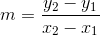
The value of the slope (m) is rise over run, and can be calculated with the formula below:
The coordinates of the first end of the plank would be (0,3), given that this is the starting point of the plank (so x would be 0), and y would be 3 since the brick is 3 inches tall.
The coordinates of the second end of the plank would be (18,9) since the plank is 18 inches long (so x would be 18) and y would be 9 since the box was 9 inches tall at the other end.
From this information we know that we can assign the following coordinates for the equation:
 and
and 
Below is the solution we would get from plugging this information into the equation for slope:

This reduces to 
The value of the slope (m) is rise over run, and can be calculated with the formula below:
The coordinates of the first end of the plank would be (0,3), given that this is the starting point of the plank (so x would be 0), and y would be 3 since the brick is 3 inches tall.
The coordinates of the second end of the plank would be (18,9) since the plank is 18 inches long (so x would be 18) and y would be 9 since the box was 9 inches tall at the other end.
From this information we know that we can assign the following coordinates for the equation:
Below is the solution we would get from plugging this information into the equation for slope:
This reduces to
← Didn't Know|Knew It →
A deer walks in a straight line for 8 hours. At the end of its journey, the deer is 30 miles north and 40 miles east of where it began. What was the average speed of the deer?
A deer walks in a straight line for 8 hours. At the end of its journey, the deer is 30 miles north and 40 miles east of where it began. What was the average speed of the deer?
Tap to reveal answer
To find the speed of the deer, you must have the distance traveled and the time.
The distance is found using the Pythagorean Theorem:


The answer must be in miles per hour so the total miles are divided by the hours to get the final answer:

To find the speed of the deer, you must have the distance traveled and the time.
The distance is found using the Pythagorean Theorem:
The answer must be in miles per hour so the total miles are divided by the hours to get the final answer:
← Didn't Know|Knew It →
The point  is reflected across
  . What is the new point?
The point
Tap to reveal answer
The horizontal distance from point  to the vertical line
  is two units. Since this point is reflected across
  , the new point will also be 2 units to the right of line
  .
.
Therefore, the correct answer is: 
The horizontal distance from point
Therefore, the correct answer is:
← Didn't Know|Knew It →
What is the slope given the following two points? 
What is the slope given the following two points?
Tap to reveal answer
Write the slope formula and substitute the two points.

Write the slope formula and substitute the two points.
← Didn't Know|Knew It →
A manufacturer makes wooden circles out of square blocks of wood. If the wood costs $0.20 per square inch, what is the minimum waste cost possible for cutting a circle with a radius of 25 in.?
A manufacturer makes wooden circles out of square blocks of wood. If the wood costs $0.20 per square inch, what is the minimum waste cost possible for cutting a circle with a radius of 25 in.?
Tap to reveal answer
The smallest block from which a circle could be made would be a square that perfectly matches the diameter of the given circle. (This is presuming we have perfectly calibrated equipment.) Such a square would have dimensions equal to the diameter of the circle, meaning it would have sides of 50 inches for our problem. Its total area would be 50 * 50 or 2500 in2.
Now, the waste amount would be the "corners" remaining after the circle was cut. The area of the circle is πr2 or π * 252 = 625π in2. Therefore, the area remaining would be 2500 - 625π. The cost of the waste would be 0.2 * (2500 – 625π). This is not an option for our answers, so let us simplify a bit. We can factor out a common 5 from our subtraction. This would give us: 0.2 * 5 * (500 – 125π). Since 0.2 is equal to 1/5, 0.2 * 625 = 125. Therefore, our final answer is: 500 – 125π dollars.
The smallest block from which a circle could be made would be a square that perfectly matches the diameter of the given circle. (This is presuming we have perfectly calibrated equipment.) Such a square would have dimensions equal to the diameter of the circle, meaning it would have sides of 50 inches for our problem. Its total area would be 50 * 50 or 2500 in2.
Now, the waste amount would be the "corners" remaining after the circle was cut. The area of the circle is πr2 or π * 252 = 625π in2. Therefore, the area remaining would be 2500 - 625π. The cost of the waste would be 0.2 * (2500 – 625π). This is not an option for our answers, so let us simplify a bit. We can factor out a common 5 from our subtraction. This would give us: 0.2 * 5 * (500 – 125π). Since 0.2 is equal to 1/5, 0.2 * 625 = 125. Therefore, our final answer is: 500 – 125π dollars.
← Didn't Know|Knew It →
Begin at the origin of the rectangular coordinate plane. Move up three units, left seven units, and down nine units. Give the coordinates of your current location.
Begin at the origin of the rectangular coordinate plane. Move up three units, left seven units, and down nine units. Give the coordinates of your current location.
Tap to reveal answer
Since you have moved left seven units, you have moved seven units in a negative horizontal direction, making the  -coordinate of your current location
  .
.
Since you have moved up three units and down nine units, you have moved six units down - this is six units in a negative vertical direction, making the  -coordinate of your current location
  .
.
Therefore, the ordered pair for your current location is  .
.
Since you have moved left seven units, you have moved seven units in a negative horizontal direction, making the
Since you have moved up three units and down nine units, you have moved six units down - this is six units in a negative vertical direction, making the
Therefore, the ordered pair for your current location is
← Didn't Know|Knew It →