
Arithmetic - HSPT Math
Card 1 of 2932
Helen wants to buy a dress for a party. It is on sale for 37% off. How much does the dress currently costs, if its original price was $45.00?
Helen wants to buy a dress for a party. It is on sale for 37% off. How much does the dress currently costs, if its original price was $45.00?
Tap to reveal answer
First, multiply 45 by 0.37:

Then, subtract that amount from 45.00 to find the sale price:

Answer: The dress' sale price is $28.35.
First, multiply 45 by 0.37:
Then, subtract that amount from 45.00 to find the sale price:
Answer: The dress' sale price is $28.35.
← Didn't Know|Knew It →
A restaurant is having a sale and lowering their prices by 20%. If an average meal for two normally costs $62.00, what will it costs under the current sale?
A restaurant is having a sale and lowering their prices by 20%. If an average meal for two normally costs $62.00, what will it costs under the current sale?
Tap to reveal answer
Multiply: 
Then, subtract that amount from the original price:

Answer: $49.60
Multiply:
Then, subtract that amount from the original price:
Answer: $49.60
← Didn't Know|Knew It →
A class with  students went on a field trip, but one of the students was absent. What percentage of students in the class went on the field trip?
A class with
Tap to reveal answer
The percentage of students who attended the field trip can be found by dividing the number present by the total number of students. Here this is  divided by
  . You then multiply by
  to get the percentage.
The percentage of students who attended the field trip can be found by dividing the number present by the total number of students. Here this is
← Didn't Know|Knew It →
Exactly  of the plants in a garden are tomato plants. Which of the following could be the total number of plants in the garden?
Exactly
Tap to reveal answer
The total number of plants has to be divisible by 3. Of the answer choices, the only one that is divisible by 3 is 18. You can check this because numbers that are divisible have the sum of their digits also divisible by 3. For example,

which is divisible by 3, so 18 is divisible by 3.
The total number of plants has to be divisible by 3. Of the answer choices, the only one that is divisible by 3 is 18. You can check this because numbers that are divisible have the sum of their digits also divisible by 3. For example,
which is divisible by 3, so 18 is divisible by 3.
← Didn't Know|Knew It →
A store normally sells a certain coat for $40. For the holidays it offers a sale where the new price of the coat is now $30. What percent discount is the store selling the coat for?
A store normally sells a certain coat for $40. For the holidays it offers a sale where the new price of the coat is now $30. What percent discount is the store selling the coat for?
Tap to reveal answer
The coat is $10 cheaper than normal.
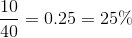
The coat is $10 cheaper than normal.
← Didn't Know|Knew It →
If Suzie's birthday cake costs $15 and it is on sale for 25% off how much will she pay at the register?
If Suzie's birthday cake costs $15 and it is on sale for 25% off how much will she pay at the register?
Tap to reveal answer
To find the answer you must first convert the sales percentage to a decimal by moving the decimal left two places yielding 
Then multiply the total cost by the decimal  .
.
We then subtract the sales number from the original cost to get the answer:

To find the answer you must first convert the sales percentage to a decimal by moving the decimal left two places yielding
Then multiply the total cost by the decimal
We then subtract the sales number from the original cost to get the answer:
← Didn't Know|Knew It →
Susan has a coupon for 10% off any one item at her favorite department store. There is also a storewide sale of 50% off all purchases.
If Susan wants to by a shirt originally priced at $42, how much will she pay?
Susan has a coupon for 10% off any one item at her favorite department store. There is also a storewide sale of 50% off all purchases.
If Susan wants to by a shirt originally priced at $42, how much will she pay?
Tap to reveal answer
The storewide sale discounts the shirt by 50%:

Susan also has the 10% off coupon, so she's really paying 90% of the cost of the shirt:

The storewide sale discounts the shirt by 50%:
Susan also has the 10% off coupon, so she's really paying 90% of the cost of the shirt:
← Didn't Know|Knew It →
The price of a suit after a 20% employee discount is $240.00. What is the original price?
The price of a suit after a 20% employee discount is $240.00. What is the original price?
Tap to reveal answer
Deducting a 20% discount is the same as charging 80% of the price, so $240.00 is 80% of the original price, which we call  . Just solve this equation:


The suit originally cost $300.00
Deducting a 20% discount is the same as charging 80% of the price, so $240.00 is 80% of the original price, which we call
The suit originally cost $300.00
← Didn't Know|Knew It →
Express  % as a fraction in lowest terms.
Express
Tap to reveal answer
Put the percent over 100 and simplify as follows:

Note: all of these choices are equivalent to  %; but only
  is in lowest terms.
Put the percent over 100 and simplify as follows:
Note: all of these choices are equivalent to
← Didn't Know|Knew It →
There are 500 students at the high school. There are only two menu options: chicken or fish. If 15% of students ordered fish, how many students ordered chicken?
There are 500 students at the high school. There are only two menu options: chicken or fish. If 15% of students ordered fish, how many students ordered chicken?
Tap to reveal answer
If 15% of students ordered fish, then 85% of the students must have ordered chicken. Then multiply 85% or  .
.
If 15% of students ordered fish, then 85% of the students must have ordered chicken. Then multiply 85% or
← Didn't Know|Knew It →
The sales tax rate for a particular locality is 9%. How much will be paid after tax for $154.92 worth of groceries?
The sales tax rate for a particular locality is 9%. How much will be paid after tax for $154.92 worth of groceries?
Tap to reveal answer
Multiply the price of the groceries before tax - $154.92 - by the decimal equivalent of 9% , which is 0.09. Round this tax to the nearest hundredth (cents), then add to the price of the groceries.
Tax: 
Price after tax: 
Multiply the price of the groceries before tax - $154.92 - by the decimal equivalent of 9% , which is 0.09. Round this tax to the nearest hundredth (cents), then add to the price of the groceries.
Tax:
Price after tax:
← Didn't Know|Knew It →
A laptop computer is on sale for 40% less than the original price. If the original price is $345.00, what is the laptop's current sale price?
A laptop computer is on sale for 40% less than the original price. If the original price is $345.00, what is the laptop's current sale price?
Tap to reveal answer
First, multiply the original price by the sale percentage:

Then, subtract that amount from the original price to get the sale price:
 .
.
The laptop's current sale price is 
First, multiply the original price by the sale percentage:
Then, subtract that amount from the original price to get the sale price:
The laptop's current sale price is
← Didn't Know|Knew It →
To get on the ballot for student body president, a student must turn in a petition with the signatures of 3% of the students. If there are 5,319 students, how many signatures must a student get to be on that ballot? (Nearest whole person)
To get on the ballot for student body president, a student must turn in a petition with the signatures of 3% of the students. If there are 5,319 students, how many signatures must a student get to be on that ballot? (Nearest whole person)
Tap to reveal answer
3% of 5,319 can be calculated by multiplying 5,319 by 0.03, the decimal equivalent of 3%:

Multiply 5,319 by 3, then move the decimal point so that two digits are to the right:
 ,
,
so

Rounded to the nearest whole number, this is 160 signatures.
3% of 5,319 can be calculated by multiplying 5,319 by 0.03, the decimal equivalent of 3%:
Multiply 5,319 by 3, then move the decimal point so that two digits are to the right:
so
Rounded to the nearest whole number, this is 160 signatures.
← Didn't Know|Knew It →
To get on the ballot for student body president, a student must turn in a petition with the signatures of 4% of the students. If there are 3,268 students, how many signatures must a student get to be on that ballot? (Round to the nearest whole person.)
To get on the ballot for student body president, a student must turn in a petition with the signatures of 4% of the students. If there are 3,268 students, how many signatures must a student get to be on that ballot? (Round to the nearest whole person.)
Tap to reveal answer
4% of 3,268 can be calculated by multiplying 3,268 by 0.04, the decimal equivalent of 4%:

Multiply 3,268 by 4, then move the decimal point two places to the right:
 ,
,
so

Rounded to the nearest whole number - 131 signatures.
4% of 3,268 can be calculated by multiplying 3,268 by 0.04, the decimal equivalent of 4%:
Multiply 3,268 by 4, then move the decimal point two places to the right:
so
Rounded to the nearest whole number - 131 signatures.
← Didn't Know|Knew It →
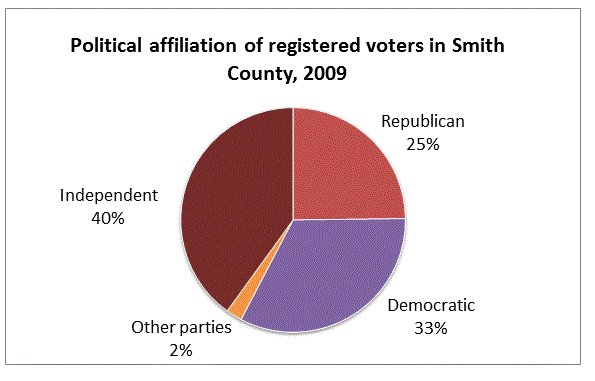
Refer to the above diagram. If there were 15,934 voters who were affiliated with a political party in Smith County in 2009, how many voters (nearest whole number) were there total?
Refer to the above diagram. If there were 15,934 voters who were affiliated with a political party in Smith County in 2009, how many voters (nearest whole number) were there total?
Tap to reveal answer
40% of the voters were registered as independents, so 60% were registered as a member of a political party. Since 60% of the voters numbered 15,934, we can find the total number of voters by setting up and solving a proportion:


which rounds to 26,557 voters.
40% of the voters were registered as independents, so 60% were registered as a member of a political party. Since 60% of the voters numbered 15,934, we can find the total number of voters by setting up and solving a proportion:
which rounds to 26,557 voters.
← Didn't Know|Knew It →
Refer to the above graph. If there were 17,856 registered voters in Smith County in 2009, how many voters were registered as neither Republicans nor Democrats (nearest whole number)?
Refer to the above graph. If there were 17,856 registered voters in Smith County in 2009, how many voters were registered as neither Republicans nor Democrats (nearest whole number)?
Tap to reveal answer
2% of the voters were registered as members of other parties, and 40% were unaffiliated, so we want to calculate 42% of 17,856, or, equivalently,

which, to the nearest whole number, rounds to 7,500 voters.
2% of the voters were registered as members of other parties, and 40% were unaffiliated, so we want to calculate 42% of 17,856, or, equivalently,
which, to the nearest whole number, rounds to 7,500 voters.
← Didn't Know|Knew It →
Candy bought a sweater and a beanie on sale for 20% off. If the sweater cost $ and the beanie cost $
 , how much did Candy spend?
Candy bought a sweater and a beanie on sale for 20% off. If the sweater cost $
Tap to reveal answer
In order to find how much money Candy spent, we must first figure out the cost of the merchandise before the discount. We do this by adding the prices together.

Next we must find 20% of $57.00.

Since 20% is the percentage Candy saved, we must subtract $11.40 from the original price.

So Candy spent $45.60.
In order to find how much money Candy spent, we must first figure out the cost of the merchandise before the discount. We do this by adding the prices together.
Next we must find 20% of $57.00.
Since 20% is the percentage Candy saved, we must subtract $11.40 from the original price.
So Candy spent $45.60.
← Didn't Know|Knew It →
What percent of 96 is 24?
What percent of 96 is 24?
Tap to reveal answer
Translate the sentence into an equation

Isolate  and you get
  .
.
Remember that the question is asking for a percentage, so convert  into
into  .
.
Translate the sentence into an equation
Isolate
Remember that the question is asking for a percentage, so convert
← Didn't Know|Knew It →
If sales tax on a pair of jeans is  , and the jeans cost
  before tax, what is the final price of the jeans including tax?
If sales tax on a pair of jeans is
Tap to reveal answer
Since the jeans are the only item being purchased, and they cost $ , we must first find
  % of $
 . In order to do that we multiply $
 by the decimal form of
  %, which is
  .
.
Note: In order to find the decimal form of a percent, we divide it by  .
. 
Find the tax:

Therefore the sales tax added to the original price is $ .
.

The final cost of the jeans is $ .
.
Since the jeans are the only item being purchased, and they cost $
Note: In order to find the decimal form of a percent, we divide it by
Find the tax:
Therefore the sales tax added to the original price is $
The final cost of the jeans is $
← Didn't Know|Knew It →
For her birthday, Susan asks her mother to buy her a car. Susan’s mother agrees to give Susan 150 percent of whatever amount Susan can save up in six months. If Susan saves  , how much does Susan’s mother owe her?
For her birthday, Susan asks her mother to buy her a car. Susan’s mother agrees to give Susan 150 percent of whatever amount Susan can save up in six months. If Susan saves
Tap to reveal answer
When Susan's mother agreed to match her savings plus fifty percent, she agreed to give Susan  % plus
  %.
%.

Before multiplying by the amount Susan saved, we must convert  % to a decimal by dividing by
  .
.

Now we multiply  time $
 .
.

Susan's mother owes her $ .
.
When Susan's mother agreed to match her savings plus fifty percent, she agreed to give Susan
Before multiplying by the amount Susan saved, we must convert
Now we multiply
Susan's mother owes her $
← Didn't Know|Knew It →