
Concepts - HSPT Math
Card 1 of 8060
Solve:

Solve:
Tap to reveal answer

When solving this problem, remember order of operations PEMDAS. The parentheses come first, followed by the multiplication, and then the addition.


When solving this problem, remember order of operations PEMDAS. The parentheses come first, followed by the multiplication, and then the addition.
← Didn't Know|Knew It →
Solve:

Solve:
Tap to reveal answer

When solving this problem, remember order of operations PEMDAS. The parentheses come first followed by the division.


When solving this problem, remember order of operations PEMDAS. The parentheses come first followed by the division.
← Didn't Know|Knew It →
Solve:

Solve:
Tap to reveal answer

When solving this problem, remember order of operations PEMDAS. The parentheses come first, followed by the multiplication, and then addition.


When solving this problem, remember order of operations PEMDAS. The parentheses come first, followed by the multiplication, and then addition.
← Didn't Know|Knew It →
Solve:

Solve:
Tap to reveal answer

When solving this problem, remember order of operations PEMDAS. The parentheses come first followed by the multiplication.


When solving this problem, remember order of operations PEMDAS. The parentheses come first followed by the multiplication.
← Didn't Know|Knew It →
Solve:

Solve:
Tap to reveal answer

When solving this problem, remember order of operations PEMDAS. The parentheses come first followed by the multiplication, and then the addition.


When solving this problem, remember order of operations PEMDAS. The parentheses come first followed by the multiplication, and then the addition.
← Didn't Know|Knew It →
Solve for  .
.

Solve for
Tap to reveal answer
Cross multiply. 
Dsitribute. 
Solve for  .
. 


Cross multiply.
Dsitribute.
Solve for
← Didn't Know|Knew It →
Erin is making thirty shirts for her upcoming family reunion. At the reunion she is selling each shirt for $18 apiece. If each shirt cost her $10 apiece to make, how much profit does she make if she only sells 25 shirts at the reunion?
Erin is making thirty shirts for her upcoming family reunion. At the reunion she is selling each shirt for $18 apiece. If each shirt cost her $10 apiece to make, how much profit does she make if she only sells 25 shirts at the reunion?
Tap to reveal answer
This problem involves two seperate multiplication problems. Erin will make $450 at the reunion but supplies cost her $300 to make the shirts. So her profit is $150.
This problem involves two seperate multiplication problems. Erin will make $450 at the reunion but supplies cost her $300 to make the shirts. So her profit is $150.
← Didn't Know|Knew It →
Billy is at the store purchasing flowers for his mother, his grandmother, and his friend. He finds roses on sale by the half dozen (6), tulips selling by the dozen (12), and daisies selling groups of 18.
Billy wants to have the same number of flowers in each bouquet, so that he is able to give everyone the same number of each flower. How many bundles of roses, tulips, and daisies will he have to buy so he has the same amount of each? (Please answer by roses, tulips, then daisies.)
Billy is at the store purchasing flowers for his mother, his grandmother, and his friend. He finds roses on sale by the half dozen (6), tulips selling by the dozen (12), and daisies selling groups of 18.
Billy wants to have the same number of flowers in each bouquet, so that he is able to give everyone the same number of each flower. How many bundles of roses, tulips, and daisies will he have to buy so he has the same amount of each? (Please answer by roses, tulips, then daisies.)
Tap to reveal answer
This is a least common multiple problem because we want to have the same number of each flower; meaning if I have 10 roses in each bouquet I should have 10 tulips and 10 daisies as well. In order to solve this problem we should break down the story problem. Let's look at the numbers we are having to work with: 6, 12, 18.
To do least common multiple we must look at the prime factors of each number and we can list them out. A factor is simply a number multiplied by a number to give us a product. A prime number is a number that contains only two factors, one of them being 1 and the other its own number.
So lets list the prime factors of 6, 12, and 18
 (2 and 3 are both prime numbers, and factors of 6)
 (2 x 2 = 4. 4x3=12 We have to say 2 x 2 because 4 is not a prime number).

Now we have the prime factors listed out for each of our numbers. Next is a fun trick. We must choose which number contains the most of each prime factor. In this case which number contains the most 2's? (12; because 12 has two 2 prime factors). Which number contains the most 3's? (18; because 18 has two 3 prime factors).
Our next step is to multiply the most of our prime factors so in this case: 
36 is our least common multiple. So now what do you think we can do with this number? Well the 36 means that is the lowest number of flowers we need of each type in order to have an equal amount of each for the boquets.
Knowing this, if we need 36 roses, and we are able to buy 6 roses per bundle. We need 6 bundles of roses, because 36 divided by 6 is 6. If we get 12 tulips by the bundle, we take 36 divided by 12 to give us 3 bundles of tulips needed. Lastly we can buy 18 daisies per bundle, 36 divided by 18 gives us 2 bundles needed giving us our answers 6, 3, 2 (bundles of roses, tulips, and daisies).
This is a least common multiple problem because we want to have the same number of each flower; meaning if I have 10 roses in each bouquet I should have 10 tulips and 10 daisies as well. In order to solve this problem we should break down the story problem. Let's look at the numbers we are having to work with: 6, 12, 18.
To do least common multiple we must look at the prime factors of each number and we can list them out. A factor is simply a number multiplied by a number to give us a product. A prime number is a number that contains only two factors, one of them being 1 and the other its own number.
So lets list the prime factors of 6, 12, and 18
Now we have the prime factors listed out for each of our numbers. Next is a fun trick. We must choose which number contains the most of each prime factor. In this case which number contains the most 2's? (12; because 12 has two 2 prime factors). Which number contains the most 3's? (18; because 18 has two 3 prime factors).
Our next step is to multiply the most of our prime factors so in this case:
36 is our least common multiple. So now what do you think we can do with this number? Well the 36 means that is the lowest number of flowers we need of each type in order to have an equal amount of each for the boquets.
Knowing this, if we need 36 roses, and we are able to buy 6 roses per bundle. We need 6 bundles of roses, because 36 divided by 6 is 6. If we get 12 tulips by the bundle, we take 36 divided by 12 to give us 3 bundles of tulips needed. Lastly we can buy 18 daisies per bundle, 36 divided by 18 gives us 2 bundles needed giving us our answers 6, 3, 2 (bundles of roses, tulips, and daisies).
← Didn't Know|Knew It →
Let  be the temperature expressed in degrees Celsius. Then the equivalent temperature
  in degrees Fahrenheit can be calculated using the formula:

What is  expressed in degrees Fahrenheit?
Let
What is
Tap to reveal answer


← Didn't Know|Knew It →
Solve:

Solve:
Tap to reveal answer

When solving this problem, remember order of operations PEMDAS. The parentheses come first followed by the subtraction.


When solving this problem, remember order of operations PEMDAS. The parentheses come first followed by the subtraction.
← Didn't Know|Knew It →
Let  be the temperature expressed in degrees Fahrenheit. Then the equivalent temperature
  in degrees Celsius can be calculated using the formula:

What is  expressed in degrees Celsius (to the nearest degree)?
Let
What is
Tap to reveal answer


 , which rounds to
← Didn't Know|Knew It →
On average, 1 in 50 apples that grow in an orchard will not be harvested. Of those, half will rot on the ground. If 500 apples are growing in an orchard, how many will rot on the ground?
On average, 1 in 50 apples that grow in an orchard will not be harvested. Of those, half will rot on the ground. If 500 apples are growing in an orchard, how many will rot on the ground?
Tap to reveal answer
If there are 500 apples and 1 in 50 will remain unharvested, then we can find the number of unharvested apples by multiplying.

10 apples will remain unharvested. Of those, half will rot on the ground. Multiply to find how many apples rot on the ground.

5 apples will rot on the ground.
If there are 500 apples and 1 in 50 will remain unharvested, then we can find the number of unharvested apples by multiplying.
10 apples will remain unharvested. Of those, half will rot on the ground. Multiply to find how many apples rot on the ground.
5 apples will rot on the ground.
← Didn't Know|Knew It →
Gary is twice as old as his niece Candy. How old will Candy will be in five years when Gary is  years old?
Gary is twice as old as his niece Candy. How old will Candy will be in five years when Gary is
Tap to reveal answer
Since Gary will be 37 in five years, he is  years old now. He is twice as old as Cathy, so she is
  years old, and in five years, she will be
  years old.
Since Gary will be 37 in five years, he is
← Didn't Know|Knew It →
Mark is three times as old as his son Brian. In ten years, Mark will be  years old. In how many years will Mark be twice as old as Brian?
Mark is three times as old as his son Brian. In ten years, Mark will be
Tap to reveal answer
In ten years, Mark will be  years old, so Mark is
  years old now, and Brian is one-third of this, or
  years old.
Let  be the number of years in which Mark will be twice Brian's age. Then Brian will be
  , and Mark will be
  . Since Mark will be twice Brian's age, we can set up and solve the equation:




Mark will be twice Brian's age in  years.
In ten years, Mark will be
Let
Mark will be twice Brian's age in
← Didn't Know|Knew It →
Write as an equation:
"Ten added to the product of a number and three is equal to twice the number."
Write as an equation:
"Ten added to the product of a number and three is equal to twice the number."
Tap to reveal answer
Let  represent the unknown quantity.
The first expression:
"The product of a number and three" is three times this number, or

"Ten added to the product" is

The second expression:
"Twice the number" is two times the number, or
 .
.
The desired equation is therefore
 .
.
Let
The first expression:
"The product of a number and three" is three times this number, or
"Ten added to the product" is
The second expression:
"Twice the number" is two times the number, or
The desired equation is therefore
← Didn't Know|Knew It →
Write as an equation:
Five-sevenths of the difference of a number and nine is equal to forty.
Write as an equation:
Five-sevenths of the difference of a number and nine is equal to forty.
Tap to reveal answer
"The difference of a number and nine" is the result of a subtraction of the two, so we write this as

"Five-sevenths of" this difference is the product of  and this, or

This is equal to forty, so write the equation as
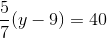
"The difference of a number and nine" is the result of a subtraction of the two, so we write this as
"Five-sevenths of" this difference is the product of
This is equal to forty, so write the equation as
← Didn't Know|Knew It →
Write as an equation:
Twice the sum of a number and ten is equal to the difference of the number and one half.
Write as an equation:
Twice the sum of a number and ten is equal to the difference of the number and one half.
Tap to reveal answer
Let  represent the unknown number.
"The sum of a number and ten" is the expression  . "Twice" this sum is two times this expression, or
 .
.
"The difference of the number and one half" is a subtraction of the two, or

Set these equal, and the desired equation is
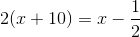
Let
"The sum of a number and ten" is the expression
"The difference of the number and one half" is a subtraction of the two, or
Set these equal, and the desired equation is
← Didn't Know|Knew It →
A parking garage charges a minimum fee of  to park in the garage. It also charges an additional fee of
  for every hour, or portion of an hour, in which a person parks in the garage. Cliff wants to pay a maximum of
  to park there. If he pulls into the garage at exactly
  , when must he leave at latest?
A parking garage charges a minimum fee of
Tap to reveal answer
Let  be the number of hours that Cliff parks his car in the garage. Since he pays a flat fee of
  plus
plus  per hour or portion thereof, he pays
  dollars. Since he does not want to spend more than
  ,
,





Since a portion of an hour counts as much as an hour,  must be a whole number.

implies that
 .
.
Cliff can park in the garage for a maximum of 6 hours, and since he entered the garage at  , he must exit
  hours later:
 ,
,
or  .
.
Let
Since a portion of an hour counts as much as an hour,
implies that
Cliff can park in the garage for a maximum of 6 hours, and since he entered the garage at
or
← Didn't Know|Knew It →

In the above diagram, which of the four points is the  -intercept of the line of the equation
  ?
?
In the above diagram, which of the four points is the
Tap to reveal answer
The  -coordinate of the
  -intercept of the line of an equation can be found by setting
  and solving for
  :
:


The  -intercept is the point
  , which is three units down from the origin. This is the point marked
  in the diagram.
The
The
← Didn't Know|Knew It →
Solve:

Solve:
Tap to reveal answer

When solving this problem, remember order of operations PEMDAS. The parentheses come first followed by the multiplication.


When solving this problem, remember order of operations PEMDAS. The parentheses come first followed by the multiplication.
← Didn't Know|Knew It →