
Fractions - HSPT Math
Card 1 of 1100
How many seconds are in  of one minute?
How many seconds are in
Tap to reveal answer
To find  of one minute in terms of seconds, you need to first convert one minute to its value in seconds, which is 60 seconds.
Now, you just need to find the value for  of 60, which you determine by multiplying the two values:
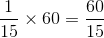
You can simplify the above fraction by division, which will you give you your correct answer in seconds:

Your answer is 4 seconds.
To find
Now, you just need to find the value for
You can simplify the above fraction by division, which will you give you your correct answer in seconds:
Your answer is 4 seconds.
← Didn't Know|Knew It →
On average, 1 in 9 peanuts that are harvested will only have one pod instead of two pods. Of those one-pod peanuts, three quarters of them will be smaller than the average peanut.
If 900 peanuts are harvested, how many will be one-pod peanuts that are smaller than average in size?
On average, 1 in 9 peanuts that are harvested will only have one pod instead of two pods. Of those one-pod peanuts, three quarters of them will be smaller than the average peanut.
If 900 peanuts are harvested, how many will be one-pod peanuts that are smaller than average in size?
Tap to reveal answer
If there are 900 peanuts and 1 in 9 will be one-podded, that means that 100 will be one-podded.
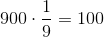
Three quarters of these 100 one-podded peanuts will be of smaller than average size. Three quarters of of 100 is 75. Therefore, 75 is the correct answer.
If there are 900 peanuts and 1 in 9 will be one-podded, that means that 100 will be one-podded.
Three quarters of these 100 one-podded peanuts will be of smaller than average size. Three quarters of of 100 is 75. Therefore, 75 is the correct answer.
← Didn't Know|Knew It →
A small bakery sells two flavors of muffins: chocolate and banana.
At the end of the day, there are 13 muffins left.
There are  chocolate muffins and
  banana muffins.
If
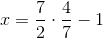
how many banana muffins are left?
A small bakery sells two flavors of muffins: chocolate and banana.
At the end of the day, there are 13 muffins left.
There are
If
how many banana muffins are left?
Tap to reveal answer
The first step is to solve for x.
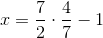


If there are 1x chocolate muffins and 2y banana muffins, for a total of 13 muffins then:



Since the number of banana muffins remaining is 2y, there are 12 banana muffins left.
The first step is to solve for x.
If there are 1x chocolate muffins and 2y banana muffins, for a total of 13 muffins then:
Since the number of banana muffins remaining is 2y, there are 12 banana muffins left.
← Didn't Know|Knew It →
One Australian dollar is equal to about 86 cents. To the nearest whole, for how many Australian dollars can a tourist to Australia expect to exchange $600 in American money?
One Australian dollar is equal to about 86 cents. To the nearest whole, for how many Australian dollars can a tourist to Australia expect to exchange $600 in American money?
Tap to reveal answer
One Australian dollar is equivalent to 86 cents, or $0.86, in American money, so divide $600 dollars by this conversion factor. $600 is equivalent to
 Australian dollars.
One Australian dollar is equivalent to 86 cents, or $0.86, in American money, so divide $600 dollars by this conversion factor. $600 is equivalent to
← Didn't Know|Knew It →
 of a class of 36 students are boys. If 2 girls and 4 boys were to drop the class, what percentage of the class would be girls?
Tap to reveal answer
First determine how many boys and girls are currently in the class.
 boys in the class, which means that there are 20 girls.
When the 6 students drop the new class size will be 30, which will be made up of  girls and
  boys.
boys.

First determine how many boys and girls are currently in the class.
When the 6 students drop the new class size will be 30, which will be made up of
← Didn't Know|Knew It →
Multiply: 
Multiply:
Tap to reveal answer
Since we are multiply fractions, multiply the numerator with numerator, and denominator with denominator. Simplify if possible.

Since we are multiply fractions, multiply the numerator with numerator, and denominator with denominator. Simplify if possible.
← Didn't Know|Knew It →
Divide: 
Divide:
Tap to reveal answer
Rewrite the expression using a division sign.

Convert the sign to a multiplication sign, and take the inverse of the second term.

Rewrite the expression using a division sign.
Convert the sign to a multiplication sign, and take the inverse of the second term.
← Didn't Know|Knew It →
A tree  feet high casts a shadow 20 feet long at the same time a tree 30 feet high casts a shadow how many feet long? Give your answer in terms of
  .
.
A tree
Tap to reveal answer
The ratio of the height of an object to the length of the shadow it casts at a point in time is the same for all objects, so, if we let the length of the shadow cast by the second tree be  :
:

Set the cross-products equal to each other and solve for 



 , the correct choice.
The ratio of the height of an object to the length of the shadow it casts at a point in time is the same for all objects, so, if we let the length of the shadow cast by the second tree be
Set the cross-products equal to each other and solve for
← Didn't Know|Knew It →
The length and width of a given make of car are 4.5 and 1.8 meters, respectively.
A scale model of this make of car will be  feet long. In terms of
  , how wide will this scale model be?
The length and width of a given make of car are 4.5 and 1.8 meters, respectively.
A scale model of this make of car will be
Tap to reveal answer
The ratio of the width of the scale model to its length is the same as the comparable ratio for the actual car, so we can set up this equation:

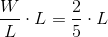

The ratio of the width of the scale model to its length is the same as the comparable ratio for the actual car, so we can set up this equation:
← Didn't Know|Knew It →
Edna needs  cups of sugar to make 24 of her world-famous Oatmeal Chocolate Dynamite Cookies.
She has  cups of sugar on hand. If the other ingredients are sufficiently plentiful, then in terms of
  , how many cookies can she make? (Note: the number of cookies need not be a multiple of 24.)
Edna needs
She has
Tap to reveal answer
An easier way to look at the number of cookies Edna can make with her sugar is as follows:
 cups of sugar go into making 24 cookies, so
 cups of sugar go into making
  cookies.
1 cup of sugar, therefore, goes into making  cookies.
 cups go into making
  , or
, or  , cookies. This is the correct response.
An easier way to look at the number of cookies Edna can make with her sugar is as follows:
1 cup of sugar, therefore, goes into making
← Didn't Know|Knew It →
On a map, one half of an inch represents  miles of real distance.
On the map, Lincoln County, which is perfectly rectangular, is four and one-fourth inches wide by three and three-fourths inches high. In terms of  , give the area of Lincoln County in square miles.
On a map, one half of an inch represents
On the map, Lincoln County, which is perfectly rectangular, is four and one-fourth inches wide by three and three-fourths inches high. In terms of
Tap to reveal answer
The dimensions of Lincoln County on the map are  inches by
  inches.
One half of an inch represents  miles, so one whole inch represents twice this, or
  miles. Consequently,
 inches represents
  miles, and
 inches represents
  miles.
Therefore, in real distance, Lincoln County has dimensions  miles and
  miles, and the area is the product of these two, or
 .
.
The dimensions of Lincoln County on the map are
One half of an inch represents
Therefore, in real distance, Lincoln County has dimensions
← Didn't Know|Knew It →
One of Floyd's World Famous Ooey Gooey Butter Cakes requires two and one-half cups of flour and four eggs, among other ingredients.
Floyd wants to make seven of these cakes for a wedding. He has sixteen cups of flour on hand as well as three dozen eggs. Assuming he has enough of all other ingredients, can Floyd make the seven cakes he wants to make?
One of Floyd's World Famous Ooey Gooey Butter Cakes requires two and one-half cups of flour and four eggs, among other ingredients.
Floyd wants to make seven of these cakes for a wedding. He has sixteen cups of flour on hand as well as three dozen eggs. Assuming he has enough of all other ingredients, can Floyd make the seven cakes he wants to make?
Tap to reveal answer
In order to make seven butter cakes, Floyd must use
 eggs.
eggs.
Floyd has three dozen, or 36, eggs on hand, so he has enough eggs.
Floyd must use
 cups of flour.
Floyd has 16 cups on hand, so he does not have enough flour.
In order to make seven butter cakes, Floyd must use
Floyd has three dozen, or 36, eggs on hand, so he has enough eggs.
Floyd must use
Floyd has 16 cups on hand, so he does not have enough flour.
← Didn't Know|Knew It →

Tap to reveal answer
The formula for multiplication of fractions is:

Where  and
and  It doesn't matter if the denominators are not the same. Just multiply the numerators, then multiply the denominators and simplify.


To simplify, divide the numerator and the denominator by the GCF or the greatest common factor, which is 3.

The formula for multiplication of fractions is:
Where
To simplify, divide the numerator and the denominator by the GCF or the greatest common factor, which is 3.
← Didn't Know|Knew It →

Tap to reveal answer
The formula for multiplication of fractions is:

Where  and
and  It doesn't matter if the denominators are not the same. Just multiply the numerators, then multiply the denominators and simplify.

 A negative times a positive is a negative.
To simplify, divide the numerator and the denominator by the GCF or the greatest common factor, which is 15.

The formula for multiplication of fractions is:
Where
To simplify, divide the numerator and the denominator by the GCF or the greatest common factor, which is 15.
← Didn't Know|Knew It →

Tap to reveal answer
The formula for multiplication of fractions is:

Where  and
and 

Convert each mixed number to an improper fraction; then multiply.


It doesn't matter if the denominators are not the same. Just multiply the numerators, then multiply the denominators and simplify.

Convert the improper fraction back to a mixed number by dividing the numerator by the denominator.

Simplify by dividing the numerator and denominator of the fraction part of the mixed number by the GCF or Greatest Common Factor which is 2.

 reduced to simplest form is
To simplify, divide the numerator and the denominator by the GCF or the greatest common factor, which is 15.

The formula for multiplication of fractions is:
Where
Convert each mixed number to an improper fraction; then multiply.
It doesn't matter if the denominators are not the same. Just multiply the numerators, then multiply the denominators and simplify.
Convert the improper fraction back to a mixed number by dividing the numerator by the denominator.
Simplify by dividing the numerator and denominator of the fraction part of the mixed number by the GCF or Greatest Common Factor which is 2.
To simplify, divide the numerator and the denominator by the GCF or the greatest common factor, which is 15.
← Didn't Know|Knew It →

Tap to reveal answer

The formula for multiplication of fractions is:

Where  and
and  It doesn't matter if the denominators are not the same. Just multiply the numerators, then multiply the denominators and simplify.
Convert any mixed number (whole number and fraction) to an improper fraction:


To simplify, divide the numerator and the denominator by the GCF, or the greatest common factor, which is 6.


The formula for multiplication of fractions is:
Where
Convert any mixed number (whole number and fraction) to an improper fraction:
To simplify, divide the numerator and the denominator by the GCF, or the greatest common factor, which is 6.
← Didn't Know|Knew It →
Evaluate  , if
, if  ,
,  , and
, and  .
.
Evaluate
Tap to reveal answer
Evaluate  , if
, if  ,
,  , and
, and 
 (A positive times a negative is negative, and a negative times a positive is negative.)
Simplify by dividing the numerator and the denominator by the GCF or the Greatest Common Factor, which is 12.


Evaluate
Simplify by dividing the numerator and the denominator by the GCF or the Greatest Common Factor, which is 12.
← Didn't Know|Knew It →
What is the area of a rectangle with  cm and a
  cm?
cm?
What is the area of a rectangle with
Tap to reveal answer
The formula for Area of a rectangle is  , where
  and
and 
To solve  , first convert both mixed numbers to improper fractions.


Then multiply the numerators and the denominators. Simplify.

Because there is a 9 in the numerator and a 9 in the denominator the nines cancel each other out, and you are left with:

Area is 2-dimensional: it has a length and a width. Area is measured in square units.
The area of the rectangle is  .
.
The formula for Area of a rectangle is
To solve
Then multiply the numerators and the denominators. Simplify.
Because there is a 9 in the numerator and a 9 in the denominator the nines cancel each other out, and you are left with:
Area is 2-dimensional: it has a length and a width. Area is measured in square units.
The area of the rectangle is
← Didn't Know|Knew It →
The gas tank in Renee's mustang is filled to capacity at  gallons. She used
  of a tank of gas to take a drive to the shore. How much gas did it take to drive to the shore?
The gas tank in Renee's mustang is filled to capacity at
Tap to reveal answer
 To solve this word problem, multiply the fractions. First convert any mixed number to an improper fraction:

Next, multiply the numerators and the denominators of both improper fractions.

 gallons of gas was consumed on Renee's trip to the shore.
Next, multiply the numerators and the denominators of both improper fractions.
← Didn't Know|Knew It →
What is the product of  ?
?
What is the product of
Tap to reveal answer

To begin solving, convert any mixed numbers to improper fractions, and if there is a whole number, place a one underneath that number to make it an improper fraction.


Then multiply the numerators and then multiply the denominators. Remember, a negative times a positive is a negative.

And a negative times a negative is positive.


Reduce the fraction part of the mixed number to simplest form by dividing both the numerator and the denominator by the GCF or the Greatest Common Factor which is 5.


To begin solving, convert any mixed numbers to improper fractions, and if there is a whole number, place a one underneath that number to make it an improper fraction.
Then multiply the numerators and then multiply the denominators. Remember, a negative times a positive is a negative.
And a negative times a negative is positive.
Reduce the fraction part of the mixed number to simplest form by dividing both the numerator and the denominator by the GCF or the Greatest Common Factor which is 5.
← Didn't Know|Knew It →