
Heat - Physics
Card 0 of 108
In order for heat transfer to occur, which of the following must be present?
In order for heat transfer to occur, which of the following must be present?
A temperature gradient is always needed for heat transfer to occur. The temperature difference is what drives a flow of heat, as heat will always travel from an area of higher temperature to an area of lower temperature. This can occur between two materials, or within a single material. For example, if an iron pot is placed on a stovetop, the entire metal pot will become hot even though only the bottom is in contact with the heat source. This is because the heat transfers through the metal, from the high heat at the bottom to the lower heat at the top.
A temperature gradient is always needed for heat transfer to occur. The temperature difference is what drives a flow of heat, as heat will always travel from an area of higher temperature to an area of lower temperature. This can occur between two materials, or within a single material. For example, if an iron pot is placed on a stovetop, the entire metal pot will become hot even though only the bottom is in contact with the heat source. This is because the heat transfers through the metal, from the high heat at the bottom to the lower heat at the top.
Compare your answer with the correct one above
A piece of bread is burned on one side and uncooked on the other after being heated in a toaster. What was the most likely form of heat transfer to cause the burn?
A piece of bread is burned on one side and uncooked on the other after being heated in a toaster. What was the most likely form of heat transfer to cause the burn?
Conduction is a form of heat transfer requiring direct contact between two objects. In the question, the burned side of the bread was likely in direct contact with the heat source, while the other was only in contact with hot air. The burned side is heated by conduction, while the uncooked side is heated by convection.
Convection is the transfer of heat through a fluid medium, namely a liquid or gas. Radiation is the transfer of heat through electromagnetic waves.
Conduction is a form of heat transfer requiring direct contact between two objects. In the question, the burned side of the bread was likely in direct contact with the heat source, while the other was only in contact with hot air. The burned side is heated by conduction, while the uncooked side is heated by convection.
Convection is the transfer of heat through a fluid medium, namely a liquid or gas. Radiation is the transfer of heat through electromagnetic waves.
Compare your answer with the correct one above
Which of the following methods of heat transfer requires the two objects to be touching?
Which of the following methods of heat transfer requires the two objects to be touching?
Conduction is the form of heat transfer that requires direct contact between two objects.
Radiation is heat transfer via electromagnetic radiation. Convection uses a fluid medium, such as air or water, for heat transfer. Induction and thermodynamic discharge are not recognized types of heat transfer.
Conduction is the form of heat transfer that requires direct contact between two objects.
Radiation is heat transfer via electromagnetic radiation. Convection uses a fluid medium, such as air or water, for heat transfer. Induction and thermodynamic discharge are not recognized types of heat transfer.
Compare your answer with the correct one above
A marshmallow on a stick is placed above a fire, but not touching the fire. The marshmallow heats up and softens. How is the marshmallow being heated?
I. Conduction
II. Convection
III. Radiation
A marshmallow on a stick is placed above a fire, but not touching the fire. The marshmallow heats up and softens. How is the marshmallow being heated?
I. Conduction
II. Convection
III. Radiation
Conduction occurs when heat is transferred by direct contact between two objects. Convection occurs when heat is transferred via contact between a fluid and an object. Radiation is heat transfer via electromagnetic radiation.
In this question, the fire is a source of heat and electromagnetic radiation. When the radiation from the fire impacts the marshmallow, it is being heated by radiation. The fire is also heating the surrounding air, creating fluid currents. The heated air is also transferring energy to the marshmallow, heating by convection.
There is no conduction in this example.
Conduction occurs when heat is transferred by direct contact between two objects. Convection occurs when heat is transferred via contact between a fluid and an object. Radiation is heat transfer via electromagnetic radiation.
In this question, the fire is a source of heat and electromagnetic radiation. When the radiation from the fire impacts the marshmallow, it is being heated by radiation. The fire is also heating the surrounding air, creating fluid currents. The heated air is also transferring energy to the marshmallow, heating by convection.
There is no conduction in this example.
Compare your answer with the correct one above
A certain amount of heat energy is added to a closed system. A few moments later, a scientist observes that the total increase in energy is LESS than that heat energy added to the system. Which could be a valid explanation for this conclusion?
A certain amount of heat energy is added to a closed system. A few moments later, a scientist observes that the total increase in energy is LESS than that heat energy added to the system. Which could be a valid explanation for this conclusion?
The most likely explanation is that work is done by the system.
The formula for change in energy shows that the net change in energy is equal to the increase in heat energy minus the work done:

Since  , there must have been work done by the system.
The most likely explanation is that work is done by the system.
The formula for change in energy shows that the net change in energy is equal to the increase in heat energy minus the work done:
Since
Compare your answer with the correct one above
An ideal gas is inside of a tube at  . If the pressure remains constant, but the volume decreases from
  to
to  , what will be the final temperature in the tube?
An ideal gas is inside of a tube at
For this problem, use Charles's Law:

In this formula,  is the volume and
  is the temperature. Charles's Law allows us to set up a proportion for changes in volume and temperature, as long as pressure remains constant. Since we are dealing with a proportion, the units for temperature are irrelevant and we do not need to convert to Kelvin.
Using the given values, we should be able to solve for the final temperature.


Cross multiply.


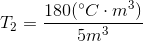

For this problem, use Charles's Law:
In this formula,
Using the given values, we should be able to solve for the final temperature.
Cross multiply.
Compare your answer with the correct one above
An ideal gas is inside of a container with a pressure of  . If it starts with a volume of
  and is compressed to
  , what is the new pressure if the temperature remains constant?
An ideal gas is inside of a container with a pressure of
We will need to use Boyle's Law to solve:

Boyle's Law allows us to set up a relationship between the changes in pressure and volume under conditions with constant temperature. Since the equation is a proportion, we do not need to convert any units.
We can use the given values to solve for the new pressure.

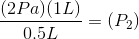
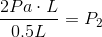

We will need to use Boyle's Law to solve:
Boyle's Law allows us to set up a relationship between the changes in pressure and volume under conditions with constant temperature. Since the equation is a proportion, we do not need to convert any units.
We can use the given values to solve for the new pressure.
Compare your answer with the correct one above
An ideal gas is compressed from  to
to  at constant temperature. If the initial pressure was
  , what is the new pressure?
An ideal gas is compressed from
For this problem, use Boyle's Law:

Boyle's Law allows us to set up a proportion between the pressure and volume at a constant temperature.
Using the values given, we can solve for the final pressure.



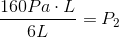

For this problem, use Boyle's Law:
Boyle's Law allows us to set up a proportion between the pressure and volume at a constant temperature.
Using the values given, we can solve for the final pressure.
Compare your answer with the correct one above
A balloon in a hot room is submerged in a bucket of cold water. What will happen to this balloon?
A balloon in a hot room is submerged in a bucket of cold water. What will happen to this balloon?
The volume of air in the balloon will increase when exposed to hotter temperatures, and decrease when exposed to colder temperatures. If we look at the ideal gas law, we can see that temperature and volume have a direct relationship. As one goes down, so does the other, assuming all other factors remain constant.

We can also look at Charles's law of volumes:

The balloon is sealed, so the amount of gas in the balloon will not change, and the elasticity of the balloon means that pressure will also remain constant. As temperature decreases, volume must also decrease. Suppose that the temperature is halved in our question. The result would be half the volume, according to Charles's law.
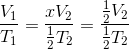
By this logic, we can conclude that the balloon will shrink when placed in the cold water.
The volume of air in the balloon will increase when exposed to hotter temperatures, and decrease when exposed to colder temperatures. If we look at the ideal gas law, we can see that temperature and volume have a direct relationship. As one goes down, so does the other, assuming all other factors remain constant.
We can also look at Charles's law of volumes:
The balloon is sealed, so the amount of gas in the balloon will not change, and the elasticity of the balloon means that pressure will also remain constant. As temperature decreases, volume must also decrease. Suppose that the temperature is halved in our question. The result would be half the volume, according to Charles's law.
By this logic, we can conclude that the balloon will shrink when placed in the cold water.
Compare your answer with the correct one above
Why does adding heat cause a gas to expand?
Why does adding heat cause a gas to expand?
Heat is a form of energy. Adding heat to a gaseous system will increase the energy of the molecules, causing them to move faster and collide more frequently. This increased velocity results in the expansion of the gas.
Heat is a form of energy. Adding heat to a gaseous system will increase the energy of the molecules, causing them to move faster and collide more frequently. This increased velocity results in the expansion of the gas.
Compare your answer with the correct one above
The temperature of an ideal gas is raised from  to
to  . If the volume remains constant, what was its initial pressure if the final pressure is
  ?
?
The temperature of an ideal gas is raised from
For this problem, use Gay-Lussac's law to set up a direct proportion between pressure and temperature. Note that this law only applies when volume is constant.

Plug in our given values and solve for the initial pressure.

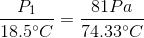
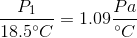
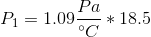

For this problem, use Gay-Lussac's law to set up a direct proportion between pressure and temperature. Note that this law only applies when volume is constant.
Plug in our given values and solve for the initial pressure.
Compare your answer with the correct one above
A bathtub and a coffee cup both contain water at  . Which of the following is true?
A bathtub and a coffee cup both contain water at
Heat is a form of energy, while temperature is a measure of the average kinetic energy of the molecules present in a system. Since both systems are measure to be at  , their average kinetic energies are the same. The cup and the bathtub have the same temperature; however, since the bathtub contains more water, it contains more molecules. Temperature is the measure of heat energy per molecule. A greater number of molecules at the same temperature is indicative of more heat energy than fewer molecules at that temperature. Since the bathtub has more molecules, it has more heat energy even though the two systems have the same temperature.
Heat is a form of energy, while temperature is a measure of the average kinetic energy of the molecules present in a system. Since both systems are measure to be at
Compare your answer with the correct one above
A  disc of copper is dropped into a
  glass of water. If the copper was at
  and the water was at
  , what is the new temperature of the mixture?
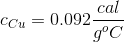
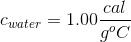
A
The relationship between mass and temperature, when two masses are mixed together, is:

Using the given values for the mass and specific heat of each compound, we can solve for the final temperature.

We need to work to isolate the final temperature.

Distribute into the parenthesis using multiplication.

Combine like terms.

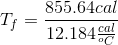

The relationship between mass and temperature, when two masses are mixed together, is:
Using the given values for the mass and specific heat of each compound, we can solve for the final temperature.
We need to work to isolate the final temperature.
Distribute into the parenthesis using multiplication.
Combine like terms.
Compare your answer with the correct one above
 of soup at
  cools down to
  after
after  . If the specific heat of the soup is
  , how much energy does the soup release into the room?
The formula for heat energy is:

We are given the initial and final temperatures, mass, and specific heat. Using these values, we can find the heat released. Note that the time is irrelevant to this calculation.


That means that the soup "lost"  of energy. This is the amount that it released into the room. The value is negative for the soup, the source of the heat, but positive for the room, which receives it.
The formula for heat energy is:
We are given the initial and final temperatures, mass, and specific heat. Using these values, we can find the heat released. Note that the time is irrelevant to this calculation.
That means that the soup "lost"
Compare your answer with the correct one above
 of soup at
  cools down after
  . If the specific heat of the soup is
  , and it released
  of energy into the room, what is the final temperature of the soup?
The formula for heat energy is:

We are given the initial temperature, mass, specific heat, and heat released. Using these values, we can find the final temperature. Note that the time is irrelevant to this calculation. Since heat is released from the soup, the net change in the soup's energy is negative. Since the soup is cooling, we expect our answer to be less than  .
.


The formula for heat energy is:
We are given the initial temperature, mass, specific heat, and heat released. Using these values, we can find the final temperature. Note that the time is irrelevant to this calculation. Since heat is released from the soup, the net change in the soup's energy is negative. Since the soup is cooling, we expect our answer to be less than
Compare your answer with the correct one above
 of soup cools down to
  after
after  . If the specific heat of the soup is
  , and it released
  of energy into the room, what was the initial temperature of the soup?
The formula for heat energy is:

We are given the final temperature, mass, specific heat, and heat released. Using these values, we can find the initial temperature. Note that the time is irrelevant to this calculation. Since heat is released from the soup, the net change in the soup's energy is negative. Since the soup is cooling, we expect our answer to be greater than  .
.


The formula for heat energy is:
We are given the final temperature, mass, specific heat, and heat released. Using these values, we can find the initial temperature. Note that the time is irrelevant to this calculation. Since heat is released from the soup, the net change in the soup's energy is negative. Since the soup is cooling, we expect our answer to be greater than
Compare your answer with the correct one above
An ice cube at  melts. As it melts, constant temperature readings are taken and the sample maintains the temperature of
  throughout the melting process. Which statement best describes the energy of the system?
An ice cube at
When an object changes phase, it requires energy called "latent heat." In this case, even though the temperature is remaining constant, the energy inside of the ice cube is decreasing as it expends energy to melt.
When an object changes phase, it requires energy called "latent heat." In this case, even though the temperature is remaining constant, the energy inside of the ice cube is decreasing as it expends energy to melt.
Compare your answer with the correct one above
A  silver spoon is placed in a
  cup of tea. If the spoon has a mass of
  and the tea has
  of mass, what is the final temperature of the spoon?


A
The equation for two items reaching a thermal equilibrium is given by describing a heat transfer. The heat removed from one object is equal to the heat added to the other.


We are given the specific heat values of each substance, as well as their masses. We also know the initial temperature of each substance. Use these terms in the equation to solve for the final temperature. Remember that the final temperature will be the same for each substance, since they will be in thermodynamic equilibrium.


The equation for two items reaching a thermal equilibrium is given by describing a heat transfer. The heat removed from one object is equal to the heat added to the other.
We are given the specific heat values of each substance, as well as their masses. We also know the initial temperature of each substance. Use these terms in the equation to solve for the final temperature. Remember that the final temperature will be the same for each substance, since they will be in thermodynamic equilibrium.
Compare your answer with the correct one above
A sample of  of water at
  is placed in a
  ceramic mug, which is at
  . What is the final temperature of the system?


A sample of
For this question, we must recognize that the system going to end up in equilibrium. That means that:

We are given the initial temperatures, masses, and specific heats of both the water and the ceramic. This will allow us to solve for the final temperature of the system; this value will be equal for both components. Notice that the specific heat given to us in the problem for the ceramic is in terms of kilograms, not grams. Convert to grams.


For this question, we must recognize that the system going to end up in equilibrium. That means that:
We are given the initial temperatures, masses, and specific heats of both the water and the ceramic. This will allow us to solve for the final temperature of the system; this value will be equal for both components. Notice that the specific heat given to us in the problem for the ceramic is in terms of kilograms, not grams. Convert to grams.
Compare your answer with the correct one above
A  vial of an unknown liquid is
  . Julie adds
  of the same liquid at
  to the vial. What is the final temperature?
A
The equation for change in temperature is 
Plug in our given values.


Notice that the specific heats will cancel out.


Combine like terms.


The equation for change in temperature is
Plug in our given values.
Notice that the specific heats will cancel out.
Combine like terms.
Compare your answer with the correct one above