
Balancing Reactions - AP Chemistry
Card 0 of 196
When balanced, what is the value of  in the following chemical equation?

When balanced, what is the value of
Recall that a balanced chemical equation has the same number of each element on one side.

Start by counting the number of each element on each side.
There are the following numbers of moles of each reactant:


There are the following numbers of moles of each product:


Add coefficients in front of the molecular compounds in the equation until there are the same numbers of sulfur, oxygen, lithium, and selenium on each side.
The balanced chemical equation is the following:

Both products and reactants now have the following number of moles:


Since the coefficient in front of  is
is  ,
,  must equal to
  .
.
Recall that a balanced chemical equation has the same number of each element on one side.
Start by counting the number of each element on each side.
There are the following numbers of moles of each reactant:
There are the following numbers of moles of each product:
Add coefficients in front of the molecular compounds in the equation until there are the same numbers of sulfur, oxygen, lithium, and selenium on each side.
The balanced chemical equation is the following:
Both products and reactants now have the following number of moles:
Since the coefficient in front of
Compare your answer with the correct one above
Balance the following chemical equation:

Balance the following chemical equation:
A balanced chemical equation will have the same number of each atom on both sides of the reaction.

Start by balancing the number of nitrate.
Since we have  nitrate on the left, we must also have
  nitrate on the right.

This equation now gives  potassium on the left, and
  potassium on the right. Balance the potassium.

This equation is balanced because there are equal numbers of each atom on both sides.
A balanced chemical equation will have the same number of each atom on both sides of the reaction.
Start by balancing the number of nitrate.
Since we have
This equation now gives
This equation is balanced because there are equal numbers of each atom on both sides.
Compare your answer with the correct one above
The following ReDox reaction takes place in acidic solution:
Fe2+ + Cr2O72– → Fe3+ + Cr3+
What is the sum of coefficients in this redox reaction?
The following ReDox reaction takes place in acidic solution:
Fe2+ + Cr2O72– → Fe3+ + Cr3+
What is the sum of coefficients in this redox reaction?
When you balance the redox reaction in acidic conditons, there are 6Fe2+, 1 Cr2O72–, 14 H+, 6 Fe3+, 2 Cr3+, and 7 H2O. Don't forget to add the 1 in front of the Cr2O72–
When you balance the redox reaction in acidic conditons, there are 6Fe2+, 1 Cr2O72–, 14 H+, 6 Fe3+, 2 Cr3+, and 7 H2O. Don't forget to add the 1 in front of the Cr2O72–
Compare your answer with the correct one above
For the following unbalanced redox reaction, how many electrons are transferred and which chemical species is being oxidized?

For the following unbalanced redox reaction, how many electrons are transferred and which chemical species is being oxidized?
To begin, we will need to separate the given reaction into the two half-reactions by identifying changes in oxidation number. In this case, mercury (Hg) and phosphorus (P) show a change in oxidation number. Mercury begins with an oxidation number of zero, and ends with an oxidation number of  . Phosphorus begins with an oxidation number of
  and ends with an oxidation number of
  . Note that the oxidation numbers for fluorine and iodine reamain constant at
  for each.
Now we can begin to look at the half-reactions.


Balance the atoms.


Now balance the electrons. We know that each mercury atom loses one electron and each fluorine atom gains one electron.


We can see that two electrons are tranferred. To identify the element being oxidized, we must find the element that is losing electrons. In this case, mercury is being oxidized.
To begin, we will need to separate the given reaction into the two half-reactions by identifying changes in oxidation number. In this case, mercury (Hg) and phosphorus (P) show a change in oxidation number. Mercury begins with an oxidation number of zero, and ends with an oxidation number of
Now we can begin to look at the half-reactions.
Balance the atoms.
Now balance the electrons. We know that each mercury atom loses one electron and each fluorine atom gains one electron.
We can see that two electrons are tranferred. To identify the element being oxidized, we must find the element that is losing electrons. In this case, mercury is being oxidized.
Compare your answer with the correct one above
How many electrons are involved in the following reaction?

How many electrons are involved in the following reaction?

The common factor between 2 e- and 5 e- is 10. Therefore the number of electrons involved is 10 e-.
The common factor between 2 e- and 5 e- is 10. Therefore the number of electrons involved is 10 e-.
Compare your answer with the correct one above
How many electrons are involved in the following reaction?

How many electrons are involved in the following reaction?
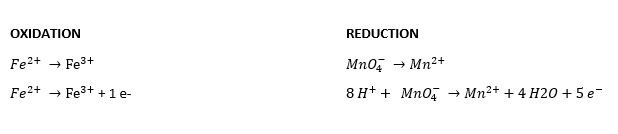
The common factor between 1 e- and 5 e- is 5. Therefore the number of electrons involved is 5 e-.
The common factor between 1 e- and 5 e- is 5. Therefore the number of electrons involved is 5 e-.
Compare your answer with the correct one above
What is the balanced coefficient on OH- for the following reaction:
 (under basic conditions)
What is the balanced coefficient on OH- for the following reaction:
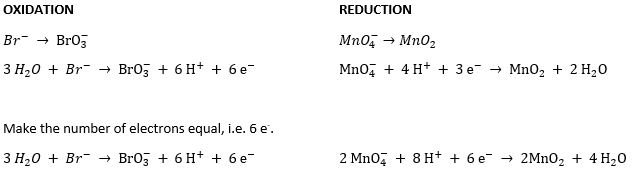
Add them together:

Simplify:

Add Hydroxides to each side to counter H+.

Simplify:

Add them together:
Simplify:
Add Hydroxides to each side to counter H+.
Simplify:
Compare your answer with the correct one above
What is the sum of all the balanced coefficients in the following reaction:
 (basic conditions)
What is the sum of all the balanced coefficients in the following reaction:
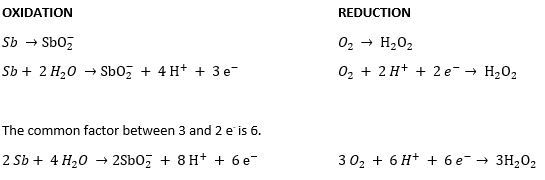
Add the equations together

Simplify

Add 2 OH- to each side to cancel out the H+.

Simplify:

Add the equations together
Simplify
Add 2 OH- to each side to cancel out the H+.
Simplify:
Compare your answer with the correct one above
The following ReDox reaction takes place in acidic solution:
Fe2+ + Cr2O72– → Fe3+ + Cr3+
What is the sum of coefficients in this redox reaction?
The following ReDox reaction takes place in acidic solution:
Fe2+ + Cr2O72– → Fe3+ + Cr3+
What is the sum of coefficients in this redox reaction?
When you balance the redox reaction in acidic conditons, there are 6Fe2+, 1 Cr2O72–, 14 H+, 6 Fe3+, 2 Cr3+, and 7 H2O. Don't forget to add the 1 in front of the Cr2O72–
When you balance the redox reaction in acidic conditons, there are 6Fe2+, 1 Cr2O72–, 14 H+, 6 Fe3+, 2 Cr3+, and 7 H2O. Don't forget to add the 1 in front of the Cr2O72–
Compare your answer with the correct one above
For the following unbalanced redox reaction, how many electrons are transferred and which chemical species is being oxidized?
For the following unbalanced redox reaction, how many electrons are transferred and which chemical species is being oxidized?
To begin, we will need to separate the given reaction into the two half-reactions by identifying changes in oxidation number. In this case, mercury (Hg) and phosphorus (P) show a change in oxidation number. Mercury begins with an oxidation number of zero, and ends with an oxidation number of . Phosphorus begins with an oxidation number of and ends with an oxidation number of . Note that the oxidation numbers for fluorine and iodine reamain constant at for each.
Now we can begin to look at the half-reactions.
Balance the atoms.
Now balance the electrons. We know that each mercury atom loses one electron and each fluorine atom gains one electron.
We can see that two electrons are tranferred. To identify the element being oxidized, we must find the element that is losing electrons. In this case, mercury is being oxidized.
To begin, we will need to separate the given reaction into the two half-reactions by identifying changes in oxidation number. In this case, mercury (Hg) and phosphorus (P) show a change in oxidation number. Mercury begins with an oxidation number of zero, and ends with an oxidation number of
Now we can begin to look at the half-reactions.
Balance the atoms.
Now balance the electrons. We know that each mercury atom loses one electron and each fluorine atom gains one electron.
We can see that two electrons are tranferred. To identify the element being oxidized, we must find the element that is losing electrons. In this case, mercury is being oxidized.
Compare your answer with the correct one above
How many electrons are involved in the following reaction?
How many electrons are involved in the following reaction?
The common factor between 2 e- and 5 e- is 10. Therefore the number of electrons involved is 10 e-.
The common factor between 2 e- and 5 e- is 10. Therefore the number of electrons involved is 10 e-.
Compare your answer with the correct one above
How many electrons are involved in the following reaction?
How many electrons are involved in the following reaction?
The common factor between 1 e- and 5 e- is 5. Therefore the number of electrons involved is 5 e-.
The common factor between 1 e- and 5 e- is 5. Therefore the number of electrons involved is 5 e-.
Compare your answer with the correct one above
What is the balanced coefficient on OH- for the following reaction:
(under basic conditions)
What is the balanced coefficient on OH- for the following reaction:
Add them together:
Simplify:
Add Hydroxides to each side to counter H+.
Simplify:
Add them together:
Simplify:
Add Hydroxides to each side to counter H+.
Simplify:
Compare your answer with the correct one above
What is the sum of all the balanced coefficients in the following reaction:
(basic conditions)
What is the sum of all the balanced coefficients in the following reaction:
Add the equations together
Simplify
Add 2 OH- to each side to cancel out the H+.
Simplify:
Add the equations together
Simplify
Add 2 OH- to each side to cancel out the H+.
Simplify:
Compare your answer with the correct one above
_Fe2O3 + _HCl ⇌ _FeCl3 + _H2O
The Following question will be based on the unbalanced reaction above
For the reaction above to be balanced what coefficient should be in front of the compound HCl?
_Fe2O3 + _HCl ⇌ _FeCl3 + _H2O
The Following question will be based on the unbalanced reaction above
For the reaction above to be balanced what coefficient should be in front of the compound HCl?
Balancing reactions is best acheived by using a stepwise approach. It is useful to work through each atom making sure it is present in a balanced fashion on both sides of the equation. Starting with Fe, Fe2O3 is the only molecule with Fe present on the left side of the equation and FeCl3 is the only molecule with Fe present on the right side of the equation. Thus the molar ratio of Fe2O3 to FeCl3 must be 1:2. Moving on to O, the O on the left side of the equation exists as Fe2O3 and H2O on the right. The molar ratio of Fe2O3 to H2O is therefore 1:3. Cl exists in HCl on the left and FeCl3 on the right. Thus the molar ratio of HCl to FeCl3 must be 3:1. To ensure that these molar ratios are maintaned the balanced formula is then determined to be Fe2O3 + 6HCl -> 2FeCl3 + 3H2O
Balancing reactions is best acheived by using a stepwise approach. It is useful to work through each atom making sure it is present in a balanced fashion on both sides of the equation. Starting with Fe, Fe2O3 is the only molecule with Fe present on the left side of the equation and FeCl3 is the only molecule with Fe present on the right side of the equation. Thus the molar ratio of Fe2O3 to FeCl3 must be 1:2. Moving on to O, the O on the left side of the equation exists as Fe2O3 and H2O on the right. The molar ratio of Fe2O3 to H2O is therefore 1:3. Cl exists in HCl on the left and FeCl3 on the right. Thus the molar ratio of HCl to FeCl3 must be 3:1. To ensure that these molar ratios are maintaned the balanced formula is then determined to be Fe2O3 + 6HCl -> 2FeCl3 + 3H2O
Compare your answer with the correct one above
Balance the following equation:
FeCl3 + NOH5 → Fe(OH)3 + NH4Cl
Balance the following equation:
FeCl3 + NOH5 → Fe(OH)3 + NH4Cl
The first thing to do is to balance the Cl (3 on the left; one on the right) ← add 3 for NH4Cl
Now, there are 3 N on the right and only one on the left; add a 3 to the NOH5
Check to see that the Fe, H, and O balance, which they do
The first thing to do is to balance the Cl (3 on the left; one on the right) ← add 3 for NH4Cl
Now, there are 3 N on the right and only one on the left; add a 3 to the NOH5
Check to see that the Fe, H, and O balance, which they do
Compare your answer with the correct one above
After the following reaction is balanced, how many moles of H2O can 4 moles of C2H6 produce?
__C2H6(s) + O2(g) → H2O(l) + CO2(g)
After the following reaction is balanced, how many moles of H2O can 4 moles of C2H6 produce?
__C2H6(s) + O2(g) → H2O(l) + CO2(g)
The reaction balances out to 2C2H6(s) + 7O2(g) → 6H2O(l) + 4CO2(g). For every 2 moles of C2H6 you can produce 6 moles of H2O. Giving you a total production of 12 moles when you have 4 moles of C2H6.
The reaction balances out to 2C2H6(s) + 7O2(g) → 6H2O(l) + 4CO2(g). For every 2 moles of C2H6 you can produce 6 moles of H2O. Giving you a total production of 12 moles when you have 4 moles of C2H6.
Compare your answer with the correct one above
Consider the following unbalanced equation for the combustion of propane,  :
:

If you were to combust one mole of propane, how many moles of water would you produce?
Consider the following unbalanced equation for the combustion of propane,
If you were to combust one mole of propane, how many moles of water would you produce?
Begin by balancing the equation. There are many ways to do this, but one method that is particularly useful is to assume that you have 1 mole of your hydrocarbon (propane), and balance the equation from there. It may be necessary to manipulate an equation further if you end up with fractions, but all you will need to do is multiply by an integer if that is the case.
First, we will balance the carbons. There are three carbons in propane, so we will make sure there are three carbons on the right side of the arrow as well:

This is not complete. We will next balance the hydrogens. There are eight hydrogens on the left side of the equation, so:

The last step is to balance the oxygens on the left and right side of the equation

Our equation is balanced and all coefficients are integers. If we begin with one mole of propane, we will produce four moles of water.
Begin by balancing the equation. There are many ways to do this, but one method that is particularly useful is to assume that you have 1 mole of your hydrocarbon (propane), and balance the equation from there. It may be necessary to manipulate an equation further if you end up with fractions, but all you will need to do is multiply by an integer if that is the case.
First, we will balance the carbons. There are three carbons in propane, so we will make sure there are three carbons on the right side of the arrow as well:
This is not complete. We will next balance the hydrogens. There are eight hydrogens on the left side of the equation, so:
The last step is to balance the oxygens on the left and right side of the equation
Our equation is balanced and all coefficients are integers. If we begin with one mole of propane, we will produce four moles of water.
Compare your answer with the correct one above
What is the chemical formula of the salt formed when a chemist mixes solvated Potassium and Arsenic ions in solution?
What is the chemical formula of the salt formed when a chemist mixes solvated Potassium and Arsenic ions in solution?
Potassium is a Group I element, so to get to a filled valence shell, it will lost one electron, yielding  .
.
Arsenic is a Group 5 element, so it needs to gain three electrons to obtain a filled valence shell, yielding  .
.
In order to balance out the charges, the resultant salt will be  .
.
Potassium is a Group I element, so to get to a filled valence shell, it will lost one electron, yielding
Arsenic is a Group 5 element, so it needs to gain three electrons to obtain a filled valence shell, yielding
In order to balance out the charges, the resultant salt will be
Compare your answer with the correct one above
Consider the following unbalanced equation:

How many grams of solid iron are needed to make 36.0g of  ? Assume that chlorine is in excess.
Consider the following unbalanced equation:
How many grams of solid iron are needed to make 36.0g of

First, we will balance the equation:

Since chlorine is in excess, we know that the limiting reagent is iron.

First, we will balance the equation:
Since chlorine is in excess, we know that the limiting reagent is iron.
Compare your answer with the correct one above