Lenses
GRE Subject Test: Physics · Learn by Concept
Help Questions
GRE Subject Test: Physics › Lenses
A candle 


No image is created.
Explanation
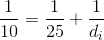
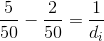
First, find the image distance 


Magnification of a lens is given by:
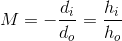
Where 


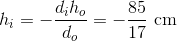
Because the sign is negative, the image is inverted.
The focal length of a thin convex lens is 


No image is created
Explanation
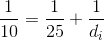
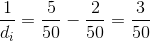
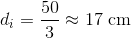
Because the object is beyond 2 focal lengths of the lens, the image must be between 1 and 2 focal lengths on the opposite side. Therefore, the image must be between 
Alternatively, one can apply the thin lens equation:

Where 


Sirius is a binary star system, consisting of two white dwarfs with an angular separation of 3 arcseconds. What is the approximate minimum diameter lens needed to resolve the two stars in Sirius for an observation at 


Explanation
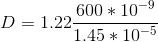
The Rayleigh Criterion gives the diffraction limit on resolution of a particular lens at a particular wavelength:

Where theta is the angular resolution in radians,