
How to find the nth term of an arithmetic sequence
GRE Quantitative Reasoning · Learn by Concept
Help Questions
GRE Quantitative Reasoning › How to find the nth term of an arithmetic sequence
Let Z represent a sequence of numbers 


Explanation
Let us first write the value of a consecutive term in a numerical format:

Consequently,
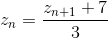
Using the first equation, we can define 


This allows us to rewrite

as

Rearrangement of terms allows us to solve for 


Now, using our second equation, we can find 

The first term in a sequence of integers is 2 and the second term is 10. All subsequent terms are the arithmetic mean of all of the preceding terms. What is the 39th term?
300
6
5
600
1200
Explanation
The first term and second term average out to 6. So the third term is 6. Now add 6 to the preceding two terms and divide by 3 to get the average of the first three terms, which is the value of the 4th term. This, too, is 6 (18/3)—all terms after the 2nd are 6, including the 39th. Thus, the answer is 6.
In a sequence of numbers, the first two values are 1 and 2. Each successive integer is calculated by adding the previous two and mutliplying that result by 3. What is fifth value in this sequence?


None of the other answers
Explanation
Our sequence begins as 1, 2.
Element 3: (Element 1 + Element 2) * 3 = (1 + 2) * 3 = 3 * 3 = 9
Element 4: (Element 2 + Element 3) * 3 = (2 + 9) * 3 = 11 * 3 = 33
Element 5: (Element 3 + Element 4) * 3 = (9 + 33) * 3 = 42 * 3 = 126
The sequence 


What is the value of the 


Explanation
The first term of the sequence is 

Plugging these values into the given expression for the nth term gives us our answer.



Consider the following sequence of integers:
5, 11, 23, 47
What is the 6th element in this sequence?
189
93
None of the other answers
191
95
Explanation
First, consider the change in each element. Notice that in each case, a given element is twice the preceding one plus one:
11 = 2 * 5 + 1
23 = 11 * 2 + 1
47 = 23 * 2 + 1
To find the 6th element, continue following this:
The 5th: 47 * 2 + 1 = 95
The 6th: 95 * 2 + 1 = 191