
Outcomes - GRE Quantitative Reasoning
Card 1 of 608
There are 15 people in a room. What is the probablility that at least 3 of them were born on the same day of the week?
There are 15 people in a room. What is the probablility that at least 3 of them were born on the same day of the week?
Tap to reveal answer
The probability is 1 because since there are 15 people and only 7 days of the week.

This means even if each of the 7 days only had 2 people's birthday on them after checking the first 14 people the 15th and final person must also have a birthday on one of these days, so at the very least one day of the week will include at least 3 people's birthday.
The probability is 1 because since there are 15 people and only 7 days of the week.
This means even if each of the 7 days only had 2 people's birthday on them after checking the first 14 people the 15th and final person must also have a birthday on one of these days, so at the very least one day of the week will include at least 3 people's birthday.
← Didn't Know|Knew It →
The probability that event A occurs is 0.22. The probability of event B occuring is 0.35. If the probability of event C occuring is 0.33, and the probability of event A or event B occuring is 0.54, then the probability of event C occuring is how many times the probability of event A and B occuring?
The probability that event A occurs is 0.22. The probability of event B occuring is 0.35. If the probability of event C occuring is 0.33, and the probability of event A or event B occuring is 0.54, then the probability of event C occuring is how many times the probability of event A and B occuring?
Tap to reveal answer
Keywords in this question are or and and. Here, the probability of event A or B is p(A) + p(B) if they are mutually exclusive. If they are not, however, the probability of A or B is p(A) + p(B) - p(A and B).
Mutually exclusive: 
Not mutually exclusive: 
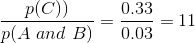
Given that p(A) + p(B) = 0.57, and we are told that p(A or B) = 0.54, it implies that p(A and B) = 0.03 (and that A and B are not mutually exclusive).


Now we can solve to ratio of p(A and B) to p(C).

Keywords in this question are or and and. Here, the probability of event A or B is p(A) + p(B) if they are mutually exclusive. If they are not, however, the probability of A or B is p(A) + p(B) - p(A and B).
Mutually exclusive:
Not mutually exclusive:
Given that p(A) + p(B) = 0.57, and we are told that p(A or B) = 0.54, it implies that p(A and B) = 0.03 (and that A and B are not mutually exclusive).
Now we can solve to ratio of p(A and B) to p(C).
← Didn't Know|Knew It →
Two six-sided dice are rolled.
Quantity A: The probability of rolling a total of 6
Quantity B: The probability of rolling a total of 9
Two six-sided dice are rolled.
Quantity A: The probability of rolling a total of 6
Quantity B: The probability of rolling a total of 9
Tap to reveal answer
List out the the possibilities of combinations for rolling a total of 6 and the possibilities of combinations for rolling a total of 9. There are 5 possible outcomes for rolling a total of 6 and 4 possible outcomes for rolling a total of 9. There are a total of 36 possible outcomes, so the probability of rolling a 6 is  and the possibility of rolling a 9 is
  .
.
List out the the possibilities of combinations for rolling a total of 6 and the possibilities of combinations for rolling a total of 9. There are 5 possible outcomes for rolling a total of 6 and 4 possible outcomes for rolling a total of 9. There are a total of 36 possible outcomes, so the probability of rolling a 6 is
← Didn't Know|Knew It →
Presented with a deck of fifty-two cards (no jokers), what is the probability of drawing either a face card or a spade?
Presented with a deck of fifty-two cards (no jokers), what is the probability of drawing either a face card or a spade?
Tap to reveal answer
A face card constitutes a Jack, Queen, or King, and there are twelve in a deck, so the probability of drawing a face card is  .
.
There are thirteen spades in the deck, so the probability of drawing a spade is  .
.
Keep in mind that there are also three cards that fit into both categories: the Jack, Queen, and King of Spades; the probability of drawing one is 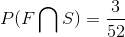
Thus the probability of drawing a face card or a spade is:

A face card constitutes a Jack, Queen, or King, and there are twelve in a deck, so the probability of drawing a face card is
There are thirteen spades in the deck, so the probability of drawing a spade is
Keep in mind that there are also three cards that fit into both categories: the Jack, Queen, and King of Spades; the probability of drawing one is
Thus the probability of drawing a face card or a spade is:
← Didn't Know|Knew It →
A jar contains 10 red marbles, 4 white marbles, and 2 blue marbles. Two are drawn in sequence, not replacing after each draw.
Quantity A
The probability of drawing two red marbles
Quantity B
The probability of drawing exactly one blue marble.
A jar contains 10 red marbles, 4 white marbles, and 2 blue marbles. Two are drawn in sequence, not replacing after each draw.
Quantity A
The probability of drawing two red marbles
Quantity B
The probability of drawing exactly one blue marble.
Tap to reveal answer
Note that there are 16 total marbles. A is simply a set of sequential events. On the first, you have 10/16 chances to draw a red. Supposing this red is not replaced, the chance of drawing a second red will be 9/15; therefore, the probability of A is (10/16) * (9/15) = 0.375. Event B is translated into 2 events: Blue + (White or Red) or (White or Red) + Blue. The probabilities of each of these events, added together would be (2/16) * (14/15) + (14/16) * (2/15) = 0.2333333333; therefore, A is more probable.
Note that there are 16 total marbles. A is simply a set of sequential events. On the first, you have 10/16 chances to draw a red. Supposing this red is not replaced, the chance of drawing a second red will be 9/15; therefore, the probability of A is (10/16) * (9/15) = 0.375. Event B is translated into 2 events: Blue + (White or Red) or (White or Red) + Blue. The probabilities of each of these events, added together would be (2/16) * (14/15) + (14/16) * (2/15) = 0.2333333333; therefore, A is more probable.
← Didn't Know|Knew It →
In a bowl containing 10 marbles, 5 are blue and 5 are pink. If 2 marbles are picked randomly, what is the probability that the 2 marbles will not both be pink?
In a bowl containing 10 marbles, 5 are blue and 5 are pink. If 2 marbles are picked randomly, what is the probability that the 2 marbles will not both be pink?
Tap to reveal answer
To solve this question, you can solve for the probability of choosing 2 marbles that are pink and subtracting that from 1 to obtain the probability of selecting any variation of marbles that are not both pink.
The probability of picking 2 marbles that are both pink would be the product of the probability of choosing the first pink marble multiplied by the probability of choosing a second pink marble from the remaining marbles in the mix.
This would be 1/2 * 4/9 = 2/9.
To obtain the probability that is asked, simply compute 1 – (2/9) = 7/9.
The probability that the 2 randomly chosen marbles are not both pink is 7/9.
To solve this question, you can solve for the probability of choosing 2 marbles that are pink and subtracting that from 1 to obtain the probability of selecting any variation of marbles that are not both pink.
The probability of picking 2 marbles that are both pink would be the product of the probability of choosing the first pink marble multiplied by the probability of choosing a second pink marble from the remaining marbles in the mix.
This would be 1/2 * 4/9 = 2/9.
To obtain the probability that is asked, simply compute 1 – (2/9) = 7/9.
The probability that the 2 randomly chosen marbles are not both pink is 7/9.
← Didn't Know|Knew It →
Choose a number at random from 1 to 5.
Column A
The probability of choosing an even number
Column B
The probability of choosing an odd number
Choose a number at random from 1 to 5.
Column A
The probability of choosing an even number
Column B
The probability of choosing an odd number
Tap to reveal answer
There are two even numbers and three odd numbers, so P (even) = 2/5 and P (odd) = 3/5.
There are two even numbers and three odd numbers, so P (even) = 2/5 and P (odd) = 3/5.
← Didn't Know|Knew It →
Two fair dice are thrown. What is the probability that the outcome will either total 7 or include a 3?
Two fair dice are thrown. What is the probability that the outcome will either total 7 or include a 3?
Tap to reveal answer
If a die is rolled twice, there are 6 * 6 = 36 possible outcomes.
Each number is equally probable in a fair die. Thus you only need to count the number of outcomes that fulfill the requirement of adding to 7 or including a 3. These include:
1 6
2 5
3 4
4 3
5 2
6 1
3 1
3 2
3 3
3 5
3 6
1 3
2 3
5 3
6 3
This is 15 possibilities. Thus the probability is 15/36 = 5/12.
If a die is rolled twice, there are 6 * 6 = 36 possible outcomes.
Each number is equally probable in a fair die. Thus you only need to count the number of outcomes that fulfill the requirement of adding to 7 or including a 3. These include:
1 6
2 5
3 4
4 3
5 2
6 1
3 1
3 2
3 3
3 5
3 6
1 3
2 3
5 3
6 3
This is 15 possibilities. Thus the probability is 15/36 = 5/12.
← Didn't Know|Knew It →
Box A has 10 green balls and 8 black balls.
Box B has 9 green balls and 5 black balls.
What is the probability if one ball is drawn from each box that both balls are green?
Box A has 10 green balls and 8 black balls.
Box B has 9 green balls and 5 black balls.
What is the probability if one ball is drawn from each box that both balls are green?
Tap to reveal answer
Note that drawing balls from each box are independent events. Thus their probabilities can be combined with multiplication.
Probability of drawing green from A:
10/18 = 5/9
Probability of drawing green from B:
9/14
So:
5/9 * 9/14 = 5/14
Note that drawing balls from each box are independent events. Thus their probabilities can be combined with multiplication.
Probability of drawing green from A:
10/18 = 5/9
Probability of drawing green from B:
9/14
So:
5/9 * 9/14 = 5/14
← Didn't Know|Knew It →
There are seven black marbles and nine white marbles in a bag. What is the approximate probability of drawing two black marbles and then a white marble without replacement?
There are seven black marbles and nine white marbles in a bag. What is the approximate probability of drawing two black marbles and then a white marble without replacement?
Tap to reveal answer
This is a straightforward probability problem. Recall that to find the probability of related draws without replacement, we multiply the relative probabilities of each event. The first draw has a probability of  , the second draw of
  , and the third draw of
  .
.

This is a straightforward probability problem. Recall that to find the probability of related draws without replacement, we multiply the relative probabilities of each event. The first draw has a probability of
← Didn't Know|Knew It →
The probability that events A and/or B will occur is 0.88.
Quantity A: The probability that event A will occur.
Quantity B: 0.44.
The probability that events A and/or B will occur is 0.88.
Quantity A: The probability that event A will occur.
Quantity B: 0.44.
Tap to reveal answer
The only probabilites that we know from this is that P(only A) + P(only B) + P (A and B) = 0.88, and that P(neither) = 0.12. We cannot calculate the probability of P(A) unless we know two of the probabilites that add up to 0.88.
The only probabilites that we know from this is that P(only A) + P(only B) + P (A and B) = 0.88, and that P(neither) = 0.12. We cannot calculate the probability of P(A) unless we know two of the probabilites that add up to 0.88.
← Didn't Know|Knew It →
a is chosen randomly from the following set:
{3, 11, 18, 22}
b is chosen randomly from the following set:
{ 4, 8, 16, 32, 64, 128}
What is the probability that a + b = 27?
a is chosen randomly from the following set:
{3, 11, 18, 22}
b is chosen randomly from the following set:
{ 4, 8, 16, 32, 64, 128}
What is the probability that a + b = 27?
Tap to reveal answer
Since any of the first set can be summed with any of the second set, the addition sign in the equation works like a conjunction. As such, there are 4 * 6 = 24 possible combinations of a and b. Only one of these combinations, 11 + 16 = 27, works. Thus the probability is 1/24, or about 0.04.
Since any of the first set can be summed with any of the second set, the addition sign in the equation works like a conjunction. As such, there are 4 * 6 = 24 possible combinations of a and b. Only one of these combinations, 11 + 16 = 27, works. Thus the probability is 1/24, or about 0.04.
← Didn't Know|Knew It →
There are four aces in a standard deck of playing cards. What is the approximate probability of drawing two consecutive aces from a standard deck of 52 playing cards?
There are four aces in a standard deck of playing cards. What is the approximate probability of drawing two consecutive aces from a standard deck of 52 playing cards?
Tap to reveal answer
Answer: .005
Explanation: The probability of two consecutive draws without replacement from a deck of cards is calculated as the number of possible successes over the number of possible outcomes, multiplied together for each case. Thus, for the first ace, there is a 4/52 probability and for the second there is a 3/51 probability. The probability of drawing both aces without replacement is thus 4/52*3/51, or approximately .005.
Answer: .005
Explanation: The probability of two consecutive draws without replacement from a deck of cards is calculated as the number of possible successes over the number of possible outcomes, multiplied together for each case. Thus, for the first ace, there is a 4/52 probability and for the second there is a 3/51 probability. The probability of drawing both aces without replacement is thus 4/52*3/51, or approximately .005.
← Didn't Know|Knew It →
In a bag, there are 10 red, 15 green, and 12 blue marbles. If you draw two marbles (without replacing), what is the approximate probability of drawing two different colors?
In a bag, there are 10 red, 15 green, and 12 blue marbles. If you draw two marbles (without replacing), what is the approximate probability of drawing two different colors?
Tap to reveal answer
Calculate the chance of drawing either 2 reds, two greens, or two blues. Then, subtract this from 1 (100%) to calculate the possibility of drawing a pair of different colors.
The combined probability of RR, GG, and BB is: (10 * 9) / (37 * 36) + (15 * 14) / (37 * 36) + (12 * 11) / (37 * 36)
This simplifies to: (90 + 210 + 132) / 1332 = 432 / 1332
Subtract from 1: 1 - 432 / 1332 = (1332 - 432) / 1332 = approx. 0.6757 or 67.57%
Calculate the chance of drawing either 2 reds, two greens, or two blues. Then, subtract this from 1 (100%) to calculate the possibility of drawing a pair of different colors.
The combined probability of RR, GG, and BB is: (10 * 9) / (37 * 36) + (15 * 14) / (37 * 36) + (12 * 11) / (37 * 36)
This simplifies to: (90 + 210 + 132) / 1332 = 432 / 1332
Subtract from 1: 1 - 432 / 1332 = (1332 - 432) / 1332 = approx. 0.6757 or 67.57%
← Didn't Know|Knew It →
Mike has a bag of marbles. 5 are green, 8 are red, and 3 are blue. He pulls one marble out of the bag and it is green. He pulls out another one and it is red. He does not return these marbles to the bag. What is the probability that the next marble he pulls out of the bag will be green?
Mike has a bag of marbles. 5 are green, 8 are red, and 3 are blue. He pulls one marble out of the bag and it is green. He pulls out another one and it is red. He does not return these marbles to the bag. What is the probability that the next marble he pulls out of the bag will be green?
Tap to reveal answer
First we need to find out how many marbles are in the bag in total. 5 + 8 + 3 = 16. He removes a green marble so now there are only 15 in total. When he removes the red one there are then 14 marbles in the bag. 14 is your denominator. The odds of picking a green one are 5 – 1 or 4 because there are only 4 green marbles left in the bag; therefore, the odds of picking another green marble is 4/14
First we need to find out how many marbles are in the bag in total. 5 + 8 + 3 = 16. He removes a green marble so now there are only 15 in total. When he removes the red one there are then 14 marbles in the bag. 14 is your denominator. The odds of picking a green one are 5 – 1 or 4 because there are only 4 green marbles left in the bag; therefore, the odds of picking another green marble is 4/14
← Didn't Know|Knew It →
A random variable  is normally distributed with a mean of 500 and a standard deviation of 20.
A
---
Probability of the event that 
B
---

A random variable
A
---
Probability of the event that
B
---
Tap to reveal answer
In a normally distributed curve, a standard deviation of 1 contains ~68% of all values within its range, and a standard deviation of 2 contains ~95% of all values within its range. Since the mean value is 500 for this situation, two standard deviations would occur at values 460 to 540 (i.e. ~95% of all values are within this range). This would mean that the value of 450 would fall outside this range, i.e. a 100%–95% = 5% probability. Since 5% expressed as a fraction is 1/20, Quantity B is far greater than the probability of landing at 450.
In a normally distributed curve, a standard deviation of 1 contains ~68% of all values within its range, and a standard deviation of 2 contains ~95% of all values within its range. Since the mean value is 500 for this situation, two standard deviations would occur at values 460 to 540 (i.e. ~95% of all values are within this range). This would mean that the value of 450 would fall outside this range, i.e. a 100%–95% = 5% probability. Since 5% expressed as a fraction is 1/20, Quantity B is far greater than the probability of landing at 450.
← Didn't Know|Knew It →
There is a bag of 28 red balls and a bag of 12 blue balls.
Quantity A: The total number of red and blue balls.
Quantity B: The number of blue balls that you can pair with one red ball.
There is a bag of 28 red balls and a bag of 12 blue balls.
Quantity A: The total number of red and blue balls.
Quantity B: The number of blue balls that you can pair with one red ball.
Tap to reveal answer
There are 40 total balls, and only 12 blue balls.
There are 40 total balls, and only 12 blue balls.
← Didn't Know|Knew It →
A classroom has 9 boys and 9 girls. One student is chosen at random as the class leader, and a second student is chosen at random as a back-up leader.
Quantity A: The probability of choosing a boy to be the leader and choosing a girl to be the back-up
Quantity B: The probability of choosing boys for both roles
A classroom has 9 boys and 9 girls. One student is chosen at random as the class leader, and a second student is chosen at random as a back-up leader.
Quantity A: The probability of choosing a boy to be the leader and choosing a girl to be the back-up
Quantity B: The probability of choosing boys for both roles
Tap to reveal answer
There are 18 students in the class, and 2 must be selected from the 9 girls and 9 boys. Key to this question is noting that the 2 students must be unique: ie once a student is selected to lead the class, he or she cannot be chosen to be the back-up.
Since these are independent events, the probability of each event is found, and the events are multiplied by each other to find the total.
Quantity A:
P(boy leader) = 9/18 = 1/2 as there are 9 boys out of a possible 18 students.
Once the boy has been chosen, there are 8 boys and 17 students total from which to choose the second student.
P(girl back-up) = 9/17 because there are 9 girls and 17 students left.
P(Quantity A) = (1/2)(9/17) = 9/34
Quantity B:
P(boy leader) = 9/18 = 1/2 as there are 9 boys out of a possible 18 students.
Once the boy has been chosen, there are 8 boys and 17 students total from which to choose the second student.
P(boy back-up) = 8/17 because there are 8 boys and 17 students left.
P(Quantity B) = (1/2)(8/17) = 8 / 34 = 4/17
There are 18 students in the class, and 2 must be selected from the 9 girls and 9 boys. Key to this question is noting that the 2 students must be unique: ie once a student is selected to lead the class, he or she cannot be chosen to be the back-up.
Since these are independent events, the probability of each event is found, and the events are multiplied by each other to find the total.
Quantity A:
P(boy leader) = 9/18 = 1/2 as there are 9 boys out of a possible 18 students.
Once the boy has been chosen, there are 8 boys and 17 students total from which to choose the second student.
P(girl back-up) = 9/17 because there are 9 girls and 17 students left.
P(Quantity A) = (1/2)(9/17) = 9/34
Quantity B:
P(boy leader) = 9/18 = 1/2 as there are 9 boys out of a possible 18 students.
Once the boy has been chosen, there are 8 boys and 17 students total from which to choose the second student.
P(boy back-up) = 8/17 because there are 8 boys and 17 students left.
P(Quantity B) = (1/2)(8/17) = 8 / 34 = 4/17
← Didn't Know|Knew It →
Aperture Industries is made up of 370 employees who work a total of 11,000 hours per week. If the number of weekly hours per employee has a normal distribution and standard deviation of 6 hours, approximately how many employees work more than 36 hours per week?
Aperture Industries is made up of 370 employees who work a total of 11,000 hours per week. If the number of weekly hours per employee has a normal distribution and standard deviation of 6 hours, approximately how many employees work more than 36 hours per week?
Tap to reveal answer
First find the average number of hours worked by every employee: 11000/370 = 29.7 ~ 30 hrs/week.
Next, recognize that a single standard deviation encompasses 34% of the population on 1 end of the curve, or 68% of the population both above and below the mean. Since a standard deviation of 6 hours means that 68% of the population works between 24 to 36 hours per week, finding the amount that works over 36 hours is 100-68 = 32; 32/2 = 16% of the entire workforce on 1 end of the curve.
.16(370) = 59.2 or 59 employees work over 36 hrs/week.
First find the average number of hours worked by every employee: 11000/370 = 29.7 ~ 30 hrs/week.
Next, recognize that a single standard deviation encompasses 34% of the population on 1 end of the curve, or 68% of the population both above and below the mean. Since a standard deviation of 6 hours means that 68% of the population works between 24 to 36 hours per week, finding the amount that works over 36 hours is 100-68 = 32; 32/2 = 16% of the entire workforce on 1 end of the curve.
.16(370) = 59.2 or 59 employees work over 36 hrs/week.
← Didn't Know|Knew It →
Quantitative Comparison
Max has 5 red marbles and 3 green marbles. He meets his friend Bob who has 4 white marbles and 4 green marbles. They combine them into a bag and pull individual marbles out one at a time with replacement.
Quantity A: The probability of picking a green marble from only Max's collection of marbles
Quantity B: The probability of picking a green marble from the combined bag of Max and Bob's marbles
Quantitative Comparison
Max has 5 red marbles and 3 green marbles. He meets his friend Bob who has 4 white marbles and 4 green marbles. They combine them into a bag and pull individual marbles out one at a time with replacement.
Quantity A: The probability of picking a green marble from only Max's collection of marbles
Quantity B: The probability of picking a green marble from the combined bag of Max and Bob's marbles
Tap to reveal answer
First let's evaluate Quantity A. Max has 5 red marbles and 3 green marbles, so the probability of picking a green marble is 3/8.
Next let's evaluate Quantity B. The bag of combined marbles now has 5 red, 7 green, and 4 white, so the probability of picking a green marble is 7/16.
To see which fraction is larger, we can make the two fractions have the same denominator. 3/8 is equivalent to 6/16, so now we can compare 6/16 to 7/16. Clearly Quantity B is bigger.
First let's evaluate Quantity A. Max has 5 red marbles and 3 green marbles, so the probability of picking a green marble is 3/8.
Next let's evaluate Quantity B. The bag of combined marbles now has 5 red, 7 green, and 4 white, so the probability of picking a green marble is 7/16.
To see which fraction is larger, we can make the two fractions have the same denominator. 3/8 is equivalent to 6/16, so now we can compare 6/16 to 7/16. Clearly Quantity B is bigger.
← Didn't Know|Knew It →