
Triangles - GRE Quantitative Reasoning
Card 1 of 552
2 triangles are similar
Triangle 1 has sides 6, 8, 10
Triangle 2 has sides 5 , 3, x
find x
2 triangles are similar
Triangle 1 has sides 6, 8, 10
Triangle 2 has sides 5 , 3, x
find x
Tap to reveal answer
Draw the triangles
Triangle 1 is a 6,8,10 right triangle with 10 as the hypotenuse
Triangle 2: 3 is half of 6, 5 is half of 10; x must be half of 8
Draw the triangles
Triangle 1 is a 6,8,10 right triangle with 10 as the hypotenuse
Triangle 2: 3 is half of 6, 5 is half of 10; x must be half of 8
← Didn't Know|Knew It →

Given the diagram, indicate if Quantity A is larger, Quantity B is larger, if they are equal, or if there is not enough information given to determine the relationship.
Quantity A: 
Quantity B: 7.5
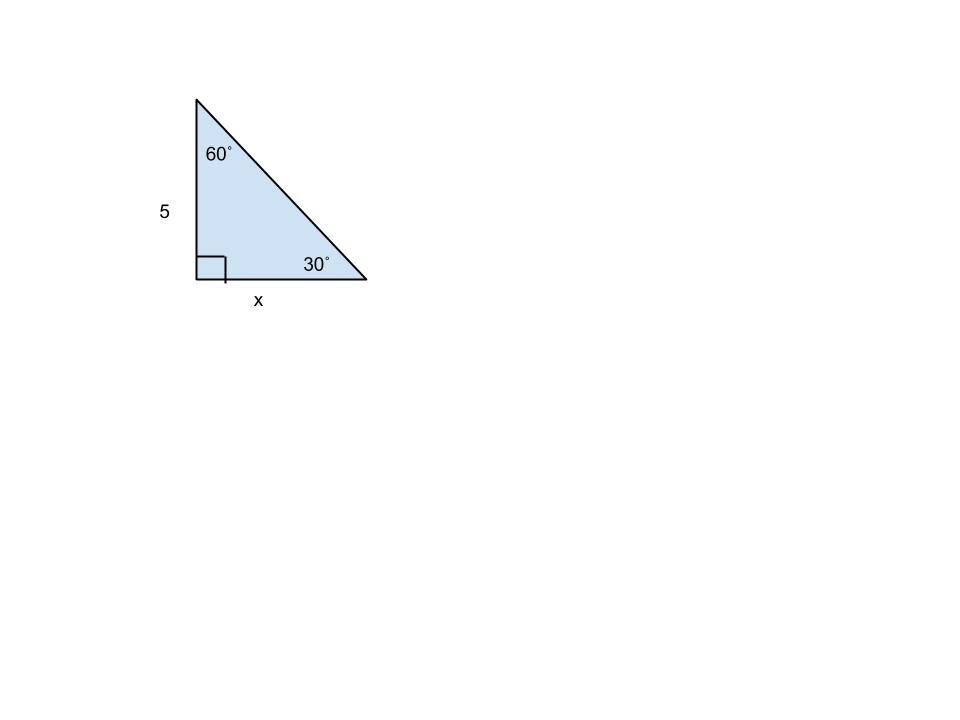
Given the diagram, indicate if Quantity A is larger, Quantity B is larger, if they are equal, or if there is not enough information given to determine the relationship.
Quantity A:
Quantity B: 7.5
Tap to reveal answer
Since this is a 30-60-90 triangle, we know that the length of the side opposite the 60 degree angle is  times the side opposite the 30 degree angle. Thus,
  , which is about 8.66. This is larger than 7.5.
Since this is a 30-60-90 triangle, we know that the length of the side opposite the 60 degree angle is
← Didn't Know|Knew It →
A right triangle's perimeter is  . The other two angles of the triangle are 30 degrees and 60 degrees.
Quantity A: The triangle's hypotenuse length
Quantity B: 2
A right triangle's perimeter is
Quantity A: The triangle's hypotenuse length
Quantity B: 2
Tap to reveal answer
The ratio of the sides of a 30-60-90 triangle is  , with the hypotenuse being
  . Thus, the perimeter of this triangle would be
  . Since the triangle depicted in this problem has a perimeter of
  ,
,  must equal 1, which would make the hypotenuse equal to 2.
The ratio of the sides of a 30-60-90 triangle is
← Didn't Know|Knew It →
If the shortest side of a right triangle has length  and its hypotenuse has length
  , what is the length of the remaining side?
If the shortest side of a right triangle has length
Tap to reveal answer
Use the Pythagorean theorem,  , with
  and
and  , and solve for
  .
.

Rearrange to isolate  :
:


Use FOIL to multiply out:

Distribute the minus sign to rewrite without parentheses:

Combine like terms:

Take the square root of both sides:

Use the Pythagorean theorem,
Rearrange to isolate
Use FOIL to multiply out:
Distribute the minus sign to rewrite without parentheses:
Combine like terms:
Take the square root of both sides:
← Didn't Know|Knew It →
Given the following triangle, what is the length of the unknown side?
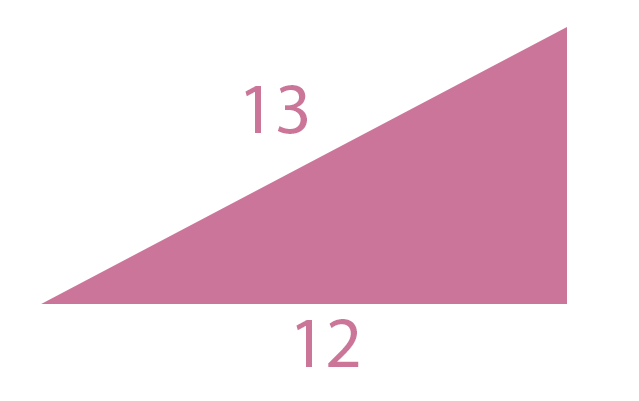
Given the following triangle, what is the length of the unknown side?
Tap to reveal answer
At first sight, it's tempting to assume this is a right triangle and to thus use the Pythagorean Theorem to find a length of 5 for the missing side.
However, the triangle was not stated to be a right triangle in the problem statement, and no indication was given in the drawing to indicate that it was a right triangle either, such as a square demarcation in the vertex opposite the side measuring 13.
Thus there is not enough information to give the length of the missing side. When taking standardized math tests, be careful making assumptions about information that is not given.
At first sight, it's tempting to assume this is a right triangle and to thus use the Pythagorean Theorem to find a length of 5 for the missing side.
However, the triangle was not stated to be a right triangle in the problem statement, and no indication was given in the drawing to indicate that it was a right triangle either, such as a square demarcation in the vertex opposite the side measuring 13.
Thus there is not enough information to give the length of the missing side. When taking standardized math tests, be careful making assumptions about information that is not given.
← Didn't Know|Knew It →
2 triangles are similar
Triangle 1 has sides 6, 8, 10
Triangle 2 has sides 5 , 3, x
find x
2 triangles are similar
Triangle 1 has sides 6, 8, 10
Triangle 2 has sides 5 , 3, x
find x
Tap to reveal answer
Draw the triangles
Triangle 1 is a 6,8,10 right triangle with 10 as the hypotenuse
Triangle 2: 3 is half of 6, 5 is half of 10; x must be half of 8
Draw the triangles
Triangle 1 is a 6,8,10 right triangle with 10 as the hypotenuse
Triangle 2: 3 is half of 6, 5 is half of 10; x must be half of 8
← Didn't Know|Knew It →
Given the diagram, indicate if Quantity A is larger, Quantity B is larger, if they are equal, or if there is not enough information given to determine the relationship.
Quantity A:
Quantity B: 7.5
Given the diagram, indicate if Quantity A is larger, Quantity B is larger, if they are equal, or if there is not enough information given to determine the relationship.
Quantity A:
Quantity B: 7.5
Tap to reveal answer
Since this is a 30-60-90 triangle, we know that the length of the side opposite the 60 degree angle is times the side opposite the 30 degree angle. Thus, , which is about 8.66. This is larger than 7.5.
Since this is a 30-60-90 triangle, we know that the length of the side opposite the 60 degree angle is
← Didn't Know|Knew It →
A right triangle's perimeter is . The other two angles of the triangle are 30 degrees and 60 degrees.
Quantity A: The triangle's hypotenuse length
Quantity B: 2
A right triangle's perimeter is
Quantity A: The triangle's hypotenuse length
Quantity B: 2
Tap to reveal answer
The ratio of the sides of a 30-60-90 triangle is , with the hypotenuse being . Thus, the perimeter of this triangle would be . Since the triangle depicted in this problem has a perimeter of , must equal 1, which would make the hypotenuse equal to 2.
The ratio of the sides of a 30-60-90 triangle is
← Didn't Know|Knew It →
If the shortest side of a right triangle has length and its hypotenuse has length , what is the length of the remaining side?
If the shortest side of a right triangle has length
Tap to reveal answer
Use the Pythagorean theorem, , with and , and solve for .
Rearrange to isolate :
Use FOIL to multiply out:
Distribute the minus sign to rewrite without parentheses:
Combine like terms:
Take the square root of both sides:
Use the Pythagorean theorem,
Rearrange to isolate
Use FOIL to multiply out:
Distribute the minus sign to rewrite without parentheses:
Combine like terms:
Take the square root of both sides:
← Didn't Know|Knew It →
Given the following triangle, what is the length of the unknown side?
Given the following triangle, what is the length of the unknown side?
Tap to reveal answer
At first sight, it's tempting to assume this is a right triangle and to thus use the Pythagorean Theorem to find a length of 5 for the missing side.
However, the triangle was not stated to be a right triangle in the problem statement, and no indication was given in the drawing to indicate that it was a right triangle either, such as a square demarcation in the vertex opposite the side measuring 13.
Thus there is not enough information to give the length of the missing side. When taking standardized math tests, be careful making assumptions about information that is not given.
At first sight, it's tempting to assume this is a right triangle and to thus use the Pythagorean Theorem to find a length of 5 for the missing side.
However, the triangle was not stated to be a right triangle in the problem statement, and no indication was given in the drawing to indicate that it was a right triangle either, such as a square demarcation in the vertex opposite the side measuring 13.
Thus there is not enough information to give the length of the missing side. When taking standardized math tests, be careful making assumptions about information that is not given.
← Didn't Know|Knew It →
An equilateral triangle has a side length of 4. What is its height?
An equilateral triangle has a side length of 4. What is its height?
Tap to reveal answer
If an equilateral triangle is divided in 2, it forms two 30-60-90 triangles. Therefore, the side of the equilateral triangle is the same as the hypotenuse of a 30-60-90 triangle. The side lengths of a 30-60-90 triangle adhere to the ratio x: x√3 :2x. since we know the hypothesis is 4, we also know that the base is 2 and the height is 2√3.
If an equilateral triangle is divided in 2, it forms two 30-60-90 triangles. Therefore, the side of the equilateral triangle is the same as the hypotenuse of a 30-60-90 triangle. The side lengths of a 30-60-90 triangle adhere to the ratio x: x√3 :2x. since we know the hypothesis is 4, we also know that the base is 2 and the height is 2√3.
← Didn't Know|Knew It →
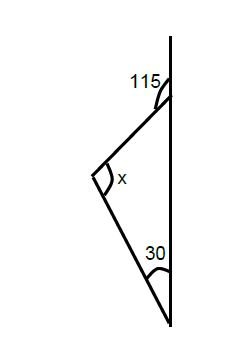
In the figure above, what is the value of angle x?
In the figure above, what is the value of angle x?
Tap to reveal answer
To find the top inner angle, recognize that a straight line contains 180o; thus we can subtract 180 – 115 = 65o. Since we are given the other interior angle of 30 degrees, we can add the two we know: 65 + 30 = 95o.
180 - 95 = 85
To find the top inner angle, recognize that a straight line contains 180o; thus we can subtract 180 – 115 = 65o. Since we are given the other interior angle of 30 degrees, we can add the two we know: 65 + 30 = 95o.
180 - 95 = 85
← Didn't Know|Knew It →
The three angles in a triangle measure 3_x_, 4_x_ + 10, and 8_x_ + 20. What is x?
The three angles in a triangle measure 3_x_, 4_x_ + 10, and 8_x_ + 20. What is x?
Tap to reveal answer
We know the angles in a triangle must add up to 180, so we can solve for x.
3_x_ + 4_x_ + 10 + 8_x_ + 20 = 180
15_x_ + 30 = 180
15_x_ = 150
x = 10
We know the angles in a triangle must add up to 180, so we can solve for x.
3_x_ + 4_x_ + 10 + 8_x_ + 20 = 180
15_x_ + 30 = 180
15_x_ = 150
x = 10
← Didn't Know|Knew It →
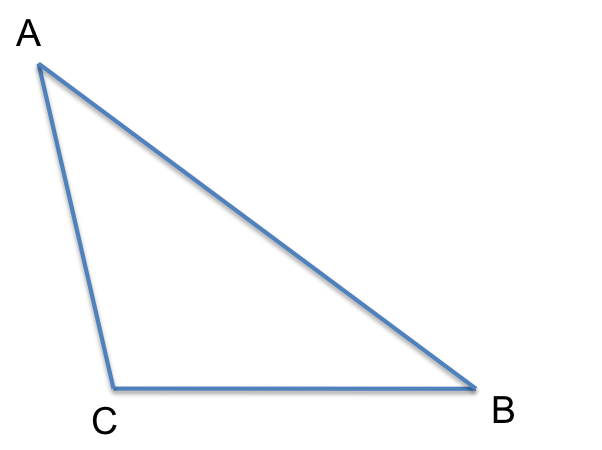
In triangle ABC, AB=6, AC=3, and BC=4.
Quantity A Quantity B
angle C the sum of angle A and angle B
In triangle ABC, AB=6, AC=3, and BC=4.
Quantity A Quantity B
angle C the sum of angle A and angle B
Tap to reveal answer
The given triangle is obtuse. Thus, angle  is greater than 90 degrees. A triangle has a sum of 180 degrees, so angle
  + angle
  + angle
  = 180. Since angle C is greater than 90 then angle
  + angle
  must be less than 90 and it follows that Quantity A is greater.
The given triangle is obtuse. Thus, angle
← Didn't Know|Knew It →
An isosceles triangle has an angle of 110°. Which of the following angles could also be in the triangle?
An isosceles triangle has an angle of 110°. Which of the following angles could also be in the triangle?
Tap to reveal answer
An isosceles triangle always has two equal angles. As there cannot be another 110° (the triangle cannot have over 180° total), the other two angles must equal eachother. 180° - 110° = 70°. 70° represents the other two angles, so it needs to be divided in 2 to get the answer of 35°.
An isosceles triangle always has two equal angles. As there cannot be another 110° (the triangle cannot have over 180° total), the other two angles must equal eachother. 180° - 110° = 70°. 70° represents the other two angles, so it needs to be divided in 2 to get the answer of 35°.
← Didn't Know|Knew It →
An isosceles triangle ABC is laid flat on its base. Given that <B, located in the lower left corner, is 84 degrees, what is the measurement of the top angle, <A?
An isosceles triangle ABC is laid flat on its base. Given that <B, located in the lower left corner, is 84 degrees, what is the measurement of the top angle, <A?
Tap to reveal answer
Since the triangle is isosceles, and <A is located at the top of the triangle that is on its base, <B and <C are equivalent. Since <B is 84 degrees, <C is also. There are 180 degrees in a triangle so 180 - 84 - 84 = 12 degrees.
Since the triangle is isosceles, and <A is located at the top of the triangle that is on its base, <B and <C are equivalent. Since <B is 84 degrees, <C is also. There are 180 degrees in a triangle so 180 - 84 - 84 = 12 degrees.
← Didn't Know|Knew It →
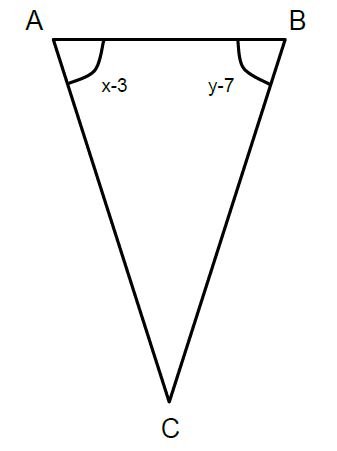
Triangle ABC is isosceles
x and y are positive integers
A
---
x
B
---
y
Triangle ABC is isosceles
x and y are positive integers
A
---
x
B
---
y
Tap to reveal answer
Since we are given expressions for the two congruent angles of the isosceles triangle, we can set the expressions equal to see how x relates to y. We get,
x – 3 = y – 7 --> y = x + 4
Logically, y must be the greater number if it takes x an additional 4 units to reach its value (knowing they are both positive integers).
Since we are given expressions for the two congruent angles of the isosceles triangle, we can set the expressions equal to see how x relates to y. We get,
x – 3 = y – 7 --> y = x + 4
Logically, y must be the greater number if it takes x an additional 4 units to reach its value (knowing they are both positive integers).
← Didn't Know|Knew It →
An isosceles triangle has one obtuse angle that is  . What is the value of one of the other angles?
An isosceles triangle has one obtuse angle that is
Tap to reveal answer
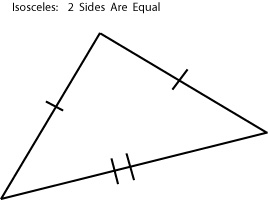
We know that an isosceles triangel has two equal sides and thus two equal angles opposite those equal sides. Because there is one obtuse angle of 112 degrees we automatically know that this angle is the vertex. If you sum any triangle's interior angles, you always get 180 degrees.
180 – 112 = 68 degrees. Thus there are 68 degrees left for the two equal angles. Each angle must therefore measure 34 degrees.
We know that an isosceles triangel has two equal sides and thus two equal angles opposite those equal sides. Because there is one obtuse angle of 112 degrees we automatically know that this angle is the vertex. If you sum any triangle's interior angles, you always get 180 degrees.
180 – 112 = 68 degrees. Thus there are 68 degrees left for the two equal angles. Each angle must therefore measure 34 degrees.
← Didn't Know|Knew It →
What is the length of a side of an equilateral triangle if the area is  ?
?
What is the length of a side of an equilateral triangle if the area is
Tap to reveal answer
The area of an equilateral triangle is  .
.
So let's set-up an equation to solve for  .
.
 Cross multiply.

The  cancels out and we get
  .
.
Then take square root on both sides and we get  as the final answer.
The area of an equilateral triangle is
So let's set-up an equation to solve for
The
Then take square root on both sides and we get
← Didn't Know|Knew It →
If the height of the equilateral triangle is  , then what is the length of a side of an equilateral triangle?
If the height of the equilateral triangle is
Tap to reveal answer
By having a height in an equilateral triangle, the angle is bisected therefore creating two  triangles.
The height is opposite the angle  . We can set-up a proportion.
Side opposite  is
is  and the side of equilateral triangle which is opposite
  is
is  .
.
 Cross multiply.
 Divide both sides by
 Multiply top and bottom by
  to get rid of the radical.

By having a height in an equilateral triangle, the angle is bisected therefore creating two
The height is opposite the angle
Side opposite
← Didn't Know|Knew It →