
Perpendicular Lines - GRE Quantitative Reasoning
Card 1 of 200
what would be the slope of a line perpendicular to
4x+3y = 6
what would be the slope of a line perpendicular to
4x+3y = 6
Tap to reveal answer
switch 4x+ 3y = 6 to "y=mx+b" form
3y= -4x + 6
y = -4/3 x + 2
m = -4/3; the perpendicular line will have the negative reciprocal of this line so it would be 3/4
switch 4x+ 3y = 6 to "y=mx+b" form
3y= -4x + 6
y = -4/3 x + 2
m = -4/3; the perpendicular line will have the negative reciprocal of this line so it would be 3/4
← Didn't Know|Knew It →
Which line is perpendicular to the line between the points (22,24) and (31,4)?
Which line is perpendicular to the line between the points (22,24) and (31,4)?
Tap to reveal answer
The line will be perpendicular if the slope is the negative reciprocal.
First we need to find the slope of our line between points (22,24) and (31,4). Slope = rise/run = (24 – 4)/(22 – 31) = 20/–9 = –2.22.
The negative reciprocal of this must be a positive fraction, so we can eliminate y = –3_x_ + 5 (because the slope is negative).
The negative reciprocal of –2.22, and therefore the slope of the perpendicular line, will be –1/–2.22 = .45, so we can also eliminate y = x (slope of 1).
Now let's look at the line between points (9, 5) and (48, 19). This slope = (5 – 19)/(9 – 48) = .358, which is incorrect.
The next answer choice is y = .45_x_ + 10. The slope is .45, which is what we're looking for so this is the correct answer.
To double check, the last answer choice is the line between (4, 7) and (7, 4). This slope = (7 – 4) / (4 – 7) = –1, which is also incorrect.
The line will be perpendicular if the slope is the negative reciprocal.
First we need to find the slope of our line between points (22,24) and (31,4). Slope = rise/run = (24 – 4)/(22 – 31) = 20/–9 = –2.22.
The negative reciprocal of this must be a positive fraction, so we can eliminate y = –3_x_ + 5 (because the slope is negative).
The negative reciprocal of –2.22, and therefore the slope of the perpendicular line, will be –1/–2.22 = .45, so we can also eliminate y = x (slope of 1).
Now let's look at the line between points (9, 5) and (48, 19). This slope = (5 – 19)/(9 – 48) = .358, which is incorrect.
The next answer choice is y = .45_x_ + 10. The slope is .45, which is what we're looking for so this is the correct answer.
To double check, the last answer choice is the line between (4, 7) and (7, 4). This slope = (7 – 4) / (4 – 7) = –1, which is also incorrect.
← Didn't Know|Knew It →
Which best describes the relationship between the lines  and
and 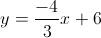 ?
?
Which best describes the relationship between the lines
Tap to reveal answer
We first need to recall the following relationships:
Lines with the same slope and same  -intercept are really the same line.
Lines with the same slope and different  -intercepts are parallel.
Lines with slopes that are negative reciprocals are perpendicular.
Then we identify the slopes of the two lines by comparing the equations to the slope-intercept form  , where
  is the slope and
  is the
  -intercept. By inspection we see the lines have slopes of
  and
and  . Since these are different, the "parallel" and "same line" choices are eliminated. To test if the slopes are negative reciprocals, we take one of the slopes, change its sign, and flip it upside-down. Starting with
  and changing the sign gives
  , then flipping gives
  . This is the same as the slope of the second line, so the two slopes are negative reciprocals and the lines are perpendicular.
We first need to recall the following relationships:
Lines with the same slope and same
Lines with the same slope and different
Lines with slopes that are negative reciprocals are perpendicular.
Then we identify the slopes of the two lines by comparing the equations to the slope-intercept form
← Didn't Know|Knew It →
Which of the following equations represents a line that is perpendicular to the line with points  and
and  ?
?
Which of the following equations represents a line that is perpendicular to the line with points
Tap to reveal answer
If lines are perpendicular, then their slopes will be negative reciprocals.
First, we need to find the slope of the given line.
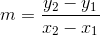
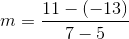


Because we know that our given line's slope is  , the slope of the line perpendicular to it must be
  .
.
If lines are perpendicular, then their slopes will be negative reciprocals.
First, we need to find the slope of the given line.
Because we know that our given line's slope is
← Didn't Know|Knew It →
Which of the following lines is perpindicular to 
Which of the following lines is perpindicular to
Tap to reveal answer
When determining if a two lines are perpindicular, we are only concerned about their slopes. Consider the basic equation of a line,  , where m is the slope of the line. Two lines are perpindicular to each other if one slope is the negative and reciprocal of the other.
The first step of this problem is to get it into the form,  , which is
  . Now we know that the slope, m, is
  . The reciprocal of that is
  , and the negative of that is
  . Therefore, any line that has a slope of
  will be perpindicular to the original line.
When determining if a two lines are perpindicular, we are only concerned about their slopes. Consider the basic equation of a line,
The first step of this problem is to get it into the form,
← Didn't Know|Knew It →
Which of the following lines is perpendicular to the line  ?
?
Which of the following lines is perpendicular to the line
Tap to reveal answer
Perpendicular lines will have slopes that are negative reciprocals of one another. Our first step will be to find the slope of the given line by putting the equation into slope-intercept form.


The slope of this line is  . The negative reciprocal will be
  , which will be the slope of the perpendicular line.
Now we need to find the answer choice with this slope by converting to slope-intercept form.


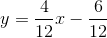

This equation has a slope of  , and must be our answer.
Perpendicular lines will have slopes that are negative reciprocals of one another. Our first step will be to find the slope of the given line by putting the equation into slope-intercept form.
The slope of this line is
Now we need to find the answer choice with this slope by converting to slope-intercept form.
This equation has a slope of
← Didn't Know|Knew It →
Which of the following lines is perpendicular to the line defined as  ?
?
Which of the following lines is perpendicular to the line defined as
Tap to reveal answer
To begin, the best thing to do is to put your equation into slope-intercept format. That is, into the format:

For your equation, you need to solve for  :
:
 , which is the same as
Then, divide both sides by  :
:

So, the slope of this line is  . The perpendicular of a line is opposite and reciprocal. Therefore, the perpendicular line will have a slope of
  . Of the options given, only
  matches this (which you can figure out when you solve for
  ).
).
To begin, the best thing to do is to put your equation into slope-intercept format. That is, into the format:
For your equation, you need to solve for
Then, divide both sides by
So, the slope of this line is
← Didn't Know|Knew It →
Which of the following lines is perpendicular to the line passing through the points  and
and  ?
?
Which of the following lines is perpendicular to the line passing through the points
Tap to reveal answer
Remember, to be perpendicular, two lines must have opposite and reciprocal slopes. Therefore, you need to begin by solving for the slope of your given line. You do this by finding:

For two points  and
and  , this is:

For our points, this is:
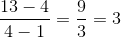
The slope of the perpendicular line will be (remember) opposite and reciprocal. Therefore, it will be  . Now, among your equations, the only one that has this slope is:

If you solve this for  , you get:
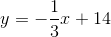
According to the slope-intercept form ( ), this means that the slope is
  .
.
Remember, to be perpendicular, two lines must have opposite and reciprocal slopes. Therefore, you need to begin by solving for the slope of your given line. You do this by finding:
For two points
For our points, this is:
The slope of the perpendicular line will be (remember) opposite and reciprocal. Therefore, it will be
If you solve this for
According to the slope-intercept form (
← Didn't Know|Knew It →
Which of the following lines is perpendicular to the line ?
Which of the following lines is perpendicular to the line
Tap to reveal answer
Perpendicular lines will have slopes that are negative reciprocals of one another. Our first step will be to find the slope of the given line by putting the equation into slope-intercept form.
The slope of this line is . The negative reciprocal will be , which will be the slope of the perpendicular line.
Now we need to find the answer choice with this slope by converting to slope-intercept form.
This equation has a slope of , and must be our answer.
Perpendicular lines will have slopes that are negative reciprocals of one another. Our first step will be to find the slope of the given line by putting the equation into slope-intercept form.
The slope of this line is
Now we need to find the answer choice with this slope by converting to slope-intercept form.
This equation has a slope of
← Didn't Know|Knew It →
what would be the slope of a line perpendicular to
4x+3y = 6
what would be the slope of a line perpendicular to
4x+3y = 6
Tap to reveal answer
switch 4x+ 3y = 6 to "y=mx+b" form
3y= -4x + 6
y = -4/3 x + 2
m = -4/3; the perpendicular line will have the negative reciprocal of this line so it would be 3/4
switch 4x+ 3y = 6 to "y=mx+b" form
3y= -4x + 6
y = -4/3 x + 2
m = -4/3; the perpendicular line will have the negative reciprocal of this line so it would be 3/4
← Didn't Know|Knew It →
Which line is perpendicular to the line between the points (22,24) and (31,4)?
Which line is perpendicular to the line between the points (22,24) and (31,4)?
Tap to reveal answer
The line will be perpendicular if the slope is the negative reciprocal.
First we need to find the slope of our line between points (22,24) and (31,4). Slope = rise/run = (24 – 4)/(22 – 31) = 20/–9 = –2.22.
The negative reciprocal of this must be a positive fraction, so we can eliminate y = –3_x_ + 5 (because the slope is negative).
The negative reciprocal of –2.22, and therefore the slope of the perpendicular line, will be –1/–2.22 = .45, so we can also eliminate y = x (slope of 1).
Now let's look at the line between points (9, 5) and (48, 19). This slope = (5 – 19)/(9 – 48) = .358, which is incorrect.
The next answer choice is y = .45_x_ + 10. The slope is .45, which is what we're looking for so this is the correct answer.
To double check, the last answer choice is the line between (4, 7) and (7, 4). This slope = (7 – 4) / (4 – 7) = –1, which is also incorrect.
The line will be perpendicular if the slope is the negative reciprocal.
First we need to find the slope of our line between points (22,24) and (31,4). Slope = rise/run = (24 – 4)/(22 – 31) = 20/–9 = –2.22.
The negative reciprocal of this must be a positive fraction, so we can eliminate y = –3_x_ + 5 (because the slope is negative).
The negative reciprocal of –2.22, and therefore the slope of the perpendicular line, will be –1/–2.22 = .45, so we can also eliminate y = x (slope of 1).
Now let's look at the line between points (9, 5) and (48, 19). This slope = (5 – 19)/(9 – 48) = .358, which is incorrect.
The next answer choice is y = .45_x_ + 10. The slope is .45, which is what we're looking for so this is the correct answer.
To double check, the last answer choice is the line between (4, 7) and (7, 4). This slope = (7 – 4) / (4 – 7) = –1, which is also incorrect.
← Didn't Know|Knew It →
Which best describes the relationship between the lines and ?
Which best describes the relationship between the lines
Tap to reveal answer
We first need to recall the following relationships:
Lines with the same slope and same -intercept are really the same line.
Lines with the same slope and different -intercepts are parallel.
Lines with slopes that are negative reciprocals are perpendicular.
Then we identify the slopes of the two lines by comparing the equations to the slope-intercept form , where is the slope and is the -intercept. By inspection we see the lines have slopes of and . Since these are different, the "parallel" and "same line" choices are eliminated. To test if the slopes are negative reciprocals, we take one of the slopes, change its sign, and flip it upside-down. Starting with and changing the sign gives , then flipping gives . This is the same as the slope of the second line, so the two slopes are negative reciprocals and the lines are perpendicular.
We first need to recall the following relationships:
Lines with the same slope and same
Lines with the same slope and different
Lines with slopes that are negative reciprocals are perpendicular.
Then we identify the slopes of the two lines by comparing the equations to the slope-intercept form
← Didn't Know|Knew It →
Which of the following equations represents a line that is perpendicular to the line with points and ?
Which of the following equations represents a line that is perpendicular to the line with points
Tap to reveal answer
If lines are perpendicular, then their slopes will be negative reciprocals.
First, we need to find the slope of the given line.
Because we know that our given line's slope is , the slope of the line perpendicular to it must be .
If lines are perpendicular, then their slopes will be negative reciprocals.
First, we need to find the slope of the given line.
Because we know that our given line's slope is
← Didn't Know|Knew It →
Which of the following lines is perpindicular to
Which of the following lines is perpindicular to
Tap to reveal answer
When determining if a two lines are perpindicular, we are only concerned about their slopes. Consider the basic equation of a line, , where m is the slope of the line. Two lines are perpindicular to each other if one slope is the negative and reciprocal of the other.
The first step of this problem is to get it into the form, , which is . Now we know that the slope, m, is . The reciprocal of that is , and the negative of that is . Therefore, any line that has a slope of will be perpindicular to the original line.
When determining if a two lines are perpindicular, we are only concerned about their slopes. Consider the basic equation of a line,
The first step of this problem is to get it into the form,
← Didn't Know|Knew It →
Which of the following lines is perpendicular to the line defined as ?
Which of the following lines is perpendicular to the line defined as
Tap to reveal answer
To begin, the best thing to do is to put your equation into slope-intercept format. That is, into the format:
For your equation, you need to solve for :
, which is the same as
Then, divide both sides by :
So, the slope of this line is . The perpendicular of a line is opposite and reciprocal. Therefore, the perpendicular line will have a slope of . Of the options given, only matches this (which you can figure out when you solve for ).
To begin, the best thing to do is to put your equation into slope-intercept format. That is, into the format:
For your equation, you need to solve for
Then, divide both sides by
So, the slope of this line is
← Didn't Know|Knew It →
Which of the following lines is perpendicular to the line passing through the points and ?
Which of the following lines is perpendicular to the line passing through the points
Tap to reveal answer
Remember, to be perpendicular, two lines must have opposite and reciprocal slopes. Therefore, you need to begin by solving for the slope of your given line. You do this by finding:
For two points and , this is:
For our points, this is:
The slope of the perpendicular line will be (remember) opposite and reciprocal. Therefore, it will be . Now, among your equations, the only one that has this slope is:
If you solve this for , you get:
According to the slope-intercept form (), this means that the slope is .
Remember, to be perpendicular, two lines must have opposite and reciprocal slopes. Therefore, you need to begin by solving for the slope of your given line. You do this by finding:
For two points
For our points, this is:
The slope of the perpendicular line will be (remember) opposite and reciprocal. Therefore, it will be
If you solve this for
According to the slope-intercept form (
← Didn't Know|Knew It →
Which of the following lines is perpendicular to the line ?
Which of the following lines is perpendicular to the line
Tap to reveal answer
Perpendicular lines will have slopes that are negative reciprocals of one another. Our first step will be to find the slope of the given line by putting the equation into slope-intercept form.
The slope of this line is . The negative reciprocal will be , which will be the slope of the perpendicular line.
Now we need to find the answer choice with this slope by converting to slope-intercept form.
This equation has a slope of , and must be our answer.
Perpendicular lines will have slopes that are negative reciprocals of one another. Our first step will be to find the slope of the given line by putting the equation into slope-intercept form.
The slope of this line is
Now we need to find the answer choice with this slope by converting to slope-intercept form.
This equation has a slope of
← Didn't Know|Knew It →
what would be the slope of a line perpendicular to
4x+3y = 6
what would be the slope of a line perpendicular to
4x+3y = 6
Tap to reveal answer
switch 4x+ 3y = 6 to "y=mx+b" form
3y= -4x + 6
y = -4/3 x + 2
m = -4/3; the perpendicular line will have the negative reciprocal of this line so it would be 3/4
switch 4x+ 3y = 6 to "y=mx+b" form
3y= -4x + 6
y = -4/3 x + 2
m = -4/3; the perpendicular line will have the negative reciprocal of this line so it would be 3/4
← Didn't Know|Knew It →
Which line is perpendicular to the line between the points (22,24) and (31,4)?
Which line is perpendicular to the line between the points (22,24) and (31,4)?
Tap to reveal answer
The line will be perpendicular if the slope is the negative reciprocal.
First we need to find the slope of our line between points (22,24) and (31,4). Slope = rise/run = (24 – 4)/(22 – 31) = 20/–9 = –2.22.
The negative reciprocal of this must be a positive fraction, so we can eliminate y = –3_x_ + 5 (because the slope is negative).
The negative reciprocal of –2.22, and therefore the slope of the perpendicular line, will be –1/–2.22 = .45, so we can also eliminate y = x (slope of 1).
Now let's look at the line between points (9, 5) and (48, 19). This slope = (5 – 19)/(9 – 48) = .358, which is incorrect.
The next answer choice is y = .45_x_ + 10. The slope is .45, which is what we're looking for so this is the correct answer.
To double check, the last answer choice is the line between (4, 7) and (7, 4). This slope = (7 – 4) / (4 – 7) = –1, which is also incorrect.
The line will be perpendicular if the slope is the negative reciprocal.
First we need to find the slope of our line between points (22,24) and (31,4). Slope = rise/run = (24 – 4)/(22 – 31) = 20/–9 = –2.22.
The negative reciprocal of this must be a positive fraction, so we can eliminate y = –3_x_ + 5 (because the slope is negative).
The negative reciprocal of –2.22, and therefore the slope of the perpendicular line, will be –1/–2.22 = .45, so we can also eliminate y = x (slope of 1).
Now let's look at the line between points (9, 5) and (48, 19). This slope = (5 – 19)/(9 – 48) = .358, which is incorrect.
The next answer choice is y = .45_x_ + 10. The slope is .45, which is what we're looking for so this is the correct answer.
To double check, the last answer choice is the line between (4, 7) and (7, 4). This slope = (7 – 4) / (4 – 7) = –1, which is also incorrect.
← Didn't Know|Knew It →
Which best describes the relationship between the lines and ?
Which best describes the relationship between the lines
Tap to reveal answer
We first need to recall the following relationships:
Lines with the same slope and same -intercept are really the same line.
Lines with the same slope and different -intercepts are parallel.
Lines with slopes that are negative reciprocals are perpendicular.
Then we identify the slopes of the two lines by comparing the equations to the slope-intercept form , where is the slope and is the -intercept. By inspection we see the lines have slopes of and . Since these are different, the "parallel" and "same line" choices are eliminated. To test if the slopes are negative reciprocals, we take one of the slopes, change its sign, and flip it upside-down. Starting with and changing the sign gives , then flipping gives . This is the same as the slope of the second line, so the two slopes are negative reciprocals and the lines are perpendicular.
We first need to recall the following relationships:
Lines with the same slope and same
Lines with the same slope and different
Lines with slopes that are negative reciprocals are perpendicular.
Then we identify the slopes of the two lines by comparing the equations to the slope-intercept form
← Didn't Know|Knew It →