
Solid Geometry - GRE Quantitative Reasoning
Card 1 of 360
You have a rectangular box with dimensions 6 inches by 6 inches by 8 inches. What is the length of the shortest distance between two non-adjacent corners of the box?
You have a rectangular box with dimensions 6 inches by 6 inches by 8 inches. What is the length of the shortest distance between two non-adjacent corners of the box?
Tap to reveal answer
The shortest length between any two non-adjacent corners will be the diagonal of the smallest face of the rectangular box. The smallest face of the rectangular box is a six-inch by six-inch square. The diagonal of a six-inch square is  .
.
The shortest length between any two non-adjacent corners will be the diagonal of the smallest face of the rectangular box. The smallest face of the rectangular box is a six-inch by six-inch square. The diagonal of a six-inch square is
← Didn't Know|Knew It →
What is the length of the diagonal of a cube with side lengths of 
 each?
each?
What is the length of the diagonal of a cube with side lengths of
Tap to reveal answer
The diagonal length of a cube is found by a form of the distance formula that is akin to the Pythagorean Theorem, though with an additional dimension added to it. It is:
 , or
, or  , or
, or 
Now, if the the value of  is
is  , we get simply
The diagonal length of a cube is found by a form of the distance formula that is akin to the Pythagorean Theorem, though with an additional dimension added to it. It is:
Now, if the the value of
← Didn't Know|Knew It →
What is the length of the diagonal of a cube that has a surface area of 
 ?
?
What is the length of the diagonal of a cube that has a surface area of
Tap to reveal answer
To begin, the best thing to do is to find the length of a side of the cube. This is done using the formula for the surface area of a cube. Recall that a cube is made up of  squares. Therefore, its surface area is:
 , where
  is the length of a side.
Therefore, for our data, we have:

Solving for  , we get:

This means that 
Now, the diagonal length of a cube is found by a form of the distance formula that is akin to the Pythagorean Theorem, though with an additional dimension added to it. It is:
 , or
, or  , or
, or 
Now, if the the value of  is
is  , we get simply
To begin, the best thing to do is to find the length of a side of the cube. This is done using the formula for the surface area of a cube. Recall that a cube is made up of
Therefore, for our data, we have:
Solving for
This means that
Now, the diagonal length of a cube is found by a form of the distance formula that is akin to the Pythagorean Theorem, though with an additional dimension added to it. It is:
Now, if the the value of
← Didn't Know|Knew It →
The surface area of a cube is 486 units. What is the distance of its diagonal (e.g. from its front-left-bottom corner to its rear-right-top corner)?
The surface area of a cube is 486 units. What is the distance of its diagonal (e.g. from its front-left-bottom corner to its rear-right-top corner)?
Tap to reveal answer
First, we must ascertain the length of each side. Based on our initial data, we know that the 6 faces of the cube will have a surface area of 6x2. This yields the equation:
6x2 = 486, which simplifies to: x2 = 81; x = 9.
Therefore, each side has a length of 9. Imagine the cube is centered on the origin. This means its "front-left-bottom corner" will be at (–4.5, –4.5, 4.5) and its "rear-right-top corner" will be at (4.5, 4.5, –4.5). To find the distance between these, we use the three-dimensional distance formula:
d = √((x1 – x2)2 + (y1 – y2)2 + (z1 – z2)2)
For our data, this will be:
√( (–4.5 – 4.5)2 + (–4.5 – 4.5)2 + (4.5 + 4.5)2) =
√( (–9)2 + (–9)2 + (9)2) = √(81 + 81 + 81) = √(243) =
√(3 * 81) = √(3) * √(81) = 9√(3)
First, we must ascertain the length of each side. Based on our initial data, we know that the 6 faces of the cube will have a surface area of 6x2. This yields the equation:
6x2 = 486, which simplifies to: x2 = 81; x = 9.
Therefore, each side has a length of 9. Imagine the cube is centered on the origin. This means its "front-left-bottom corner" will be at (–4.5, –4.5, 4.5) and its "rear-right-top corner" will be at (4.5, 4.5, –4.5). To find the distance between these, we use the three-dimensional distance formula:
d = √((x1 – x2)2 + (y1 – y2)2 + (z1 – z2)2)
For our data, this will be:
√( (–4.5 – 4.5)2 + (–4.5 – 4.5)2 + (4.5 + 4.5)2) =
√( (–9)2 + (–9)2 + (9)2) = √(81 + 81 + 81) = √(243) =
√(3 * 81) = √(3) * √(81) = 9√(3)
← Didn't Know|Knew It →
You have a rectangular box with dimensions 6 inches by 6 inches by 8 inches. What is the length of the shortest distance between two non-adjacent corners of the box?
You have a rectangular box with dimensions 6 inches by 6 inches by 8 inches. What is the length of the shortest distance between two non-adjacent corners of the box?
Tap to reveal answer
The shortest length between any two non-adjacent corners will be the diagonal of the smallest face of the rectangular box. The smallest face of the rectangular box is a six-inch by six-inch square. The diagonal of a six-inch square is .
The shortest length between any two non-adjacent corners will be the diagonal of the smallest face of the rectangular box. The smallest face of the rectangular box is a six-inch by six-inch square. The diagonal of a six-inch square is
← Didn't Know|Knew It →
What is the length of the diagonal of a cube with side lengths of each?
What is the length of the diagonal of a cube with side lengths of
Tap to reveal answer
The diagonal length of a cube is found by a form of the distance formula that is akin to the Pythagorean Theorem, though with an additional dimension added to it. It is:
, or , or
Now, if the the value of is , we get simply
The diagonal length of a cube is found by a form of the distance formula that is akin to the Pythagorean Theorem, though with an additional dimension added to it. It is:
Now, if the the value of
← Didn't Know|Knew It →
What is the length of the diagonal of a cube that has a surface area of ?
What is the length of the diagonal of a cube that has a surface area of
Tap to reveal answer
To begin, the best thing to do is to find the length of a side of the cube. This is done using the formula for the surface area of a cube. Recall that a cube is made up of squares. Therefore, its surface area is:
, where is the length of a side.
Therefore, for our data, we have:
Solving for , we get:
This means that
Now, the diagonal length of a cube is found by a form of the distance formula that is akin to the Pythagorean Theorem, though with an additional dimension added to it. It is:
, or , or
Now, if the the value of is , we get simply
To begin, the best thing to do is to find the length of a side of the cube. This is done using the formula for the surface area of a cube. Recall that a cube is made up of
Therefore, for our data, we have:
Solving for
This means that
Now, the diagonal length of a cube is found by a form of the distance formula that is akin to the Pythagorean Theorem, though with an additional dimension added to it. It is:
Now, if the the value of
← Didn't Know|Knew It →
The surface area of a cube is 486 units. What is the distance of its diagonal (e.g. from its front-left-bottom corner to its rear-right-top corner)?
The surface area of a cube is 486 units. What is the distance of its diagonal (e.g. from its front-left-bottom corner to its rear-right-top corner)?
Tap to reveal answer
First, we must ascertain the length of each side. Based on our initial data, we know that the 6 faces of the cube will have a surface area of 6x2. This yields the equation:
6x2 = 486, which simplifies to: x2 = 81; x = 9.
Therefore, each side has a length of 9. Imagine the cube is centered on the origin. This means its "front-left-bottom corner" will be at (–4.5, –4.5, 4.5) and its "rear-right-top corner" will be at (4.5, 4.5, –4.5). To find the distance between these, we use the three-dimensional distance formula:
d = √((x1 – x2)2 + (y1 – y2)2 + (z1 – z2)2)
For our data, this will be:
√( (–4.5 – 4.5)2 + (–4.5 – 4.5)2 + (4.5 + 4.5)2) =
√( (–9)2 + (–9)2 + (9)2) = √(81 + 81 + 81) = √(243) =
√(3 * 81) = √(3) * √(81) = 9√(3)
First, we must ascertain the length of each side. Based on our initial data, we know that the 6 faces of the cube will have a surface area of 6x2. This yields the equation:
6x2 = 486, which simplifies to: x2 = 81; x = 9.
Therefore, each side has a length of 9. Imagine the cube is centered on the origin. This means its "front-left-bottom corner" will be at (–4.5, –4.5, 4.5) and its "rear-right-top corner" will be at (4.5, 4.5, –4.5). To find the distance between these, we use the three-dimensional distance formula:
d = √((x1 – x2)2 + (y1 – y2)2 + (z1 – z2)2)
For our data, this will be:
√( (–4.5 – 4.5)2 + (–4.5 – 4.5)2 + (4.5 + 4.5)2) =
√( (–9)2 + (–9)2 + (9)2) = √(81 + 81 + 81) = √(243) =
√(3 * 81) = √(3) * √(81) = 9√(3)
← Didn't Know|Knew It →
You have a rectangular box with dimensions 6 inches by 6 inches by 8 inches. What is the length of the shortest distance between two non-adjacent corners of the box?
You have a rectangular box with dimensions 6 inches by 6 inches by 8 inches. What is the length of the shortest distance between two non-adjacent corners of the box?
Tap to reveal answer
The shortest length between any two non-adjacent corners will be the diagonal of the smallest face of the rectangular box. The smallest face of the rectangular box is a six-inch by six-inch square. The diagonal of a six-inch square is .
The shortest length between any two non-adjacent corners will be the diagonal of the smallest face of the rectangular box. The smallest face of the rectangular box is a six-inch by six-inch square. The diagonal of a six-inch square is
← Didn't Know|Knew It →
What is the length of the diagonal of a cube with side lengths of each?
What is the length of the diagonal of a cube with side lengths of
Tap to reveal answer
The diagonal length of a cube is found by a form of the distance formula that is akin to the Pythagorean Theorem, though with an additional dimension added to it. It is:
, or , or
Now, if the the value of is , we get simply
The diagonal length of a cube is found by a form of the distance formula that is akin to the Pythagorean Theorem, though with an additional dimension added to it. It is:
Now, if the the value of
← Didn't Know|Knew It →
What is the length of the diagonal of a cube that has a surface area of ?
What is the length of the diagonal of a cube that has a surface area of
Tap to reveal answer
To begin, the best thing to do is to find the length of a side of the cube. This is done using the formula for the surface area of a cube. Recall that a cube is made up of squares. Therefore, its surface area is:
, where is the length of a side.
Therefore, for our data, we have:
Solving for , we get:
This means that
Now, the diagonal length of a cube is found by a form of the distance formula that is akin to the Pythagorean Theorem, though with an additional dimension added to it. It is:
, or , or
Now, if the the value of is , we get simply
To begin, the best thing to do is to find the length of a side of the cube. This is done using the formula for the surface area of a cube. Recall that a cube is made up of
Therefore, for our data, we have:
Solving for
This means that
Now, the diagonal length of a cube is found by a form of the distance formula that is akin to the Pythagorean Theorem, though with an additional dimension added to it. It is:
Now, if the the value of
← Didn't Know|Knew It →
The surface area of a sphere is  . What is its diameter?
The surface area of a sphere is
Tap to reveal answer
The surface area of a sphere is defined by the equation:

For our data, this means:

Solving for  , we get:
 or
or 
The diameter of the sphere is  .
.
The surface area of a sphere is defined by the equation:
For our data, this means:
Solving for
The diameter of the sphere is
← Didn't Know|Knew It →
The volume of one sphere is  . What is the diameter of a sphere of half that volume?
The volume of one sphere is
Tap to reveal answer
Do not assume that the diameter will be half of the diameter of a sphere with volume of  . Instead, begin with the sphere with a volume of
  . Such a simple action will prevent a vexing error!
Thus, we know from our equation for the volume of a sphere that:
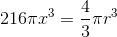
Solving for  , we get:

If you take the cube-root of both sides, you have:

First, you can factor out an  :
:

Next, factor the  :
:

Which simplifies to:

Thus, the diameter is double that or:

Do not assume that the diameter will be half of the diameter of a sphere with volume of
Thus, we know from our equation for the volume of a sphere that:
Solving for
If you take the cube-root of both sides, you have:
First, you can factor out an
Next, factor the
Which simplifies to:
Thus, the diameter is double that or:
← Didn't Know|Knew It →
The surface area of a sphere is . What is its diameter?
The surface area of a sphere is
Tap to reveal answer
The surface area of a sphere is defined by the equation:
For our data, this means:
Solving for , we get:
or
The diameter of the sphere is .
The surface area of a sphere is defined by the equation:
For our data, this means:
Solving for
The diameter of the sphere is
← Didn't Know|Knew It →
The volume of one sphere is . What is the diameter of a sphere of half that volume?
The volume of one sphere is
Tap to reveal answer
Do not assume that the diameter will be half of the diameter of a sphere with volume of . Instead, begin with the sphere with a volume of . Such a simple action will prevent a vexing error!
Thus, we know from our equation for the volume of a sphere that:
Solving for , we get:
If you take the cube-root of both sides, you have:
First, you can factor out an :
Next, factor the :
Which simplifies to:
Thus, the diameter is double that or:
Do not assume that the diameter will be half of the diameter of a sphere with volume of
Thus, we know from our equation for the volume of a sphere that:
Solving for
If you take the cube-root of both sides, you have:
First, you can factor out an
Next, factor the
Which simplifies to:
Thus, the diameter is double that or:
← Didn't Know|Knew It →
The surface area of a sphere is . What is its diameter?
The surface area of a sphere is
Tap to reveal answer
The surface area of a sphere is defined by the equation:
For our data, this means:
Solving for , we get:
or
The diameter of the sphere is .
The surface area of a sphere is defined by the equation:
For our data, this means:
Solving for
The diameter of the sphere is
← Didn't Know|Knew It →
The volume of one sphere is . What is the diameter of a sphere of half that volume?
The volume of one sphere is
Tap to reveal answer
Do not assume that the diameter will be half of the diameter of a sphere with volume of . Instead, begin with the sphere with a volume of . Such a simple action will prevent a vexing error!
Thus, we know from our equation for the volume of a sphere that:
Solving for , we get:
If you take the cube-root of both sides, you have:
First, you can factor out an :
Next, factor the :
Which simplifies to:
Thus, the diameter is double that or:
Do not assume that the diameter will be half of the diameter of a sphere with volume of
Thus, we know from our equation for the volume of a sphere that:
Solving for
If you take the cube-root of both sides, you have:
First, you can factor out an
Next, factor the
Which simplifies to:
Thus, the diameter is double that or:
← Didn't Know|Knew It →
Quantity A: The length of a side of a cube with a volume of 
 .
.
Quantity B: The length of a side of a cube with surface area of 
 .
.
Which of the following is true?
Quantity A: The length of a side of a cube with a volume of
Quantity B: The length of a side of a cube with surface area of
Which of the following is true?
Tap to reveal answer
Recall that the equation for the volume of a cube is:

Since the sides of a cube are merely squares, the surface area equation is just  times the area of one of those squares:

So, for our two quantities:
Quantity A

Use your calculator to estimate this value (since you will not have a square root key). This is  .
.
Quantity B

First divide by  :
:

Therefore, 
Therefore, the two quantities are equal.
Recall that the equation for the volume of a cube is:
Since the sides of a cube are merely squares, the surface area equation is just
So, for our two quantities:
Quantity A
Use your calculator to estimate this value (since you will not have a square root key). This is
Quantity B
First divide by
Therefore,
Therefore, the two quantities are equal.
← Didn't Know|Knew It →
What is the length of an edge of a cube with a surface area of  ?
?
What is the length of an edge of a cube with a surface area of
Tap to reveal answer
The surface area of a cube is made up of  squares. Therefore, the equation is merely
  times the area of one of those squares. Since the sides of a square are equal, this is:
 , where
  is the length of one side of the square.
For our data, we know:

This means that:

Now, while you will not have a calculator with a square root key, you do know that  . (You can always use your calculator to test values like this.) Therefore, we know that
  . This is the length of one side
The surface area of a cube is made up of
For our data, we know:
This means that:
Now, while you will not have a calculator with a square root key, you do know that
← Didn't Know|Knew It →
If a cube has a total surface area of  square inches, what is the length of one edge?
If a cube has a total surface area of
Tap to reveal answer
There are 6 sides to a cube. If the total surface area is 54 square inches, then each face must have an area of 9 square inches.


Every face of a cube is a square, so if the area is 9 square inches, each edge must be 3 inches.
There are 6 sides to a cube. If the total surface area is 54 square inches, then each face must have an area of 9 square inches.
Every face of a cube is a square, so if the area is 9 square inches, each edge must be 3 inches.
← Didn't Know|Knew It →