
Geometry - GRE Quantitative Reasoning
Card 1 of 2800
Quantitative Comparison
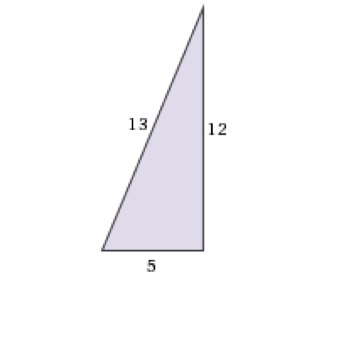
Column A
Area
Column B
Perimeter
Quantitative Comparison
Column A
Area
Column B
Perimeter
Tap to reveal answer
To find the perimeter, add up the sides, here 5 + 12 + 13 = 30. To find the area, multiply the two legs together and divide by 2, here (5 * 12)/2 = 30.
To find the perimeter, add up the sides, here 5 + 12 + 13 = 30. To find the area, multiply the two legs together and divide by 2, here (5 * 12)/2 = 30.
← Didn't Know|Knew It →
What is the slope of the line perpendicular to the line given by the equation
6x – 9y +14 = 0
What is the slope of the line perpendicular to the line given by the equation
6x – 9y +14 = 0
Tap to reveal answer
First rearrange the equation so that it is in slope-intercept form, resulting in y=2/3 x + 14/9. The slope of this line is 2/3, so the slope of the line perpendicular will have the opposite reciprocal as a slope, which is -3/2.
First rearrange the equation so that it is in slope-intercept form, resulting in y=2/3 x + 14/9. The slope of this line is 2/3, so the slope of the line perpendicular will have the opposite reciprocal as a slope, which is -3/2.
← Didn't Know|Knew It →
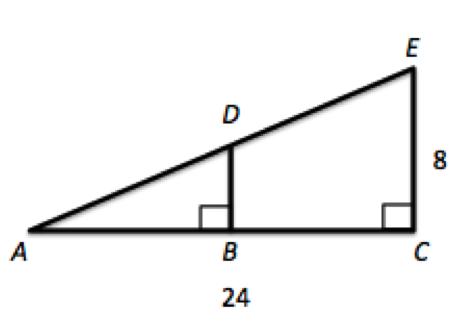
Given triangle ACE where B is the midpoint of AC, what is the area of triangle ABD?
Given triangle ACE where B is the midpoint of AC, what is the area of triangle ABD?
Tap to reveal answer
If B is a midpoint of AC, then we know AB is 12. Moreover, triangles ACE and ABD share angle DAB and have right angles which makes them similar triangles. Thus, their sides will all be proportional, and BD is 4. 1/2bh gives us 1/2 * 12 * 4, or 24.
If B is a midpoint of AC, then we know AB is 12. Moreover, triangles ACE and ABD share angle DAB and have right angles which makes them similar triangles. Thus, their sides will all be proportional, and BD is 4. 1/2bh gives us 1/2 * 12 * 4, or 24.
← Didn't Know|Knew It →
What is the area of a right triangle with hypotenuse of 13 and base of 12?
What is the area of a right triangle with hypotenuse of 13 and base of 12?
Tap to reveal answer
Area = 1/2(base)(height). You could use Pythagorean theorem to find the height or, if you know the special right triangles, recognize the 5-12-13. The area = 1/2(12)(5) = 30.
Area = 1/2(base)(height). You could use Pythagorean theorem to find the height or, if you know the special right triangles, recognize the 5-12-13. The area = 1/2(12)(5) = 30.
← Didn't Know|Knew It →
What is the slope of the line perpendicular to the line represented by the equation y = -2x+3?
What is the slope of the line perpendicular to the line represented by the equation y = -2x+3?
Tap to reveal answer
Perpendicular lines have slopes that are the opposite of the reciprocal of each other. In this case, the slope of the first line is -2. The reciprocal of -2 is -1/2, so the opposite of the reciprocal is therefore 1/2.
Perpendicular lines have slopes that are the opposite of the reciprocal of each other. In this case, the slope of the first line is -2. The reciprocal of -2 is -1/2, so the opposite of the reciprocal is therefore 1/2.
← Didn't Know|Knew It →
What is the distance between the two points, (1,1) and (7,9)?
What is the distance between the two points, (1,1) and (7,9)?
Tap to reveal answer
distance2 = (_x_2 – _x_1)2 + (_y_2 – _y_1)2
Looking at the two order pairs given, _x_1 = 1, _y_1 = 1, _x_2 = 7, _y_2 = 9.
distance2 = (7 – 1)2 + (9 – 1)2 = 62 + 82 = 100
distance = 10
distance2 = (_x_2 – _x_1)2 + (_y_2 – _y_1)2
Looking at the two order pairs given, _x_1 = 1, _y_1 = 1, _x_2 = 7, _y_2 = 9.
distance2 = (7 – 1)2 + (9 – 1)2 = 62 + 82 = 100
distance = 10
← Didn't Know|Knew It →
Quantitative Comparison
Quantity A: the area of a right triangle with sides 10, 24, 26
Quantity B: twice the area of a right triangle with sides 5, 12, 13
Quantitative Comparison
Quantity A: the area of a right triangle with sides 10, 24, 26
Quantity B: twice the area of a right triangle with sides 5, 12, 13
Tap to reveal answer
Quantity A: area = base * height / 2 = 10 * 24 / 2 = 120
Quantity B: 2 * area = 2 * base * height / 2 = base * height = 5 * 12 = 60
Therefore Quantity A is greater.
Quantity A: area = base * height / 2 = 10 * 24 / 2 = 120
Quantity B: 2 * area = 2 * base * height / 2 = base * height = 5 * 12 = 60
Therefore Quantity A is greater.
← Didn't Know|Knew It →
Quantitative Comparison
Quantity A: The area of a triangle with a height of 6 and a base of 7
Quantity B: Half the area of a trapezoid with a height of 6, a base of 6, and another base of 10
Quantitative Comparison
Quantity A: The area of a triangle with a height of 6 and a base of 7
Quantity B: Half the area of a trapezoid with a height of 6, a base of 6, and another base of 10
Tap to reveal answer
Quantity A: Area = 1/2 * b * h = 1/2 * 6 * 7 = 42/2 = 21
Quantity B: Area = 1/2 * (_b_1 + _b_2) * h = 1/2 * (6 + 10) * 6 = 48
Half of the area = 48/2 = 24
Quantity B is greater.
Quantity A: Area = 1/2 * b * h = 1/2 * 6 * 7 = 42/2 = 21
Quantity B: Area = 1/2 * (_b_1 + _b_2) * h = 1/2 * (6 + 10) * 6 = 48
Half of the area = 48/2 = 24
Quantity B is greater.
← Didn't Know|Knew It →
Consider the lines described by the following two equations:
4y = 3x2
3y = 4x2
Find the vertical distance between the two lines at the points where x = 6.
Consider the lines described by the following two equations:
4y = 3x2
3y = 4x2
Find the vertical distance between the two lines at the points where x = 6.
Tap to reveal answer
Since the vertical coordinates of each point are given by y, solve each equation for y and plug in 6 for x, as follows:

Taking the difference of the resulting y -values give the vertical distance between the points (6,27) and (6,48), which is 21.
Since the vertical coordinates of each point are given by y, solve each equation for y and plug in 6 for x, as follows:
Taking the difference of the resulting y -values give the vertical distance between the points (6,27) and (6,48), which is 21.
← Didn't Know|Knew It →
Solve the following system of equations:
–2x + 3y = 10
2x + 5y = 6
Solve the following system of equations:
–2x + 3y = 10
2x + 5y = 6
Tap to reveal answer
Since we have –2x and +2x in the equations, it makes sense to add the equations together to give 8y = 16 yielding y = 2. Then we substitute y = 2 into one of the original equations to get x = –2. So the solution to the system of equations is (–2, 2)
Since we have –2x and +2x in the equations, it makes sense to add the equations together to give 8y = 16 yielding y = 2. Then we substitute y = 2 into one of the original equations to get x = –2. So the solution to the system of equations is (–2, 2)
← Didn't Know|Knew It →
Find the point where the line y = .25(x – 20) + 12 crosses the x-axis.
Find the point where the line y = .25(x – 20) + 12 crosses the x-axis.
Tap to reveal answer
When the line crosses the x-axis, the y-coordinate is 0. Substitute 0 into the equation for y and solve for x.
.25(x – 20) + 12 = 0
.25_x_ – 5 = –12
.25_x_ = –7
x = –28
The answer is the point (–28,0).
When the line crosses the x-axis, the y-coordinate is 0. Substitute 0 into the equation for y and solve for x.
.25(x – 20) + 12 = 0
.25_x_ – 5 = –12
.25_x_ = –7
x = –28
The answer is the point (–28,0).
← Didn't Know|Knew It →
What is the slope of a line perpendicular to the following:
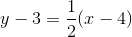
What is the slope of a line perpendicular to the following:
Tap to reveal answer
The question puts the line in point-slope form y – y1 = m(x – x1), where m is the slope. Therefore, the slope of the original line is 1/2. A line perpendicular to another has a slope that is the negative reciprocal of the slope of the other line. The negative reciprocal of the original line is _–_2, and is thus the slope of its perpendicular line.
The question puts the line in point-slope form y – y1 = m(x – x1), where m is the slope. Therefore, the slope of the original line is 1/2. A line perpendicular to another has a slope that is the negative reciprocal of the slope of the other line. The negative reciprocal of the original line is _–_2, and is thus the slope of its perpendicular line.
← Didn't Know|Knew It →
A line is defined by the following equation:

What is the slope of a line that is perpendicular to the line above?
A line is defined by the following equation:
What is the slope of a line that is perpendicular to the line above?
Tap to reveal answer
The equation of a line is  where
where  is the slope.
Rearrange the equation to match this:




For the perpendicular line, the slope is the negative reciprocal;
therefore 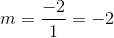
The equation of a line is
Rearrange the equation to match this:
For the perpendicular line, the slope is the negative reciprocal;
therefore
← Didn't Know|Knew It →
Find the slope of a line perpendicular to the line y = –3x – 4.
Find the slope of a line perpendicular to the line y = –3x – 4.
Tap to reveal answer
First we must find the slope of the given line. The slope of y = –3x – 4 is –3. The slope of the perpendicular line is the negative reciprocal. This means you change the sign of the slope to its opposite: in this case to 3. Then find the reciprocal by switching the denominator and numerator to get 1/3; therefore the slope of the perpendicular line is 1/3.
First we must find the slope of the given line. The slope of y = –3x – 4 is –3. The slope of the perpendicular line is the negative reciprocal. This means you change the sign of the slope to its opposite: in this case to 3. Then find the reciprocal by switching the denominator and numerator to get 1/3; therefore the slope of the perpendicular line is 1/3.
← Didn't Know|Knew It →
What is the slope of a line perpendicular to line passing through the points (5, 7) and (2, 12)?
What is the slope of a line perpendicular to line passing through the points (5, 7) and (2, 12)?
Tap to reveal answer
We find the slope of a perpendicular line by taking the opposite and reciprocal of our given line's slope; therefore, we must first solve for the slope of our line. Given our points, we must find the ratio of the rise to the run, that is:
slope = rise/run = (y2 – y1)/(x2 – x1)
slope = (7 – 12)/(5 – 2) = –5/3
The perpendicular will be "flipped" (i.e. reciprocal) and also positive (opposite); therefore, it is: 3/5.
We find the slope of a perpendicular line by taking the opposite and reciprocal of our given line's slope; therefore, we must first solve for the slope of our line. Given our points, we must find the ratio of the rise to the run, that is:
slope = rise/run = (y2 – y1)/(x2 – x1)
slope = (7 – 12)/(5 – 2) = –5/3
The perpendicular will be "flipped" (i.e. reciprocal) and also positive (opposite); therefore, it is: 3/5.
← Didn't Know|Knew It →
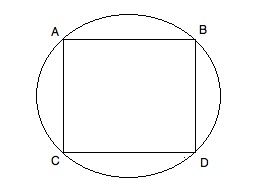
In the diagram above, square ABCD is inscribed in the circle. If the area of the square is 9, what is the area of the circle?
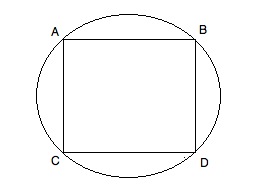
In the diagram above, square ABCD is inscribed in the circle. If the area of the square is 9, what is the area of the circle?
Tap to reveal answer
If the area of the square is 9, then s2 = 9 and s = 3. If the sides thus equal 3, we can calculate the diagonals (either CB or AD) by using the 45-45-90 triangle ratio. For a side of 3, the diagonal will be 3√(2). Note that since the square is inscribed in the circle, this diagonal is also the diameter of the circle. If it is such, the radius is one half of that or 1.5√(2).
Based on that value, we can computer the circle’s area:
A = πr2 = π(1.5√(2))2 = (2.25 * 2)π = 4.5π
If the area of the square is 9, then s2 = 9 and s = 3. If the sides thus equal 3, we can calculate the diagonals (either CB or AD) by using the 45-45-90 triangle ratio. For a side of 3, the diagonal will be 3√(2). Note that since the square is inscribed in the circle, this diagonal is also the diameter of the circle. If it is such, the radius is one half of that or 1.5√(2).
Based on that value, we can computer the circle’s area:
A = πr2 = π(1.5√(2))2 = (2.25 * 2)π = 4.5π
← Didn't Know|Knew It →
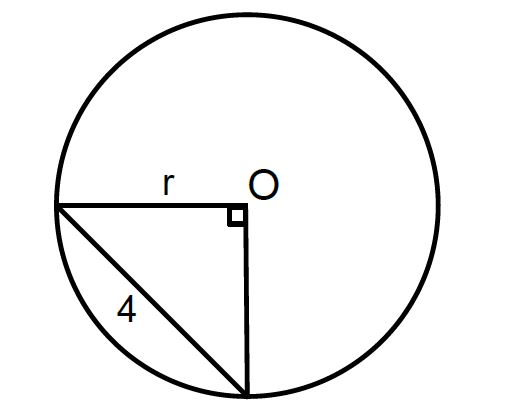
"O" is the center of the circle as shown below.
A
---
The radius of the circle
B
---
3
"O" is the center of the circle as shown below.
A
---
The radius of the circle
B
---
3
Tap to reveal answer
We know the triangle inscribed within the circle must be isosceles, as it contains a 90-degree angle and fixed radii. As such, the opposite angles must be equal. Therefore we can use a simplified version of the Pythagorean Theorem,
a2 + a2 = c2 → 2r2 = 16 → r2 = 8; r = √8 < 3. (since we know √9 = 3, we know √8 must be less); therefore, Quantity B is greater.
We know the triangle inscribed within the circle must be isosceles, as it contains a 90-degree angle and fixed radii. As such, the opposite angles must be equal. Therefore we can use a simplified version of the Pythagorean Theorem,
a2 + a2 = c2 → 2r2 = 16 → r2 = 8; r = √8 < 3. (since we know √9 = 3, we know √8 must be less); therefore, Quantity B is greater.
← Didn't Know|Knew It →
Which point could lie on the circle with radius 5 and center (1,2)?
Which point could lie on the circle with radius 5 and center (1,2)?
Tap to reveal answer
A radius of 5 means we need a distance of 5 from the center to any points on the circle. We need 52 = (1 – _x_2)2 + (2 – _y_2)2. Let's start with the first point, (3,4). (1 – 3)2 + (2 – 4)2 ≠ 25. Next let's try (4,6). (1 – 4)2 + (2 – 6)2 = 25, so (4,6) is our answer. The same can be done for the other three points to prove they are incorrect answers, but this is something to do ONLY if you have enough time.
A radius of 5 means we need a distance of 5 from the center to any points on the circle. We need 52 = (1 – _x_2)2 + (2 – _y_2)2. Let's start with the first point, (3,4). (1 – 3)2 + (2 – 4)2 ≠ 25. Next let's try (4,6). (1 – 4)2 + (2 – 6)2 = 25, so (4,6) is our answer. The same can be done for the other three points to prove they are incorrect answers, but this is something to do ONLY if you have enough time.
← Didn't Know|Knew It →
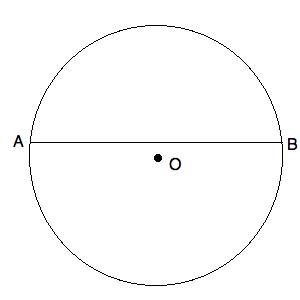
O is the center of the circle above.
The length of  is
is  .
.
Quantity A: The area of the circle.
Quantity B: 
Which of the following is true?
O is the center of the circle above.
The length of
Quantity A: The area of the circle.
Quantity B:
Which of the following is true?
Tap to reveal answer
O is the center of the circle above.
The length of  is
is  .
.
Quantity A: The area of the circle.
Quantity B: 
Do not be tricked by this question. It is true that  can be split into halves, each of which are
  in length. These halves are not, however, radii to the circle. Since this does not go through the center of the circle, its length is shorter than the diameter. This means that the radius of the circle must be greater than
  . Now, if it were
  , the area would be
  . Since it is larger than
  , the area must be larger than
  . Quantity A is larger than quantity B.
O is the center of the circle above.
The length of
Quantity A: The area of the circle.
Quantity B:
Do not be tricked by this question. It is true that
← Didn't Know|Knew It →
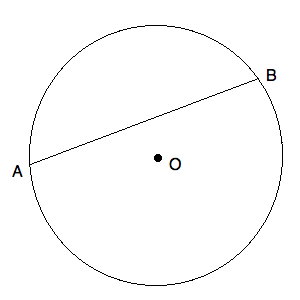
O is the center of the circle above.
The circumference of the circle above is  .
.
Quantity A: The length of  .
.
Quantity B: 
Which of the following is true?
O is the center of the circle above.
The circumference of the circle above is
Quantity A: The length of
Quantity B:
Which of the following is true?
Tap to reveal answer
Now, we know that the circumference of a circle is:
 or
or 
This means that the diameter of our circle is must be  . Given this, we know that the
  must be shorter than
  , for the diameter is the longer than any chord that does not pass through the center of the circle. Quantity B is larger than quantity A.
Now, we know that the circumference of a circle is:
This means that the diameter of our circle is must be
← Didn't Know|Knew It →