
Simplifying Fractions - GRE Quantitative Reasoning
Card 1 of 144
Simplify:

Simplify:
Tap to reveal answer
With this problem the first thing to do is cancel out variables. The x2 can all be divided by each other because they are present in each system. The equation will now look like this:

Now we can see that the equation can all be divided by y, leaving the answer to be:

With this problem the first thing to do is cancel out variables. The x2 can all be divided by each other because they are present in each system. The equation will now look like this:
Now we can see that the equation can all be divided by y, leaving the answer to be:
← Didn't Know|Knew It →
Simplify:

Simplify:
Tap to reveal answer
_x_2 – _y_2 can be also expressed as (x + y)(x – y).
Therefore, the fraction now can be re-written as (x + y)(x – y)/(x + y).
This simplifies to (x – y).
_x_2 – _y_2 can be also expressed as (x + y)(x – y).
Therefore, the fraction now can be re-written as (x + y)(x – y)/(x + y).
This simplifies to (x – y).
← Didn't Know|Knew It →
Simplify the following expression:

Simplify the following expression:
Tap to reveal answer
Following this equation, you divide 4 by 8 to get 1/2. When a variable is raised to an exponent, and you are dividing, you subtract the exponents, so 6 – 3 = 3.
Following this equation, you divide 4 by 8 to get 1/2. When a variable is raised to an exponent, and you are dividing, you subtract the exponents, so 6 – 3 = 3.
← Didn't Know|Knew It →
Simplify the given fraction:

Simplify the given fraction:
Tap to reveal answer
125 goes into 2000 evenly 16 times. 1/16 is the fraction in its simplest form.
125 goes into 2000 evenly 16 times. 1/16 is the fraction in its simplest form.
← Didn't Know|Knew It →
Simplify the given fraction:

Simplify the given fraction:
Tap to reveal answer
120 goes into 6000 evenly 50 times, so we get 1/50 as our simplified fraction.
120 goes into 6000 evenly 50 times, so we get 1/50 as our simplified fraction.
← Didn't Know|Knew It →
Simplify:
(2_x_ + 4)/(x + 2)
Simplify:
(2_x_ + 4)/(x + 2)
Tap to reveal answer
(2_x_ + 4)/(x + 2)
To simplify you must first factor the top polynomial to 2(x + 2). You may then eliminate the identical (x + 2) from the top and bottom leaving 2.
(2_x_ + 4)/(x + 2)
To simplify you must first factor the top polynomial to 2(x + 2). You may then eliminate the identical (x + 2) from the top and bottom leaving 2.
← Didn't Know|Knew It →
A train travels at a constant rate of  meters per second. How many kilometers does it travel in
  minutes?
A train travels at a constant rate of
Tap to reveal answer
Set up the conversions as fractions and solve:

Set up the conversions as fractions and solve:
← Didn't Know|Knew It →
Simplify. 
Simplify.
Tap to reveal answer
To simplify exponents which are being divided, subtract the exponents on the bottom from exponents on the top. Remember that only exponents with the same bases can be simplified
To simplify exponents which are being divided, subtract the exponents on the bottom from exponents on the top. Remember that only exponents with the same bases can be simplified
← Didn't Know|Knew It →
Simplify the following expression:

Simplify the following expression:
Tap to reveal answer
Factor both the numerator and the denominator:
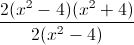
After reducing the fraction, all that remains is:

Factor both the numerator and the denominator:
After reducing the fraction, all that remains is:
← Didn't Know|Knew It →
Simplify:

Simplify:
Tap to reveal answer
Notice that the  term appears frequently. Let's try to factor that out:

Now multiply both the numerator and denominator by the conjugate of the denominator:

Notice that the
Now multiply both the numerator and denominator by the conjugate of the denominator:
← Didn't Know|Knew It →
Reduce the fraction:

Reduce the fraction:
Tap to reveal answer
The numerator and denominator are both divisible by 12. Thus, we divide both by 12 to get our final answer.
If we instead divide by another common factor, we may need to complete the process again to make sure that we have completely reduced the fraction.
In mathematical words we get the following:
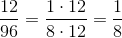
The numerator and denominator are both divisible by 12. Thus, we divide both by 12 to get our final answer.
If we instead divide by another common factor, we may need to complete the process again to make sure that we have completely reduced the fraction.
In mathematical words we get the following:
← Didn't Know|Knew It →
Which quantity is greater?
Quantity A

Quantity B

Which quantity is greater?
Quantity A
Quantity B
Tap to reveal answer
This can be solved using 2 methods.
The most time-efficient solution would recognize that  is the largest value and nearly equals the sum the other fraction by itself.
The more time consuming method would be to convert each fraction to decimal form and calculate the sum of each quantity.
Quantity A: 
Quantity B: 
This can be solved using 2 methods.
The most time-efficient solution would recognize that
The more time consuming method would be to convert each fraction to decimal form and calculate the sum of each quantity.
Quantity A:
Quantity B:
← Didn't Know|Knew It →
Simplify.

Simplify.
Tap to reveal answer
When we factor the numerator and denominator, we get:
 .
.
After cancelling  , we are left with
  .
.
When we factor the numerator and denominator, we get:
After cancelling
← Didn't Know|Knew It →
Which of the following fractions is between  and
and  ?
?
Which of the following fractions is between
Tap to reveal answer
With common denominators, the range is from

or
 .
.
The only fraction that falls in either of these ranges is  .
.
With common denominators, the range is from
or
The only fraction that falls in either of these ranges is
← Didn't Know|Knew It →
Simplify:
(2_x_ + 4)/(x + 2)
Simplify:
(2_x_ + 4)/(x + 2)
Tap to reveal answer
(2_x_ + 4)/(x + 2)
To simplify you must first factor the top polynomial to 2(x + 2). You may then eliminate the identical (x + 2) from the top and bottom leaving 2.
(2_x_ + 4)/(x + 2)
To simplify you must first factor the top polynomial to 2(x + 2). You may then eliminate the identical (x + 2) from the top and bottom leaving 2.
← Didn't Know|Knew It →
Simplify:
Simplify:
Tap to reveal answer
With this problem the first thing to do is cancel out variables. The x2 can all be divided by each other because they are present in each system. The equation will now look like this:
Now we can see that the equation can all be divided by y, leaving the answer to be:
With this problem the first thing to do is cancel out variables. The x2 can all be divided by each other because they are present in each system. The equation will now look like this:
Now we can see that the equation can all be divided by y, leaving the answer to be:
← Didn't Know|Knew It →
Simplify:
Simplify:
Tap to reveal answer
_x_2 – _y_2 can be also expressed as (x + y)(x – y).
Therefore, the fraction now can be re-written as (x + y)(x – y)/(x + y).
This simplifies to (x – y).
_x_2 – _y_2 can be also expressed as (x + y)(x – y).
Therefore, the fraction now can be re-written as (x + y)(x – y)/(x + y).
This simplifies to (x – y).
← Didn't Know|Knew It →
Simplify the following expression:
Simplify the following expression:
Tap to reveal answer
Following this equation, you divide 4 by 8 to get 1/2. When a variable is raised to an exponent, and you are dividing, you subtract the exponents, so 6 – 3 = 3.
Following this equation, you divide 4 by 8 to get 1/2. When a variable is raised to an exponent, and you are dividing, you subtract the exponents, so 6 – 3 = 3.
← Didn't Know|Knew It →
Simplify the given fraction:
Simplify the given fraction:
Tap to reveal answer
125 goes into 2000 evenly 16 times. 1/16 is the fraction in its simplest form.
125 goes into 2000 evenly 16 times. 1/16 is the fraction in its simplest form.
← Didn't Know|Knew It →
Simplify the given fraction:
Simplify the given fraction:
Tap to reveal answer
120 goes into 6000 evenly 50 times, so we get 1/50 as our simplified fraction.
120 goes into 6000 evenly 50 times, so we get 1/50 as our simplified fraction.
← Didn't Know|Knew It →