
Proportion / Ratio / Rate - GRE Quantitative Reasoning
Card 1 of 552
A solution made up of  alcohol by volume is mixed with
  liters of solution that is
  alcohol by volume. How much, in liters, of the
  alcoholic solution is needed to make a mixture that is
  alcohol by volume?
A solution made up of
Tap to reveal answer
Let  represent the number of liters of the 40% solution. Then it follows that
  liters of the 40% solution plus 4 liters of the 10% solution will equal (x+4) liters of a 25% solution. This can be represented by the following equation:

Now solve for x:



You will need 4 liters of the 40% solution in order to make a mixture that is 25% alcohol by volume
Let
Now solve for x:
You will need 4 liters of the 40% solution in order to make a mixture that is 25% alcohol by volume
← Didn't Know|Knew It →
A solution is  parts water,
  parts wine, and
  part honey. If a container of this solution contains
  gallons of water, how much total solution is there in it?
A solution is
Tap to reveal answer
To begin, notice that there is a  ratio between the water in your container and the water specified by the mix of the components. Given that there are
  total parts in your solution, this means that you can set up this equation:

Multiplying both sides by 8, you get:

There are  total gallons of solution.
To begin, notice that there is a
Multiplying both sides by 8, you get:
There are
← Didn't Know|Knew It →
A solution is made up of  parts water,
  parts orange juice, and
  parts apple juice. If you wanted the percentage of orange juice to be
  % of the solution, how many parts would you need to add?
A solution is made up of
Tap to reveal answer
To begin, you know that the basic form of the solution has a total of  , or
, or  parts. Now, we know that we are going to have to add
  parts of orange juice. This means that the new solution will have
  parts orange juice and
  total parts (since we are adding to the original). Since we want this to be
  % orange juice, we really want the following equation to be true:

Solve the following equation, therefore:
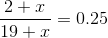
Multipy by  :
:


Now, isolate  :
:


To begin, you know that the basic form of the solution has a total of
Solve the following equation, therefore:
Multipy by
Now, isolate
← Didn't Know|Knew It →
If Mary has $17 and gains a $2 weekly allowance, while Todd has $4 and gains a $3 weekly allowance, what is the least number of weeks that will pass before Todd has more money than Mary?
If Mary has $17 and gains a $2 weekly allowance, while Todd has $4 and gains a $3 weekly allowance, what is the least number of weeks that will pass before Todd has more money than Mary?
Tap to reveal answer
First we set up two equations, one for Mary and one for Todd. Mary’s money growth is represented by y = 2x + 17 (she starts with $17 so this is our y-intercept and she gains $2 weekly so this is our slope).
Todd’s money growth is represented by y = 3x + 4 (he starts with $4 so this is our y-intercept and he gains $3 weekly so this is our slope). Set these two equal and solve for x. We find that after 13 weeks they have the same amount of money. But this is not what the question asked for. They want to know how many weeks it will take before Todd has MORE than Mary. Thus the answer must be 14 weeks.
First we set up two equations, one for Mary and one for Todd. Mary’s money growth is represented by y = 2x + 17 (she starts with $17 so this is our y-intercept and she gains $2 weekly so this is our slope).
Todd’s money growth is represented by y = 3x + 4 (he starts with $4 so this is our y-intercept and he gains $3 weekly so this is our slope). Set these two equal and solve for x. We find that after 13 weeks they have the same amount of money. But this is not what the question asked for. They want to know how many weeks it will take before Todd has MORE than Mary. Thus the answer must be 14 weeks.
← Didn't Know|Knew It →
Kathy travels 40 miles in 1 hour and then 60 miles in 3 hours. What is her average speed in miles per hour?
Kathy travels 40 miles in 1 hour and then 60 miles in 3 hours. What is her average speed in miles per hour?
Tap to reveal answer
It's tempting to take the two rates and average them. This is wrong but the GRE will always give you this as a trap answer choice. In this problem, looking at the two rates separately would give us 40 mi/hr and 20 mi/hr, making the trap answer here 30 mi/hr.
The key is that Kathy goes 40 mi/hr for 1 hour and then 20 mi/hr for 3 hours, so the speed should be less than the middle number of 30. 18 mi/hr is lower than her lowest speed so that doesn't make sense, and 20 mi/hr is too low because the 1 hour at 40 mi/hr should bring the average up a little bit. Therefore the answer must be 25 mi/hr.
We can also do the computations to find the answer. The correct formula is average miles per hour = total miles / total hours. Plugging in our values, average speed = (40 + 60) miles / (1 + 3) hours = 25 mi/hr.
It's tempting to take the two rates and average them. This is wrong but the GRE will always give you this as a trap answer choice. In this problem, looking at the two rates separately would give us 40 mi/hr and 20 mi/hr, making the trap answer here 30 mi/hr.
The key is that Kathy goes 40 mi/hr for 1 hour and then 20 mi/hr for 3 hours, so the speed should be less than the middle number of 30. 18 mi/hr is lower than her lowest speed so that doesn't make sense, and 20 mi/hr is too low because the 1 hour at 40 mi/hr should bring the average up a little bit. Therefore the answer must be 25 mi/hr.
We can also do the computations to find the answer. The correct formula is average miles per hour = total miles / total hours. Plugging in our values, average speed = (40 + 60) miles / (1 + 3) hours = 25 mi/hr.
← Didn't Know|Knew It →
Two cars begin 500 miles apart and begin driving directly toward each other. One car proceeds at a rate of 50 miles per hour, while the other proceeds at a rate of 40 miles per hour. Rounding down, many minutes will it take for the two drivers to be 150 miles apart?
Two cars begin 500 miles apart and begin driving directly toward each other. One car proceeds at a rate of 50 miles per hour, while the other proceeds at a rate of 40 miles per hour. Rounding down, many minutes will it take for the two drivers to be 150 miles apart?
Tap to reveal answer
You know that the distance between these cars is defined by the following equation: Answer "250" = 500 – 90t. This is because the cars get 90 miles closer every t hours. You want to solve for t when the distance is 150: 150 = 500 – 90t; –350 = –90t; t = 35/9. Recall, however, that the question asked for the rounded-down number of minutes; therefore, multiply your answer by 60: 35 * 60/9 = 2331/3
Rounding down, you get 233.
You know that the distance between these cars is defined by the following equation: Answer "250" = 500 – 90t. This is because the cars get 90 miles closer every t hours. You want to solve for t when the distance is 150: 150 = 500 – 90t; –350 = –90t; t = 35/9. Recall, however, that the question asked for the rounded-down number of minutes; therefore, multiply your answer by 60: 35 * 60/9 = 2331/3
Rounding down, you get 233.
← Didn't Know|Knew It →
It takes Mary 45 minutes to completely frost 100 cupcakes, and it takes Benjamin 80 minutes to completely frost 110 cupcakes. How many cupcakes can they completely frost, working together, in 1 hour?
It takes Mary 45 minutes to completely frost 100 cupcakes, and it takes Benjamin 80 minutes to completely frost 110 cupcakes. How many cupcakes can they completely frost, working together, in 1 hour?
Tap to reveal answer
In this rate word problem, we need to find the rates at which Mary and Bejamin frost their respective cupcakes, and then sum their respective rates per hour. In one hour Mary frosts 133 cupcakes. (Note: the question specifies COMPLETELY frosted cupcakes only, so the fractional results here will need to be rounded down to the nearest integer.) Benjamin frosts 82 cupcakes.
82 + 133=215
In this rate word problem, we need to find the rates at which Mary and Bejamin frost their respective cupcakes, and then sum their respective rates per hour. In one hour Mary frosts 133 cupcakes. (Note: the question specifies COMPLETELY frosted cupcakes only, so the fractional results here will need to be rounded down to the nearest integer.) Benjamin frosts 82 cupcakes.
82 + 133=215
← Didn't Know|Knew It →
At a widget factory, 60 workers produce 1,000 widgets per week using power from internal generators. If (f) cubic meters of fuel are required by (g) number of generators every day to power the factory, how long will (t) cubic meters of fuel last in days?
At a widget factory, 60 workers produce 1,000 widgets per week using power from internal generators. If (f) cubic meters of fuel are required by (g) number of generators every day to power the factory, how long will (t) cubic meters of fuel last in days?
Tap to reveal answer
This is a plug and chug sort of problem, where choosing values is arbitrary. Suppose the generators consume 5 cubic meters of fuel per day and there are 10 generators. Then the number of days that 100 cubic meters of fuel will last is expressed as 100/5*10. Switching back to variables, that comes out to t/fg.
This is a plug and chug sort of problem, where choosing values is arbitrary. Suppose the generators consume 5 cubic meters of fuel per day and there are 10 generators. Then the number of days that 100 cubic meters of fuel will last is expressed as 100/5*10. Switching back to variables, that comes out to t/fg.
← Didn't Know|Knew It →
Beverly just filled up her gas tank, which has enough gas to last her, at her usual driving rate, about 45 days. However, Beverly becomes extra busy and begins driving 66.6% more than she usually does. How many days does the tank of gas last Beverly at her new rate?
Beverly just filled up her gas tank, which has enough gas to last her, at her usual driving rate, about 45 days. However, Beverly becomes extra busy and begins driving 66.6% more than she usually does. How many days does the tank of gas last Beverly at her new rate?
Tap to reveal answer
Answer: 27 days
Explanation: Recall that the rate of gas consumption is INVERSELY related to the time it takes to consume the gas. Thus, if the rate of gas consumption increases to 5/3 of it's original rate (a 66.6% increase), then the time it will take to consume all of the gas decreases to the inverse, or 3/5 of the original. The answer is thus 27 (3/5 of 45).
Answer: 27 days
Explanation: Recall that the rate of gas consumption is INVERSELY related to the time it takes to consume the gas. Thus, if the rate of gas consumption increases to 5/3 of it's original rate (a 66.6% increase), then the time it will take to consume all of the gas decreases to the inverse, or 3/5 of the original. The answer is thus 27 (3/5 of 45).
← Didn't Know|Knew It →
A Super Sweet Candy Puff Roll has 1450 calories per roll. A man eats one roll in 10 minutes. During the work day, the man eats a roll at the start of the shift and then eats another a roll every two hours after finishing the last one. Since he is watching his health, he eats only until 3 PM but will not start eating another one at any time after 3 PM. If his shift begins at 8 AM and ends at 5 PM, how many calories per minute does he consume in Super Sweet Candy Puff Rolls® during the whole work day?
A Super Sweet Candy Puff Roll has 1450 calories per roll. A man eats one roll in 10 minutes. During the work day, the man eats a roll at the start of the shift and then eats another a roll every two hours after finishing the last one. Since he is watching his health, he eats only until 3 PM but will not start eating another one at any time after 3 PM. If his shift begins at 8 AM and ends at 5 PM, how many calories per minute does he consume in Super Sweet Candy Puff Rolls® during the whole work day?
Tap to reveal answer
It is probably easiest just to write out the eating schedule:
Roll 1: 8:00 AM - 8:10 AM
Roll 2: 10:10 AM - 10:20 AM
Roll 3: 12:20 PM - 12:30 PM
Roll 4: 2:40 PM - 2:50 PM
Therefore, he eats 4 rolls, or 1450 * 4 = 5800 calories. To get the rate, this must be divided across the whole day's minutes: 9 work hours * 60 = 540 minutes. The average calories per minute = 10.74.
It is probably easiest just to write out the eating schedule:
Roll 1: 8:00 AM - 8:10 AM
Roll 2: 10:10 AM - 10:20 AM
Roll 3: 12:20 PM - 12:30 PM
Roll 4: 2:40 PM - 2:50 PM
Therefore, he eats 4 rolls, or 1450 * 4 = 5800 calories. To get the rate, this must be divided across the whole day's minutes: 9 work hours * 60 = 540 minutes. The average calories per minute = 10.74.
← Didn't Know|Knew It →
The cold-water faucet can fill a bucket in 30 minutes, and the hot-water faucet can fill a bucket in 60 minutes. How long will it take to fill a bucket when the two faucets are running together?
The cold-water faucet can fill a bucket in 30 minutes, and the hot-water faucet can fill a bucket in 60 minutes. How long will it take to fill a bucket when the two faucets are running together?
Tap to reveal answer
The cold-water faucet fills the bucket in 30 minutes, so in 1 minute it fills 1/30 of the bucket. The hot-water faucet fills the bucket in 60 minutes, so in 1 minute it fills 1/60 of the bucket. Then, when they're both running together they fill 1/30 + 1/60 of the bucket in 1 minute.
1/30 + 1/60 = 2/60 + 1/60 = 3/60 = 1/20, so they fill the whole bucket in 20 minutes.
The cold-water faucet fills the bucket in 30 minutes, so in 1 minute it fills 1/30 of the bucket. The hot-water faucet fills the bucket in 60 minutes, so in 1 minute it fills 1/60 of the bucket. Then, when they're both running together they fill 1/30 + 1/60 of the bucket in 1 minute.
1/30 + 1/60 = 2/60 + 1/60 = 3/60 = 1/20, so they fill the whole bucket in 20 minutes.
← Didn't Know|Knew It →
Quantitative Comparison
Alice has a puppy and a kitten. The puppy weighs 4 pounds and grows at a rate of 1 pound per month. The kitten weighs 2 pounds and grows at a rate of 2 pounds per month.
Quantity A: Weight of the puppy after 8 months
Quantity B: Weight of the kitten after 7 months
Quantitative Comparison
Alice has a puppy and a kitten. The puppy weighs 4 pounds and grows at a rate of 1 pound per month. The kitten weighs 2 pounds and grows at a rate of 2 pounds per month.
Quantity A: Weight of the puppy after 8 months
Quantity B: Weight of the kitten after 7 months
Tap to reveal answer
The puppy starts at 4 pounds and gains 1 pound per month for 8 months, so he weighs 4 + 8 = 12 pounds at the end of 8 months. The kitten starts at 2 pounds and gains 2 pounds per month for 7 months, so he weighs 2 + 14 = 16 pounds at the end of 7 months. Therefore Quantity B is greater.
The puppy starts at 4 pounds and gains 1 pound per month for 8 months, so he weighs 4 + 8 = 12 pounds at the end of 8 months. The kitten starts at 2 pounds and gains 2 pounds per month for 7 months, so he weighs 2 + 14 = 16 pounds at the end of 7 months. Therefore Quantity B is greater.
← Didn't Know|Knew It →
A 10,000 gallon shark tank is filled by two hoses. Hose A fills at a rate of 1,000 gallons per hour. When Hose A and Hose B are both on, they fill the shark tank in 4 hours. At what rate does Hose B fill the tank?
A 10,000 gallon shark tank is filled by two hoses. Hose A fills at a rate of 1,000 gallons per hour. When Hose A and Hose B are both on, they fill the shark tank in 4 hours. At what rate does Hose B fill the tank?
Tap to reveal answer
This problem gives the rate of Hose A instead of the time it takes to fill the shark tank. Let's convert the rest of the problem information into rates as well. The tank is 10,000 gallons, and it takes the two hoses together 4 hours to fill the tank. Therefore, the combined rate is 10,000/4 = 2,500 gallons per hour.
Now we know that Hose A can deliver 1,000 gallons in an hour, and together Hose A and Hose B can deliver 2,500 gallons in an hour. So 1,000 gallons + Hose B gallons = 2,500 gallons. Then Hose B fills the tank at 2500 – 1000 = 1500 gallons/hour.
This problem gives the rate of Hose A instead of the time it takes to fill the shark tank. Let's convert the rest of the problem information into rates as well. The tank is 10,000 gallons, and it takes the two hoses together 4 hours to fill the tank. Therefore, the combined rate is 10,000/4 = 2,500 gallons per hour.
Now we know that Hose A can deliver 1,000 gallons in an hour, and together Hose A and Hose B can deliver 2,500 gallons in an hour. So 1,000 gallons + Hose B gallons = 2,500 gallons. Then Hose B fills the tank at 2500 – 1000 = 1500 gallons/hour.
← Didn't Know|Knew It →
At 9 AM, the temperature is 65 degrees. At 2 PM, the temperature has risen to 100 degrees. What is the rate of temperature change in degrees per hour?
At 9 AM, the temperature is 65 degrees. At 2 PM, the temperature has risen to 100 degrees. What is the rate of temperature change in degrees per hour?
Tap to reveal answer
The change in temperature is 100 – 65 = 35 degrees. The change in time is 9 AM to 2 PM, or 5 hours. So the rate of change is 35 degrees / 5 hours = 7 degrees / hour.
The change in temperature is 100 – 65 = 35 degrees. The change in time is 9 AM to 2 PM, or 5 hours. So the rate of change is 35 degrees / 5 hours = 7 degrees / hour.
← Didn't Know|Knew It →
Ben mows the lawn in 1 hour. Kent mows the lawn in 2 hours. How long will it take them to mow the lawn working together?
Ben mows the lawn in 1 hour. Kent mows the lawn in 2 hours. How long will it take them to mow the lawn working together?
Tap to reveal answer
Ben mows 1 lawn in 1 hour, or 1/60 of the lawn in 1 minute. Ken mows 1 lawn in 2 hours, or 1/120 of the lawn in 1 minute. Then each minute they mow 1/60 + 1/120 = 3/120 = 1/40 of the lawn. That means the entire lawn takes 40 minutes to mow.
Ben mows 1 lawn in 1 hour, or 1/60 of the lawn in 1 minute. Ken mows 1 lawn in 2 hours, or 1/120 of the lawn in 1 minute. Then each minute they mow 1/60 + 1/120 = 3/120 = 1/40 of the lawn. That means the entire lawn takes 40 minutes to mow.
← Didn't Know|Knew It →
A train travels at 50 feet per second. If there are 5280 feet in a mile, how many miles will the train travel in an hour?
A train travels at 50 feet per second. If there are 5280 feet in a mile, how many miles will the train travel in an hour?
Tap to reveal answer
First, we must determine how many feet per hour the train travels.
50 feet per second * 60 seconds in a minute * 60 minutes in an hour.
50 * 60 * 60 = 180,000
Then, it's just a matter of converting 180,000 feet to miles. Because there are 5280 feet in a mile, just divide.
180,000 / 5280 = 34.091
First, we must determine how many feet per hour the train travels.
50 feet per second * 60 seconds in a minute * 60 minutes in an hour.
50 * 60 * 60 = 180,000
Then, it's just a matter of converting 180,000 feet to miles. Because there are 5280 feet in a mile, just divide.
180,000 / 5280 = 34.091
← Didn't Know|Knew It →
John can paint a room in 4 hours, and Susan can paint the same room in 6 hours. How many minutes would it take them to paint the room together?
John can paint a room in 4 hours, and Susan can paint the same room in 6 hours. How many minutes would it take them to paint the room together?
Tap to reveal answer
First find what fraction of the job is completed per hour. If John can paint the room in 4 hours, then he completes  of it per hour. Similarly, Susan paints
  of it per hour. So together they paint
  of the room per hour.
Add  by rewriting them with the same common denominator (least common multiple of 4 and 6 is 12, so 12 is the least common denominator):

This means  of the job is completed per hour. To find the number of hours for the whole job (1 room), divide the whole by the fraction completed per hour:


Convert hours to minutes:

First find what fraction of the job is completed per hour. If John can paint the room in 4 hours, then he completes
Add
This means
Convert hours to minutes:
← Didn't Know|Knew It →
Carol ate 3 pancakes in 5 minutes. If she continues to eat at the same rate, how many whole pancakes can she eat in 24 minutes?
Carol ate 3 pancakes in 5 minutes. If she continues to eat at the same rate, how many whole pancakes can she eat in 24 minutes?
Tap to reveal answer
If Carol ate 3 pancakes in 5 minutes, she can eat  of a pancake every minute.
  .
.
That means she ate 14 whole pancakes (and an additional 2/5 of another pancake).
If Carol ate 3 pancakes in 5 minutes, she can eat
That means she ate 14 whole pancakes (and an additional 2/5 of another pancake).
← Didn't Know|Knew It →
If 24 machines can make 5 devices in 30 minutes, how many hours will it take 4 machines to make 15 devices?
If 24 machines can make 5 devices in 30 minutes, how many hours will it take 4 machines to make 15 devices?
Tap to reveal answer
Approach this problem with the following reasoning.
Unit of work done = number of workers * rate * time
In our case, we are given 24 "workers," able to make 5 "units of work," in 0.5 "time." The rate is not given, but can be solved for with our given information.
Units of work = 5
Number of workers = 24
Time = 0.5 hours (30 minutes)

Now, since we know the rate, which does not chage, we can solve for the new time when the number of machines is decreased and the number of devices is increased.
Unit of work done = number of workers * rate * time


Approach this problem with the following reasoning.
Unit of work done = number of workers * rate * time
In our case, we are given 24 "workers," able to make 5 "units of work," in 0.5 "time." The rate is not given, but can be solved for with our given information.
Units of work = 5
Number of workers = 24
Time = 0.5 hours (30 minutes)
Now, since we know the rate, which does not chage, we can solve for the new time when the number of machines is decreased and the number of devices is increased.
Unit of work done = number of workers * rate * time
← Didn't Know|Knew It →
Mario can solve  problems in
  hours. At this rate, how many problems can he solve in
  hours?
Mario can solve
Tap to reveal answer
The rate is given by amount of probems over time.

To find the amount of problems done in a given amount of time, mulitply the rate by the given amount of time.

We can combine our y terms and cancel our n terms to simplify.

The rate is given by amount of probems over time.
To find the amount of problems done in a given amount of time, mulitply the rate by the given amount of time.
We can combine our y terms and cancel our n terms to simplify.
← Didn't Know|Knew It →