
Decimals with Fractions - GRE Quantitative Reasoning
Card 1 of 408
Quantitative Comparison: Compare Quantity A and Quantity B, using additional information centered above the two quantities if such information is given.
10 < n < 15
Quantity A Quantity B
7/13 4/n
Quantitative Comparison: Compare Quantity A and Quantity B, using additional information centered above the two quantities if such information is given.
10 < n < 15
Quantity A Quantity B
7/13 4/n
Tap to reveal answer
To determine which quantity is greater, we must first determine the range of potential values for Quantity B. Let's call this quantity m. This is most efficiently done by dividing 4 by the highest and lowest possible values for n.
4/10 = 0.4
4/15 = 0.267
So the possible values for m are 0.267 < m < 0.4
Now let's find the value for 7/13, to make comparison easier.
7/13 = 0.538
Given this, no matter what the value of n is, 7/13 will still be a higher proportion, so Quantity B is greater.
To determine which quantity is greater, we must first determine the range of potential values for Quantity B. Let's call this quantity m. This is most efficiently done by dividing 4 by the highest and lowest possible values for n.
4/10 = 0.4
4/15 = 0.267
So the possible values for m are 0.267 < m < 0.4
Now let's find the value for 7/13, to make comparison easier.
7/13 = 0.538
Given this, no matter what the value of n is, 7/13 will still be a higher proportion, so Quantity B is greater.
← Didn't Know|Knew It →
Convert  to a mixed number fraction. Then simplify your answer.
Convert
Tap to reveal answer
Both decimals and fractions represent part of a whole. To convert this decimal number to a mixed number fraction, use the following steps:

(because the decimal number has a  in the ones place value and an
  in the hundredths place value).
Then simplify  .
.

Thus, the correct answer is 
Both decimals and fractions represent part of a whole. To convert this decimal number to a mixed number fraction, use the following steps:
(because the decimal number has a
Then simplify
Thus, the correct answer is
← Didn't Know|Knew It →
Convert  to a fraction. Then simplify.
Convert
Tap to reveal answer
Both decimals and fractions represent part of a whole. Since this decimal number has a value of  in the tenths place and a value of
  in the hundredths place, it can be re-written as:
 .
.
Then, simplify the fraction by dividing both the numerator and denominator by a divisor of 
Thus, the solution is:

Both decimals and fractions represent part of a whole. Since this decimal number has a value of
Then, simplify the fraction by dividing both the numerator and denominator by a divisor of
Thus, the solution is:
← Didn't Know|Knew It →
Find the fractional equivalent to  .
.
Find the fractional equivalent to
Tap to reveal answer
This problem requires several conversions. First, convert  into a mixed number fraction. This means, the new fraction will have a whole number of
  and a fraction that represents
  thousandths. Then, convert the mixed number to an improper fraction by multiplying the denominator by the whole number, and then add that product to the numerator.
Thus, the solution is:

This problem requires several conversions. First, convert
Thus, the solution is:
← Didn't Know|Knew It →
Convert  to an improper fraction.
Convert
Tap to reveal answer
This problem requires two conversions. First convert  to a mixed number fraction. This must equal a whole number of
  and a fraction that represents a value of
  tenths. Then, convert the mixed number to an improper fraction by multiplying the denominator by the whole number, and then add that product to the numerator.
Thus, the solution is:

This problem requires two conversions. First convert
Thus, the solution is:
← Didn't Know|Knew It →
Find the fractional equivalent to  . Then reduce the fraction if possible.
Find the fractional equivalent to
Tap to reveal answer
To solve this problem, make a mixed number fraction with a whole number of  and a fraction that represents
  hundredths. Then simplify the fraction portion of the mixed number by dividing the numerator and denominator by their largest common divisor.

To solve this problem, make a mixed number fraction with a whole number of
← Didn't Know|Knew It →
Convert  to an equivalent decimal number.
Convert
Tap to reveal answer
To convert this fraction to a decimal number, divide the numerator by the denominator. Since this fraction has a larger numerator than denominator, the fraction is classified as an improper fraction. This means that the fraction represents a value greater than one whole. Thus, the solution must be greater than one.

Note that  fits into
  evenly
  times, and has a remainder for of
To convert this fraction to a decimal number, divide the numerator by the denominator. Since this fraction has a larger numerator than denominator, the fraction is classified as an improper fraction. This means that the fraction represents a value greater than one whole. Thus, the solution must be greater than one.
Note that
← Didn't Know|Knew It →
Find the fractional equivalent to  . Then simplify.
Find the fractional equivalent to
Tap to reveal answer
This problem requires you to first convert the decimal number to a mixed number fraction that has a whole number of  and a fraction that represents
  thousandths. Then reduce the numerator and denominator by common divisors until you can no longer simplify the fraction.

This problem requires you to first convert the decimal number to a mixed number fraction that has a whole number of
← Didn't Know|Knew It →
Convert  to a fraction. Then simplify.
Convert
Tap to reveal answer
Both fractions and decimals represent part of a whole. The value of this decimal number reaches the ten-thousandths place value. Thus, the fraction must represent  ten-thousandths. Then reduce the numerator and denominator by the common divisor of
  .
.

Both fractions and decimals represent part of a whole. The value of this decimal number reaches the ten-thousandths place value. Thus, the fraction must represent
← Didn't Know|Knew It →
Find the decimal equivalent of  .
.
Find the decimal equivalent of
Tap to reveal answer
Fractions and decimals both represent part of a whole. To solve this problem you may divide  by
by  , or you can reduce the fraction by dividing the numerator and denominator by the common factor of
  This will equal a fraction of
  hundredths, which can be written as the decimal number "zero and
  hundredths."

Note: both  and
and  equal
equal 
Fractions and decimals both represent part of a whole. To solve this problem you may divide
Note: both
← Didn't Know|Knew It →
Convert  to an improper fraction.
Convert
Tap to reveal answer
First convert this decimal number to a mixed number fraction, then covert the mixed number to an improper fraction. The mixed number fraction must have a whole number of  and a fraction that represents
  tenths. Then, convert the mixed number to an improper fraction by multiplying the denominator by the whole number, and then add that product to the numerator.

First convert this decimal number to a mixed number fraction, then covert the mixed number to an improper fraction. The mixed number fraction must have a whole number of
← Didn't Know|Knew It →
Find the fractional equivalent for  .
.
Find the fractional equivalent for
Tap to reveal answer
Decimal numbers and fractions both represent part of a whole. This decimal number has a value of  in the tenths and thousandths place values. Since the decimal number reaches the thousandths place, the correct answer is
  over
over  --which represents
  thousandths.

Decimal numbers and fractions both represent part of a whole. This decimal number has a value of
← Didn't Know|Knew It →
Convert the mixed fraction  to a decimal number.
Convert the mixed fraction
Tap to reveal answer
Since the starting number is a mixed number fraction, the decimal number must also have a value in the ones place. Since the denominator in the fraction has a value that is a factor of  , both the numerator and denominator can be multiplied by a factor of
  to form
  tenths. (Note, the first decimal place value is the tenths place).

Since the starting number is a mixed number fraction, the decimal number must also have a value in the ones place. Since the denominator in the fraction has a value that is a factor of
← Didn't Know|Knew It →
A retailer can only order wristbands in bulk cases. Each case has 300 wristbands and costs $1172.
Quantity A: The number of wristbands that can be bought for $10547.
Quantity B: The number of wristbands that can be bought for $10560.
A retailer can only order wristbands in bulk cases. Each case has 300 wristbands and costs $1172.
Quantity A: The number of wristbands that can be bought for $10547.
Quantity B: The number of wristbands that can be bought for $10560.
Tap to reveal answer
The key to this problem is to realize that the store cannot buy partial crates of wristbands--it's all or nothing. Calculate how many crates can be bought with each sum of money by dividing the sum by the price of a crate.
Quantity A:
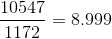
Although oh so close, only eight crates can be bought with this sum of money. Don't round up!
Quantity B:
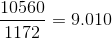
There's just enough to buy nine crates.
Quantity B is greater.
The key to this problem is to realize that the store cannot buy partial crates of wristbands--it's all or nothing. Calculate how many crates can be bought with each sum of money by dividing the sum by the price of a crate.
Quantity A:
Although oh so close, only eight crates can be bought with this sum of money. Don't round up!
Quantity B:
There's just enough to buy nine crates.
Quantity B is greater.
← Didn't Know|Knew It →
If 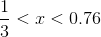 ,
,  can equal which of the following?
If
Tap to reveal answer
Convert all of the fractions to decimals. Thus, x is contained within the range of 0.33 < x < 0.76. The answers choices become 1/4 = 0.25, 4/12 = 0.33, 2/5 = 0.4, and 5/16 = 0.3125, respectively. Therefore, the only answer which is within the desired range is 2/5.
Convert all of the fractions to decimals. Thus, x is contained within the range of 0.33 < x < 0.76. The answers choices become 1/4 = 0.25, 4/12 = 0.33, 2/5 = 0.4, and 5/16 = 0.3125, respectively. Therefore, the only answer which is within the desired range is 2/5.
← Didn't Know|Knew It →
Choose the answer which best expresses the following fraction in decimal form (round to the nearest thousandth):

Choose the answer which best expresses the following fraction in decimal form (round to the nearest thousandth):
Tap to reveal answer
To convert a fraction into a decimal, you simply need to divide the numerator by the denominator. When the problem prompts you to round to the nearest thousandth, that means that you round to the third decimal place (i.e. go to the third decimal place, if the fourth is four or lower, you can leave the third decimal place digit alone, if the fourth is five or higher, raise the third decimal place digit by one).
When you divide 16 by 17 you will need to add a zero and a decimal place to 16 making it 160. From here we see that
 but since we added a decimal place to 16 to create 160 we now need to move the decimal place of the answer one unit to the left.

To convert a fraction into a decimal, you simply need to divide the numerator by the denominator. When the problem prompts you to round to the nearest thousandth, that means that you round to the third decimal place (i.e. go to the third decimal place, if the fourth is four or lower, you can leave the third decimal place digit alone, if the fourth is five or higher, raise the third decimal place digit by one).
When you divide 16 by 17 you will need to add a zero and a decimal place to 16 making it 160. From here we see that
← Didn't Know|Knew It →
Vega only purchases gardening claws in bulk cases. Each case is 150 claws for $2415.17.
Quantity A: The number of claws Vega can purchase with $41,082.05
Quantity B: The number of claws Vega can purchase with $43,473.05
Vega only purchases gardening claws in bulk cases. Each case is 150 claws for $2415.17.
Quantity A: The number of claws Vega can purchase with $41,082.05
Quantity B: The number of claws Vega can purchase with $43,473.05
Tap to reveal answer
Looking at the differences in prices, one might guess that Quantity B is the answer. Beware the easy answer; always check.
Instead, calculating how many cases of claws Vega can buy, keeping in mind that he cannot purchase part of a case. Do not round up!
Quantity A:
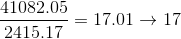
Quantity B:

In either case, he can buy no more than seventeen cases. The two quantities are equal.
Looking at the differences in prices, one might guess that Quantity B is the answer. Beware the easy answer; always check.
Instead, calculating how many cases of claws Vega can buy, keeping in mind that he cannot purchase part of a case. Do not round up!
Quantity A:
Quantity B:
In either case, he can buy no more than seventeen cases. The two quantities are equal.
← Didn't Know|Knew It →
Isley only buys seeds for her gardening store in bulk cases, with each case containing  packets of seeds and costing $343.25.
Quantity A: The number of seeds Isley can purchase with $3837.54
Quantity B: The number of seeds Isley can purchase with $3871.86
Isley only buys seeds for her gardening store in bulk cases, with each case containing
Quantity A: The number of seeds Isley can purchase with $3837.54
Quantity B: The number of seeds Isley can purchase with $3871.86
Tap to reveal answer
Looking at how close the dollar values are for A and B, it's tempting to think the GRE is being tricky, and that B will allow for the purchase of more cases of seeds.
Do not assume; check to see whether or not this is the situation. Note that a portion of a case cannot be purchased; round down to the nearest integer when calculating how many cases may be bought.
Since each case is $343.25
Quantity A:
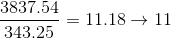
Quantity B:
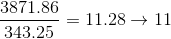
The two quantities are equal.
Looking at how close the dollar values are for A and B, it's tempting to think the GRE is being tricky, and that B will allow for the purchase of more cases of seeds.
Do not assume; check to see whether or not this is the situation. Note that a portion of a case cannot be purchased; round down to the nearest integer when calculating how many cases may be bought.
Since each case is $343.25
Quantity A:
Quantity B:
The two quantities are equal.
← Didn't Know|Knew It →
A tub of food contains  pounds of vegetables,
  pounds of lard, and
  pounds of sausage. What is its total weight as an improper fraction?
A tub of food contains
Tap to reveal answer
To begin with, it is easiest just to add these decimals together using your calculator:

Now, this is the same thing as:

We can rewrite this:

To find this, you need to give the two numbers a common denominator:
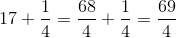
This is your answer.
To begin with, it is easiest just to add these decimals together using your calculator:
Now, this is the same thing as:
We can rewrite this:
To find this, you need to give the two numbers a common denominator:
This is your answer.
← Didn't Know|Knew It →
What is the fractional equivalent of  ?
?
What is the fractional equivalent of
Tap to reveal answer
In decimal form  is said 33 hundredths.
This is equal to
 .
.
This fraction cannot be reduced any further therefore it is in its final answer form.
In decimal form
This is equal to
This fraction cannot be reduced any further therefore it is in its final answer form.
← Didn't Know|Knew It →