
Percentage - GRE Quantitative Reasoning
Card 1 of 880
What percentage of a solution is blood if it contains  ml blood and
  ml water? Round to the nearest thousandth?
What percentage of a solution is blood if it contains
Tap to reveal answer
First, you must find the total amount of solution. This is  , or
, or  .
.
Now, the percentage of the solution that is blood can be represented:
 , or
, or 
This is the same as  % Rounded, it is
  %
%
First, you must find the total amount of solution. This is
Now, the percentage of the solution that is blood can be represented:
This is the same as
← Didn't Know|Knew It →
30 is  percent of 210
20 is  percent of 160
Quantity A: 
Quantity B: 
30 is
20 is
Quantity A:
Quantity B:
Tap to reveal answer
To attempt this problem, translate the statements into mathematical equations. When you see the word 'is', it very often means 'equals:
30 is  percent of 210:
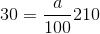

20 is  percent of 160:
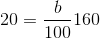

Since Quantity A has the smaller denominator with an equivalent numerator, it is the larger value. Quantity A is greater.
To attempt this problem, translate the statements into mathematical equations. When you see the word 'is', it very often means 'equals:
30 is
20 is
Since Quantity A has the smaller denominator with an equivalent numerator, it is the larger value. Quantity A is greater.
← Didn't Know|Knew It →
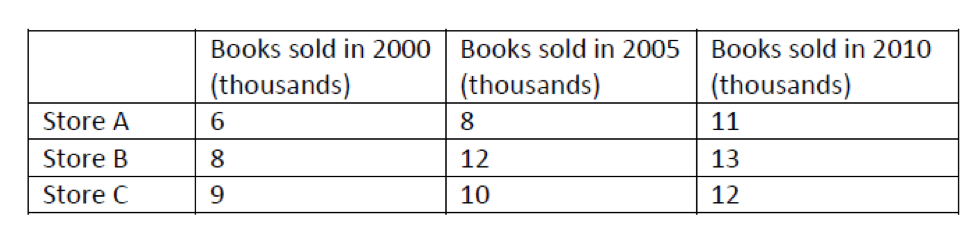
By what percentage did the total book sales of the three stores increase from 2005 to 2010?
By what percentage did the total book sales of the three stores increase from 2005 to 2010?
Tap to reveal answer
Find the total number of books sold in 2005: 8 + 12 + 10 = 30 thousand
Find the total number of books sold in 2010: 11 + 13 + 12 = 36 thousand


Find the total number of books sold in 2005: 8 + 12 + 10 = 30 thousand
Find the total number of books sold in 2010: 11 + 13 + 12 = 36 thousand
← Didn't Know|Knew It →
How much does a sweater cost that is 18% more than a $50 dress?
How much does a sweater cost that is 18% more than a $50 dress?
Tap to reveal answer
18% of the dress is .18 * 50 = $9. Then the sweater costs $50 + $9 = $59.
18% of the dress is .18 * 50 = $9. Then the sweater costs $50 + $9 = $59.
← Didn't Know|Knew It →
Column A: 
Column B: 
Column A:
Column B:
Tap to reveal answer
2/5% = 0.40% = 0.004. Therefore, Column B is greater.
2/5% = 0.40% = 0.004. Therefore, Column B is greater.
← Didn't Know|Knew It →
 is
is  percent of
 is
is  percent of
Quantity A: 
Quantity B: 
Quantity A:
Quantity B:
Tap to reveal answer
To do this problem, translate each expression into mathematical terms:
 is
is  percent of
  :
:
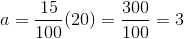
 is
is  percent of
  :
:
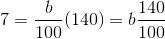
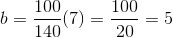
Quantity B is greater.
To do this problem, translate each expression into mathematical terms:
Quantity B is greater.
← Didn't Know|Knew It →
Quantity A: 20% of 
Quantity B: 30% of 
Quantity A: 20% of
Quantity B: 30% of
Tap to reveal answer
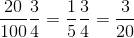
To solve this problem, consider writing the quantities in terms of only fractions:
Quantity A: 20% of 
Quantity B: 30% of 
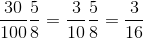
Quantity B has the smaller denominator for an equal numerator. There is no need for calculation beyond this, and time on the GRE would be best spent elsewhere.
Quantity B is greater.
To solve this problem, consider writing the quantities in terms of only fractions:
Quantity A: 20% of
Quantity B: 30% of
Quantity B has the smaller denominator for an equal numerator. There is no need for calculation beyond this, and time on the GRE would be best spent elsewhere.
Quantity B is greater.
← Didn't Know|Knew It →
Billy scored a  on his last math exam. If there were one hundred questions on the test, what is the ratio of his correct answers to total questions? Express the answer as a fraction, and simplify.
Billy scored a
Tap to reveal answer
This problem is fairly simple. If we know he scored a  , then we know that he got
  correct answers.
Both the numerator and denominator of the expression are divisible by two, so your final, simplified answer should be:
 .
.
This problem is fairly simple. If we know he scored a
Both the numerator and denominator of the expression are divisible by two, so your final, simplified answer should be:
← Didn't Know|Knew It →
Choose the answer which best converts the following percentage into a fraction (the answer should be simplified):

Choose the answer which best converts the following percentage into a fraction (the answer should be simplified):
Tap to reveal answer
To solve this problem, first convert the percentage into a decimal by dividing the percentage by 100:

Then, you can convert the decimal into a fraction:

Both the numerator and the denomenator are divisible by  , so now you may simplify:

To solve this problem, first convert the percentage into a decimal by dividing the percentage by 100:
Then, you can convert the decimal into a fraction:
Both the numerator and the denomenator are divisible by
← Didn't Know|Knew It →
Choose the answer below which best expresses the following percentage as a fraction (the answer should be simplified as much as possible):
 %
%
Choose the answer below which best expresses the following percentage as a fraction (the answer should be simplified as much as possible):
Tap to reveal answer
To find your answer, first convert the percentage into a decimal:

Then, you can place the digits of the decimal over one, followed by a number of zeroes equal to the number of digits (in this case, 1,000):

Both the numerator and denomenator are divisible by  , so you can simplify to:

To find your answer, first convert the percentage into a decimal:
Then, you can place the digits of the decimal over one, followed by a number of zeroes equal to the number of digits (in this case, 1,000):
Both the numerator and denomenator are divisible by
← Didn't Know|Knew It →
Choose the answer which best expresses the following percentage as a fraction, ensure that the answer is simplified:
 %
%
Choose the answer which best expresses the following percentage as a fraction, ensure that the answer is simplified:
Tap to reveal answer
To convert, simply first convert the percentage into a decimal:

Then, you can convert the decimal into a fraction, by putting the digits over one, followed by a number of zeroes equal to the number of digits:

Both are divisible by five, so you can simplify:

To convert, simply first convert the percentage into a decimal:
Then, you can convert the decimal into a fraction, by putting the digits over one, followed by a number of zeroes equal to the number of digits:
Both are divisible by five, so you can simplify:
← Didn't Know|Knew It →
Choose the answer which best converts the following percentage into a fraction:
 %
%
Choose the answer which best converts the following percentage into a fraction:
Tap to reveal answer
To convert, first express the percentage as a decimal:

Then, you can place the digits of the decimal over one followed by a number of zeroes equal to the number of digits:

Both of these numbers are divisible by  , so you can simplify:

To convert, first express the percentage as a decimal:
Then, you can place the digits of the decimal over one followed by a number of zeroes equal to the number of digits:
Both of these numbers are divisible by
← Didn't Know|Knew It →
Column A:
Column B:
Column A:
Column B:
Tap to reveal answer
2/5% = 0.40% = 0.004. Therefore, Column B is greater.
2/5% = 0.40% = 0.004. Therefore, Column B is greater.
← Didn't Know|Knew It →
is percent of
is percent of
Quantity A:
Quantity B:
Quantity A:
Quantity B:
Tap to reveal answer
To do this problem, translate each expression into mathematical terms:
is percent of :
is percent of :
Quantity B is greater.
To do this problem, translate each expression into mathematical terms:
Quantity B is greater.
← Didn't Know|Knew It →
Quantity A: 20% of
Quantity B: 30% of
Quantity A: 20% of
Quantity B: 30% of
Tap to reveal answer
To solve this problem, consider writing the quantities in terms of only fractions:
Quantity A: 20% of
Quantity B: 30% of
Quantity B has the smaller denominator for an equal numerator. There is no need for calculation beyond this, and time on the GRE would be best spent elsewhere.
Quantity B is greater.
To solve this problem, consider writing the quantities in terms of only fractions:
Quantity A: 20% of
Quantity B: 30% of
Quantity B has the smaller denominator for an equal numerator. There is no need for calculation beyond this, and time on the GRE would be best spent elsewhere.
Quantity B is greater.
← Didn't Know|Knew It →
Billy scored a on his last math exam. If there were one hundred questions on the test, what is the ratio of his correct answers to total questions? Express the answer as a fraction, and simplify.
Billy scored a
Tap to reveal answer
This problem is fairly simple. If we know he scored a , then we know that he got correct answers.
Both the numerator and denominator of the expression are divisible by two, so your final, simplified answer should be:
.
This problem is fairly simple. If we know he scored a
Both the numerator and denominator of the expression are divisible by two, so your final, simplified answer should be:
← Didn't Know|Knew It →
Choose the answer which best converts the following percentage into a fraction (the answer should be simplified):
Choose the answer which best converts the following percentage into a fraction (the answer should be simplified):
Tap to reveal answer
To solve this problem, first convert the percentage into a decimal by dividing the percentage by 100:
Then, you can convert the decimal into a fraction:
Both the numerator and the denomenator are divisible by , so now you may simplify:
To solve this problem, first convert the percentage into a decimal by dividing the percentage by 100:
Then, you can convert the decimal into a fraction:
Both the numerator and the denomenator are divisible by
← Didn't Know|Knew It →
Choose the answer below which best expresses the following percentage as a fraction (the answer should be simplified as much as possible):
%
Choose the answer below which best expresses the following percentage as a fraction (the answer should be simplified as much as possible):
Tap to reveal answer
To find your answer, first convert the percentage into a decimal:
Then, you can place the digits of the decimal over one, followed by a number of zeroes equal to the number of digits (in this case, 1,000):
Both the numerator and denomenator are divisible by , so you can simplify to:
To find your answer, first convert the percentage into a decimal:
Then, you can place the digits of the decimal over one, followed by a number of zeroes equal to the number of digits (in this case, 1,000):
Both the numerator and denomenator are divisible by
← Didn't Know|Knew It →
Choose the answer which best expresses the following percentage as a fraction, ensure that the answer is simplified:
%
Choose the answer which best expresses the following percentage as a fraction, ensure that the answer is simplified:
Tap to reveal answer
To convert, simply first convert the percentage into a decimal:
Then, you can convert the decimal into a fraction, by putting the digits over one, followed by a number of zeroes equal to the number of digits:
Both are divisible by five, so you can simplify:
To convert, simply first convert the percentage into a decimal:
Then, you can convert the decimal into a fraction, by putting the digits over one, followed by a number of zeroes equal to the number of digits:
Both are divisible by five, so you can simplify:
← Didn't Know|Knew It →
Choose the answer which best converts the following percentage into a fraction:
%
Choose the answer which best converts the following percentage into a fraction:
Tap to reveal answer
To convert, first express the percentage as a decimal:
Then, you can place the digits of the decimal over one followed by a number of zeroes equal to the number of digits:
Both of these numbers are divisible by , so you can simplify:
To convert, first express the percentage as a decimal:
Then, you can place the digits of the decimal over one followed by a number of zeroes equal to the number of digits:
Both of these numbers are divisible by
← Didn't Know|Knew It →