
Fractions - GRE Quantitative Reasoning
Card 1 of 1968
You have a rope of some length, but 2/3rds of it is cut off and thrown away. 1/4th of the remaining rope is cut off and thrown away. What proportion of the original rope remains?
You have a rope of some length, but 2/3rds of it is cut off and thrown away. 1/4th of the remaining rope is cut off and thrown away. What proportion of the original rope remains?
Tap to reveal answer
If 2/3 is cut off and thrown away, that means 1/3 of the original length remains. Of this, 1/4 gets cut off and thrown away, meaning 3/4 of 1/3 still remains. Multiplying 3/4 * 1/3, we get 1/4.
If 2/3 is cut off and thrown away, that means 1/3 of the original length remains. Of this, 1/4 gets cut off and thrown away, meaning 3/4 of 1/3 still remains. Multiplying 3/4 * 1/3, we get 1/4.
← Didn't Know|Knew It →
If the sum of a, b and c is 400, and a is 1/3 b and b is 1/4 c, what is the value of a?
If the sum of a, b and c is 400, and a is 1/3 b and b is 1/4 c, what is the value of a?
Tap to reveal answer
Answer: 25
Explanation: For this type of problem, build an equation that represents the relationships between the quantities and solve for the quantitiy you need. The problem states that b=1/4c and a = 1/3b. Thus, a = 1/3(1/4)c, or 1/12 of c. Now put everything in terms of c, thus 1/12c + 1/4c +c = 400. Now comes the tricky step--combine like terms and create the improper fraction (1/12c + 3/12c + 12/12c = 16/12c). Reduce the fraction to 4/3. So 400 is 4/3 of c. Thus c is 3/4 of 400, or 300. a is 1/12 of 300, or 25.
Answer: 25
Explanation: For this type of problem, build an equation that represents the relationships between the quantities and solve for the quantitiy you need. The problem states that b=1/4c and a = 1/3b. Thus, a = 1/3(1/4)c, or 1/12 of c. Now put everything in terms of c, thus 1/12c + 1/4c +c = 400. Now comes the tricky step--combine like terms and create the improper fraction (1/12c + 3/12c + 12/12c = 16/12c). Reduce the fraction to 4/3. So 400 is 4/3 of c. Thus c is 3/4 of 400, or 300. a is 1/12 of 300, or 25.
← Didn't Know|Knew It →
Erin went to the movies with her friends. She spent 1/4 of her allowance on movie tickets and 3/5 of the remaining money on popcorn. If her allowance is $10, how much money remains?
Erin went to the movies with her friends. She spent 1/4 of her allowance on movie tickets and 3/5 of the remaining money on popcorn. If her allowance is $10, how much money remains?
Tap to reveal answer
Since she spent 1/4 on the ticket, 3/5 of the remaining 3/4 of the money was spent on popcorn: 3/5 x 3/4 = 9/20. This means 9/20 of the money was spent on popcorn so in total: 1/4 + 9/20 = 14/20 = 7/10 of her money was spent. This leaves 3/10 of her money behind: 3/10x 10 = 3.00.
Since she spent 1/4 on the ticket, 3/5 of the remaining 3/4 of the money was spent on popcorn: 3/5 x 3/4 = 9/20. This means 9/20 of the money was spent on popcorn so in total: 1/4 + 9/20 = 14/20 = 7/10 of her money was spent. This leaves 3/10 of her money behind: 3/10x 10 = 3.00.
← Didn't Know|Knew It →
Fudge sells at $18.50 for 5 pounds. What is the cost for 2 pounds?
Fudge sells at $18.50 for 5 pounds. What is the cost for 2 pounds?
Tap to reveal answer
Set up a proportion: 18.50/5 = x/2. Cross multiply and solve for x: 37 = 5x.... x = 7.40.
Set up a proportion: 18.50/5 = x/2. Cross multiply and solve for x: 37 = 5x.... x = 7.40.
← Didn't Know|Knew It →
3 men can paint 3 rooms in 3 hours. How long would it take 1 man to paint 1 room?
3 men can paint 3 rooms in 3 hours. How long would it take 1 man to paint 1 room?
Tap to reveal answer
It's tempting to pick 1 hour, but that is a trick answer! Picture 3 men each painting 1 room. All 3 of the rooms are done after 3 hours, so each man actually spends 3 hours painting his room, not 1 hour.
It's tempting to pick 1 hour, but that is a trick answer! Picture 3 men each painting 1 room. All 3 of the rooms are done after 3 hours, so each man actually spends 3 hours painting his room, not 1 hour.
← Didn't Know|Knew It →
Bob can paint a house in 3 hours. If Bob and his friend Ron work together to paint the house, it takes 2 hours. How long would it take Ron to paint the house if he worked alone?
Bob can paint a house in 3 hours. If Bob and his friend Ron work together to paint the house, it takes 2 hours. How long would it take Ron to paint the house if he worked alone?
Tap to reveal answer
The easiest way to solve this is with a rate formula: 1 / combined time = 1 / Bob's time + 1 / Ron's time. We know the combined time and Bob's time, so we can solve for Ron's time:
1/2 = 1/3 + 1/Ron's time
1/Ron's time = 1/2 – 1/3 = 1/6
Ron's time = 6 hours
The easiest way to solve this is with a rate formula: 1 / combined time = 1 / Bob's time + 1 / Ron's time. We know the combined time and Bob's time, so we can solve for Ron's time:
1/2 = 1/3 + 1/Ron's time
1/Ron's time = 1/2 – 1/3 = 1/6
Ron's time = 6 hours
← Didn't Know|Knew It →
Convert  to a mixed number fraction. Then simplify your answer.
Convert
Tap to reveal answer
Both decimals and fractions represent part of a whole. To convert this decimal number to a mixed number fraction, use the following steps:

(because the decimal number has a  in the ones place value and an
  in the hundredths place value).
Then simplify  .
.

Thus, the correct answer is 
Both decimals and fractions represent part of a whole. To convert this decimal number to a mixed number fraction, use the following steps:
(because the decimal number has a
Then simplify
Thus, the correct answer is
← Didn't Know|Knew It →
Convert  to a fraction. Then simplify.
Convert
Tap to reveal answer
Both decimals and fractions represent part of a whole. Since this decimal number has a value of  in the tenths place and a value of
  in the hundredths place, it can be re-written as:
 .
.
Then, simplify the fraction by dividing both the numerator and denominator by a divisor of 
Thus, the solution is:

Both decimals and fractions represent part of a whole. Since this decimal number has a value of
Then, simplify the fraction by dividing both the numerator and denominator by a divisor of
Thus, the solution is:
← Didn't Know|Knew It →
Find the fractional equivalent to  .
.
Find the fractional equivalent to
Tap to reveal answer
This problem requires several conversions. First, convert  into a mixed number fraction. This means, the new fraction will have a whole number of
  and a fraction that represents
  thousandths. Then, convert the mixed number to an improper fraction by multiplying the denominator by the whole number, and then add that product to the numerator.
Thus, the solution is:

This problem requires several conversions. First, convert
Thus, the solution is:
← Didn't Know|Knew It →
Convert  to an improper fraction.
Convert
Tap to reveal answer
This problem requires two conversions. First convert  to a mixed number fraction. This must equal a whole number of
  and a fraction that represents a value of
  tenths. Then, convert the mixed number to an improper fraction by multiplying the denominator by the whole number, and then add that product to the numerator.
Thus, the solution is:

This problem requires two conversions. First convert
Thus, the solution is:
← Didn't Know|Knew It →
Find the fractional equivalent to  . Then reduce the fraction if possible.
Find the fractional equivalent to
Tap to reveal answer
To solve this problem, make a mixed number fraction with a whole number of  and a fraction that represents
  hundredths. Then simplify the fraction portion of the mixed number by dividing the numerator and denominator by their largest common divisor.

To solve this problem, make a mixed number fraction with a whole number of
← Didn't Know|Knew It →
Convert  to an equivalent decimal number.
Convert
Tap to reveal answer
To convert this fraction to a decimal number, divide the numerator by the denominator. Since this fraction has a larger numerator than denominator, the fraction is classified as an improper fraction. This means that the fraction represents a value greater than one whole. Thus, the solution must be greater than one.

Note that  fits into
  evenly
  times, and has a remainder for of
To convert this fraction to a decimal number, divide the numerator by the denominator. Since this fraction has a larger numerator than denominator, the fraction is classified as an improper fraction. This means that the fraction represents a value greater than one whole. Thus, the solution must be greater than one.
Note that
← Didn't Know|Knew It →
Find the fractional equivalent to  . Then simplify.
Find the fractional equivalent to
Tap to reveal answer
This problem requires you to first convert the decimal number to a mixed number fraction that has a whole number of  and a fraction that represents
  thousandths. Then reduce the numerator and denominator by common divisors until you can no longer simplify the fraction.

This problem requires you to first convert the decimal number to a mixed number fraction that has a whole number of
← Didn't Know|Knew It →
Convert  to a fraction. Then simplify.
Convert
Tap to reveal answer
Both fractions and decimals represent part of a whole. The value of this decimal number reaches the ten-thousandths place value. Thus, the fraction must represent  ten-thousandths. Then reduce the numerator and denominator by the common divisor of
  .
.

Both fractions and decimals represent part of a whole. The value of this decimal number reaches the ten-thousandths place value. Thus, the fraction must represent
← Didn't Know|Knew It →
Find the decimal equivalent of  .
.
Find the decimal equivalent of
Tap to reveal answer
Fractions and decimals both represent part of a whole. To solve this problem you may divide  by
by  , or you can reduce the fraction by dividing the numerator and denominator by the common factor of
  This will equal a fraction of
  hundredths, which can be written as the decimal number "zero and
  hundredths."

Note: both  and
and  equal
equal 
Fractions and decimals both represent part of a whole. To solve this problem you may divide
Note: both
← Didn't Know|Knew It →
Convert  to an improper fraction.
Convert
Tap to reveal answer
First convert this decimal number to a mixed number fraction, then covert the mixed number to an improper fraction. The mixed number fraction must have a whole number of  and a fraction that represents
  tenths. Then, convert the mixed number to an improper fraction by multiplying the denominator by the whole number, and then add that product to the numerator.

First convert this decimal number to a mixed number fraction, then covert the mixed number to an improper fraction. The mixed number fraction must have a whole number of
← Didn't Know|Knew It →
Find the fractional equivalent for  .
.
Find the fractional equivalent for
Tap to reveal answer
Decimal numbers and fractions both represent part of a whole. This decimal number has a value of  in the tenths and thousandths place values. Since the decimal number reaches the thousandths place, the correct answer is
  over
over  --which represents
  thousandths.

Decimal numbers and fractions both represent part of a whole. This decimal number has a value of
← Didn't Know|Knew It →
Convert the mixed fraction  to a decimal number.
Convert the mixed fraction
Tap to reveal answer
Since the starting number is a mixed number fraction, the decimal number must also have a value in the ones place. Since the denominator in the fraction has a value that is a factor of  , both the numerator and denominator can be multiplied by a factor of
  to form
  tenths. (Note, the first decimal place value is the tenths place).

Since the starting number is a mixed number fraction, the decimal number must also have a value in the ones place. Since the denominator in the fraction has a value that is a factor of
← Didn't Know|Knew It →
A retailer can only order wristbands in bulk cases. Each case has 300 wristbands and costs $1172.
Quantity A: The number of wristbands that can be bought for $10547.
Quantity B: The number of wristbands that can be bought for $10560.
A retailer can only order wristbands in bulk cases. Each case has 300 wristbands and costs $1172.
Quantity A: The number of wristbands that can be bought for $10547.
Quantity B: The number of wristbands that can be bought for $10560.
Tap to reveal answer
The key to this problem is to realize that the store cannot buy partial crates of wristbands--it's all or nothing. Calculate how many crates can be bought with each sum of money by dividing the sum by the price of a crate.
Quantity A:
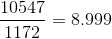
Although oh so close, only eight crates can be bought with this sum of money. Don't round up!
Quantity B:
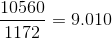
There's just enough to buy nine crates.
Quantity B is greater.
The key to this problem is to realize that the store cannot buy partial crates of wristbands--it's all or nothing. Calculate how many crates can be bought with each sum of money by dividing the sum by the price of a crate.
Quantity A:
Although oh so close, only eight crates can be bought with this sum of money. Don't round up!
Quantity B:
There's just enough to buy nine crates.
Quantity B is greater.
← Didn't Know|Knew It →
If 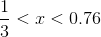 ,
,  can equal which of the following?
If
Tap to reveal answer
Convert all of the fractions to decimals. Thus, x is contained within the range of 0.33 < x < 0.76. The answers choices become 1/4 = 0.25, 4/12 = 0.33, 2/5 = 0.4, and 5/16 = 0.3125, respectively. Therefore, the only answer which is within the desired range is 2/5.
Convert all of the fractions to decimals. Thus, x is contained within the range of 0.33 < x < 0.76. The answers choices become 1/4 = 0.25, 4/12 = 0.33, 2/5 = 0.4, and 5/16 = 0.3125, respectively. Therefore, the only answer which is within the desired range is 2/5.
← Didn't Know|Knew It →