
Basic Squaring / Square Roots - GRE Quantitative Reasoning
Card 1 of 528
Simplify: 
Simplify:
Tap to reveal answer
Take each fraction separately first:
(2√3)/(√2) = \[(2√3)/(√2)\] * \[(√2)/(√2)\] = (2 * √3 * √2)/(√2 * √2) = (2 * √6)/2 = √6
Similarly:
(4√2)/(√3) = \[(4√2)/(√3)\] * \[(√3)/(√3)\] = (4√6)/3 = (4/3)√6
Now, add them together:
√6 + (4/3)√6 = (3/3)√6 + (4/3)√6 = (7/3)√6
Take each fraction separately first:
(2√3)/(√2) = \[(2√3)/(√2)\] * \[(√2)/(√2)\] = (2 * √3 * √2)/(√2 * √2) = (2 * √6)/2 = √6
Similarly:
(4√2)/(√3) = \[(4√2)/(√3)\] * \[(√3)/(√3)\] = (4√6)/3 = (4/3)√6
Now, add them together:
√6 + (4/3)√6 = (3/3)√6 + (4/3)√6 = (7/3)√6
← Didn't Know|Knew It →
Compare the quantities.
Quantity A: 
Quantity B: 
Compare the quantities.
Quantity A:
Quantity B:
Tap to reveal answer
Begin by breaking down each of the roots in question. Often, for the GRE, your answer arises out of doing such basic "simplification moves".
Quantity A

This is the same as:
 , which can be reduced to:

Quantity B

This is the same as:
 , which can be reduced to:

Thus, at the end of working through the proper math, you realize that the two values are equal!
Begin by breaking down each of the roots in question. Often, for the GRE, your answer arises out of doing such basic "simplification moves".
Quantity A
This is the same as:
Quantity B
This is the same as:
Thus, at the end of working through the proper math, you realize that the two values are equal!
← Didn't Know|Knew It →
Simplify the following expression: 
Simplify the following expression:
Tap to reveal answer
Begin by factoring out each of the radicals:

For the first two radicals, you can factor out a  or
or  :
:

The other root values cannot be simply broken down. Now, combine the factors with  :
:

This is your simplest form.
Begin by factoring out each of the radicals:
For the first two radicals, you can factor out a
The other root values cannot be simply broken down. Now, combine the factors with
This is your simplest form.
← Didn't Know|Knew It →
Solve for  .
.
Note,  :
:

Solve for
Note,
Tap to reveal answer
Begin by getting your  terms onto the left side of the equation and your numeric values onto the right side of the equation:

Next, you can combine your radicals. You do this merely by subtracting their respective coefficients:

Now, square both sides:



Solve by dividing both sides by  :
:

Begin by getting your
Next, you can combine your radicals. You do this merely by subtracting their respective coefficients:
Now, square both sides:
Solve by dividing both sides by
← Didn't Know|Knew It →
Simplify the following expression: 
Simplify the following expression:
Tap to reveal answer
To solve this problem, we must realize that the only way to add or subtract square roots is if the number under to square root is equivalent to each other. Therefore we must find a way to simplify each square root.
First we attempt to simplify the first term,

We break apart the number under the square root and find

Simplifying

Therefore we know that in order to try and simplify the other terms, the number under the square root has to be 3. By removing  from the other terms in the equation, we will attempt to see if they can be simplified as well.
For the second term,

Finally for the last term,

Our new equation becomes 
Once all number under the square roots become the same, we can treat it as simple addition/subtraction and solve.
To solve this problem, we must realize that the only way to add or subtract square roots is if the number under to square root is equivalent to each other. Therefore we must find a way to simplify each square root.
First we attempt to simplify the first term,
We break apart the number under the square root and find
Simplifying
Therefore we know that in order to try and simplify the other terms, the number under the square root has to be 3. By removing
For the second term,
Finally for the last term,
Our new equation becomes
Once all number under the square roots become the same, we can treat it as simple addition/subtraction and solve.
← Didn't Know|Knew It →
Simplify:
Simplify:
Tap to reveal answer
Take each fraction separately first:
(2√3)/(√2) = \[(2√3)/(√2)\] * \[(√2)/(√2)\] = (2 * √3 * √2)/(√2 * √2) = (2 * √6)/2 = √6
Similarly:
(4√2)/(√3) = \[(4√2)/(√3)\] * \[(√3)/(√3)\] = (4√6)/3 = (4/3)√6
Now, add them together:
√6 + (4/3)√6 = (3/3)√6 + (4/3)√6 = (7/3)√6
Take each fraction separately first:
(2√3)/(√2) = \[(2√3)/(√2)\] * \[(√2)/(√2)\] = (2 * √3 * √2)/(√2 * √2) = (2 * √6)/2 = √6
Similarly:
(4√2)/(√3) = \[(4√2)/(√3)\] * \[(√3)/(√3)\] = (4√6)/3 = (4/3)√6
Now, add them together:
√6 + (4/3)√6 = (3/3)√6 + (4/3)√6 = (7/3)√6
← Didn't Know|Knew It →
Compare the quantities.
Quantity A:
Quantity B:
Compare the quantities.
Quantity A:
Quantity B:
Tap to reveal answer
Begin by breaking down each of the roots in question. Often, for the GRE, your answer arises out of doing such basic "simplification moves".
Quantity A
This is the same as:
, which can be reduced to:
Quantity B
This is the same as:
, which can be reduced to:
Thus, at the end of working through the proper math, you realize that the two values are equal!
Begin by breaking down each of the roots in question. Often, for the GRE, your answer arises out of doing such basic "simplification moves".
Quantity A
This is the same as:
Quantity B
This is the same as:
Thus, at the end of working through the proper math, you realize that the two values are equal!
← Didn't Know|Knew It →
Simplify the following expression:
Simplify the following expression:
Tap to reveal answer
Begin by factoring out each of the radicals:
For the first two radicals, you can factor out a or :
The other root values cannot be simply broken down. Now, combine the factors with :
This is your simplest form.
Begin by factoring out each of the radicals:
For the first two radicals, you can factor out a
The other root values cannot be simply broken down. Now, combine the factors with
This is your simplest form.
← Didn't Know|Knew It →
Solve for .
Note, :
Solve for
Note,
Tap to reveal answer
Begin by getting your terms onto the left side of the equation and your numeric values onto the right side of the equation:
Next, you can combine your radicals. You do this merely by subtracting their respective coefficients:
Now, square both sides:
Solve by dividing both sides by :
Begin by getting your
Next, you can combine your radicals. You do this merely by subtracting their respective coefficients:
Now, square both sides:
Solve by dividing both sides by
← Didn't Know|Knew It →
Simplify the following expression:
Simplify the following expression:
Tap to reveal answer
To solve this problem, we must realize that the only way to add or subtract square roots is if the number under to square root is equivalent to each other. Therefore we must find a way to simplify each square root.
First we attempt to simplify the first term,
We break apart the number under the square root and find
Simplifying
Therefore we know that in order to try and simplify the other terms, the number under the square root has to be 3. By removing from the other terms in the equation, we will attempt to see if they can be simplified as well.
For the second term,
Finally for the last term,
Our new equation becomes
Once all number under the square roots become the same, we can treat it as simple addition/subtraction and solve.
To solve this problem, we must realize that the only way to add or subtract square roots is if the number under to square root is equivalent to each other. Therefore we must find a way to simplify each square root.
First we attempt to simplify the first term,
We break apart the number under the square root and find
Simplifying
Therefore we know that in order to try and simplify the other terms, the number under the square root has to be 3. By removing
For the second term,
Finally for the last term,
Our new equation becomes
Once all number under the square roots become the same, we can treat it as simple addition/subtraction and solve.
← Didn't Know|Knew It →
Simplify the following: (√(6) + √(3)) / √(3)
Simplify the following: (√(6) + √(3)) / √(3)
Tap to reveal answer
Begin by multiplying top and bottom by √(3):
(√(18) + √(9)) / 3
Note the following:
√(9) = 3
√(18) = √(9 * 2) = √(9) * √(2) = 3 * √(2)
Therefore, the numerator is: 3 * √(2) + 3. Factor out the common 3: 3 * (√(2) + 1)
Rewrite the whole fraction:
(3 * (√(2) + 1)) / 3
Simplfy by dividing cancelling the 3 common to numerator and denominator: √(2) + 1
Begin by multiplying top and bottom by √(3):
(√(18) + √(9)) / 3
Note the following:
√(9) = 3
√(18) = √(9 * 2) = √(9) * √(2) = 3 * √(2)
Therefore, the numerator is: 3 * √(2) + 3. Factor out the common 3: 3 * (√(2) + 1)
Rewrite the whole fraction:
(3 * (√(2) + 1)) / 3
Simplfy by dividing cancelling the 3 common to numerator and denominator: √(2) + 1
← Didn't Know|Knew It →
what is
√0.0000490
what is
√0.0000490
Tap to reveal answer
easiest way to simplify: turn into scientific notation
√0.0000490= √4.9 X 10⁻⁵
finding the square root of an even exponent is easy, and 49 is a perfect square, so we can write out an improper scientific notation:
√4.9 X 10-5 = √49 X 10-6
√49 = 7; √10-6 = 10-3 this is equivalent to raising 10-6 to the 1/2 power, in which case all that needs to be done is multiply the two exponents: 7 X 10-3= 0.007
easiest way to simplify: turn into scientific notation
√0.0000490= √4.9 X 10⁻⁵
finding the square root of an even exponent is easy, and 49 is a perfect square, so we can write out an improper scientific notation:
√4.9 X 10-5 = √49 X 10-6
√49 = 7; √10-6 = 10-3 this is equivalent to raising 10-6 to the 1/2 power, in which case all that needs to be done is multiply the two exponents: 7 X 10-3= 0.007
← Didn't Know|Knew It →
Which of the following is the most simplified form of:

Which of the following is the most simplified form of:
Tap to reveal answer
First find all of the prime factors of 

So 
First find all of the prime factors of
So
← Didn't Know|Knew It →
Which of the following is equal to  ?
?
Which of the following is equal to
Tap to reveal answer
√75 can be broken down to √25 * √3. Which simplifies to 5√3.
√75 can be broken down to √25 * √3. Which simplifies to 5√3.
← Didn't Know|Knew It →
Simplify: 
Simplify:
Tap to reveal answer
In order to take the square root, divide 576 by 2.

In order to take the square root, divide 576 by 2.
← Didn't Know|Knew It →
Simplify  .
.
Simplify
Tap to reveal answer


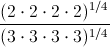


← Didn't Know|Knew It →
Simplify  .
.
Simplify
Tap to reveal answer
Rewrite what is under the radical in terms of perfect squares:


Therefore,  .
.
Rewrite what is under the radical in terms of perfect squares:
Therefore,
← Didn't Know|Knew It →
Which of the following is equivalent to  ?
?
Which of the following is equivalent to
Tap to reveal answer
Multiply by the conjugate and the use the formula for the difference of two squares:

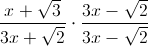

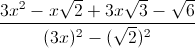

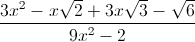
Multiply by the conjugate and the use the formula for the difference of two squares:
← Didn't Know|Knew It →
What is  ?
?
What is
Tap to reveal answer
We know that 25 is a factor of 50. The square root of 25 is 5. That leaves  which can not be simplified further.
We know that 25 is a factor of 50. The square root of 25 is 5. That leaves
← Didn't Know|Knew It →
What is  equal to?
What is
Tap to reveal answer

1. We know that  , which we can separate under the square root:

2. 144 can be taken out since it is a perfect square:  . This leaves us with:

This cannot be simplified any further.
1. We know that
2. 144 can be taken out since it is a perfect square:
This cannot be simplified any further.
← Didn't Know|Knew It →