
Arithmetic - GRE Quantitative Reasoning
Card 1 of 4976
If a is the greatest common divisor of 64 and 14 and b is the least common multiple of 16 and 52 then a + b = ?
If a is the greatest common divisor of 64 and 14 and b is the least common multiple of 16 and 52 then a + b = ?
Tap to reveal answer
The greatest common divisor of 64 and 14 is 2, as found by the prime factorization of 64 and 14. The least common multiple of 16 and 52 is 208, which can be found by looking at the decimal when 52 is divided by 16. The remainder is 0.25, or 1/4 so the fourth multiple of 52 is 208, which is also divisible by 16.
The greatest common divisor of 64 and 14 is 2, as found by the prime factorization of 64 and 14. The least common multiple of 16 and 52 is 208, which can be found by looking at the decimal when 52 is divided by 16. The remainder is 0.25, or 1/4 so the fourth multiple of 52 is 208, which is also divisible by 16.
← Didn't Know|Knew It →
Quantity A: 
Quantity B: 
Which of the following is true?
Quantity A:
Quantity B:
Which of the following is true?
Tap to reveal answer
Start by looking at Quantity A. The common denominator for this expression is  . To calculate this, you perform the following multiplications:
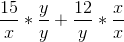
This is the same as:
 , or
, or 
This is the same as Quantity B. They are equal!
Start by looking at Quantity A. The common denominator for this expression is
This is the same as:
This is the same as Quantity B. They are equal!
← Didn't Know|Knew It →
Of a group of 335 graduating high school atheletes, 106 played basketball, 137 ran track and field, and 51 participated in swimming. What is the maximum number of students that did both track and field and swimming upon graduation?
Of a group of 335 graduating high school atheletes, 106 played basketball, 137 ran track and field, and 51 participated in swimming. What is the maximum number of students that did both track and field and swimming upon graduation?
Tap to reveal answer
Simply recognize that logically, the participation of either sport is non-exclusive, that is, just because people took track and field does not necessarily mean they did not take swimming as well. As such, those 51 who took swimming could have all potentially done track and field, which means all 51 students.
Simply recognize that logically, the participation of either sport is non-exclusive, that is, just because people took track and field does not necessarily mean they did not take swimming as well. As such, those 51 who took swimming could have all potentially done track and field, which means all 51 students.
← Didn't Know|Knew It →
Choose the answer below which best solves the following equation:

Choose the answer below which best solves the following equation:
Tap to reveal answer
The sum of any two negative numbers will be negative. Remember, also, that adding a negative number is like subtracting it. Therefore:

The sum of any two negative numbers will be negative. Remember, also, that adding a negative number is like subtracting it. Therefore:
← Didn't Know|Knew It →
Of 300 students, 120 are enrolled in math club, 150 are enrolled in chess club, and 100 are enrolled in both. How many students are not members of either club?
Of 300 students, 120 are enrolled in math club, 150 are enrolled in chess club, and 100 are enrolled in both. How many students are not members of either club?
Tap to reveal answer
There are 120 students in the math club and 150 students in the chess club, for a total membership of 270. However, 100 students are in both clubs, which means they are counted twice. You simply subtract 100 from 270, which will give you a total of 170 different students participating in both clubs. This means that the remaining 130 students do not participate in either club.
There are 120 students in the math club and 150 students in the chess club, for a total membership of 270. However, 100 students are in both clubs, which means they are counted twice. You simply subtract 100 from 270, which will give you a total of 170 different students participating in both clubs. This means that the remaining 130 students do not participate in either club.
← Didn't Know|Knew It →
Choose the answer which best solves the following equation:

Choose the answer which best solves the following equation:
Tap to reveal answer
When adding integers, one needs to pay close attention to the sign. When you add a negative integer, it's the same thing as subtracting that integer. Therefore:

When adding integers, one needs to pay close attention to the sign. When you add a negative integer, it's the same thing as subtracting that integer. Therefore:
← Didn't Know|Knew It →
Choose the answer below which best solves the following equation:
Choose the answer below which best solves the following equation:
Tap to reveal answer
The sum of any two negative numbers will be negative. Remember, also, that adding a negative number is like subtracting it. Therefore:
The sum of any two negative numbers will be negative. Remember, also, that adding a negative number is like subtracting it. Therefore:
← Didn't Know|Knew It →
Of a group of 335 graduating high school atheletes, 106 played basketball, 137 ran track and field, and 51 participated in swimming. What is the maximum number of students that did both track and field and swimming upon graduation?
Of a group of 335 graduating high school atheletes, 106 played basketball, 137 ran track and field, and 51 participated in swimming. What is the maximum number of students that did both track and field and swimming upon graduation?
Tap to reveal answer
Simply recognize that logically, the participation of either sport is non-exclusive, that is, just because people took track and field does not necessarily mean they did not take swimming as well. As such, those 51 who took swimming could have all potentially done track and field, which means all 51 students.
Simply recognize that logically, the participation of either sport is non-exclusive, that is, just because people took track and field does not necessarily mean they did not take swimming as well. As such, those 51 who took swimming could have all potentially done track and field, which means all 51 students.
← Didn't Know|Knew It →
Of 300 students, 120 are enrolled in math club, 150 are enrolled in chess club, and 100 are enrolled in both. How many students are not members of either club?
Of 300 students, 120 are enrolled in math club, 150 are enrolled in chess club, and 100 are enrolled in both. How many students are not members of either club?
Tap to reveal answer
There are 120 students in the math club and 150 students in the chess club, for a total membership of 270. However, 100 students are in both clubs, which means they are counted twice. You simply subtract 100 from 270, which will give you a total of 170 different students participating in both clubs. This means that the remaining 130 students do not participate in either club.
There are 120 students in the math club and 150 students in the chess club, for a total membership of 270. However, 100 students are in both clubs, which means they are counted twice. You simply subtract 100 from 270, which will give you a total of 170 different students participating in both clubs. This means that the remaining 130 students do not participate in either club.
← Didn't Know|Knew It →
Choose the answer which best solves the following equation:
Choose the answer which best solves the following equation:
Tap to reveal answer
When adding integers, one needs to pay close attention to the sign. When you add a negative integer, it's the same thing as subtracting that integer. Therefore:
When adding integers, one needs to pay close attention to the sign. When you add a negative integer, it's the same thing as subtracting that integer. Therefore:
← Didn't Know|Knew It →
Choose the answer below which best solves the following equation:
Choose the answer below which best solves the following equation:
Tap to reveal answer
The sum of any two negative numbers will be negative. Remember, also, that adding a negative number is like subtracting it. Therefore:
The sum of any two negative numbers will be negative. Remember, also, that adding a negative number is like subtracting it. Therefore:
← Didn't Know|Knew It →
Of a group of 335 graduating high school atheletes, 106 played basketball, 137 ran track and field, and 51 participated in swimming. What is the maximum number of students that did both track and field and swimming upon graduation?
Of a group of 335 graduating high school atheletes, 106 played basketball, 137 ran track and field, and 51 participated in swimming. What is the maximum number of students that did both track and field and swimming upon graduation?
Tap to reveal answer
Simply recognize that logically, the participation of either sport is non-exclusive, that is, just because people took track and field does not necessarily mean they did not take swimming as well. As such, those 51 who took swimming could have all potentially done track and field, which means all 51 students.
Simply recognize that logically, the participation of either sport is non-exclusive, that is, just because people took track and field does not necessarily mean they did not take swimming as well. As such, those 51 who took swimming could have all potentially done track and field, which means all 51 students.
← Didn't Know|Knew It →
Of 300 students, 120 are enrolled in math club, 150 are enrolled in chess club, and 100 are enrolled in both. How many students are not members of either club?
Of 300 students, 120 are enrolled in math club, 150 are enrolled in chess club, and 100 are enrolled in both. How many students are not members of either club?
Tap to reveal answer
There are 120 students in the math club and 150 students in the chess club, for a total membership of 270. However, 100 students are in both clubs, which means they are counted twice. You simply subtract 100 from 270, which will give you a total of 170 different students participating in both clubs. This means that the remaining 130 students do not participate in either club.
There are 120 students in the math club and 150 students in the chess club, for a total membership of 270. However, 100 students are in both clubs, which means they are counted twice. You simply subtract 100 from 270, which will give you a total of 170 different students participating in both clubs. This means that the remaining 130 students do not participate in either club.
← Didn't Know|Knew It →
Choose the answer which best solves the following equation:
Choose the answer which best solves the following equation:
Tap to reveal answer
When adding integers, one needs to pay close attention to the sign. When you add a negative integer, it's the same thing as subtracting that integer. Therefore:
When adding integers, one needs to pay close attention to the sign. When you add a negative integer, it's the same thing as subtracting that integer. Therefore:
← Didn't Know|Knew It →
Tap to reveal answer
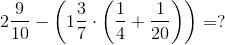
Begin by simplifying all terms inside the parentheses. Begin with the innermost set. Find a common denominator for the two terms. In this case, the common denominator will be twenty:
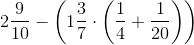
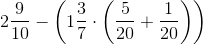
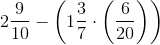
Simplify  to
to  and convert
  to not a mixed fraction:

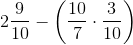
Multiply the two fractions in the parentheses by multiplying straight across (A quick shortcut would be to factor out the 10 on top and bottom).


Now convert  to a non-mixed fraction. It will become
  .
.

In order to subtract the two fractions, find a common denominator. In this case, it will be 70.

Now subtract, and find the answer!
 is the answer
Begin by simplifying all terms inside the parentheses. Begin with the innermost set. Find a common denominator for the two terms. In this case, the common denominator will be twenty:
Simplify
Multiply the two fractions in the parentheses by multiplying straight across (A quick shortcut would be to factor out the 10 on top and bottom).
Now convert
In order to subtract the two fractions, find a common denominator. In this case, it will be 70.
Now subtract, and find the answer!
← Didn't Know|Knew It →
Solve:

Solve:
Tap to reveal answer
To simplify a complex fraction, simply invert the denomenator and multiply by the numerator:

Multiplying the numerator by the reciprocal of the denominator for each term we get:
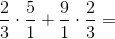

Since we have a common denominator we can now add these two terms.

To simplify a complex fraction, simply invert the denomenator and multiply by the numerator:
Multiplying the numerator by the reciprocal of the denominator for each term we get:
Since we have a common denominator we can now add these two terms.
← Didn't Know|Knew It →
Simplify:

Simplify:
Tap to reveal answer
Although you could look for the common denominator of the fraction as it has been written, it is probably easiest to rewrite the fraction in slightly simpler terms. Thus, recall that you can rewrite your fraction as:

Using the rule for dividing fractions, you can rewrite your expression as:

Then, you can multiply each set of fractions, getting:

This makes things very easy, for then your value is:

Although you could look for the common denominator of the fraction as it has been written, it is probably easiest to rewrite the fraction in slightly simpler terms. Thus, recall that you can rewrite your fraction as:
Using the rule for dividing fractions, you can rewrite your expression as:
Then, you can multiply each set of fractions, getting:
This makes things very easy, for then your value is:
← Didn't Know|Knew It →
Simplify:

Simplify:
Tap to reveal answer
For this problem, begin by rewriting the complex fraction, using the rule for dividing fractions:

This is much easier to work on. Cancel out the  s and the
  and the
  , this gives you:
 , which is merely
  . Thus, your problem is:

The common denominator is  , so you can rewrite this as:
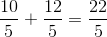
For this problem, begin by rewriting the complex fraction, using the rule for dividing fractions:
This is much easier to work on. Cancel out the
The common denominator is
← Didn't Know|Knew It →
Tap to reveal answer
Begin by simplifying all terms inside the parentheses. Begin with the innermost set. Find a common denominator for the two terms. In this case, the common denominator will be twenty:
Simplify to and convert to not a mixed fraction:
Multiply the two fractions in the parentheses by multiplying straight across (A quick shortcut would be to factor out the 10 on top and bottom).
Now convert to a non-mixed fraction. It will become .
In order to subtract the two fractions, find a common denominator. In this case, it will be 70.
Now subtract, and find the answer!
is the answer
Begin by simplifying all terms inside the parentheses. Begin with the innermost set. Find a common denominator for the two terms. In this case, the common denominator will be twenty:
Simplify
Multiply the two fractions in the parentheses by multiplying straight across (A quick shortcut would be to factor out the 10 on top and bottom).
Now convert
In order to subtract the two fractions, find a common denominator. In this case, it will be 70.
Now subtract, and find the answer!
← Didn't Know|Knew It →
Solve:
Solve:
Tap to reveal answer
To simplify a complex fraction, simply invert the denomenator and multiply by the numerator:
Multiplying the numerator by the reciprocal of the denominator for each term we get:
Since we have a common denominator we can now add these two terms.
To simplify a complex fraction, simply invert the denomenator and multiply by the numerator:
Multiplying the numerator by the reciprocal of the denominator for each term we get:
Since we have a common denominator we can now add these two terms.
← Didn't Know|Knew It →