
Algebra - GRE Quantitative Reasoning
Card 1 of 3896
What is the value of xy_2(xy – 3_xy) given that x = –3 and y = 7?
What is the value of xy_2(xy – 3_xy) given that x = –3 and y = 7?
Tap to reveal answer
Evaluating yields –6174.
–147(–21 + 63) =
–147 * 42 = –6174
Evaluating yields –6174.
–147(–21 + 63) =
–147 * 42 = –6174
← Didn't Know|Knew It →
Simplify:
(2_x_ + 4)/(x + 2)
Simplify:
(2_x_ + 4)/(x + 2)
Tap to reveal answer
(2_x_ + 4)/(x + 2)
To simplify you must first factor the top polynomial to 2(x + 2). You may then eliminate the identical (x + 2) from the top and bottom leaving 2.
(2_x_ + 4)/(x + 2)
To simplify you must first factor the top polynomial to 2(x + 2). You may then eliminate the identical (x + 2) from the top and bottom leaving 2.
← Didn't Know|Knew It →
A function f(x) = –1 for all values of x. Another function g(x) = 3_x_ for all values of x. What is g(f(x)) when x = 4?
A function f(x) = –1 for all values of x. Another function g(x) = 3_x_ for all values of x. What is g(f(x)) when x = 4?
Tap to reveal answer
We work from the inside out, so we start with the function f(x). f(4) = –1. Then we plug that value into g(x), so g(f(x)) = 3 * (–1) = –3.
We work from the inside out, so we start with the function f(x). f(4) = –1. Then we plug that value into g(x), so g(f(x)) = 3 * (–1) = –3.
← Didn't Know|Knew It →
What is f(–3) if f(x) = _x_2 + 5?
What is f(–3) if f(x) = _x_2 + 5?
Tap to reveal answer
f(–3) = (–3)2 + 5 = 9 + 5 = 14
f(–3) = (–3)2 + 5 = 9 + 5 = 14
← Didn't Know|Knew It →
A store sells potatoes for $0.24 and tomatoes for $0.76. Fred bought 12 individual vegetables. If he paid $6.52 total, how many potatoes did Fred buy?
A store sells potatoes for $0.24 and tomatoes for $0.76. Fred bought 12 individual vegetables. If he paid $6.52 total, how many potatoes did Fred buy?
Tap to reveal answer
Set up an equation to represent the total cost in cents: 24P + 76T = 652. In order to reduce the number of variables from 2 to 1, let the # tomatoes = 12 – # of potatoes. This makes the equation 24P + 76(12 – P) = 652.
Solving for P will give the answer.
Set up an equation to represent the total cost in cents: 24P + 76T = 652. In order to reduce the number of variables from 2 to 1, let the # tomatoes = 12 – # of potatoes. This makes the equation 24P + 76(12 – P) = 652.
Solving for P will give the answer.
← Didn't Know|Knew It →
Kim is twice as old as Claire. Nick is 3 years older than Claire. Kim is 6 years older than Emily. Their ages combined equal 81. How old is Nick?
Kim is twice as old as Claire. Nick is 3 years older than Claire. Kim is 6 years older than Emily. Their ages combined equal 81. How old is Nick?
Tap to reveal answer
The goal in this problem is to have only one variable. Variable “x” can designate Claire’s age.
Then Nick is x + 3, Kim is 2x, and Emily is 2x – 6; therefore x + x + 3 + 2x + 2x – 6 = 81
Solving for x gives Claire’s age, which can be used to find Nick’s age.
The goal in this problem is to have only one variable. Variable “x” can designate Claire’s age.
Then Nick is x + 3, Kim is 2x, and Emily is 2x – 6; therefore x + x + 3 + 2x + 2x – 6 = 81
Solving for x gives Claire’s age, which can be used to find Nick’s age.
← Didn't Know|Knew It →
If 6h – 2g = 4g + 3h
In terms of g, h = ?
If 6h – 2g = 4g + 3h
In terms of g, h = ?
Tap to reveal answer
If we solve the equation for b, we add 2g to, and subtract 3h from, both sides, leaving 3h = 6g. Solving for h we find that h = 2g.
If we solve the equation for b, we add 2g to, and subtract 3h from, both sides, leaving 3h = 6g. Solving for h we find that h = 2g.
← Didn't Know|Knew It →
If 2x + y = 9 and y – z = 4 then 2x + z = ?
If 2x + y = 9 and y – z = 4 then 2x + z = ?
Tap to reveal answer
If we solve the first equation for 2x we find that 2x = 9 – y. If we solve the second equation for z we find z = –4 + y. Adding these two manipulated equations together we see (2x) + (y) = (9 – y)+(–4 + y).
The y’s cancel leaving us with an answer of 5.
If we solve the first equation for 2x we find that 2x = 9 – y. If we solve the second equation for z we find z = –4 + y. Adding these two manipulated equations together we see (2x) + (y) = (9 – y)+(–4 + y).
The y’s cancel leaving us with an answer of 5.
← Didn't Know|Knew It →
11/(x – 7) + 4/(7 – x) = ?
11/(x – 7) + 4/(7 – x) = ?
Tap to reveal answer
We must find a common denominator and here they changed the first fraction by removing a negative from the numerator and denominator, leaving –11/(7 – x). We add the numerators and keep the same denominator to find the answer.
We must find a common denominator and here they changed the first fraction by removing a negative from the numerator and denominator, leaving –11/(7 – x). We add the numerators and keep the same denominator to find the answer.
← Didn't Know|Knew It →
25_x_2 – 36_y_2 can be factored into:
25_x_2 – 36_y_2 can be factored into:
Tap to reveal answer
This is the difference of squares. You must know this formula for the GRE!
_a_2 – _b_2 = (a – b)(a + b)
Here a = 5_x_ and b = 6_y_, so the difference of squares formula gives us (5_x_ – 6_y_)(5_x_ + 6_y_).
This is the difference of squares. You must know this formula for the GRE!
_a_2 – _b_2 = (a – b)(a + b)
Here a = 5_x_ and b = 6_y_, so the difference of squares formula gives us (5_x_ – 6_y_)(5_x_ + 6_y_).
← Didn't Know|Knew It →
For all values of x, f(x) = 7_x_2 – 3, and for all values of y, g(y) = 2_y_ + 9. What is g(f(x))?
For all values of x, f(x) = 7_x_2 – 3, and for all values of y, g(y) = 2_y_ + 9. What is g(f(x))?
Tap to reveal answer
The inner function f(x) is like our y-value that we plug into g(y).
g(f(x)) = 2(7_x_2 – 3) + 9 = 14_x_2 – 6 + 9 = 14_x_2 + 3.
The inner function f(x) is like our y-value that we plug into g(y).
g(f(x)) = 2(7_x_2 – 3) + 9 = 14_x_2 – 6 + 9 = 14_x_2 + 3.
← Didn't Know|Knew It →


Tap to reveal answer
A fraction is considered undefined when the denominator equals 0. Set the denominator equal to zero and solve for the variable.


A fraction is considered undefined when the denominator equals 0. Set the denominator equal to zero and solve for the variable.
← Didn't Know|Knew It →
If  and
and  , then
If
Tap to reveal answer
We have three variables and only two equations, so we will not be able to solve for each independent variable. We need to think of another solution.
Notice what happens if we line up the two equations and add them together.
(x + y) + (3_x –_ y + z) = 4x + z
and 5 + 3 = 8
Lets take this equation and multiply the whole thing by 3:
3(4_x_ + z = 8)
Thus, 12_x_ + 3_z_ = 24.
We have three variables and only two equations, so we will not be able to solve for each independent variable. We need to think of another solution.
Notice what happens if we line up the two equations and add them together.
(x + y) + (3_x –_ y + z) = 4x + z
and 5 + 3 = 8
Lets take this equation and multiply the whole thing by 3:
3(4_x_ + z = 8)
Thus, 12_x_ + 3_z_ = 24.
← Didn't Know|Knew It →
Simplify the result of the following steps, to be completed in order:
1. Add 7_x_ to 3_y_
2. Multiply the sum by 4
3. Add x to the product
4. Subtract x – y from the sum
Simplify the result of the following steps, to be completed in order:
1. Add 7_x_ to 3_y_
2. Multiply the sum by 4
3. Add x to the product
4. Subtract x – y from the sum
Tap to reveal answer
Step 1: 7_x_ + 3_y_
Step 2: 4 * (7_x_ + 3_y_) = 28_x_ + 12_y_
Step 3: 28_x_ + 12_y_ + x = 29_x_ + 12_y_
Step 4: 29_x_ + 12_y_ – (x – y) = 29_x_ + 12_y_ – x + y = 28_x_ + 13_y_
Step 1: 7_x_ + 3_y_
Step 2: 4 * (7_x_ + 3_y_) = 28_x_ + 12_y_
Step 3: 28_x_ + 12_y_ + x = 29_x_ + 12_y_
Step 4: 29_x_ + 12_y_ – (x – y) = 29_x_ + 12_y_ – x + y = 28_x_ + 13_y_
← Didn't Know|Knew It →
Quantitative Comparison
 is an integer.
Quantity A: 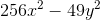
Quantity B: 
Quantitative Comparison
Quantity A:
Quantity B:
Tap to reveal answer
Plugging in numbers is not the best strategy here. Instead, let's see how we can equate the two expressions. Quantity A is actually a difference of squares. 256_x_2 = (16_x_)2 and 49_y_2 = (7_y_)2. These look like the expressions in Quantity B. The formula to remember here is the difference of squares formula, a very important one for this test! a_2 – b_2 = (a + b)(a – b). Thus, if a = 16_x and b = 7_y, 256_x_2 – 49_y_2 = (16_x_ – 7_y_)(16_x_ + 7_y_), and the quantities are equal.
Plugging in numbers is not the best strategy here. Instead, let's see how we can equate the two expressions. Quantity A is actually a difference of squares. 256_x_2 = (16_x_)2 and 49_y_2 = (7_y_)2. These look like the expressions in Quantity B. The formula to remember here is the difference of squares formula, a very important one for this test! a_2 – b_2 = (a + b)(a – b). Thus, if a = 16_x and b = 7_y, 256_x_2 – 49_y_2 = (16_x_ – 7_y_)(16_x_ + 7_y_), and the quantities are equal.
← Didn't Know|Knew It →
Quantitative Comparison
Quantity A: 
Quantity B: 
Quantitative Comparison
Quantity A:
Quantity B:
Tap to reveal answer
(x + y)2 = x_2 + 2_xy + _y_2
Now, since there are no specifications on what x and y can equal, one or both of them could be 0, making the two columns equal. Any value other than 0 will make the columns unequal because of the additional 2xy term, so the answer cannot be determined.
(x + y)2 = x_2 + 2_xy + _y_2
Now, since there are no specifications on what x and y can equal, one or both of them could be 0, making the two columns equal. Any value other than 0 will make the columns unequal because of the additional 2xy term, so the answer cannot be determined.
← Didn't Know|Knew It →
Quantitative Comparison
x and y are non-zero integers.
Quantity A: (x – y)2
Quantity B: (x + y)2
Quantitative Comparison
x and y are non-zero integers.
Quantity A: (x – y)2
Quantity B: (x + y)2
Tap to reveal answer
Quantity A: (x – y)2 = x_2 – 2_xy + _y_2
Quantity B: (x + y)2 = x_2 + 2_xy + _y_2
Both have x_2 + y_2 so cancel those from both columns and just compare –2_xy in Quantity A to 2_xy in Quantity B. If x = 1 and y = 1, –2_xy_ = –2 and 2_xy_ = 2, so Quantity B is greater. But if x = 1 and y = –1, –2_xy_ = 2 and 2_xy_ = –2, so Quantity A is greater. The contradiction means the answer cannot be determined.
Quantity A: (x – y)2 = x_2 – 2_xy + _y_2
Quantity B: (x + y)2 = x_2 + 2_xy + _y_2
Both have x_2 + y_2 so cancel those from both columns and just compare –2_xy in Quantity A to 2_xy in Quantity B. If x = 1 and y = 1, –2_xy_ = –2 and 2_xy_ = 2, so Quantity B is greater. But if x = 1 and y = –1, –2_xy_ = 2 and 2_xy_ = –2, so Quantity A is greater. The contradiction means the answer cannot be determined.
← Didn't Know|Knew It →
Which is the greater quantity: the median of 5 positive sequential integers or the mean of 5 positive sequential integers?
Which is the greater quantity: the median of 5 positive sequential integers or the mean of 5 positive sequential integers?
Tap to reveal answer
If the first integer is  , then
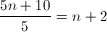
This is the same as the median.
If the first integer is
This is the same as the median.
← Didn't Know|Knew It →
Given the functions f(x) = 2_x_ + 4 and g(x) = 3_x_ – 6, what is f(g(x)) when x = 6?
Given the functions f(x) = 2_x_ + 4 and g(x) = 3_x_ – 6, what is f(g(x)) when x = 6?
Tap to reveal answer
We need to work from the inside to the outside, so g(6) = 3(6) – 6 = 12.
Then f(g(6)) = 2(12) + 4 = 28.
We need to work from the inside to the outside, so g(6) = 3(6) – 6 = 12.
Then f(g(6)) = 2(12) + 4 = 28.
← Didn't Know|Knew It →
Simplify (4x)/(x2 – 4) * (x + 2)/(x2 – 2x)
Simplify (4x)/(x2 – 4) * (x + 2)/(x2 – 2x)
Tap to reveal answer
Factor first. The numerators will not factor, but the first denominator factors to (x – 2)(x + 2) and the second denomintaor factors to x(x – 2). Multiplying fractions does not require common denominators, so now look for common factors to divide out. There is a factor of x and a factor of (x + 2) that both divide out, leaving 4 in the numerator and two factors of (x – 2) in the denominator.
Factor first. The numerators will not factor, but the first denominator factors to (x – 2)(x + 2) and the second denomintaor factors to x(x – 2). Multiplying fractions does not require common denominators, so now look for common factors to divide out. There is a factor of x and a factor of (x + 2) that both divide out, leaving 4 in the numerator and two factors of (x – 2) in the denominator.
← Didn't Know|Knew It →