
Calculating percents
GMAT Quantitative · Learn by Concept
Help Questions
GMAT Quantitative › Calculating percents


None of the other responses is correct.
Explanation
If 


Equivalently,


Gary weighs 20 percent more than Harry who's weight is 80 percent of James' weight. If James weighs 172 pounds, how much would Gary weigh if he lost 12 pounds? (Rounded to the nearest pound).


Explanation
If James weighs 172 pounds, and Harry weighs 80% of that, then


he is 120% Harry's weight 
he would weigh 153.12 or 153 pounds.
A number is multiplied by one-sixth; the product is divided by one-seventh; that quotient is multiplied by seven-tenths. What percent of the original number is the final result?


Explanation
The best way to do this is to start with 100 and to calculate the final result, which will be the correct answer.
The final result will be as follows:


The final number will be 
The price of an item is decreased by 10%, then by 20%, then by 30%. This is equivalent to doing what?
Decreasing the price by 49.6%
Decreasing the price by 50.4%
Decreasing the price by 60%.
Decreasing the price by 40%
Decreasing the price by 50%.
Explanation
Decreasing a price by 10%, then by 20%, then by 30% is equivalent to taking 90% of a price, then taking 80% of that, then taking 70% of that. That, in turn, is equivalent to multiplying the price by 0.90, then by 0.80, then by 0.70.
For simplicity's sake, assume the initial price was \$100. Then we can calculate the final price as follows:

The final price is \$50.40, so we essentially discounted the price by \$49.60, which is 49.6%.
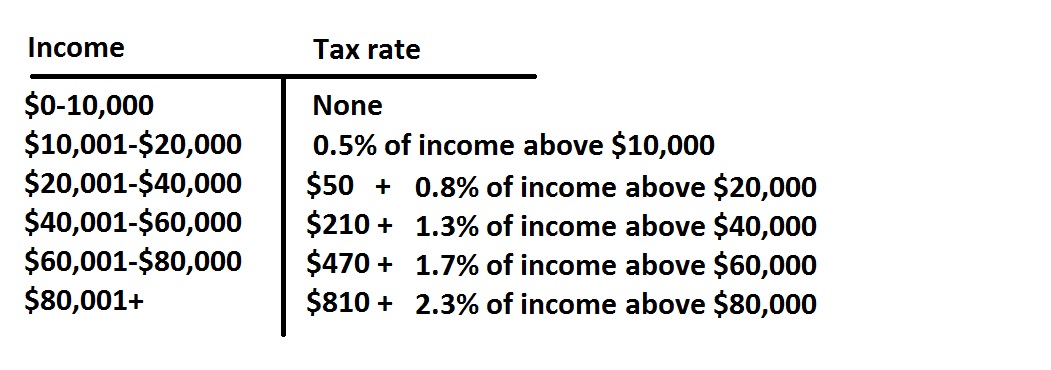
The above is an annual income tax table for single persons in a given state.
Between January 1 and July 1, Mr. Smith earned \$722 per month from a part time job. He earned a raise beginning on July 1, but he ended up not paying any income tax for the year. Assuming he had no other income, what percent was the highest possible raise in his salary? Choose the answer that is closest to the maximum possible raise.


Explanation
Since Mr. Smith did not pay any income tax, his income was at most \$10,000.
He earned \$722 per month over six months for a total of

The maximum he earned over the remaining six months is


This represents a

maximum raise.
The closest choice is 30%.
Given a number 
(a) 30% of 40% of 50% of

(b) 40% of 50% of 30% of

(c) 50% of 30% of 40% of

All three are equal to one another
30% of 40% of 50% of

40% of 50% of 30% of

50% of 30% of 40% of

It is impossible to tell without knowing the value of

Explanation
All three are equal.
30% of 40% of 50% of 


40% of 50% of 30% of 


50% of 30% of 40% of 


A number is divided by two; then its decimal point is moved to the left two spaces. This is the same as taking what percent of the number?


Explanation
Let's do these two things to 100. Dividing 100 by 2 yields 50; moving the decimal point two places left changes 50, or 50.0, to 0.50.
This means that the new number is 0.50% , or 
Total sales at XYZ Corporation increased by 


Explanation
The amount of sales for this year is 125% of last year's sales. Therefore, we can calculate in the following way:

Or:

Rob, Tim, and Peggy are the three managers at a local restaurant. Peggy's salary is 


Explanation
Let 
Then, since Tim's salary is 10% less than Rob's salary, we can write Tim's salary as 
Since Peggy's salary is 20% less than Tim's salary, we can write Peggy's salary as 
Peggy's salary is 72% of Rob's salary as we can write:
Peggy salary/ Rob salary =

Making the answer into a percent we get,

A randomly selected study sample includes 


Not enough information
Explanation
The percentage of women who have an income greater than 


The percentage of women who earn more than 

Or, we could assume there are 


The percentage of women who earn more than 

Let's verify this answer by taking another sample size, let's say there are 
The number of women who earn more than 

The percentage of women who earn more than 

We still get the same result because the number of people in the sample is not necessary to find that percentage since we are given the percentage of women in the sample and the percentage of these women in the sample who earn more than 