
Understanding measurement - GMAT Quantitative
Card 1 of 216
Fill in the blank:

Fill in the blank:
Tap to reveal answer
One yard is equal to 36 inches; one square yard is equal to  .
.
Multiply this conversion factor by 13:
 , the correct choice.
One yard is equal to 36 inches; one square yard is equal to
Multiply this conversion factor by 13:
← Didn't Know|Knew It →
Two jars each hold a quantity of water. The first jar is 20% full; the second jar, which has twice the capacity of the first, is 40% full. The total amount of water in the two jars is 600 milliliters.
How much more water will the first (smaller) jar hold before it is completely full?
Two jars each hold a quantity of water. The first jar is 20% full; the second jar, which has twice the capacity of the first, is 40% full. The total amount of water in the two jars is 600 milliliters.
How much more water will the first (smaller) jar hold before it is completely full?
Tap to reveal answer
Call the capacity of the first jar, in milliliters,  ; the capacity of the second jar is therefore twice this, or
  .
.
The first jar is 20% full, so the amount of water in this jar is currently  milliliters. The second jar is 40% full, so it contains
  milliliters of water. Therefore, since the total amount of water is 600 milliliters:


The first jar has a capacity of 600 milliliters. It is 20% full, so it has
 milliliters of water, and it can hold
 milliliters more. Divide by 1,000 milliliters per liter to convert to liters:; this is
 liters.
Call the capacity of the first jar, in milliliters,
The first jar is 20% full, so the amount of water in this jar is currently
The first jar has a capacity of 600 milliliters. It is 20% full, so it has
← Didn't Know|Knew It →
Two jars of identical size each hold a quantity of water; the first jar is  full, the second,
  full. The total amount of water in the two jars is
  .
.
How much more water can be poured into the first jar until it is full?
Two jars of identical size each hold a quantity of water; the first jar is
How much more water can be poured into the first jar until it is full?
Tap to reveal answer
Since the two jars have the same capacity, which we will call  milliliters, the amount of water in the first and second jars, respectively, are
  , and
, and  of
of  , or
, or  . The total amount of water is


The capacity of each jar is  . The first jar is
  full and therefore contains
  milliliters of water; it can hold
  milliliters more.
Divide by  to convert to liters:
 .
.
Since the two jars have the same capacity, which we will call
The capacity of each jar is
Divide by
← Didn't Know|Knew It →
A jar is 40% full of water. If 250 milliliters of water are added, the jar will be half full. What is the total capacity of the jar?
A jar is 40% full of water. If 250 milliliters of water are added, the jar will be half full. What is the total capacity of the jar?
Tap to reveal answer
Since the addition of 250 milliliters of water changes the status of the jar from 40% full to half, or 50%, full, then 250 milliliters is  of the capacity of the jar. Therefore, the jar holds
 milliliters of water total.
Divide by 1,000 milliliters per liter to convert to liters:
 liters.
Since the addition of 250 milliliters of water changes the status of the jar from 40% full to half, or 50%, full, then 250 milliliters is
Divide by 1,000 milliliters per liter to convert to liters:
← Didn't Know|Knew It →
Two jars each contain a quantity of water. The first jar is filled to capacity. The second jar has 40% greater capacity than the first jar, and contains 20% less water. If the second jar is  full, which of the following is equal to
  ?
?
Two jars each contain a quantity of water. The first jar is filled to capacity. The second jar has 40% greater capacity than the first jar, and contains 20% less water. If the second jar is
Tap to reveal answer
For the sake of simplicity, assume that the first jar holds 100 milliliters of water - this reasoning is independent of the actual capacity. The second jar holds 40% more water, which is
 milliliters capacity.
The first jar is filled to capacity, so it holds 100 milliliters of water. The second jar contains 20% less water, so it contains
 milliliters of water.
The jar is  full.
full.
For the sake of simplicity, assume that the first jar holds 100 milliliters of water - this reasoning is independent of the actual capacity. The second jar holds 40% more water, which is
The first jar is filled to capacity, so it holds 100 milliliters of water. The second jar contains 20% less water, so it contains
The jar is
← Didn't Know|Knew It →
An empty jar has capacity two liters. There are several other jars of equal capacity (to each other, but not necessarily to the first); each contains water to 25% capacity.
The contents of eight of the other jars are emptied into the two-liter jar when it is discovered that there is not enough space left in that jar to hold all of the contents of another of the other jars. What could the capacity of each of the other jars be?
An empty jar has capacity two liters. There are several other jars of equal capacity (to each other, but not necessarily to the first); each contains water to 25% capacity.
The contents of eight of the other jars are emptied into the two-liter jar when it is discovered that there is not enough space left in that jar to hold all of the contents of another of the other jars. What could the capacity of each of the other jars be?
Tap to reveal answer
Let  be the capacity, in liters, of each of the other jars. Since each jar is 25% full, the amount of water in each jar is 25% of
  , or
, or  . The contents of eight such jars will fit in the two-liter jar, so


This means each jar can be at most one liter in capacity.
The contents of nine such jars will not fit, however, so


This means that each jar must be at least about 0.88 liters in capacity.
The only choice that falls in this range is 0.9 liters, so this is the correct choice.
Let
This means each jar can be at most one liter in capacity.
The contents of nine such jars will not fit, however, so
This means that each jar must be at least about 0.88 liters in capacity.
The only choice that falls in this range is 0.9 liters, so this is the correct choice.
← Didn't Know|Knew It →
Two jars have identical capacity. The first jar contains 200 milliliters of water. The contents of the second jar, which is 10% full, are poured into the first, after which the first jar contains 250 milliliters.
Give the capacity of the first jar.
Two jars have identical capacity. The first jar contains 200 milliliters of water. The contents of the second jar, which is 10% full, are poured into the first, after which the first jar contains 250 milliliters.
Give the capacity of the first jar.
Tap to reveal answer
The second jar was 10% full and contained  milliliters of water. Therefore, the capacity of the second jar, which is also that of the first, is
 milliliters.
Divide this by the conversion factor of 1,000 to convert to liters:
 liters, the correct response.
The second jar was 10% full and contained
Divide this by the conversion factor of 1,000 to convert to liters:
← Didn't Know|Knew It →
A baseball travels at a rate of  . How long does it take to reach a fence that is
  away?
away?
A baseball travels at a rate of
Tap to reveal answer
The first step is to convert the distance into feet:
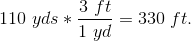
Then, divide the distance by the baseball's rate of travel:
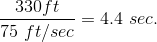
The first step is to convert the distance into feet:
Then, divide the distance by the baseball's rate of travel:
← Didn't Know|Knew It →
Big Bob the, 8-feet tall warehouse foreman is stacking uniformly sized boxes of goods in the warehouse. Big Bob notices that he is the exact same height as 3 boxes stacked on top of each other. If the warehouse ceiling is 55 feet high, what is the maximum number of boxes that he can stack on top of one another before he hits the ceiling?
Big Bob the, 8-feet tall warehouse foreman is stacking uniformly sized boxes of goods in the warehouse. Big Bob notices that he is the exact same height as 3 boxes stacked on top of each other. If the warehouse ceiling is 55 feet high, what is the maximum number of boxes that he can stack on top of one another before he hits the ceiling?
Tap to reveal answer
To find the height of each box set the 3 boxes equal to the height of Big Bob. So, let  be the height of each box. Then,
 or
or 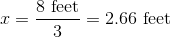
Therefore to find the maximum number of boxes that fit under the ceiling, we divide the ceiling height by the height of each box. So,
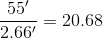 or 20 whole boxes would fit under the ceiling.
To find the height of each box set the 3 boxes equal to the height of Big Bob. So, let
Therefore to find the maximum number of boxes that fit under the ceiling, we divide the ceiling height by the height of each box. So,
← Didn't Know|Knew It →
It takes Jim 30 minutes to drive to work and 45 minutes to drive home from work. What is Jim's average driving speed in miles per hour if Jim lives 25 miles from work?
It takes Jim 30 minutes to drive to work and 45 minutes to drive home from work. What is Jim's average driving speed in miles per hour if Jim lives 25 miles from work?
Tap to reveal answer
The formula to find the average speed is  .
.
Since the question deals with miles per hour, the time must be converted to hours from minutes:
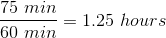
Plugging the numbers into the equation gives 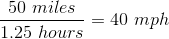 .
.
The formula to find the average speed is
Since the question deals with miles per hour, the time must be converted to hours from minutes:
Plugging the numbers into the equation gives
← Didn't Know|Knew It →
A really backward country does not use inches, feet, yards, or meters to measure distance, it uses units called flots, glots, and klots. It takes 17 flots to make a glot, and 7 glots to make a klot.
These units can also be used to form units of area and volume (i.e. square flots, cubic klots).
How many cubic flots make a cubic klot?
A really backward country does not use inches, feet, yards, or meters to measure distance, it uses units called flots, glots, and klots. It takes 17 flots to make a glot, and 7 glots to make a klot.
These units can also be used to form units of area and volume (i.e. square flots, cubic klots).
How many cubic flots make a cubic klot?
Tap to reveal answer
First, multiply to find the number of flots in a klot.

Cube that to find the number of cubic flots in a cubic klot.

Therefore, 1,685,159 cubic flots = 1 cubic klot
First, multiply to find the number of flots in a klot.
Cube that to find the number of cubic flots in a cubic klot.
Therefore, 1,685,159 cubic flots = 1 cubic klot
← Didn't Know|Knew It →
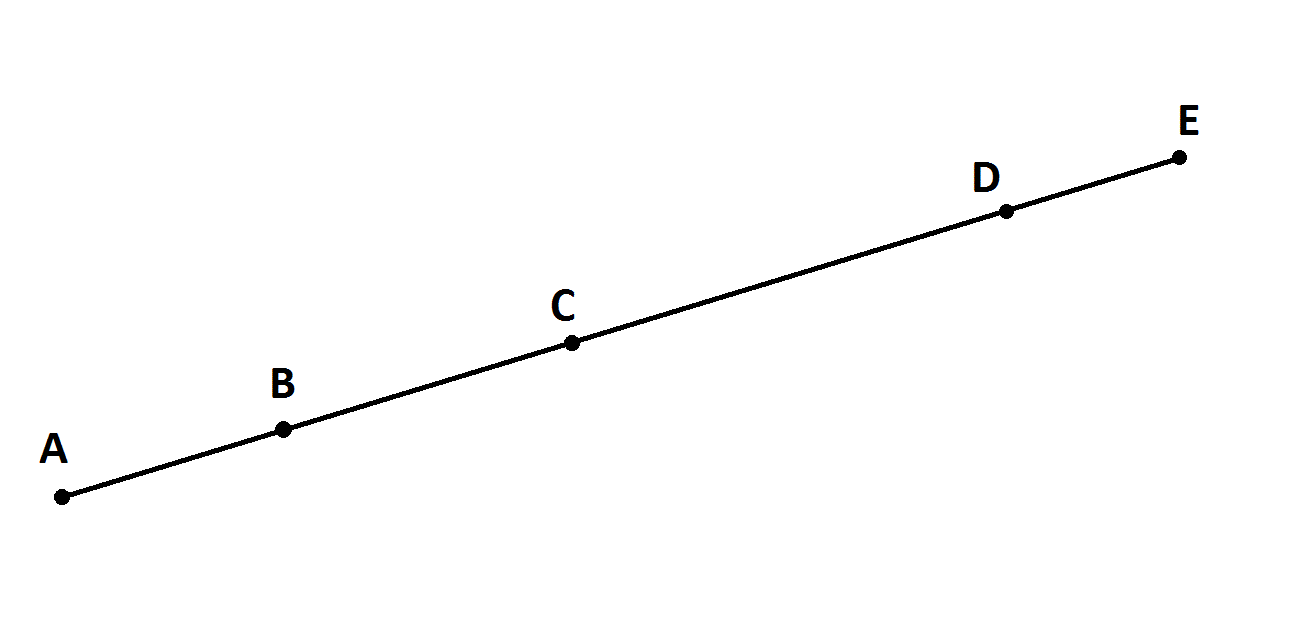
Note: Figure NOT drawn to scale.


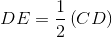
Give  in terms of
  .
.
Note: Figure NOT drawn to scale.
Give
Tap to reveal answer
Since 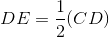 ,
, 
Since  ,
,  , and, subsequently,




Since
Since
← Didn't Know|Knew It →
If the length and width of a rectangular room is increased by 20%, what percent has the area increased by?
If the length and width of a rectangular room is increased by 20%, what percent has the area increased by?
Tap to reveal answer





← Didn't Know|Knew It →
Two bedrooms have the same area. Bedroom A is  by
by  and the width of Bedroom B is
  . Find the length of Bedroom B.
Two bedrooms have the same area. Bedroom A is
Tap to reveal answer
Area of Bedroom A is equal to area of Bedroom B, therefore:


Area of Bedroom A is equal to area of Bedroom B, therefore:
← Didn't Know|Knew It →
Convert  to Fahrenheit (to the nearest tenth).

Convert
Tap to reveal answer
The Celsius-to-Fahrenheit conversion formula is:
Substitute 45 for  :
:

The answer is  .
.
The Celsius-to-Fahrenheit conversion formula is:
Substitute 45 for
The answer is
← Didn't Know|Knew It →
Convert  to degrees Celsius (nearest whole degree).
Convert
Tap to reveal answer
If  is the Fahrenheit temperature, then the equivalent Celsius temperature is
 .
.
Substitute  into the equation.


This rounds up to  .
.
If
Substitute
This rounds up to
← Didn't Know|Knew It →
Restate 100 miles per hour in feet per second (rounded to the nearest whole number).
Restate 100 miles per hour in feet per second (rounded to the nearest whole number).
Tap to reveal answer
One mile is equal to 5,280 feet, and one hour is equal to 3,600 seconds, The speed can be converted as follows:

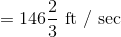
or, rounded, 147 feet per second.
One mile is equal to 5,280 feet, and one hour is equal to 3,600 seconds, The speed can be converted as follows:
or, rounded, 147 feet per second.
← Didn't Know|Knew It →
Restate 200 feet per second in miles per hour (nearest whole number).
Restate 200 feet per second in miles per hour (nearest whole number).
Tap to reveal answer
One mile is equal to 5,280 feet, and one hour is equal to 3,600 seconds, The speed can be converted as follows:

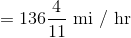
or, rounded, 136 miles per hour.
One mile is equal to 5,280 feet, and one hour is equal to 3,600 seconds, The speed can be converted as follows:
or, rounded, 136 miles per hour.
← Didn't Know|Knew It →
Using the conversion factor 2.54 centimeters = 1 inch, rewrite 100 square inches in square centimeters (nearest tenth).
Using the conversion factor 2.54 centimeters = 1 inch, rewrite 100 square inches in square centimeters (nearest tenth).
Tap to reveal answer
1 inch = 2.54 centimeters, so 1 square inch =  square centimeters.
100 square inches are equal to  square centimeters, which rounds to 645.2 square centimeters.
1 inch = 2.54 centimeters, so 1 square inch =
100 square inches are equal to
← Didn't Know|Knew It →
A furlong is a unit of length used in horse racing; it is equal to one-eighth of a mile. To the nearest tenth, how many meters are equal to a furlong if 1.609 kilometers are equal to a mile?
A furlong is a unit of length used in horse racing; it is equal to one-eighth of a mile. To the nearest tenth, how many meters are equal to a furlong if 1.609 kilometers are equal to a mile?
Tap to reveal answer
1.609 kilometers, or 1,609 meters, are equal to a mile. One furlong, or one eighth of a mile, is equal to one eighth of 1,609 meters, or
 meters.
1.609 kilometers, or 1,609 meters, are equal to a mile. One furlong, or one eighth of a mile, is equal to one eighth of 1,609 meters, or
← Didn't Know|Knew It →