
Other Quadrilaterals - GMAT Quantitative
Card 1 of 456
While walking with some friends on campus, you come across an open grassy rectangular area. You shout "Pythagoras!" and run across the rectangular area from one corner to another. If the rectangle measures  meters by
  meters, what distance did you cover?
While walking with some friends on campus, you come across an open grassy rectangular area. You shout "Pythagoras!" and run across the rectangular area from one corner to another. If the rectangle measures
Tap to reveal answer
This problem can be solved in a variety of ways, however you do it, it may be worth eliminating any options shorter than either side of the quad. The diagonal distance is the hypotenuse of a triangle, so it must be longer than 25 or 60 meters.
Then, we can either find our hypotenuse via Pythagorean Theorem, or our knowledge of Pythagorean Triples.
Using Pythagorean Theorem:


So 65 meters.
Alternatively, recognize the triangle as a 5x/12x/13x triangle


 so
so 
This problem can be solved in a variety of ways, however you do it, it may be worth eliminating any options shorter than either side of the quad. The diagonal distance is the hypotenuse of a triangle, so it must be longer than 25 or 60 meters.
Then, we can either find our hypotenuse via Pythagorean Theorem, or our knowledge of Pythagorean Triples.
Using Pythagorean Theorem:
So 65 meters.
Alternatively, recognize the triangle as a 5x/12x/13x triangle
← Didn't Know|Knew It →
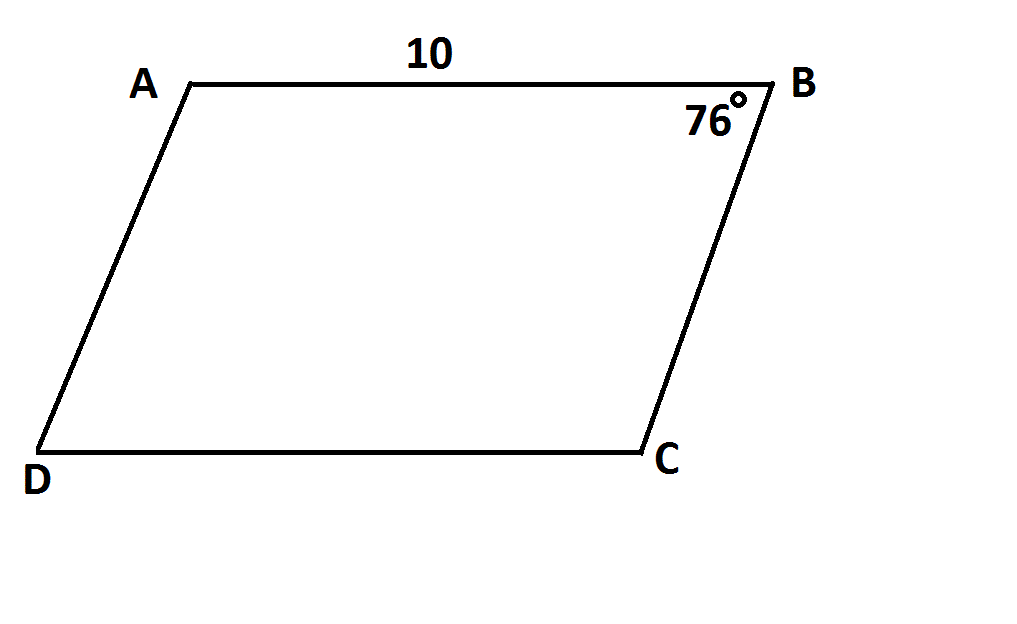
Note: Diagram is NOT drawn to scale.
Refer to the above diagram.
Any of the following facts alone would be enough to prove that  is not a parallelogram, EXCEPT:
Note: Diagram is NOT drawn to scale.
Refer to the above diagram.
Any of the following facts alone would be enough to prove that
Tap to reveal answer
Opposite sides of a parallelogram are congruent; if  , then
  , violating this condition.
Consecutive angles of a parallelogram are supplementary; if  , then
  , violating this condition.
Opposite angles of a parallelogram are congruent; if  , then
  , violating this condition.
Adjacent sides of a parallelogram, however, may or may not be congruent, so the condition that  would not by itself prove that the quadrilateral is not a parallelogram.
Opposite sides of a parallelogram are congruent; if
Consecutive angles of a parallelogram are supplementary; if
Opposite angles of a parallelogram are congruent; if
Adjacent sides of a parallelogram, however, may or may not be congruent, so the condition that
← Didn't Know|Knew It →
Which of the following can not be the measures of the four interior angles of a quadrilateral?
Which of the following can not be the measures of the four interior angles of a quadrilateral?
Tap to reveal answer
The four interior angles of a quadrilateral measure a total of  , so we test each group of numbers to see if they have this sum.


This last group does not have the correct sum, so it is the correct choice.
The four interior angles of a quadrilateral measure a total of
This last group does not have the correct sum, so it is the correct choice.
← Didn't Know|Knew It →
A circle can be circumscribed about each of the following figures except:
A circle can be circumscribed about each of the following figures except:
Tap to reveal answer
A circle can be circumscribed about any triangle regardless of its sidelengths or angle measures, so we can eliminate the two triangle choices.
A circle can be circumscribed about a quadrilateral if and only if both pairs of its opposite angles are supplementary. An isosceles trapezoid has this characteristic; this can be proved by the fact that base angles are congruent, and by the Same-Side Interior Angles Statement. For a parallelogram to have this characteristic, since opposite angles are congruent also, all angles must measure  ; the rectangle fits this description, but the rhombus does not.
A circle can be circumscribed about any triangle regardless of its sidelengths or angle measures, so we can eliminate the two triangle choices.
A circle can be circumscribed about a quadrilateral if and only if both pairs of its opposite angles are supplementary. An isosceles trapezoid has this characteristic; this can be proved by the fact that base angles are congruent, and by the Same-Side Interior Angles Statement. For a parallelogram to have this characteristic, since opposite angles are congruent also, all angles must measure
← Didn't Know|Knew It →
Two angles of a parallelogram measure  and
and  . What are the possible values of
  ?
?
Two angles of a parallelogram measure
Tap to reveal answer
Case 1: The two angles are opposite angles of the parallelogram. In this case, they are congruent, and


Case 2: The two angles are consecutive angles of the parallelogram. In this case, they are supplementary, and


Case 1: The two angles are opposite angles of the parallelogram. In this case, they are congruent, and
Case 2: The two angles are consecutive angles of the parallelogram. In this case, they are supplementary, and
← Didn't Know|Knew It →
Rhombus  has two diagonals that intersect at point
  ;
;  .
.
What is  ?
?
Rhombus
What is
Tap to reveal answer
The diagonals of a rhombus always intersect at right angles, so  . The measures of the interior angles of the rhombus are irrelevant.
The diagonals of a rhombus always intersect at right angles, so
← Didn't Know|Knew It →
Quadrilateral  is inscribed in circle
 .
.  . What is
  ?
?
Quadrilateral
Tap to reveal answer
Two opposite angles of a quadrilateral inscribed inside a circle are supplementary, so

Two opposite angles of a quadrilateral inscribed inside a circle are supplementary, so
← Didn't Know|Knew It →

Note: Figure NOT drawn to scale.
The above figure is of a rhombus and one of its diagonals. What is  equal to?
Note: Figure NOT drawn to scale.
The above figure is of a rhombus and one of its diagonals. What is
Tap to reveal answer
The four sides of a rhombus are congruent, so a diagonal of the rhombus cuts it into two isosceles triangles. The two angles adjacent to the diagonal are congruent, so the third angle, the one marked, measures:

The four sides of a rhombus are congruent, so a diagonal of the rhombus cuts it into two isosceles triangles. The two angles adjacent to the diagonal are congruent, so the third angle, the one marked, measures:
← Didn't Know|Knew It →

Refer to the above figure. You are given that Polygon  is a parallelogram, but NOT that it is a rectangle.
Which of the following statements is not enough to prove that Polygon  is also a rectangle?
Refer to the above figure. You are given that Polygon
Which of the following statements is not enough to prove that Polygon
Tap to reveal answer
To prove that Polygon  is also a rectangle, we need to prove that any one of its angles is a right angle.
If  , then by definition of perpendicular lines,
  is right.
If  , then, since
  and
and  form a linear pair,
  is right.
If  , then, by the Converse of the Pythagorean Theorem,
  is a right triangle with right angle
  .
.
If  and
and  are complementary angles, then, since
 , making
  right.
However, since, by definition of a parallelogram,  , by the Alternate Interior Angles Theorem,
  regardless of whether the parallelogram is a rectangle or not.
To prove that Polygon
If
If
If
If
However, since, by definition of a parallelogram,
← Didn't Know|Knew It →
What is the area of a trapezoid with a height of 7, a base of 5, and another base of 13?
What is the area of a trapezoid with a height of 7, a base of 5, and another base of 13?
Tap to reveal answer

← Didn't Know|Knew It →
A circle can be circumscribed about each of the following figures except:
A circle can be circumscribed about each of the following figures except:
Tap to reveal answer
A circle can be circumscribed about any triangle regardless of its sidelengths or angle measures, so we can eliminate the two triangle choices.
A circle can be circumscribed about any regular polygon, so we can eliminate those two choices as well.
The correct choice is that each figure can have a circle circumscribed about it.
A circle can be circumscribed about any triangle regardless of its sidelengths or angle measures, so we can eliminate the two triangle choices.
A circle can be circumscribed about any regular polygon, so we can eliminate those two choices as well.
The correct choice is that each figure can have a circle circumscribed about it.
← Didn't Know|Knew It →
What is the area of a quadrilateral on the coordinate plane with vertices  ?
?
What is the area of a quadrilateral on the coordinate plane with vertices
Tap to reveal answer
As can be seen from this diagram, this is a parallelogram with base 8 and height 4:

The area of this parallelogram is the product of its base and its height:

As can be seen from this diagram, this is a parallelogram with base 8 and height 4:
The area of this parallelogram is the product of its base and its height:
← Didn't Know|Knew It →
What is the area of a quadrilateral on the coordinate plane with vertices  ?
?
What is the area of a quadrilateral on the coordinate plane with vertices
Tap to reveal answer
As can be seen in this diagram, this is a trapezoid with bases 10 and 5 and height 8.

Setting  in the following formula, we can calculate the area of the trapezoid:

As can be seen in this diagram, this is a trapezoid with bases 10 and 5 and height 8.
Setting
← Didn't Know|Knew It →
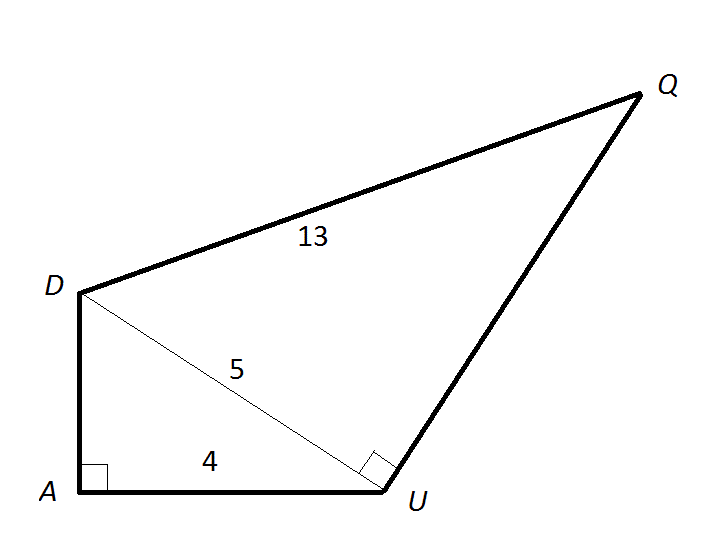
Note: Figure NOT drawn to scale
What is the area of Quadrilateral  , above?
Note: Figure NOT drawn to scale
What is the area of Quadrilateral
Tap to reveal answer
Quadrilateral  is a composite of two right triangles,
  and
and  , so we find the area of each and add the areas. First, we need to find
  and
and  , since the area of a right triangle is half the product of the lengths of its legs.
By the Pythagorean Theorem:


Also by the Pythagorean Theorem:


The area of  is
is  .
.
The area of  is
is  .
.
Add the areas to get  , the area of Quadrilateral
  .
.
Quadrilateral
By the Pythagorean Theorem:
Also by the Pythagorean Theorem:
The area of
The area of
Add the areas to get
← Didn't Know|Knew It →
What is the area of the quadrilateral on the coordinate plane with vertices  ?
?
What is the area of the quadrilateral on the coordinate plane with vertices
Tap to reveal answer
The quadrilateral formed is a trapezoid with two horizontal bases. One base connects (0,0) and (9,0) and therefore has length  ; the other connects (4,7) and (7,7) and has length
  . The height is the vertical distance between the two bases, which is the difference of the
  coorindates:
  . Therefore, the area of the trapezoid is

The quadrilateral formed is a trapezoid with two horizontal bases. One base connects (0,0) and (9,0) and therefore has length
← Didn't Know|Knew It →
What is the area of the quadrilateral on the coordinate plane with vertices  .
.
What is the area of the quadrilateral on the coordinate plane with vertices
Tap to reveal answer
The quadrilateral is a trapezoid with horizontal bases; one connects  and
and  and has length
  , and the other connects
  and
and  and has length
  . The height is the vertical distance between the bases, which is the difference of the
  -coordinates; this is
  . Substitute
  in the formula for the area of a trapezoid:

The quadrilateral is a trapezoid with horizontal bases; one connects
← Didn't Know|Knew It →
What is the area of the quadrilateral on the coordinate plane with vertices  ?
?
What is the area of the quadrilateral on the coordinate plane with vertices
Tap to reveal answer
The quadrilateral is a parallelogram with two vertical bases, each with length  . Its height is the distance between the bases, which is the difference of the
  -coordinates:
  . The area of the parallelogram is the product of its base and its height:

The quadrilateral is a parallelogram with two vertical bases, each with length
← Didn't Know|Knew It →
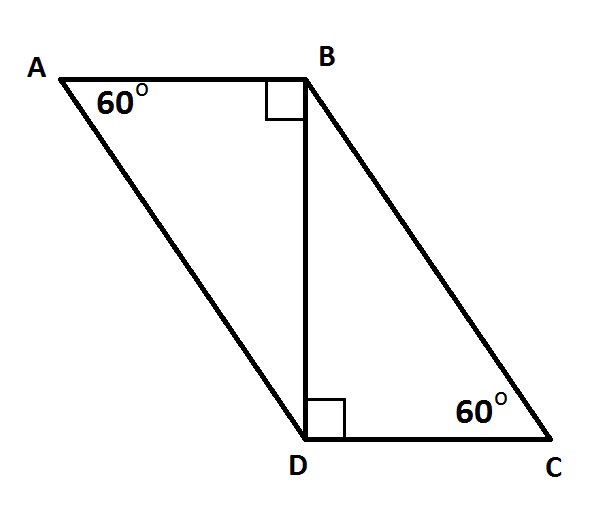
Give the area of the above parallelogram if  .
.
Give the area of the above parallelogram if
Tap to reveal answer
Multiply height  by base
  to get the area.
By the 30-60-90 Theorem:
 .
.

The area is therefore

Multiply height
By the 30-60-90 Theorem:
The area is therefore
← Didn't Know|Knew It →
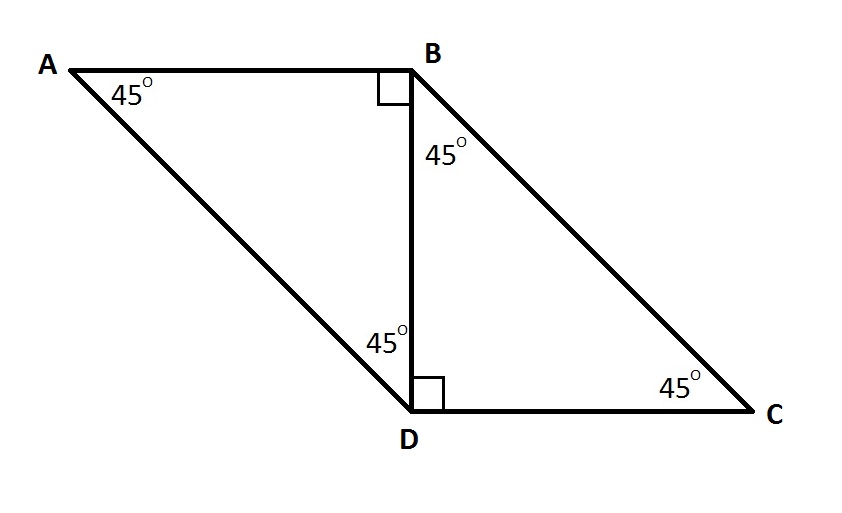
Give the area of the above parallelogram if  .
.
Give the area of the above parallelogram if
Tap to reveal answer
Multiply height by base to get the area.
By the 45-45-90 Theorem,
 .
.
Since the product of the height and the base of a parallelogram is its area,


Multiply height
By the 45-45-90 Theorem,
Since the product of the height and the base of a parallelogram is its area,
← Didn't Know|Knew It →
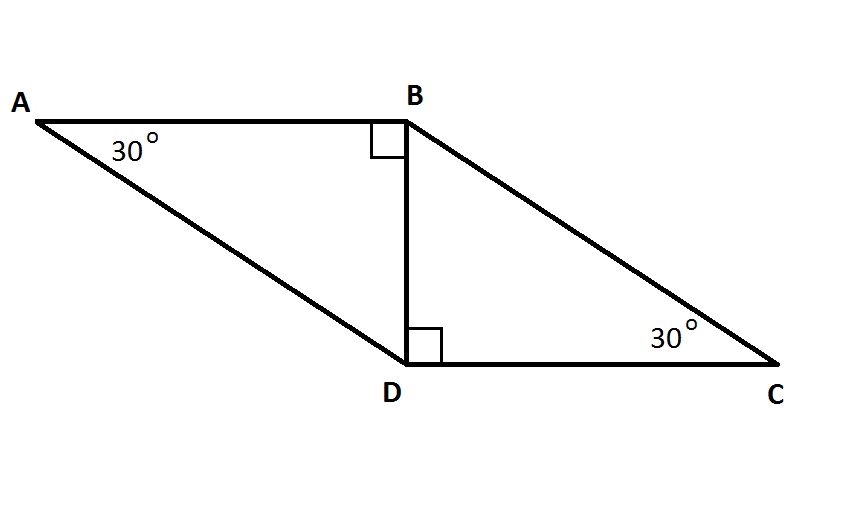
Give the area of the above parallelogram if  .
.
Give the area of the above parallelogram if
Tap to reveal answer
Multiply height by base to get the area.
By the 30-60-90 Theorem:
 .
.

The area is therefore

Multiply height
By the 30-60-90 Theorem:
The area is therefore
← Didn't Know|Knew It →